Valentina knew how to do everything.
She could cook, wash clothes, and iron shirts so perfectly they looked ready for a shop window. She knew when to stay silent. She knew when to smile. But most of all, she knew how to endure. Perhaps that had been her greatest skill in life. The only one no one had ever praised her for.
Her husband, Sergey Mikhailovich, was a retired mechanical engineer and a man with opinions. Opinions so strong that any other point of view seemed to evaporate the moment it crossed the threshold of their apartment. He watched the news loudly. Complained about prices loudly. Demanded dinner at seven sharp — absolutely not at half past seven.
His life was adjusted like a well-built machine: every part had its proper place.
Valentina was also a part.
An important one, yes — but not one that required attention.
As long as she worked, everything was fine.
For thirty-two years she cooked, cleaned, raised the children, carried heavy bags from the market, and looked after the neighbors’ grandchildren whenever Sergey asked her not to make noise. Their son, Anton, grew up and moved to Yekaterinburg. He called on major holidays, and sometimes even on smaller ones. Their daughter, Marina, lived in the next district and visited every two weeks with a bag of tangerines and a guilty look on her face.
She had understood everything for a long time.
But she kept quiet.
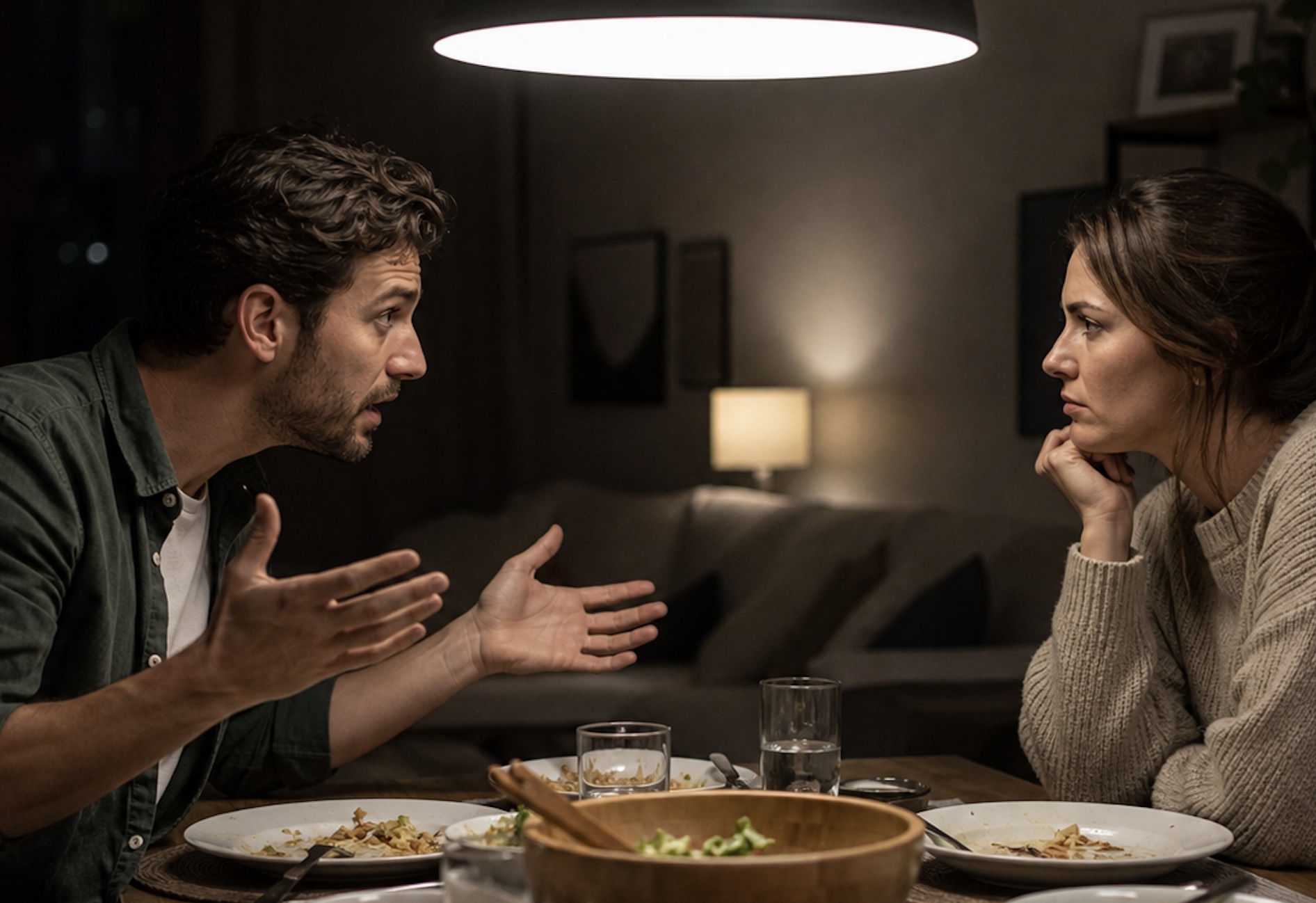
That evening, Valentina was making chicken soup. Onion, carrot, homemade noodles.
Sergey sat down, ate, put his spoon aside.
And then, casually, the way people talk about the weather or traffic on the Garden Ring, he said:
“You know, Val, honestly, you’re not much of a wife.”
Valentina was silent for a few seconds.
Then she stood up, cleared the plates, washed her hands, and went into the bedroom.
Sergey shrugged and turned on the television.
Football.
Perfect timing.
Only Fyodor the cat, who had been dozing on the windowsill, opened one eye, looked at the closed bedroom door, and turned his face toward the wall.
The next morning, Sergey woke up and discovered there was no breakfast.
That was strange.
In thirty-two years, there had always been breakfast. Fried eggs, or porridge, or at least bread with butter on a plate — something was always on the table. It had been one of life’s constants, like the sunrise or the weather forecast on Moscow-24.
That is how it always happens: you do not notice things while they exist. You notice them only when they disappear.
He went into the kitchen.
Empty and clean.
Fyodor the cat was sitting by the refrigerator, looking at him with the expression usually reserved for a person who was entirely to blame for everything.
“Val!” Sergey shouted toward the bedroom.
Silence.
“Valentina!”
The bedroom remained quiet.
Sergey stood there for a moment, then made himself tea from a teabag and decided she would get over it.
That was his favorite phrase in such situations.
When she was upset — she would get over it.
When she cried in the bathroom — she would get over it.
Even a year earlier, when he had said at his mother-in-law’s birthday that “Valya had always been a bit of a hopeless housewife,” he had thought the same thing afterward.
She would get over it.
But there was no lunch either.
Sergey looked into the bedroom. Valentina was sitting at the table by the window with a book in her hands.
Reading.
Completely calm, as if nothing at all was happening.
“Will there be lunch?” he asked.
“No.”
“Why not?”
“I don’t feel like cooking.”
He waited for more.
There was no more.
She turned the page.
Sergey went to the kitchen, found a can of fish in the cupboard, and ate it straight from the tin.
Fyodor watched from the windowsill.
Silently.
But very expressively.
Sergey snorted.
She would get over it.
He was certain.
It was a reliable, time-tested statistic.
But there was one thing he had not taken into account.
That evening, Valentina was speaking to someone on the phone — quietly, with the door half-closed. He caught a fragment:
“…yes, I understand… I’ll come by on Friday…”
Come by where?
He did not ask. He did not want to show that he was interested. That would have seemed somehow undignified.
And then she began leaving in the mornings.
She simply picked up her bag and went out.
She came back two or three hours later, silently took off her coat, and went to her room. No report. No explanation. As if she were not a wife in that apartment, but a tenant.
A temporary one.
It was beginning to truly irritate him.
“Where do you keep going?” he asked on Thursday, when she returned with some sort of folder — thin, blue, tied with strings.
“On errands.”
“What kind of errands?”
“My own.”
He stared at the folder. Folders like that were used at social services, at the housing office, at…
He did not finish the thought, because Valentina had already walked past him and closed the door behind her.
Fyodor looked at the folder.
Then at Sergey.
Then he jumped down from the windowsill and went after Valentina.
Even the cat had taken her side.
On Friday evening, Sergey called his friend Lyokha Gromov. Just to talk, for no particular reason. And somehow, almost without noticing, he said:
“You know, my Valya has been acting strange.”
“What happened?”
“Well, I told her that, honestly, she wasn’t much of a wife. Not in a cruel way, just…”
“Wait,” Lyokha said after a pause. “You said it exactly like that?”
“Well, yes.”
Lyokha was silent again.
Longer this time.
“Seryoga. Are you an idiot?”
“Why am I suddenly an idiot?”
“She’s been carrying everything on herself for thirty-two years, and you say something like that to her?”
“I meant it as a joke.”
“Seryoga,” Lyokha interrupted him, “my Ninka didn’t speak to me for two weeks after I once told her she cooked badly. Do you understand? And you said, ‘You’re not much of a wife.’ That, brother, is a whole different level. That’s already a survival exam.”
Sergey hung up.
He sat down on the sofa.
The television was on, but he could not hear it.
On Saturday morning, Valentina came into the kitchen, poured herself coffee, and said:
“Seryozha, I’m going to live separately.”
Sergey looked up from his newspaper.
“What?”
“We’ll remain legally married, but I’m renting a room. I’m moving on Wednesday.”
He stared at her.
She looked back at him.
Fyodor the cat watched them both from the refrigerator, from the position of a neutral observer who had clearly drawn his own conclusions long ago.
Sergey laughed.
Not nervously. Not angrily.
He genuinely laughed, from the heart, the way one laughs at a good joke.
Because it was absurd.
This was Valentina.
His Valentina.
The woman who, for thirty-two years…
The woman who never…
The woman who always…
“Val. What do you mean, living separately? Where would you go? And with what money?”
“With my own money.”
“What money of your own?” he asked, still smiling, although the smile had begun to change, as if it had been slightly twisted out of shape. “When was the last time you even worked?”
“A long time ago,” Valentina agreed. “That’s why last Friday I signed a contract with an accounting firm. Remote work. Four hours a day. It will be enough for a room and for living expenses.”
The smile slid off his face completely.
“What contract? But you…”
“I have a degree, Seryozha. You may have forgotten. I haven’t.”
He stood up.
“Wait. Are you serious? Are you being serious right now?”
“Of course.”
“Because of what I said that day? Well, yes, I said it. Maybe it came out badly…”
“No. That phrase was just the last drop.”
“I supported you for thirty years! I worked! I carried everything!”
Valentina looked at him.
Looked at him carefully.
The way people look when they are no longer arguing — only recording a fact. The way a doctor looks at a cardiogram.
“You carried everything,” she repeated evenly. “All right.”
And she went into the bedroom.
Sergey remained standing in the middle of the kitchen.
Fyodor jumped down from the refrigerator, went to his bowl, sniffed it, and also left after Valentina.
He had long since formed his own opinion on the matter.
Sergey called Marina.
“Did you know what your mother was planning?”
A pause.
“About the work, yes. She told me.”
“And you didn’t tell me?!”
“Dad,” Marina said quietly, but very clearly, “it’s Mom’s decision. Not mine.”
“She’s renting a room, Marina!”
“Dad. You told her yourself that she was a bad wife.”
“I didn’t… I didn’t mean…”
He hung up.
Then he called Anton.
Anton did not answer for a long time.
Eventually, he picked up.
“Do you know about your mother?”
“Yes.”
“And what, you also think she’s right?”
Anton was silent — just like Lyokha Gromov had been on Friday, just like Marina a few minutes ago.
Sergey was beginning to truly hate those pauses, as if everyone around him had conspired to stay silent before saying something unpleasant.
“Dad,” Anton said. “Do you remember the time you called Mom a ‘house chicken’ in front of my friends?”
“Anton, that was completely different.”
“Fine, Dad. I have to go.”
And he hung up.
Sergey put the phone down on the sofa.
He looked out the window.
Outside was a gray March day — damp, dull, promising nothing.
On Wednesday, Valentina left.
She took two suitcases — one medium, one small. Her winter coat. Her documents.
Fyodor sat in the hallway, watching her pack.
Sergey stood in the kitchen doorway and watched too.
“Val. Come on, let’s talk properly.”
“We already talked,” she said, fastening the suitcase.
“Let me say it, then. I’ll apologize. All right? I apologize.”
She lifted her eyes to him.
She looked at him without anger.
He waited for her to say, “Fine then,” put the suitcase back, and go into the kitchen.
That was how it was supposed to happen.
That was how it had always happened — forty thousand times over thirty-two years.
The mechanism worked exactly that way.
But Valentina only nodded.
“All right, Seryozha. I heard you.”
And she picked up the suitcase.
“Where are you going?!” His voice sounded unfamiliar. Too loud for that hallway.
“To Butyrskaya. There’s a room there. The landlady is normal. I’ve already met her.”
“Will you come back?”
She stopped for a second right by the door.
“I don’t know.”
The door closed.
Sergey stood in the hallway.
The scent of her perfume — simple and inexpensive, the kind she bought every six months from the same pharmacy kiosk — still hung in the air.
For a minute.
Maybe two.
Then it disappeared too.
Fyodor walked up to the closed door.
Sniffed the doormat.
Sat down.
And meowed — softly, like an old man.
The mechanism had broken.
Completely.
Three months passed.
Sergey Mikhailovich learned many things.
He lived alone.
The apartment was clean, because he cleaned it himself — dust annoyed him.
It was quiet, because Fyodor the cat had gone with Valentina.
She had simply come for him on Wednesday, and he had climbed into the carrier himself, as if he had been waiting for that moment all along.
The children called more often than before.
Marina still came by every two weeks.
In April, Sergey finally called.
“Val, let’s talk.”
“All right,” she agreed.
They met in a café — neutral territory, her idea.
She arrived with a short haircut.
At first, Sergey could not understand what had changed.
She looked different.
Not better.
Not worse.
Just different.
“How are you?” he asked.
“I’m good. The work is fine. The landlady doesn’t bother me. Fyodor has settled in.”
“Val. I want you to come back.”
She looked at him.
“I hear you, Seryozha.”
“And?”
“And I’m not ready yet. Maybe later.”
He wanted to say something weighty.
To explain.
To object.
But nothing weighty came to him.
“You’ve changed,” he said.
“Yes,” she agreed. “I suppose I have.”
They sat for a little while longer.
Drank coffee.
Talked about Anton, about Marina’s work.
Then she left — calmly, without tears.
Sergey stayed there for another ten minutes.
Looking out the window.
Behind the glass, April rain was falling — fine, practical, without any romance.
People walked along the pavement, some with umbrellas, some without.
Life went on as it always had.
Only he had been left standing beside the ruins of what he once had.
Not because his wife had left.
But because he finally understood:
He had had a wife.
A real one.
He simply had not noticed.
Fyodor the cat had noticed immediately.