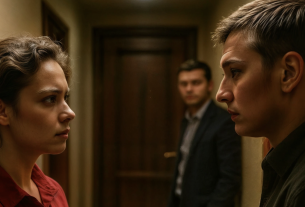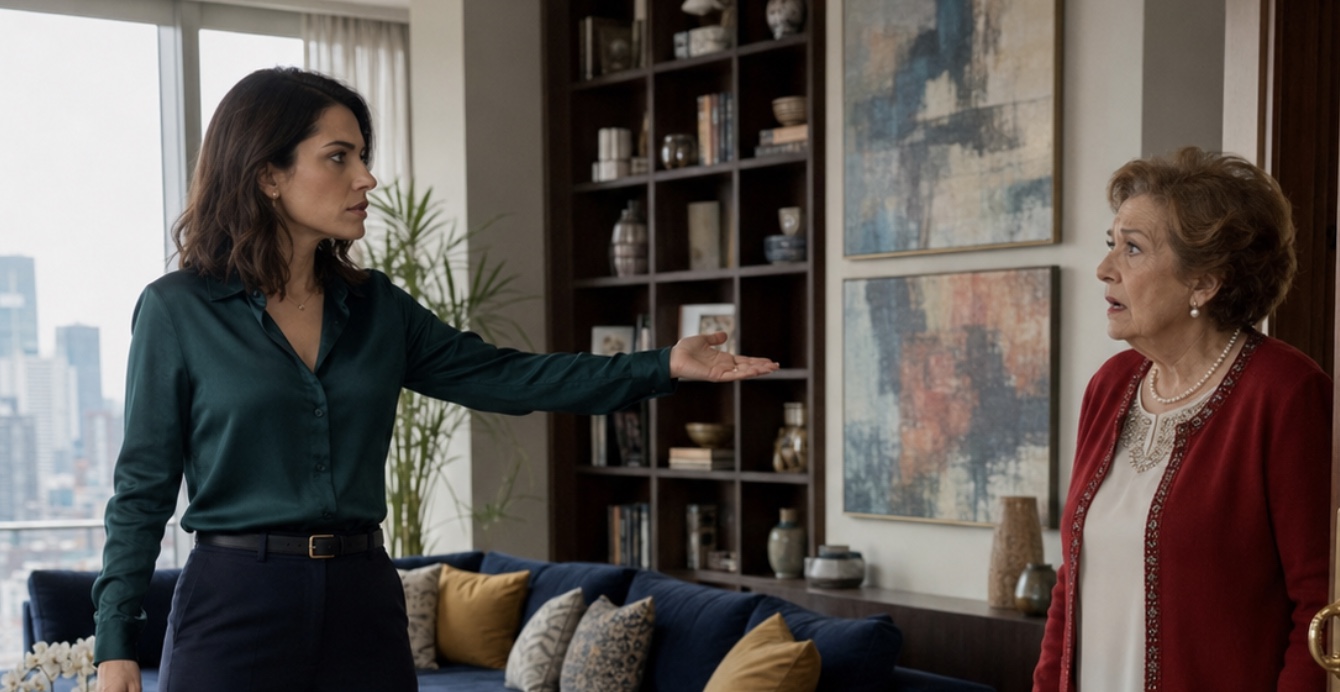
“Mom, you’re going to pack your things and leave on your own right now—or should I call the local police officer and ask him to escort you out?”
The words practically begged to become a headline as Olga stood barefoot on the cold laminate floor of the hallway, watching her mother-in-law, Svetlana Petrovna, calmly unpack a travel bag on Olga’s brand-new ottoman.
The ottoman was cream-colored and upholstered in suede. She had bought it online only a week earlier for next to nothing. Now an old gray duffel bag, worn shiny with age, was sprawled across it. A pair of slippers, several bottles of valerian drops, and an ancient electric heating pad stuck out from the open zipper.
Olga stared at the heating pad and felt a cold, sticky rage turning slowly inside her, like concrete rolling through a cement mixer.
It was not hurt or confusion. It was rage—calm, calculating rage that made her fingertips go numb and every thought in her mind become crystal clear.
Andrei stood in the doorway leading to the living room, twisting a kitchen towel between his hands. Whenever he was nervous, he had to crumple something: the edge of a tablecloth, a paper napkin, even his passport.
After a year of living together, Olga knew that habit by heart. At that moment, it irritated her even more than the invasion itself. She hated his limp, helpless posture.
He looked like a schoolboy who had been caught smoking, not a grown man whose mother had just declared herself the mistress of someone else’s apartment.
“Ol, why are you reacting like this right away?” he mumbled. The towel crackled pitifully in his hands. “Calling the police, threatening to bring in an officer… We’re family. Mom only wants to stay with us for a little while. She wants to help. She’s going through a difficult time, you understand? A radiator burst in her two-bedroom apartment. The place flooded, the downstairs neighbors got soaked, and now there’s renovation work, mold, that terrible smell… We can’t send her back into that nightmare.”
Without straightening up, Svetlana Petrovna continued digging through her bag. Olga heard her release a dramatic, whistling sigh.
Her back, wrapped in a cheap knitted cardigan, expressed the suffering of the entire universe.
It was a one-woman performance.
Olga had worked as a chief accountant for years, and her professional instincts had trained her to spot inconsistencies in facts and numbers almost instantly.
“Andrei,” she said, her voice sounding strangely dull even to her own ears. “Let’s clear up a few things. First, your mother lives in a one-bedroom apartment on Teplichnaya Street. That’s number one. One bedroom. Not two. Second, the pipes in that old apartment block run vertically, not horizontally. Even if something had burst, she couldn’t have flooded half the building. At most, she might have flooded her own bathroom.
“Third, I spoke to Galina Stepanovna from apartment ten today. Your mother’s downstairs neighbor. We exchanged phone numbers last New Year’s when we were choosing presents at the supermarket. She was extremely surprised by my call. Her apartment is as dry as the Sahara, and there hasn’t been a heating-pipe emergency in that building since last spring.
“And finally, please stop crushing my new kitchen towel. I paid extra for it. It’s organic cotton, and you’re completely ruining its shape.”
Silence settled over the apartment.
Even the refrigerator in the kitchen seemed to stop humming so that it could listen.
Andrei froze with his mouth open. The towel hung lifelessly from his hand. Olga saw panic flash through his gray eyes, which were usually so calm.
He had not expected to be exposed so quickly or dissected with such anatomical precision.
He was used to Olga being accommodating and understanding. She came home exhausted from work and usually agreed to things simply to avoid an argument. He had grown accustomed to Olga being a quiet harbor.
He had not expected her to turn into a guarded border crossing with armed sentries in watchtowers.
Svetlana Petrovna straightened abruptly, like a folding knife snapping open.
Her expression, which until then had been a portrait of humble suffering, hardened into a mask. Her eyes, outlined with cheap blue eyeliner, became two cold buttons.
She looked at Olga, and there was no trace of helplessness left in her face.
Only pure, undisguised malice.
“So you’ve been investigating me, have you, sweetheart?” Her voice rang like a stretched wire. “You call my neighbors and sniff around to find out what an elderly woman is doing? You dig through our dirty laundry? Andryusha, look at her! Do you see the kind of woman you’re living with? She isn’t a wife. She’s a tax investigator!”
“I’m not digging into anything, Svetlana Petrovna.”
Olga walked over to the ottoman and carefully lifted the bag with two fingers, placing it on the floor. The ottoman gave a faint creak as it slowly returned to its original shape.
“I’m checking facts. Because recently, people have started treating me like I don’t exist in my own apartment. You decided you could simply show up, invent a story about a flood, and move in permanently. And I was just supposed to be informed after the decision had already been made. Something like, ‘Move over, Olenka. Mom will be living here now. Why don’t you go outside and get some fresh air?’”
Andrei finally threw the towel aside and stepped forward.
He looked cornered, but he was trying to imitate righteous anger. He was not doing it very convincingly.
He reminded Olga of a Pekingese attempting to bark at a German shepherd while fully aware that the fight would not be equal.
“Olga, stop this circus! You’re saying things that make me ashamed of you! My mother doesn’t deserve to be treated this way. Yes, maybe she exaggerated the situation a little. But she did it because she was desperate! She wants to feel needed. She’s afraid of being alone. Do you have any idea what it’s like to grow old in complete isolation? Her blood pressure keeps rising, and she’s frightened to be alone at night. She only needs some basic support. We’re a family, damn it!”
“Andryusha.”
Olga folded her arms and leaned one shoulder against the doorframe. At thirty-four, she usually looked no older than twenty-eight, but exhaustion and tension had carved deep lines around her mouth.
“We’ve been living together for one year. Only one year. Until today, I believed our family consisted of the two of us. You and me. Two adults who decided to build a life together.
“But when I look at you now, I realize you never truly separated from your mother. You aren’t even trying. You’re making excuses for her lies, yet you haven’t made the slightest effort to defend me.
“Again and again, you ask me to understand. To be considerate. To make myself smaller. To move aside. And the moment I refuse, I become cruel, heartless, and selfish.
“That’s a convenient position, isn’t it?”
“Oh, what kind of family are you?” Svetlana Petrovna exploded.
Her voice jumped into a shrill falsetto as she stepped toward Olga, stabbing the air with one finger.
“You used my son, young lady! You bought yourself an apartment and decided that means you can do whatever you want. You think having a few square meters in your name makes you a goddess and everyone else should crawl at your feet?
“Andryusha left his own home for you. He abandoned me, an old, sick woman, and you can’t even tolerate me for a couple of months! I would have devoted my entire life to you. I would have cooked, washed your clothes, cleaned the apartment, and treated you like royalty if you had been a normal woman.
“But you? You’re a selfish creature with a calculator where your heart should be!”
That was the moment something broke loose inside Olga.
She did not shout. She had never been good at shouting; her voice always gave out immediately.
Instead, what burst free was the cool, sarcastic power of observation she had been storing for years. It had accumulated inside her like water behind a dam, and now the barrier was finally beginning to crack.
“Svetlana Petrovna,” she began, letting every word drop into the silence like a stone falling into a well. “Let’s settle this once and for all.
“You say you’ll clean? The last three times you visited, you washed your cup so poorly that there was still tea residue at the bottom, and I had to wash it again.
“You say you’ll cook? You forget to turn off the gas. Twice, you left a burner running, and I noticed it only by chance before we went to bed. Do you honestly expect me to sleep peacefully knowing that someone in my home might start a fire because she forgot to turn off the stove?
“You want to do the laundry? You wash everything on the same setting. My cashmere sweater, which cost me half a month’s salary, turned into a floor rag after your last attempt to help.
“And treat me like royalty? You don’t even know that I’m allergic to dust. Your assistance would leave me taking antihistamines every day.
“Most importantly, you claim that I stole your son from you. Andrei, please remind us how we met.”
She turned toward her husband.
He stood as still as a dead man.
Svetlana Petrovna fell silent for a moment, clearly unprepared for such a detailed counterattack.
“We met through a classified advertisement,” Olga continued when Andrei failed to make a sound. “I was selling an old sofa for two thousand rubles. He arrived to collect it in a battered delivery van with a friend. We started talking.
“Andrei told me he was renting an apartment with a coworker because he wanted to be independent. That was the first lie he ever told me, although I didn’t find out until three months later, when he admitted that he still lived with you.
“You had him in a death grip. You tormented him every evening because he wanted to move out. You cried, called ambulances, and pretended to have heart attacks. He told me all of that himself when he got drunk at my birthday party.
“And now you want to move into my apartment and turn my life into another branch of your private drama theater?”
Olga stopped to catch her breath.
Her temples were pounding, but her mind remained perfectly clear.
She looked at Andrei and watched him shrink. Not physically, but mentally. He seemed to be becoming smaller and less noticeable, as though he wanted to blend into the wallpaper.
Olga had chosen that wallpaper herself. Beige, decorated with a delicate pattern of leaves. She remembered putting it up with Andrei. He had complained that the pattern would never line up, and then they had both laughed when he accidentally glued his sleeve to the wall.
Back then, she had believed that happiness was made of moments like those—simple, ridiculous moments shared by two people.
Now the wallpaper looked like scenery from a badly written play.
“Andryusha,” Svetlana Petrovna said suddenly.
Her voice became quiet, coaxing, almost affectionate. She changed tactics as quickly as a chameleon changes color.
“Son, listen to the things she’s saying. She hates me. She will never love me. Are you really going to live with a woman who despises your mother?
“That would be hell, son. Absolute hell. Every day you’d come home and feel that hatred surrounding you. Is that what you want?
“Let her choke on her precious apartment! Come home with me, back to our little Khrushchev-era flat. It’s cramped, but there’s love there. What is there here? Laminate flooring and ambition.
“You’re still young. You’ll find a normal, simple girl who won’t divide living space or count every penny. Come with me.”
She held out her hand.
It was her final desperate move.
Olga understood perfectly that this was a test of strength. If Andrei took his mother’s hand, he would erase everything they had built.
She did not want him to stay out of pity. In truth, she was no longer sure she wanted him to stay at all.
Something inside her seemed to have burned out.
She listened to them and realized that her husband and his mother spoke their own distorted language—a language in which lying meant caring and invasion meant love.
Andrei stood with his head lowered.
He stared at the seam between two laminate panels. His shoulders sagged, and he looked like a broken toy.
The silence lasted perhaps a full minute.
For that entire minute, the only sounds in the apartment were the ticking clock on the wall and Svetlana Petrovna’s heavy breathing.
“Ol,” Andrei finally said, his voice muffled as if he were speaking from underneath a pillow. “Can’t you just… try? For one month? Like a trial period?
“We could put a folding bed in the living room for Mom. She wouldn’t bother us. The three of us could live together, and if you truly hated it, she’d leave. I promise. You have my word. I’d drive her home myself.
“But you have to understand that I can’t throw her out into the street now, after she came here with so much hope. That would be cruel. You aren’t a cruel person. I know you’re kind. You’re just tired.”
Olga smiled, but there was not a trace of warmth in it.
“A trial period? Are you serious?”
She shook her head.
“You’re asking me to bring your mother into my apartment the way someone agrees to foster a kitten from a shelter—just temporarily, until a permanent home is found.
“But your mother isn’t a kitten. She’s an adult woman. She’s clever, manipulative, and extremely difficult to remove once she settles in.
“And I know how these ‘trial months’ work. First comes a folding bed in the living room. Then her back starts hurting, so you suggest giving her our bedroom while we move into the living room.
“Then our television bothers her because she goes to bed early. Then she dislikes the amount of salt I put in the soup. Then she starts telling the neighbors outside the building that her daughter-in-law is mistreating her and refusing to let her live normally in our ‘shared’ apartment.
“Andrei, I’m an accountant. I know how to calculate risk.
“This scenario has only one possible ending. Either I lose my mind and throw both of you out, or I move into a rented apartment and leave you living in the home I paid for with my own money.
“There is no third option.”
“You’re impossible!” Andrei suddenly shouted.
It was the first time he had raised his voice, and Olga actually flinched.
“You calculate everything! You analyze everything! You don’t live—you keep financial records! You spent so many years paying off your mortgage that it paid off your humanity along with the debt! You don’t understand ordinary human feelings!
“Mom is right. You have a calculator instead of a heart!”
“And you, Andryusha,” Olga replied quietly, looking directly into his eyes, “have your mother’s will where your brain should be.
“You haven’t made a single independent decision since we’ve been together. You eat whatever I cook. You wear whatever I buy. You go on vacation wherever I choose. You don’t even know where the apartment bills are kept.
“You simply drift with the current. And now that your mother has forced her way into your life, you’re drifting after her because her current is stronger than mine.
“I’m tired of being the tugboat that drags you forward. Do you understand? I want to be a wife, not the captain of a cargo ship permanently burdened with your indecision.”
When Svetlana Petrovna saw her son shouting, her confidence returned.
She rushed to Andrei’s side and clung to his arm.
“You see, son? She has no respect for you! She only used you because you were convenient and never argued with her. Now that I’m here—your own mother—she’s frightened that we’ll unite and show her where she belongs.
“She thinks we’re unwanted guests in her palace! Fine. We’re leaving. Let her sit alone in her three-room cage, stroke her wallpaper, and count her money. Let her howl at the moon from loneliness!”
The final words struck Olga harder than she expected.
Not because they were true, but because Svetlana Petrovna’s voice carried such raw, animal triumph that it made Olga feel sick.
And suddenly Olga realized she might truly be left alone.
Right now.
This man, who had sworn that he loved her, who slept beside her, ate the meals she cooked, and called her his own, might simply walk away.
It would not be a cinematic breakup filled with shattered dishes and passionate declarations. It would be a quiet, cowardly betrayal carried out in the most ordinary way, accompanied by the rustle of clothes being packed into a bag.
Something inside Olga broke.
But it broke in the wrong direction.
Instead of hysteria, she felt absolute, icy calm.
The anger disappeared. She looked at Andrei—at his trembling lips and the red patches spreading across his cheeks. Then she looked at his mother, clinging to his arm like a tick.
For the first time, Olga saw the entire scene from the outside.
A weak, miserable man who suddenly seemed like a stranger.
A hysterical older woman who also seemed like a stranger.
And Olga herself, standing in the apartment she had honestly earned, trying to prove something to them.
To whom?
And why?
“Andrei,” she said, her voice as flat as the heart monitor of a dead patient. “I’m not going to hold you here. I won’t cry or beg you to stay.
“You’ve made your decision. You don’t want to cut the umbilical cord, and that is your right.
“But I want you to leave now. No more arguments. Take whatever you need and go. Leave your keys on the cabinet in the hallway.”
Andrei froze.
He had clearly expected a different reaction.
He expected her to beg, grab his hands, and promise that everything could be fixed. That was what his mother always did whenever he attempted to show any independence.
But Olga was not his mother.
She simply stood there, watching him with empty, exhausted eyes.
“You… you’re serious?” he muttered, pulling his arm free from his mother’s grip. “You’re throwing me out?”
“I’m not throwing you out, Andrei. You made your choice when you allowed your mother to lie to me and attempt to take over my apartment through deception.
“You didn’t choose me. You didn’t even choose the truth. You chose the lie that was most convenient for you.
“So please don’t turn me into the villain. Just leave.”
Svetlana Petrovna sensed that her victory was slipping away and immediately began to fuss.
She stuffed her belongings back into the bag. The heating pad refused to fit. The slippers kept falling onto the floor. She hissed with frustration as she struggled to pack everything.
Her plan to move in permanently had collapsed spectacularly. Now she had to retreat while preserving what little dignity she had left.
“We’re leaving,” she announced, lifting her chin proudly. “But you’ll regret this, young lady. You’ll cry plenty of tears in this empty apartment of yours. You’ll call him at night, and I’ll be the one answering his phone!”
“Unlikely,” Olga replied calmly. “I don’t have a habit of calling places where I’m not wanted.”
Without a word, Andrei went into the bedroom.
Olga did not follow him.
She heard drawers opening, zippers closing, and clothes being shoved into a bag.
He was packing.
He did not argue. He did not apologize. He did not attempt to find a compromise.
He simply left.
And that was the most revealing confession of all.
He was admitting that he was weak.
He was admitting that he was not Olga’s equal.
While he gathered his belongings, Svetlana Petrovna stood in the hallway, radiating offended dignity. Her lips were tightly pursed, and she stared pointedly at the wall.
Olga walked past her into the kitchen, filled a glass with tap water, and drank it all in one swallow.
Her hands were trembling slightly, but otherwise she felt a strange sense of relief. It was as though a diseased tooth that had been aching for years had finally been removed.
There was pain. There was emptiness.
But the pain was clean and promised that healing could begin.
Andrei eventually came into the hallway carrying a huge sports bag over one shoulder.
He looked lost and even a little frightened.
He was still waiting for Olga to stop him. In his understanding of the world, a woman was supposed to cry and cling to a man as he left.
He paused by the door and looked at her.
“Ol, maybe we should still—”
“Don’t, Andrei,” she interrupted. “You’ve already said everything. Or rather, your silence said it for you.”
He pulled a set of keys from his pocket and hesitated for a moment.
A small dog-shaped keychain hung from the ring. Olga had given it to him as a present.
He placed the keys on the hallway cabinet.
The sound they made as they fell onto the wooden surface was like the final chord of a symphony that had gone on far too long.
“I’m sorry if I did something wrong,” he muttered before stepping through the doorway.
Svetlana Petrovna lifted her bag and marched after him, each step full of exaggerated pride.
The door slammed behind them.
The lock clicked with a sound that seemed far too loud.
Olga remained standing alone in the hallway.
She stared at the front door, which was covered in black imitation leather.
The silence in the apartment felt sharp and airless, like a vacuum.
She took one step and then another. Her bare feet touched the cold laminate in the living room.
She sat on the sofa and looked around.
This was where they had spent their evenings watching ridiculous talk shows.
On the windowsill stood a dying plant that Andrei had promised to water but always forgot.
His old T-shirt was still hanging over the back of a chair. He had forgotten to put it in his bag.
Olga picked it up and brought it close to her face.
It smelled of his deodorant—a sharp, cheap supermarket spray.
She folded the T-shirt neatly and placed it to one side.
She could throw it away tomorrow.
Or cut it into dusting cloths, just to prove to herself that she had no sentimentality left.
She had expected to cry.
She prepared herself for tears, but her eyes remained dry.
The anger had been replaced by emptiness.
It was enormous and bottomless, yet somehow peaceful.
She remembered how she had felt ten years earlier after signing the final document in her mortgage agreement. She had walked out of the bank officially owing several million rubles.
She had been so overwhelmed that she almost walked in front of a car because she was staring up at the sky, filled with terror and exhilaration.
She had felt the same emptiness then.
Fear of the future mixed with the intoxicating sensation of freedom.
She had taken a risk and survived.
She would survive this too.
Olga went to the window.
The evening city moved and glittered below her. Headlights flowed along the streets. The supermarket across the road glowed brightly. Children shouted on the playground.
Life continued.
Suddenly, Olga realized she was hungry. The argument had burned through an enormous number of calories.
She went into the kitchen and opened the refrigerator.
Inside was a pot of soup she had made the day before.
Mushroom soup.
Andrei hated it. He always turned up his nose and asked her to fry sausages instead.
Olga poured herself a full bowl, placed it in the microwave, and watched the glass plate turn.
Standing in the kitchen in her socks and staring at the rotating bowl of soup, she suddenly began to laugh.
Quietly at first.
Then louder and louder.
She laughed at herself and at how blind she had been. She laughed at the absurd mother-in-law and her imaginary flood. She laughed at Andrei, who had failed to say a single word in her defense.
She laughed from relief.
No more nightly calls to his mother. No more complaints. No more endless whining about how unfair life was.
She ate the soup standing beside the window, looking out into the darkness. With every spoonful, she felt her strength returning.
Life stretched ahead of her like a clean sheet of paper.
She could start saving money again, but this time not from a sense of duty. She could save simply because she was greedy for life.
She could travel.
Not to Turkey, where she and Andrei had gone and where he had burned himself red on the first day.
She could go somewhere wild.
Karelia, perhaps.
Or the Altai Mountains.
She had always wanted to see real mountains.
When she finished the soup and washed the bowl, the doorbell rang.
Olga froze with the sponge still in her hand.
Her heart skipped a beat.
Had Andrei returned?
Had he finally found the courage to walk away from his mother and come back to make peace?
Her first reaction was a flash of joy—automatic and instinctive.
A second later, it was replaced by cold calm.
She dried her hands, approached the door, and looked through the peephole.
Nina, the neighbor from the fifth floor, stood on the landing, shifting nervously from one foot to the other.
She had been crying.
Usually loud and heavily made-up, Nina now looked lost and helpless.
She was holding an empty cat carrier.
Olga opened the door.
“Hi, Ol,” Nina sniffled. “I’m so sorry to bother you this late. My Baron didn’t happen to run into your apartment, did he?
“I went out to take the garbage down and didn’t close my door properly. That little monster escaped into the stairwell. I’ve searched the entire building and can’t find him anywhere.
“Maybe he hid near your door or climbed onto your balcony?”
Olga looked at Nina’s tear-streaked face, the empty carrier, and her trembling hands.
Suddenly, she understood.
This was life.
Ordinary, everyday life.
Life was not made only of mortgages, betrayals, arguments, and broken relationships. It was also made of escaped cats, burned-out light bulbs, and neighbors who needed help.
Her personal disaster, which only five minutes earlier had felt like the center of the universe, was merely one tiny episode in a huge, noisy human colony.
Olga suddenly felt such a sharp, aching tenderness—for herself, for Nina, and even for that ridiculous cat Baron—that her nose began to sting.
“No, Nina, he didn’t come in,” she said gently. “But don’t cry. I’ll put on my shoes, grab a flashlight, and help you look.
“He’s probably hiding in the attic, chasing pigeons. Do you think you can manage one more trip up and down the stairs?”
Nina nodded gratefully and wiped her nose.
Olga pulled a windbreaker from the coat hook, put on her sneakers, and picked up the powerful flashlight she kept on the hallway cabinet in case of a power outage.
She stepped onto the landing.
The door closed behind her with a soft, solid sound, cutting off the path back.
The stairwell smelled of damp walls and cats.
The bulb between the fifth and sixth floors had burned out again.
The two women started down the stairs while the beam of Olga’s flashlight danced across the peeling walls.
Olga thought about returning to an apartment where Andrei no longer lived.
For the first time that day, the thought did not frighten or sadden her.
The apartment was not going anywhere.
It stood firmly on a solid foundation.
The walls belonged to her.
So did the floor, the ceiling, and even the foolish dying plant on the windowsill.
Everything else would come in time.
Life, after all, was a fairly simple thing.
The important part was not allowing other people’s hysterics to confuse you—and never being too absorbed in your own troubles to help search for a neighbor’s missing cat.
Everything else was merely noise.