Floristry, contrary to popular belief, is not about fluttering around like an elf among petals, breathing in the scent of morning dew.
Floristry means hauling buckets of icy water that weigh roughly as much as my mother-in-law’s sins, cutting your hands raw with pruning shears, and being able to explain with a tender smile why a bouquet of blue peonies in December costs as much as a wing from a Boeing.
I am forty-two. I own a cozy little flower studio in the city center, I have two assistants, and my nervous system is made of reinforced concrete.
My husband, Pasha, is a saint of a man. His survival instinct is so brilliantly developed that he never gets involved in my relationship with his relatives. Pasha knows that I am a patient woman, but once I go into battle, I take no prisoners.
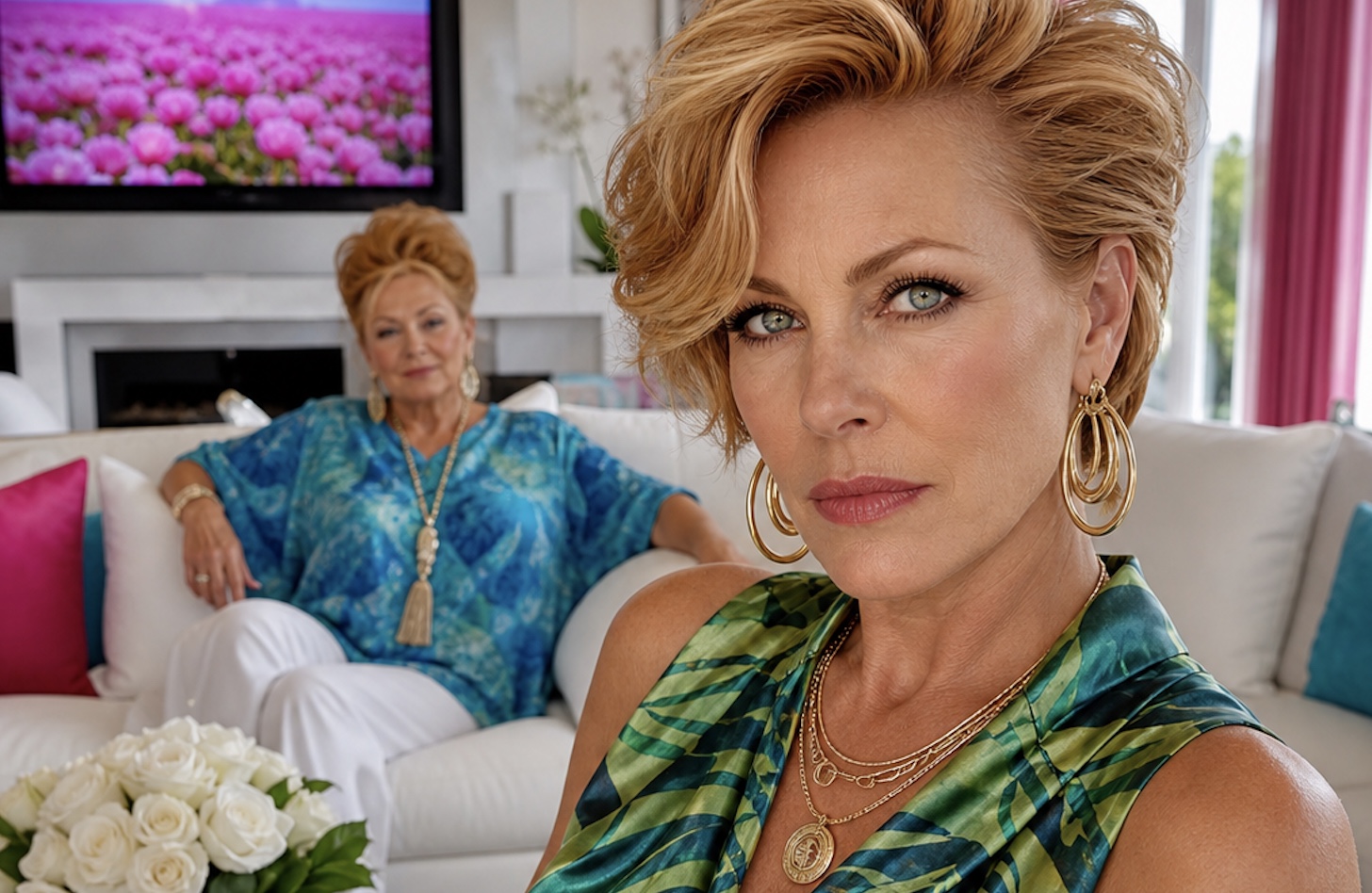
His mother, Zinaida Pavlovna, is a very self-assured woman. Her hairstyle can best be described as “an explosion at a pasta factory, secured with a whole can of hairspray,” and she firmly believes that my job is just “twisting weeds out of boredom.” We keep things polite, at a safe distance. At least until the relatives need something for free.
It all began on a gloomy Tuesday in November. The bell on the door of my studio rang, and Zinaida Pavlovna appeared on the threshold, accompanied by her niece Vika. Vika was twenty-five, worked as a “content creator” — mostly taking selfies in the mirrors of other people’s restaurants — and was preparing for her wedding.
“Anya, hello, dear!” Zinaida Pavlovna said, moving a bucket of hydrangeas aside as if she owned the place. “We’ve come to you as family. Our Vikusya is getting married. We need the venue decorated. You know, an arch, guest tables, the head table, everything rich and luxurious. And the bouquet, of course, should cascade all the way down! You work with flowers, so this must be nothing for you.”
Vika silently shoved her phone under my nose. On the screen was a glowing image: cascades of white orchids, clouds of baby’s breath, thousands of White O’Hara roses. The flower budget for a wedding like that started at the price of a used car.
“It’s very beautiful,” I said sincerely. “A wonderful choice.”
“There you go!” my mother-in-law rejoiced. “Make it just like that for us. But we won’t be paying much, of course. We’re family. You must have all sorts of discounts at the wholesale bases. Maybe some expired flowers that still look decent. You’ll figure something out from whatever you have lying around.”
I silently counted to five. Inhale. Exhale. Sugary smile.
“Zinaida Pavlovna. Vika. Let’s be honest. What you’re showing me in that picture is premium flowers. There is no such thing as ‘expired’ premium flowers that look like that.”
“I can offer you two options. The first is a generous one: I’ll give Vika a beautiful bridal bouquet and a boutonniere for the groom as my wedding gift. Made from the best flowers, completely free. You can order the rest of the decorations wherever you like.”
My mother-in-law’s face stretched.
“And the second option?” she asked, narrowing her eyes suspiciously.
“The second option is a partnership. I’ll do the full venue decoration for you. My work, my assistants’ work, installation, and removal — all as a gift. But you pay for the flowers and materials strictly according to the wholesale receipts. At cost. Based on Vika’s picture, that will come to approximately one hundred and fifty thousand rubles.”
Silence fell over the studio, broken only by the hum of the flower cooler.
“One hundred and fifty thousand? For grass that will wilt the next day?” Zinaida Pavlovna clutched her heart.
“Anya, have some fear of God! Where are we supposed to get that kind of money? We still haven’t paid for the limousine! We’re family!”
“Flowers don’t grow in my backyard, Zinaida Pavlovna. I buy them. In euros,” I replied sweetly.
They whispered among themselves for about ten minutes, huddled together by the display of succulents. Finally, my mother-in-law turned to me with a sly, revolutionary squint.
“Fine, Anya. We choose the second option. Do it like in the picture. But we’ll pay you after the wedding. From the gift envelopes. You know us. We won’t cheat you.”
Oh, I knew them. I knew them perfectly well.
“Payment from the envelopes,” translated from the language of shameless relatives, means: “After the wedding, we’ll say everyone gave us empty cards, throw up our hands, cry a little, and then fly to Turkey with the money that’s left. And you, dear Anya, will survive somehow. You’re family.”
If I agreed, I would become the main sponsor of this celebration of love — against my will.
Refuse? That would mean a scandal across the entire clan, dragging in my husband and night calls saying, “Your wife left poor orphaned Vika without a wedding!”
“Agreed,” I said, smiling radiantly. “I’ll do everything beautifully.”
Zinaida Pavlovna and Vika left in triumph. They were convinced they had brilliantly outsmarted “that florist.”
I made myself a coffee, opened my laptop, and began calculating my revenge.
I had no intention of investing a single kopeck of my own money. But ruining my reputation with cheap decorations was not part of my plan either.
I needed to find someone who would pay for the banquet.
And I knew exactly who that someone would be.
The next day I called Margarita Eduardovna, Vika’s future mother-in-law. She was a woman of an entirely different caliber: chief accountant at a large factory, the kind of woman whose brooches seemed to look down on people with quiet contempt.
She and Zinaida Pavlovna were locked in a cold war over influence on the young couple. Margarita Eduardovna considered Vika “a simple girl with no dowry” and her relatives “a bunch of beggars.”
We met in a café. I laid the decoration sketches out in front of her.
“Margarita Eduardovna,” I began, with a faint sadness in my voice, “I’ve come to you about a very delicate matter. As a florist, I have no right to discuss clients. But this concerns the honor of your family.”
She immediately perked up, setting her Americano aside.
“Zinaida Pavlovna and Vika ordered the venue decorations from me. But the budget they allocated was… how shall I put it… offensively small. Zinaida Pavlovna said, ‘Make something from leftovers, use field daisies, dyed carnations, throw in more greenery from some wasteland. We’re not going to spend money on the groom’s guests. Let them sit in hay if they have to.’”
Margarita Eduardovna’s eyes widened.
“In hay? My guests are respectable people! The Davankovs are coming, Pyotr Ilyich from the ministry! And they’re supposed to sit among daisies?”
“That’s exactly what I thought,” I sighed. “I couldn’t allow your only son’s wedding to look like a village disco from the nineties. So I put together a project worthy of your level. White orchids, premium roses. The cost price is one hundred and fifty thousand. I’m doing my own work for free out of deep respect for you.”
Margarita Eduardovna’s eyes flashed with a predatory, excited gleam.
To put the other mother-in-law in her place, prove her superiority, and save face in front of “respectable people” — that was worth any amount of money.
“I’ll pay,” she said sharply, taking out her phone. “I’m transferring the money right now. Make it so beautiful, Anya, that Zinaida chokes on her envy. And not one word to them before the wedding.”
The big day arrived.
The restaurant looked like a branch of paradise. The tables were drowning in white floral clouds, and the registration arch looked like a portal into a fairy tale. The air smelled of expensive perfume from hundreds of blossoms.
When Zinaida Pavlovna and Vika walked into the hall, their faces were worth seeing. First shock, then wild, undisguised delight mixed with smug satisfaction. My mother-in-law flew over to me, shining like a freshly polished samovar.
“Anka! Well, look at you!” she whispered into my ear. “You found some defective stock at the wholesale bases after all, didn’t you? And look how expensive it seems! Rich and luxurious! It probably cost you three kopecks, and you wanted to rip one hundred and fifty thousand out of us! Smart girls, Vikusya and I, for not paying in advance. Some businesswoman you are!”
I modestly lowered my eyes.
“Enjoy the celebration, Zinaida Pavlovna.”
The banquet went on as banquets do. Guests ate, drank, and shouted, “Kiss! Kiss!” Then came the time for the parents’ speeches.
Margarita Eduardovna, wearing a dress the color of ripe plum, took the microphone. She stepped into the center of the room, adjusted her diamond earrings, and swept her royal gaze across the guests.
The hall fell silent.
“Dear guests!” Her voice, edged with metal, carried across the restaurant. “A wedding is the union of two families. And of course, every family has its own means.”
“I am a straightforward person. When I found out that our respected matchmaker, Zinaida Pavlovna, had planned to decorate this beautiful hall with weeds, dyed carnations, and hay in order to save money on my guests…”
Zinaida Pavlovna choked on her champagne. Vika slid down in her chair as if trying to merge with the tablecloth. The groom’s guests began whispering indignantly.
“…my mother’s heart simply could not bear it!” Margarita Eduardovna continued tragically. “I could not allow my son and his bride to celebrate their special day in such misery. That is why I personally and fully paid for all this magnificent floral decoration! Every last kopeck! To our beautiful evening! Drink, eat, Zinaida Pavlovna, don’t be shy. Today you are a guest at the celebration!”
The groom’s side of the room burst into applause. Margarita Eduardovna raised her glass triumphantly.
In those ninety seconds, my mother-in-law’s face went through three shades: from pale gray to the color of overripe beet soup. She sat there with her head pulled into her shoulders while the neighbors at the table threw mocking looks at her.
Closer to the cake, I went to powder my nose.
Zinaida Pavlovna was waiting for me in the ladies’ room. She was breathing heavily, like a cornered rhinoceros.
“You… snake!” she hissed, nervously crumpling a paper towel in her hands. “You arranged all of this! You humiliated me in front of the new relatives! We had an agreement — from the envelopes!”
I calmly took out my lipstick, looking at her distorted face through the mirror.
“Zinaida Pavlovna, what are you talking about?” I asked, pretending to be deeply surprised. “I offered you two options. You wanted to receive work worth one hundred and fifty thousand for free and were planning to cheat me with those envelopes.”
“I simply found an investor. I didn’t take a single ruble from you, exactly as you dreamed. Are there flowers? Yes. Did you pay for them? No. So what exactly is your complaint?”
“You made me look like a pauper!” she shrieked.
“I made you look like a person who loves counting other people’s money,” I cut her off firmly, turning toward her without a smile. “Remember this, Mom. My work costs money. My knowledge costs money. And I help relatives only when they respect me — not when they try to use me.”
I snapped the cap back onto my lipstick and headed for the door. Just before leaving, I turned around.
“By the way, that small bridal bouquet we discussed at the very beginning? That was from me. Completely free.”
Since then, peace and quiet have settled over our big family. Zinaida Pavlovna is extremely polite with me, and whenever she hears the word “discount,” she starts blinking nervously. Vika leaves enthusiastic comments under my social media posts, clearly hoping for future goodwill.
And me? I still keep twisting my “weeds.”
Because, as practice shows, even the most shameless relatives can be taught to value someone else’s work.
You just have to choose the right fertilizer.