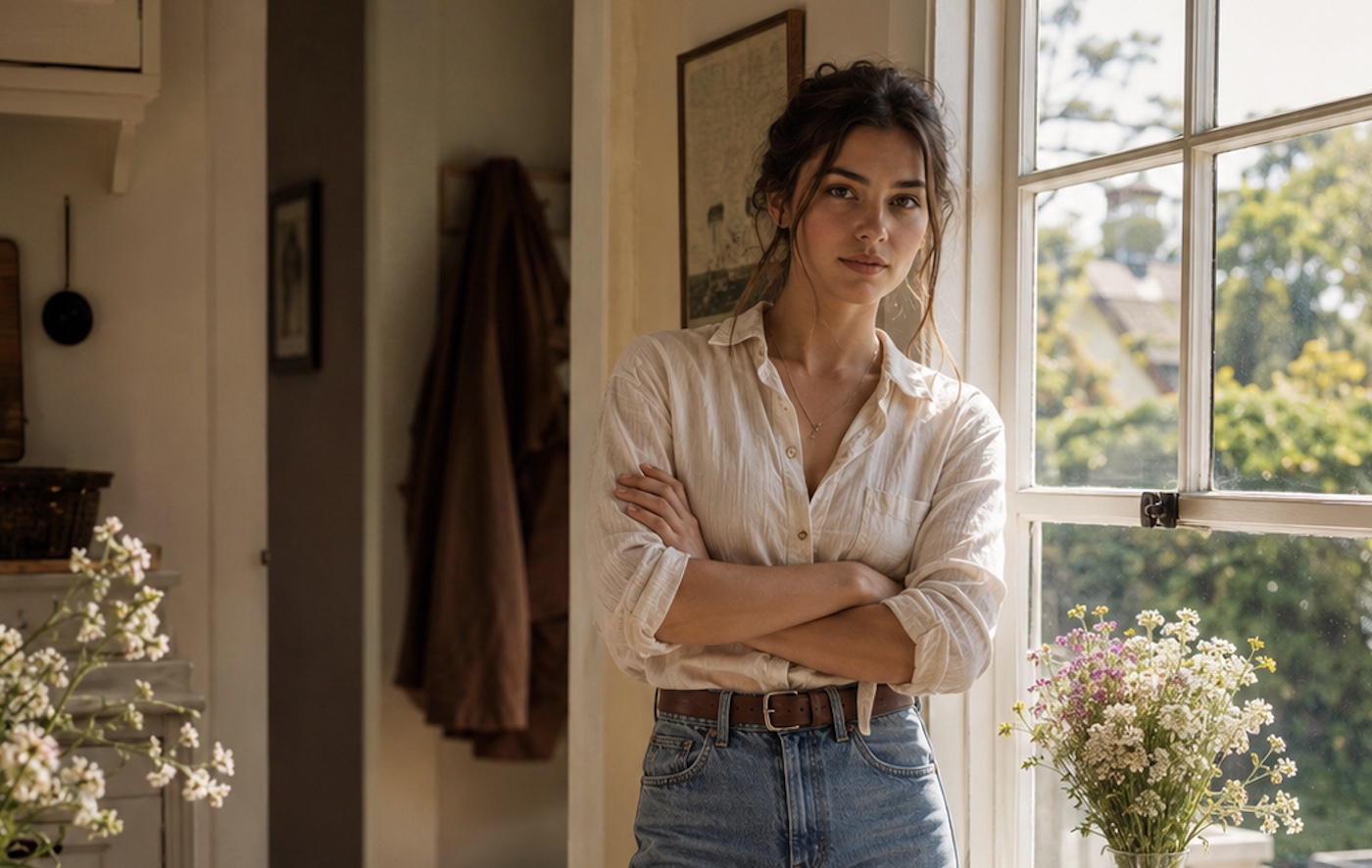
Twelve years of marriage ended with a single suitcase in the hallway.
He was packing with the confidence of a man who had made up his mind long ago. But there was one thing he had forgotten to consider.
Larisa was standing at the stove, stirring rassolnik soup, when she heard the suitcase lock click in the hallway. Not the small travel one, but the large dark-blue suitcase they had bought together at Auchan four years earlier for their trip to Anapa.
She turned down the heat, wiped her hands on the towel hanging from the oven handle, and stepped into the corridor.
Igor was kneeling in front of the open suitcase, folding his shirts. Carefully, in neat stacks, the way he had never folded them while he lived here. The collars were straight. The cuffs were tucked inside.
“Where are you going?”
He did not look up. He placed another shirt into the suitcase, a pale blue one with thin stripes, the one she had given him for his thirty-fifth birthday.
“Larisa, sit down.”
“I’m fine standing.”
“All right. Stand, then.”
He rose, brushed off his knees, and looked at her. Gray eyes, with tiny amber flecks around the pupils. She had known those eyes for twelve years. Now they were looking past her.
“I’m leaving. Not for a while. For good.”
The soup on the stove began bubbling louder. Larisa could hear every single bubble burst.
“Who is she?”
“That doesn’t matter.”
“No. It does. Who?”
He ran a hand over the back of his head, over his short dark hair, then turned toward the hallway mirror. In the reflection, she saw his jaw tighten.
“Nadya. From work.”
Larisa nodded. Not because she accepted it. Her neck simply made the movement on its own.
She had seen Nadya once. At a New Year’s office party Igor had taken her to two years earlier. Tall, with a long neck and short hair, about five foot nine. She laughed loudly, throwing her head back, and wore hoop earrings the size of five-ruble coins. Larisa had thought then, She’s beautiful.
And then she had forgotten.
Igor had not.
She returned to the kitchen and turned off the stove. She had oversalted the soup that morning while slicing the pickles and thinking about something else. Now it no longer mattered. Who was going to eat it? Her? Alone?
Larisa sat down on a stool and placed her palms on the table. The tabletop was warm from the sunlight coming through the window. April, six in the evening, and the light was still bright. Outside, someone in the courtyard was beating a carpet. Rhythmic thuds, as if counting: one, two, three.
Igor appeared in the kitchen doorway.
“I’ll pick up the rest of my things tomorrow.”
“All right.”
“And we need to talk about the apartment.”
There it was.
She had been waiting for that sentence from the moment she saw the suitcase in the hallway. Not “I’m leaving.” Not the name. This sentence.
“We’ll talk,” Larisa said.
“I think we should sell it and split the money.”
“You think so.”
“Well, how else? We were together for twelve years. I invested in it too.”
She looked at him. Six feet tall, broad shoulders, a mole on his left cheekbone. A handsome man. A stranger.
“Igor, the apartment is registered in my name.”
He blinked. Quickly, twice. As if something had flown into his eye.
“What do you mean?”
“I mean exactly that. The purchase agreement, the registration certificate. Everything is in my name. You were the one who wanted it that way.”
It had happened seven years earlier, in 2019. They had saved for the apartment for three years, putting money aside from both their salaries, living with his mother, Valentina Petrovna, in her two-room apartment on Leninsky Avenue. Larisa worked as an accountant for a construction company. Igor was a sales manager at a company that sold ventilation equipment.
They had enough money for a one-room apartment in a new building on the outskirts of the city. They did not take out a mortgage. Their savings were enough, with help from his mother. Valentina Petrovna had given them eight hundred thousand rubles.
“For your first place,” she had said. “You’ll figure the rest out later.”
When it came time to sign the documents, Igor was sitting in the car. He had a toothache, his cheek was swollen, and he was swallowing painkillers, barely able to speak properly.
“Register it under your name,” he had mumbled through his swollen cheek. “I can’t make it to the government office.”
“Are you sure?”
“What difference does it make? We’re family.”
So she did.
The purchase agreement, the certificate, the registry extract. All in the name of Larisa Viktorovna Melnikova. No marriage contract. No property division agreement. Nothing.
Back then, she had thought it did not matter.
They were family.
Igor stood in the kitchen doorway, turning his keys between his fingers. She remembered him doing the same thing on their first date, in a café on Taganka twelve years earlier. He had spun car keys in his hand, even though the car had not been his. He had borrowed it from a friend.
“But I put money into it,” he said.
“You did.”
“The renovation. The furniture. I bought this kitchen.”
“Your mother bought this kitchen. She gave it to us for her birthday. You forgot her birthday that year, so she decided to give herself a present. Through us.”
He fell silent. The keys stopped moving.
“Larisa, I don’t want to fight.”
“Neither do I.”
“But this isn’t fair.”
“What exactly?”
“You know exactly what.”
She did.
But understanding worked both ways.
He was leaving her for another woman. Nadya, with the long neck and hoop earrings. And at the same time, he wanted half of the apartment where Larisa had changed the wallpaper three times in seven years, flooded the downstairs neighbors when the washing machine hose burst, and spent every New Year alone while Igor “stayed late” at office parties.
Every. Single. New Year.
“I’ll speak to a lawyer,” Igor said.
“Do that.”
He left. The door did not slam. It closed awkwardly, scraping against the frame. The lock clicked.
Silence.
Larisa went to the window. Down in the courtyard, Igor was walking toward his car. The gray Škoda he had bought on credit, the same car for which she would still be getting calls from the bank for another year and a half because she was his guarantor.
He got behind the wheel but did not start the engine. He sat there for a minute, maybe two. Then he drove away.
The apartment smelled of soup.
Oversalted soup.
That night, she did not sleep. She lay on her side of the bed, her left arm stretched along her body, her right hand under the pillow. His side was empty. The sheet was smooth, untouched.
She did not think about Nadya. Not about the betrayal. The betrayal made sense. He had become a stranger long before the suitcase appeared in the hallway.
Instead, she remembered specific things.
How last August she had found a receipt in the pocket of his jacket from the Matsoni restaurant on Patriarch’s Ponds. Two glasses of wine, khinkali, dessert. Two thousand four hundred rubles. She had never been there.
How in October he had started ironing his shirts himself. Before that, he had thrown them into the laundry basket and waited.
How in December he put fingerprint lock on his phone and changed the passcode. She had not asked. He had not explained.
And in January he had started going to the gym. For five years, he could not make himself do morning exercises. And suddenly there was a gym membership, new sneakers, protein bars in his backpack.
It had all been clear.
For a long time.
Larisa turned onto her side. The clock on the bedside table read 2:14. Behind the wall, the neighbors’ television was on, a muffled murmur, as if someone were telling a story through the wall. She pulled the blanket up to her chin and closed her eyes.
She did not cry.
She simply lay there and listened to the ticking clock.
In the morning, her mother called.
Larisa was sitting in the kitchen, drinking coffee from a large white mug with a chipped rim. She had wanted to throw it away six months ago, but could not bring herself to do it. She had grown used to it, like an old scar.
“Good morning, my girl. How are you?”
“I’m fine, Mom.”
“You don’t sound fine.”
“Mom.”
“What happened?”
Larisa was silent for four seconds. Then she said:
“Igor left.”
Her mother was silent longer. About ten seconds. Larisa could hear the kettle boiling on the other end of the line.
“For that woman?”
“You knew?”
Another pause.
“Larisa, I didn’t know. But I saw it. In November, at Sveta’s birthday. The way he looked at his phone. Not in front of you, no. When you went to get the cake. His face was… glowing. The last time I saw that face was when he was courting you.”
Larisa finished her coffee. Grounds remained at the bottom.
“He wants half the apartment.”
“What half? The apartment is yours.”
“He says he invested money.”
“And you didn’t? Twelve years of cooking weren’t an investment? Laundry, cleaning, taking his mother to the hospital when her blood pressure spiked — who did all that, if not you? And when he was unemployed for eight months in 2021, who paid for everything?”
Her mother spoke evenly. She did not shout. Her shouting was different: quiet and factual.
“Mom, I’ll handle it.”
“Handle it. And go see a lawyer. First. Before he does.”
The lawyer’s name was Alevtina Robertovna. She was a small woman, about five foot one, with thick brown-framed glasses, around fifty years old. Her office was on the third floor of a building near the government services center. The laminate floor creaked under every step. On her desk stood a cactus in a red pot and a photograph of a ginger cat.
Larisa came two days after speaking with her mother. She sat down and placed a folder of documents on the desk: the purchase agreement, the registration certificate, the property registry extract, and the marriage certificate.
Alevtina Robertovna flipped through the papers, her short unpainted nails tapping against the edges of the pages.
“When was the apartment purchased?”
“In April 2019.”
“During the marriage?”
“Yes.”
“With whose money?”
“Our joint money. But part of it came from his mother. Eight hundred thousand.”
“Was there a deed of gift?”
“No. She just transferred it to my card.”
“To whose card?”
“Mine.”
Alevtina Robertovna removed her glasses and rubbed the bridge of her nose.
“All right. The apartment was purchased during the marriage. Under Article 34 of the Family Code, it is marital property. It does not matter whose name it is registered under. He has the right to claim half.”
Larisa felt the chair beneath her become harder.
“But it’s registered in my name.”
“Registration does not determine the marital property regime. The apartment was bought with joint funds while you were married. He has the right to file a claim for division.”
The office smelled of old paper and coffee from the vending machine in the hallway. Behind the wall, someone was typing quickly, sharply.
“So I have to give him half?”
“Wait. Tell me about his mother’s money. The eight hundred thousand. How exactly was it transferred?”
Larisa opened her phone and found an old screenshot. A transfer from Valentina Petrovna, dated March 23, 2019. Eight hundred thousand rubles. The comment read: “For the children’s apartment.”
“For the children,” Alevtina Robertovna repeated. “Not ‘for my son.’ For the children.”
“What does that mean?”
“It could be considered a gift to both spouses. Or it could be treated as a gift specifically to you, since she transferred it to your card and addressed it to you. That would need to be examined. But I see something more interesting here.”
She put her glasses back on and returned to the documents.
“You said he was unemployed for eight months?”
“In 2021. From February to October. He was laid off.”
“Who paid the mortgage?”
“We didn’t have a mortgage.”
“Utilities? Apartment maintenance? Household expenses?”
“I did.”
“Was he working unofficially?”
“No. He sat at home. Played computer games. Sometimes he did odd jobs as a loader, but that was cash, no contract.”
“I see. And during that time, you continued working?”
“Yes. As an accountant. Full-time.”
“And you ran the household.”
“Well, who else would have?”
Alevtina Robertovna wrote something in her notebook. Her handwriting was tiny, sharp, leaning left.
“Larisa Viktorovna, the situation is more complicated than ‘the apartment is in my name, so it’s mine.’ But it is also not as simple as ‘it is marital property, so we split it equally.’ I need time. Bring me bank statements for the last three years, yours and his if you can access them. Utility payments. Renovation receipts, if you still have them.”
“I have everything.”
“All the receipts?”
“I’m an accountant.”
Alevtina Robertovna looked at her over the top of her glasses. For the first time in the whole conversation, she almost smiled.
For three days, Larisa sorted through papers.
The folders were in the hallway closet, on the top shelf, where Igor had never once looked. Green folder: utilities. Blue folder: renovations. Red folder: major purchases.
She spread the receipts across the kitchen table and remembered.
Bathroom renovation, 2021. Forty-seven thousand for tiles, twenty thousand for the contractor, nine thousand for plumbing fixtures. Igor had promised to find a cheaper worker. He did not. She found one herself through an online forum.
New bedroom window, 2022. The plastic had yellowed, the hardware had loosened. Fifteen thousand. He was supposed to call the technician. For three weeks, he promised. She called herself.
Washing machine, 2023. The old one broke and flooded the downstairs neighbors. There was no insurance. Larisa had to compensate them: twenty-two thousand to the neighbors and thirty-eight for a new machine. Igor had been “at a meeting” that day. She still did not know with whom.
Every receipt. Every bill. Every transfer.
She arranged them chronologically. Then by category. Then she photographed each one and emailed them to Alevtina Robertovna.
By one in the morning, her fingers ached from handling paper. But inside her, something new had appeared.
Not anger.
Not resentment.
Something solid and calm, like a stone at the bottom of a river.
Igor called on the fourth day.
“Can we talk?”
“Talk.”
“Not over the phone. I’ll come by.”
“Don’t come. Talk on the phone.”
A pause. She could hear something in the background: music, quiet, maybe jazz. Nadya’s apartment? Or a café?
“Larisa, I saw a lawyer.”
“So did I.”
“They told me the apartment is marital property. Regardless of whose name it’s in.”
“They told me the same thing.”
“So you understand.”
“I do. Do you?”
He did not answer immediately. In the background, the music changed. A saxophone began playing something slow.
“What am I supposed to understand?”
“That ‘marital property’ means we examine who contributed what. It doesn’t automatically mean half and half. The court will look at everything. Income, expenses, who paid for what. The eight months when you didn’t work. The renovations I paid for. Every receipt.”
“What renovations? You mean the bathroom?”
“The bathroom. The window. The washing machine. The kitchen ceiling. Everything.”
“Larisa, did you keep the receipts?”
“I’m an accountant, Igor. I kept everything.”
He was silent for a long time. Twenty seconds. She counted.
“All right,” he said. “Fine. Let’s not go to war.”
“I’m not at war. I’m calculating.”
The next week passed strangely. Larisa went to work, sat at her computer in the accounting department, entered transactions, reconciled balances. Her colleagues did not notice anything. Or they noticed and chose not to ask.
Only Rita, who sat at the next desk and always brought cabbage pastries on Fridays, placed a note on her keyboard: “If anything happens, I’m here.”
No signature. No questions.
Larisa put the note into her pocket and carried it with her for three days.
In the evenings, she returned to the empty apartment. She reheated food and sat by the window. The courtyard looked the same as always: the playground, three birch trees, the bench where the old man from the second entrance sat every evening with his cane. He sat there and looked at the birches. Every day. Larisa used to wonder why.
Now she did not wonder.
She simply looked with him through the glass.
On Wednesday, Igor sent a message: “Can we meet on Saturday? We need to discuss things.”
She replied: “Fine. Twelve o’clock. The café on Profsoyuznaya.”
Not at home. Not at his place. Neutral ground, where everything smelled of someone else’s coffee and where nobody could shout.
The café was called Shelf. Narrow, long, with wooden tables and bookshelves along the walls. Larisa arrived fifteen minutes early and ordered sea buckthorn tea. The cup was yellow and hot, and she warmed her fingers around it, even though it was sixteen degrees outside.
Igor arrived exactly at noon. He had lost weight. Or perhaps it only seemed that way. He sat across from her and ordered an Americano.
“Well,” he said.
“Well.”
He took a folder from his backpack. Beige, with the logo of a law firm.
“My lawyer prepared a proposal. We sell the apartment and split it sixty-forty. Sixty for me, because my mother gave eight hundred thousand.”
“Eight hundred thousand out of the three million six hundred thousand we paid. That is twenty-two percent, Igor. Not sixty.”
“Well, plus my salary from the three years we were saving.”
“And my salary from those same three years. And my salary from the eight months when you sat at home. And my payments for renovations, utilities, appliances that broke, and the neighbors we flooded.”
She opened her own folder. Not beige. Green, old, with worn corners.
“Here are the statements. My income for twelve years. His income. Here is the unemployed period: zero income for eight months. Here are the renovation receipts. Here are the utility bills, every month, every year. Here is the compensation paid to the neighbors after the flood. Here are the expenses for kitchen appliances. Here are furniture costs.”
She laid out the pages one after another.
The stack grew.
“My lawyer says that under these circumstances, the court may deviate from an equal division. Article 39 of the Family Code. The court has the right to increase the share of the spouse who bore the main costs of maintaining the property and supporting the family.”
Igor stared at the stack of papers. The Americano in front of him went cold.
“You seriously kept all of this?”
“For twelve years.”
“Why?”
“I don’t know. Habit.”
It was true.
She had not kept the receipts in preparation for divorce. She had kept them because she was an accountant. Because numbers gave her a sense of order in a world that was not orderly.
“Larisa, I didn’t want it to be like this.”
“Like what?”
“Like this. With papers.”
“And how did you want it? You say, ‘Let’s sell it and split it,’ and I just agree?”
He did not answer.
The sea buckthorn tea had gone cold too. The berries floated darkened on the surface.
Three days later, Valentina Petrovna called. Her mother-in-law. Former mother-in-law. Or not yet former — no one had filed for divorce yet.
“Larisa, Igor told me.”
Her voice was low, slightly hoarse. Sixty-three years old, about five foot three, dyed red hair, always wearing a floral housecoat. Larisa had lived with her for two years and knew every cup in her sideboard.
“Valentina Petrovna, I—”
“Wait. Let me speak.”
Larisa fell silent.
“I know about Nadya. He didn’t tell me, but I’m his mother. I can see. And here’s what I’ll tell you. The eight hundred thousand I gave was not for him. It was for both of you. More precisely, it was for you.”
“For me?”
“You lived in my home for two years. You cooked. You cleaned. You brought me medicine when my blood pressure jumped. You never once said, ‘Why should I?’ Not once, Larisa. Not a single time.”
The line was quiet. Then Valentina Petrovna’s voice trembled.
“If he goes to court and says those were my money and they belong to him, I will come and say that the money was a gift to you. Personally to you. I don’t care that he’s my son. A man who leaves his wife does not deserve to take what he did not build.”
Larisa stood by the window. In the courtyard, the old man with the cane was sitting on the bench. The birch trees swayed.
“Thank you, Valentina Petrovna.”
“Don’t thank me. I’m angry. And when I’m angry, I tell the truth.”
The call ended. Larisa stood there for another minute, holding the phone to her ear, even though the conversation was over.
Igor came for his things on Saturday. Larisa was home, but she did not go into the bedroom while he packed. She sat in the kitchen with her laptop, working on a quarterly report. The numbers blurred before her eyes, but she forced herself to focus. Columns. Totals. Balances. This, she knew how to do.
He carried boxes into the hallway. Four of them. One with winter clothes, one with books, one with tools, and one with things she could not identify. On top of the last box were his sneakers, the ones for the gym.
When he came out for the final time, he stopped in the kitchen doorway.
“Should I leave the keys?”
She looked at him.
“Leave them.”
He placed the keys on the shelf by the mirror. Two keys on a keychain shaped like the Eiffel Tower. They had bought it in Paris five years earlier, on the only trip abroad they had ever taken together. Four days. He had complained about the prices and refused to go into the Louvre.
“Larisa.”
“What?”
“I’m sorry it turned out this way.”
She looked at the laptop screen. The cursor blinked in an empty cell.
“So am I.”
He left.
The door closed smoothly this time, without scraping. Apparently, he had finally noticed that the frame needed trimming and had pulled the handle carefully.
Larisa stood, went to the shelf, and picked up the keys. The Eiffel Tower lay in her palm, small and silver, with paint peeling from the tip. She put the keys into the dresser drawer, the one where spare batteries and an old flashlight were kept.
The second meeting with Alevtina Robertovna was longer than the first. Two hours. The same cactus stood on the desk. The cat in the photograph was still looking off to the side.
“I have reviewed your documents,” the lawyer said, removing her glasses. “Here is the picture. The apartment was purchased during the marriage, so it is marital property. However.”
She raised one finger.
“Your contribution to maintaining the apartment and supporting the family was disproportionately higher. Especially during his unemployment. Repairs, utilities, household appliances, resolving the flooding incident — all of it is documented. In addition, if your husband’s mother confirms that the money was a gift to you and not to her son, those eight hundred thousand rubles may be excluded from the marital property.”
“She’ll confirm it. She told me she would.”
“Good. We need it in writing. I’ll prepare a notarized statement. Let her sign it.”
Alevtina Robertovna put her glasses back on and wrote something in her notebook.
“With this evidence, if the case reaches court, we can ask for an increased share for you. I will not guarantee seventy-thirty, but sixty-five-thirty-five is realistic. And that is if he files a claim at all.”
“And if he doesn’t?”
“The apartment remains registered in your name. He can file a claim for property division within three years after the divorce. If he does not, the property stays with you.”
Larisa sat still. Behind the wall, someone was typing again. Fast. Like a machine gun.
“Three years,” she repeated.
“Three years. But I advise you not to wait. File for divorce yourself. The sooner the process begins, the better for you. Taking the initiative shows the court that you are ready for a constructive resolution.”
“Can he file a counterclaim for property division?”
“He can. And most likely, he will. But you have a folder full of receipts, and he has words.”
Alevtina Robertovna almost smiled again. Barely, with one corner of her mouth.
Larisa filed for divorce two weeks later. An application to the magistrate’s court. Igor did not object. He signed his consent and sent a scan by email. Quickly, as if he had been waiting for it.
She was standing by the window in the courthouse corridor, looking down at the parking lot, when her phone rang. An unfamiliar number.
“Hello?”
“Larisa? This is Nadya.”
Silence. Larisa pressed the phone tighter to her ear.
“I’m listening.”
“I wanted… I just wanted to say I’m sorry. For how things happened.”
Her voice was lower than Larisa had expected. Steady. No tremble. The voice of a person who had rehearsed.
“Why are you calling me?”
“Igor doesn’t know I’m calling. He wouldn’t approve.”
“Then why?”
“Because he told me about the apartment. About your receipts. About his mother. And it seemed to me that he doesn’t fully understand what happened. I want you to know I’m not laying claim to anything that’s yours.”
Larisa leaned against the wall. The plaster was cold even through her sweater.
“Nadya, I don’t know why I need to know that.”
“Just know it.”
The call ended. Larisa put the phone into her pocket and looked at her hands. Her fingers were not shaking. She had expected them to shake, but they did not.
The divorce hearing took place in June. Twenty minutes. The judge, a woman of about forty-five with tired eyes, read the decision. The marriage was dissolved. The parties had made no property claims.
Igor stood by the courtroom door, picking at the edge of his folder with his fingernail.
“Are you going to file for division?” Larisa asked.
He looked at the floor for a long time. The linoleum was gray, worn down by thousands of pairs of shoes.
“No.”
“Why?”
“Because my mother said that if I do, she will never open her door to me again. And I believe her. She doesn’t joke.”
Larisa nodded. This time, the movement felt normal.
“And also,” he said more quietly, “because you’re right. You invested more. I know that.”
He left first.
She stood in the courthouse corridor and felt the floor humming beneath her feet from the footsteps of people in other courtrooms. Other divorces. Other disputes. Other stacks of receipts.
That evening, she came home.
Her home.
Her apartment.
A one-room apartment, thirty-eight square meters, fifth floor, windows facing the courtyard.
She took off her shoes and went into the kitchen. The kettle stood on the stove. The soup had long been poured away, the pot washed clean. She took a mug from the cupboard. The white one with the chipped rim. She poured water into it and placed it on the table.
She did not drink.
She simply sat and watched the water in the mug become still.
On the windowsill stood a flower, an African violet she had bought at the market a week earlier. Small, with purple petals. Its leaves were soft and fuzzy if you touched them.
She touched one.
Outside, the old man sat on the bench. The birch trees were green now, full of May. The sky was pink from the sunset.
The phone lay on the table. No one called. No one wrote.
The silence was not empty.
It was different.
Like a room after unnecessary furniture has been carried out, and suddenly you can see how spacious it really is.
Larisa stood up, went to the window, and opened the small vent pane. The smell of May leaves entered the apartment, along with the distant scent of someone’s pilaf from the first floor.
She breathed in.
And breathed out.
Slowly, as if she had been holding that breath for twelve years.
The chipped white mug stood on the table. The water inside it was clear and quiet.
Larisa sat back down. Wrapped both hands around the mug. Took a sip.
It was ordinary water.
Cold.
From the tap.
It was enough.