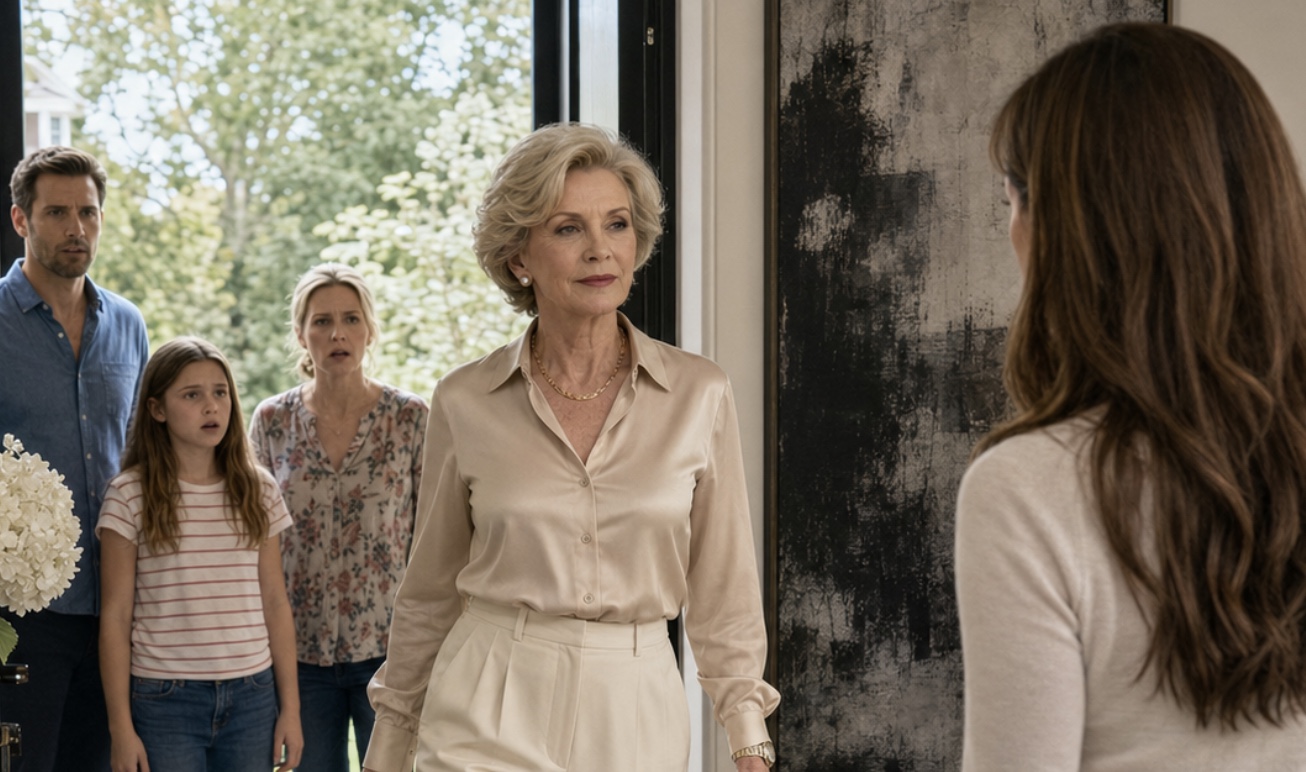
Behind her stood Lada’s father-in-law, holding two large plaid bags. Farther away, near the gate, a driver was unloading cardboard boxes, rolled-up carpets, and plastic storage containers from an old minivan. The entire procession looked as though everything had been decided long ago and all that remained was to carry the belongings inside.
Lada did not move away from the doorway.
It was a stifling July afternoon. The heated path gave off the smell of hot stone, bees buzzed in the garden, and someone in the neighboring yard was sawing boards for a terrace. The house behind Lada was cool and quiet. She had closed all the windows on the sunny side and switched on the air conditioner that morning.
“Where exactly are you planning to move?” she asked calmly.
Raisa Pavlovna smiled the way people smile at someone who is asking unnecessary questions.
“Here, of course. With you. We’ve discussed everything.”
Lada looked at her husband.
Anton stood to one side, avoiding her eyes. He was wearing the new T-shirt he had bought a week earlier and the familiar expression of a man who had decided in advance that someone else would handle the unpleasant part of the conversation for him.
“Who exactly discussed everything?” Lada asked.
“Why are you starting this?” Anton finally said. “My parents sold their country house. They have nowhere to live for the moment. We have a large house.”
He said it casually, as though they were talking about leaving a couple of extra chairs on the veranda.
Lada looked at the boxes.
One of them had “KITCHEN — UPPER CABINETS” written across it in black marker. Another was labeled “BEDDING — BEDROOM.” A long garment bag stood separately.
This was not a temporary visit.
This was a complete move.
The house stood forty kilometers outside the city. Lada’s father had built it, but he had managed to register it in his daughter’s name before he died. After his death, Lada had spent two years finishing everything: replacing the electrical wiring, rebuilding the boiler room, insulating the attic, and installing a proper water filtration system.
Anton had only participated when someone needed to choose the color of the tiles or complain to the workers for arriving late.
He liked telling people, “We built the house.”
Lada had never corrected him.
Not until today.
“Turn the van around,” she told the driver.
Raisa Pavlovna did not immediately realize that Lada was not speaking to her.
The driver froze with a box in his hands.
“Don’t unload anything,” Lada added. “Put it all back.”
“Lada, stop this,” Anton said irritably. “They’ve already come all this way.”
“I can see that.”
“You can’t expect my parents to live on the street.”
“Where were they planning to live after selling the country house?”
Her father-in-law, Viktor Semyonovich, lowered the bags to the ground and sighed heavily.
“Anton told us the house belonged to both of you and that there was plenty of room.”
Only then did Lada truly look at her husband.
Not with hurt.
Not with surprise.
She simply memorized the sentence.
Anton shrugged.
“What’s wrong with that? We’ve been married for eight years. This is our house.”
“No. This is my house.”
Raisa Pavlovna stopped smiling.
“Here we go. So because it’s yours, your husband is nobody here?”
“I didn’t say that.”
“But that’s what you meant.”
Lada did not argue.
She had noticed long ago that Raisa Pavlovna only heard the part of a conversation that allowed her to go on the attack.
Her mother-in-law would have walked inside if Lada had not remained in the doorway.
“We’re not asking for an entire floor,” Raisa Pavlovna said. “Two rooms will be enough. Your father-in-law needs a bedroom, and I need a room for my things. The living room can remain shared.”
Lada nodded slowly.
“So you’ve already made a plan.”
“Of course. You can’t leave everything until the last minute.”
“And when were you planning to inform me?”
Anton ran a frustrated hand through his hair.
“I was going to speak to you this evening.”
“After the belongings had already been carried inside?”
“What difference does it make?”
That sentence put everything into place.
Lada realized that talking would not change anything.
Anton had not made a mistake. He had not panicked, and he had not been pressured by his parents.
He had planned everything.
He had deliberately chosen a day when Lada was working from home and could not leave. He had brought his parents and all their possessions, hoping she would be too embarrassed to create a scene in front of the driver, the neighbors, and his elderly father.
It was not a bad calculation.
Anton’s only mistake was that he still believed Lada could be forced into submission through discomfort.
“All right,” she said. “Let’s not create a scene in the street. Come onto the veranda. The belongings stay in the van for now.”
Raisa Pavlovna straightened triumphantly.
Anton visibly relaxed.
Lada stepped aside and allowed them onto the enclosed veranda only. It contained a wicker sofa, a table, and two chairs. Another door led from the veranda into the house, and Lada locked it from the inside.
“Would you like some tea?” she asked.
“This is no time for tea,” her mother-in-law snapped. “We need to see the rooms.”
“First, I want to understand what happened to the country house.”
Viktor Semyonovich sat down in one of the chairs. He looked tired and, unlike his wife, did not appear eager to conquer new territory.
“We sold it,” he said. “A buyer appeared quickly.”
“For how much?”
Raisa Pavlovna pressed her lips together.
“That is a family matter.”
“You have arrived to live in my house, so now it is my business too.”
Anton turned sharply toward her.
“Lada, you’re going too far.”
“No. So far, I’m only asking questions.”
Silence settled over the veranda. A fly drifted lazily behind the mosquito screen, while the automatic sprinklers continued watering the garden outside.
Lada knew that her in-laws’ country property was located near Luga. It consisted of a small house, twelve hundred square meters of land, a bathhouse, and an old but sturdy garage.
Only that spring, Raisa Pavlovna had insisted that they would never sell it.
“It will go to the children,” she had said.
Now the property was gone, and its former owners had arrived with boxes.
“Where is the money?” Lada asked.
“In an account,” Viktor Semyonovich replied.
Raisa Pavlovna shot him an angry look.
“What account?”
“Mine,” Anton interrupted. “It’s safer that way.”
Lada looked at him and felt something other than anger.
Almost professional curiosity.
Anton was a sales department manager and knew how to make other people’s decisions sound convincing. At home, he rarely lied outright. He preferred to omit details, replace one motive with another, or reveal a fact only when it was already too late to change anything.
“So your parents sold their country house, transferred the money to you, and decided to live in my home?”
“Not forever.”
“For how long?”
“How am I supposed to know?” he snapped. “Until we figure things out.”
“Figure out what?”
“Our future plans.”
Raisa Pavlovna interrupted.
“We want to buy an apartment, but prices are ridiculous right now. We need to wait. Maybe a year. Maybe two.”
Lada nodded.
At last, the truth had been spoken.
This was not a matter of a few weeks.
It was not an emergency.
They had sold their property at the height of the summer market, handed the money to their son, and decided to live in Lada’s house for free until the property market became more convenient for them.
“Why didn’t you rent an apartment?” she asked.
“Why throw money away?” her mother-in-law asked with genuine surprise. “Our son has a house standing here.”
“Your son does not own a house.”
“There you go again.”
Lada stood up.
“I’ve heard enough. You will not be living here.”
Raisa Pavlovna rose as well.
“Anton, do you hear the way your wife is speaking to your parents?”
“I hear her,” he replied darkly. “Lada, unlock the house. That’s enough of this circus.”
“No.”
“I’m officially registered here.”
“No, you aren’t.”
For a moment, Anton looked confused.
He really was not registered at that address.
When they had moved into the house, Lada had offered to arrange his registration, but Anton had brushed the idea aside. It had been more convenient for him to remain registered in his parents’ city apartment.
Now that minor detail had suddenly become important.
“I’m your husband,” he said more quietly.
“Yes. And that is exactly why I want to know when you decided you had the right to manage my property without consulting me.”
Raisa Pavlovna stepped closer.
“Listen to me, young lady. This is not how a family behaves. Today you own a house, tomorrow Anton has money. Everything should be shared.”
Lada smiled faintly.
“Then let’s begin with the money.”
“What?”
“Is the money from the country house shared? Show me the sale agreement and the amount in the account. If you consider my house a shared family resource, then your money becomes a shared resource too.”
Raisa Pavlovna went pale.
Anton swore under his breath.
“You’re deliberately twisting everything.”
“No. I’m simply accepting your rules in full, not only the part that benefits you.”
Viktor Semyonovich looked heavily at his son.
“You told us Lada had agreed,” he said.
Anton turned sharply.
“I said she wouldn’t object.”
“That is not the same thing.”
“Dad, don’t start.”
Lada noticed the shift.
Viktor Semyonovich apparently had not been told all the details. Perhaps he had genuinely believed the matter had already been settled.
Raisa Pavlovna, on the other hand, clearly understood that nobody had asked the owner of the house.
She simply did not care.
“The belongings are going back into the van,” Lada said. “Tonight, you can stay at a hotel or return to the city. Tomorrow you can calmly decide what to do next.”
“And Anton?” her mother-in-law asked.
“Anton can decide for himself where he wants to be.”
Her husband stared at her defiantly.
“Fine. I’ll leave with my parents.”
“Fine.”
He had obviously expected a different reaction.
He had expected pleading, tears, or an attempt to soften the situation.
Lada gave him none of those things.
Anton threw open the door leading to the garden.
“Load everything back into the van!” he shouted to the driver.
Ten minutes later, the minivan drove away.
Anton’s car followed it.
Lada closed the gate and returned to the house.
The silence no longer felt comforting. Something sticky seemed to remain in it, like fingerprints left on glass.
She walked through the rooms.
The bedroom.
The study.
The guest room.
The small room on the ground floor where she kept shelves and a sewing machine.
These were the rooms they had already divided among themselves without her permission.
That evening, Lada did not cry or call her friends.
She opened her laptop.
First, she checked the documents for the house and the land. Then she reviewed the bank accounts. After that, she listed all the payments made during the previous two years.
Anton contributed to groceries and fuel and occasionally paid for small repairs. The car loan was his responsibility.
Every major expense connected with the house had been paid from Lada’s account: the boiler, the well, the pump, the windows, the exterior, the furniture, and the appliances.
The following day, she called a lawyer she knew through work.
Not to discuss divorce.
Not yet.
She needed to understand the limits of her risk.
By noon, the situation was clear.
The house and land had belonged to her before the marriage. Anton’s contributions had been minor and poorly documented. He had no legal basis to claim a share.
But there was another problem.
He still had keys.
Lada drove to a hardware store and bought a new cylinder for the front-door lock. She chose a model that came with five keys. That evening, she removed the old cylinder and installed the new one herself.
The job took twenty minutes.
She placed the old lock cylinder in a box and stored it in the pantry.
She did not write to Anton.
He appeared two days later.
He arrived after nine in the evening and spent a long time trying to unlock the door. Then he called her.
“You changed the lock?”
“The cylinder.”
“Very funny. Open the door.”
“Why?”
“I live here.”
“You left.”
“For two days.”
“And you took most of your belongings.”
That was true.
Anton had left that evening with only a backpack. But the next day, while Lada was in the city, he had returned and collected his clothes, documents, and work laptop.
Apparently, he had expected to punish her with his dramatic absence.
“I want to talk,” he said.
“Talk.”
“Through the door?”
“We can speak on the phone.”
He fell silent.
Then he said, “You’re behaving like a lunatic.”
“And you brought two people and all their belongings into my home without my consent.”
“They’re my parents.”
“That is exactly why you should have discussed it with me beforehand.”
“I knew you would refuse.”
Lada gave a quiet laugh.
“So my consent was never necessary.”
Anton struck the door with his palm.
“Open it.”
“No.”
“My belongings are inside.”
“Make a list. I’ll pack them.”
“Are you serious?”
“Completely.”
He argued for another five minutes before leaving.
The next morning, Lada received a long message from Raisa Pavlovna. It contained accusations of cruelty, ingratitude, destroying the family, and condemning elderly people to humiliation.
Lada replied with one sentence:
“My offer to review the sale agreement and discuss fair living arrangements still stands.”
There was no response.
A week later, Viktor Semyonovich called.
“May I come by alone?” he asked.
They met on the veranda.
Her father-in-law looked worse than he had during his previous visit. The heat was oppressive, his shirt clung to his back, and his face seemed thinner.
“We’re staying with Raisa’s sister,” he said. “It’s a two-room apartment. There are five of us living there.”
Lada placed a glass of cold water in front of him.
“Does Anton still have the money from the country house?”
“Yes.”
“How much?”
He named the amount.
Lada raised her eyebrows.
The property had sold for considerably more than she had expected.
“Why did you transfer all of it to him?”
Viktor Semyonovich was silent for a moment.
“He suggested investing it. He said he knew of a good project. The amount would grow within a year.”
“What kind of project?”
“I’m not entirely sure. Something involving warehouse properties.”
The picture became even clearer.
Anton had not merely planned to move his parents into Lada’s home.
He had taken their money with the promise of earning a return, while free accommodation in his wife’s house would remove the need to repay them quickly.
“Did you see a contract?” she asked.
“What contract?”
“Any contract. A loan agreement, an investment agreement, an asset-management contract.”
He looked away.
“We’re family.”
“That is not a legal document.”
“I understand that now.”
There was no resentment toward Lada in his voice.
Only the exhaustion of a man who had realized too late that his son had not told him everything.
“Raisa thinks you threw us out,” he said.
“I refused to let you move in. Those are different things.”
“I understand.”
“Does she?”
“She doesn’t want to understand anything right now.”
Lada took a sip of water.
“Do you have the option of living somewhere separately?”
“We could rent an apartment. But Raisa is against it. She says the money should be working.”
“Is the money working now?”
Viktor Semyonovich did not answer.
Lada did not pressure him.
She had no intention of rescuing adults from decisions they had made themselves. But she needed to understand how far Anton had gone.
“Ask him for a bank statement,” she said. “And request the investment documents. Not explanations. Actual paperwork.”
“Do you think things are bad?”
“I think an honest person is usually not afraid to show documents.”
Three days later, Anton returned.
This time he came during the day, and he was not alone. A man in a linen shirt stood beside him and introduced himself as a real-estate agent.
“What is going on?” Lada asked without opening the gate.
“We need to inspect the house,” Anton said.
“Why?”
“To value it.”
“For what purpose?”
The real-estate agent turned away awkwardly.
Anton lowered his voice.
“My parents need an apartment. I want to know how much the house is worth.”
For a moment, Lada could not answer.
“You brought someone to value my house?”
“Our house.”
“Leave.”
“Listen to me first. If we sell this place, we can buy two apartments. One for us and one for my parents.”
Lada looked at him and finally understood why he had been so confident about moving his parents in.
To Anton, the house had long ago stopped being a home. It had become an asset that could be redistributed.
His wife, his parents, the money from the country house, a future sale—everything belonged to one scheme in which he made all the decisions.
“You truly believed I would agree to sell the house my father built?”
“It’s only real estate.”
“To you, perhaps.”
“You can’t live in the past.”
“But you can live on your parents’ money?”
He went pale.
“What does that have to do with anything?”
“Viktor Semyonovich told me about the investment.”
The agent coughed and took a step toward the car.
Anton glanced quickly at him.
“Wait in the car.”
When they were alone, he spoke more quietly.
“Don’t interfere in things you don’t understand.”
“Then explain them.”
“Everything is under control.”
“Show me the documents.”
“I don’t have to report to you.”
“That’s true. But you won’t live at my expense either.”
Anton clenched his jaw.
“You’ve already made your decision, haven’t you?”
“Not yet.”
“Then what are you doing?”
“Gathering information.”
He left without accomplishing anything.
That same evening, Lada reviewed their shared expenses and discovered another detail.
Over the previous four months, Anton had repeatedly transferred money from their joint card to his personal account. The amounts were not enormous, but the transfers were regular.
She removed his access and left only enough money on the card to cover current household payments.
Anton called the following day.
“Did you block the card?”
“No. I removed your access.”
“There was some of my money on it.”
“I transferred your contributions to your account. Everything else was mine.”
“Are we strangers now?”
“You started living that way before I did.”
He ended the call.
August arrived dry and scorching. The lawns turned yellow, the grass along the road faded to gray, and a heavy haze hung over the fields at night.
Lada continued working, watering the garden, and putting the house in order.
She did not create public scenes or tell acquaintances about the war inside her family. Preparing herself was more important.
She made an inventory of Anton’s belongings, photographed every box, and sent him a list. She offered to let him collect everything on a convenient day.
He did not reply.
Raisa Pavlovna did.
This time, her voice was not commanding. It was sharp with fear.
“What have you been telling Viktor? Now he is demanding documents from Anton.”
“He is right to demand them.”
“You’re turning a father against his son.”
“I told him to verify where the money went.”
“The money is invested.”
“In what?”
Her mother-in-law fell silent.
“Anton will return everything,” she said, sounding less certain.
“When?”
“Soon.”
“So there are still no documents.”
Raisa Pavlovna began shouting, but Lada ended the call.
Two days later, Viktor Semyonovich came again.
This time he arrived without calling, but he was alone.
He was carrying a folder.
“Take a look,” he asked.
Inside was a printed bank-transfer receipt and several pages bearing the logo of a company Lada had never heard of.
The agreement was in Anton’s name.
His parents were not mentioned anywhere.
The money had not been used to purchase warehouse properties. It had been issued to the company as an interest-free loan for eighteen months.
“Who owns the company?” Lada asked.
“One of Anton’s acquaintances.”
“Is the loan secured?”
“What do you mean?”
“Is there collateral, a guarantor, or any guarantee of repayment?”
There was nothing.
Lada turned through the pages in silence.
Anton had placed someone else’s money into a risky venture, registered the entire arrangement in his own name, and then tried to solve his parents’ housing problem using his wife’s house.
The scheme was calculating.
It was not particularly secure.
“You can demand that Anton sign a written acknowledgment of the debt,” she said. “He must formally confirm that he owes you the money.”
“He refuses.”
“Then you have a serious problem.”
Viktor Semyonovich closed his eyes.
“Raisa says we should wait.”
“Does Raisa still believe you will move in here?”
He nodded.
“And what do you think?”
“I don’t want to anymore.”
It was the first sensible answer Lada had heard from her husband’s family in a month.
At the end of August, Anton finally returned for his belongings.
He entered the property after Lada opened the gate and stopped near the front steps. He had changed over the past several weeks. His face looked thinner, he had lost weight, and shadows had appeared beneath his eyes.
“The company isn’t paying?” Lada asked.
He looked sharply at her.
“Did Dad tell you?”
“It wasn’t difficult to guess.”
“It’s temporary.”
“Perhaps.”
“Are you pleased?”
“No. I don’t care.”
Those words hurt him more than any accusation could have.
Anton walked onto the veranda. The boxes were already stacked against the wall.
“You packed everything.”
“As promised.”
“You didn’t even leave me a reason to return.”
“A reason to return should not be based on socks and documents.”
He sat on the edge of a chair.
“I wanted what was best.”
“For whom?”
“For everyone.”
“At my expense.”
“The house is too large for two people.”
“Then why didn’t you offer to sell your share of your parents’ apartment?”
Anton looked away.
The city apartment had been privatized in three equal shares belonging to him and his parents. Lada had known about it for years.
“That’s different.”
“Of course. You consider your own property untouchable.”
He said nothing.
“You had a plan,” Lada continued. “Your parents would sell the country house. The money would go to you. They would move into my house. Then you would persuade me to sell it and purchase two apartments. In the end, you would keep your share of your parents’ apartment, gain an interest in a new apartment, and retain control over their money. Not bad.”
“You make it sound as though I’m a fraud.”
“I’m simply listing the events in the order they happened.”
“I wasn’t trying to deceive you.”
“Is that why you told me nothing beforehand?”
Anton rubbed a hand over his face.
“I knew you would be stubborn.”
“Because the arrangement was bad for me.”
“Family is not always about personal benefit.”
“Then why did you calculate your own benefit so carefully?”
He stood up.
“So this is it?”
Lada looked at him calmly.
“Yes.”
“You aren’t even going to try to save our marriage?”
“I spent eight years preserving our marriage. You were preserving your comfort.”
Anton collected the boxes in two trips.
In September, Lada filed for divorce.
There were no scandals, mutual accusations, or endless conversations.
Anton delayed the process at first, but eventually agreed. Perhaps he expected her to change her mind. Perhaps he was simply too occupied with the company’s problems.
In October, the company stopped answering calls.
Viktor Semyonovich eventually forced his son to sign a written acknowledgment of the debt.
Raisa Pavlovna spent several months blaming Lada for destroying the family.
Then she stopped calling.
The house survived the hot summer without changing.
The three rooms were still not empty.
Lada turned one of them into a studio. In another, she placed a large desk and created a new office. The third remained a guest room—not for people who arrived with a ready-made plan for her life, but for those she genuinely wanted to welcome.
At the beginning of the following June, Lada was replacing the mosquito screen on the veranda when Viktor Semyonovich stopped outside the gate.
He looked older, but calmer.
“I won’t stay long,” he said.
Lada let him in.
He told her that he and Raisa had rented a small apartment. Anton was repaying the money in installments after selling his car and giving up his share in his parents’ home.
“Raisa still believes everything could have been handled differently,” he said.
“It could have.”
“How?”
“You could have asked me before hiring the van.”
Her father-in-law smiled.
“That’s what I think now too.”
Before leaving, he paused at the gate.
“You’re a hard woman, Lada.”
“No. I simply refuse to give other people the right to make decisions for me.”
He nodded as though he finally understood the difference.
Lada closed the gate and returned to the garden.
The summer was hot again. Currants were ripening on the bushes, bumblebees circled above the flower beds, and music drifted through the open window of her study.
The house was not empty.
It simply belonged once again to someone who knew the difference between family and the seizure of another person’s territory.