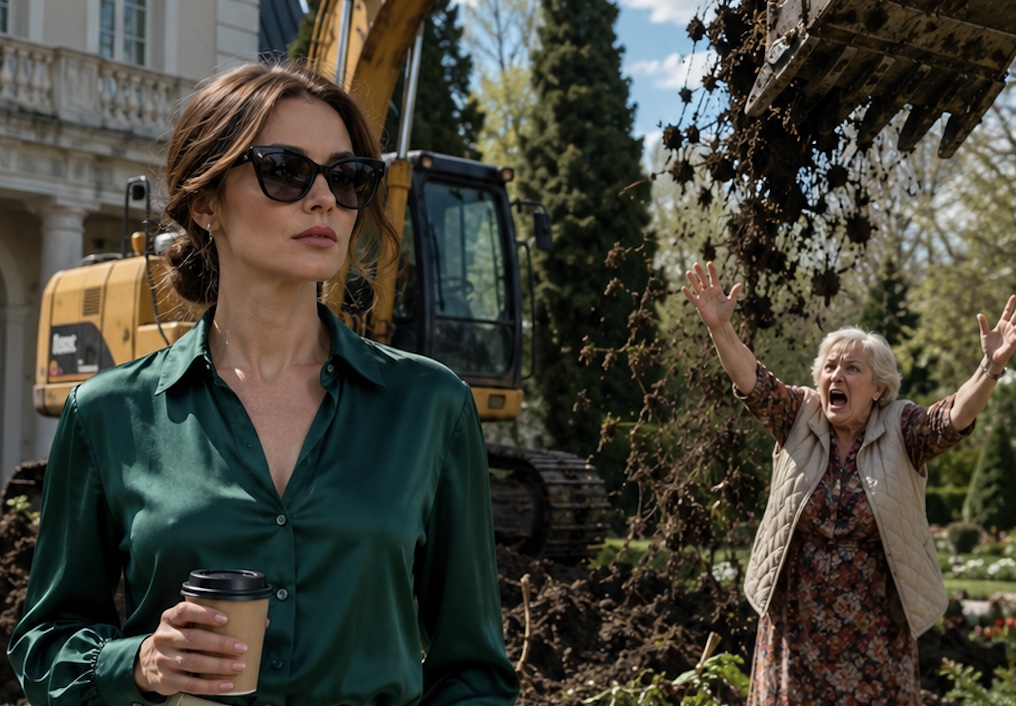
The bulldozer started moving at half past eight in the morning.
Alisa stood beside the gate in white linen trousers and dark sunglasses, holding a paper cup of coffee as she watched the machine’s bucket descend onto the rose bushes Valentina Stepanovna had spent the entire summer tending.
The soil gave way easily.
The flower bed her mother-in-law had bordered with paving stones over three exhausting weeks vanished within seconds.
“Stop! Stop this immediately!”
Valentina Stepanovna came running across the yard in house slippers, clutching the front of her dressing gown to keep it closed. She screamed so loudly that people were already peering over the fence from the neighboring properties.
Alisa calmly took another sip of coffee.
“I’ll make you pay for this! All of you! Boris! Boris, do something!”
Boris stood a short distance away near the car, staring at the scene like a man who had been dragged out of bed in the middle of the night and ordered to explain the theory of relativity.
He opened his mouth several times, closed it again, and finally shoved both hands into his pockets.
Alisa finished her coffee, placed the cup on the ground, and adjusted her sunglasses.
The neighbors were watching.
That was exactly what she wanted.
Alisa had been forty when she decided that perhaps it was finally time to lower her expectations.
She had made that decision soberly, almost clinically, the same way she made choices at work when she had to select between contractors or approve the budget for the next quarter.
She worked as a manager for a large logistics company, supervised a department of twelve people, traveled regularly for business, and finished at least one book every month.
She was attractive, financially secure, owned two apartments, and had a personality her colleagues privately described as steel.
They did not mean it as an insult.
They respected her.
Her personal life, however, had been empty for years.
Not because she did not want a relationship. Of course she did.
But the men she genuinely liked were always either already committed or so dull that she lost interest within a month. The men who actively pursued her, meanwhile, were usually intimidated sooner or later by her independence, her income, her apartments, and her habit of making decisions without asking permission.
She met Boris at a mutual friend’s birthday party.
He was pleasant.
That was the exact word for him: pleasant, without an exclamation mark.
He was of average height, neatly dressed, polite, and knew how to listen without interrupting. He worked as an engineer at a design firm, rarely drank, could carry a conversation about films, and offered to drive her home that very first evening without expecting anything in return.
Alisa noticed that.
She counted it in his favor.
They started dating.
The first few months were comfortable. Pleasant again, without excitement, but also without obvious warning signs. Boris was attentive and punctual. He brought flowers and never kept her waiting.
There was only one detail Alisa noticed almost immediately but deliberately pushed aside, placing it in the mental folder people open only when it is already too late.
Boris was deeply attached to his mother.
Loving one’s mother was not a problem in itself. Alisa loved her own mother, who lived in another city, and they spoke once a week.
But Boris and Valentina Stepanovna were different.
He called her several times a day: in the morning, during lunch, after work, and occasionally once more before going to bed.
He told her everything.
What he had eaten, what he had seen, how he felt about the weather, and what he thought about politics.
Once, Alisa overheard him giving his mother a detailed explanation of why he had chosen one brand of laundry detergent over another.
“My mother is the most important woman in my life,” he said one evening, casually, as if stating an obvious fact.
Alisa said nothing.
They married a year after meeting.
The wedding was modest because Alisa preferred it that way: a small restaurant, close friends, and family.
Valentina Stepanovna wore a bright fuchsia dress and spent most of the evening rearranging the table decorations because the flowers had not been placed according to her standards.
After the wedding, Alisa and Boris moved into the apartment Alisa was still paying off.
Her second property had belonged to her grandmother. It was a spacious two-bedroom apartment in a desirable neighborhood, with high ceilings and large windows.
It had remained empty for some time.
Alisa planned to rent it out. It was the practical thing to do. The extra income would help her pay off the mortgage much faster.
That apartment was where everything began.
Alisa was admitted to the hospital at the start of autumn.
It happened suddenly, the way serious health problems often happen to people who are used to ignoring their bodies.
It was not life-threatening, but it was severe enough to require several weeks of inpatient treatment.
Perhaps longer.
Lying in her hospital bed, Alisa stared at the ceiling and thought about the apartment.
The tenants were supposed to move in at the end of the month. She had already shown them the property, agreed on the terms, and accepted a deposit.
All that remained was to sign the contract, hand over the keys, and complete the paperwork.
“Boris,” she said during one of his visits, “I need your help.”
He nodded, listened carefully, and wrote things down.
He appeared organized and responsible, and Alisa almost convinced herself that she had been foolish to worry.
To allow him to act on her behalf, she needed to sign a power of attorney.
A notary came directly to the hospital, which was not unusual. Such arrangements were common for patients who could not leave the ward.
Alisa signed the documents.
She was taking pain medication. She was tired and slightly distracted.
The notary explained everything quickly and professionally. Boris sat beside her with the expression of a man who did not want to burden his sick wife with unnecessary details.
Much later, she would replay that moment in her mind again and again.
She tried to remember whether there had been any warning.
The notary’s wording.
Her husband’s voice.
A glance.
A hesitation.
Something she should have noticed.
At the time, she noticed nothing.
Three weeks later, Boris came to the hospital, sat down beside her bed, folded his hands over his knees, and said:
“Alisa, I need to tell you something. But please don’t get upset. You’re still recovering.”
There could hardly have been a worse way to begin.
He spoke for a long time, carefully and methodically, with the precision of an engineer explaining a complicated calculation.
He had sold the apartment.
A buyer had appeared quickly, and the price had been good.
He had given the money to his mother.
Valentina Stepanovna had always dreamed of owning a country house. Her heart was weak, she needed fresh air, and she had sacrificed so much for him throughout her life.
Was it not fair, Boris asked, that he should finally do something for her?
“Don’t worry,” he added. “The property is large. There’s a garden and plenty of space for flower beds. Mother said you’ll always be welcome there. You’re so capable with your hands. You can help her with the vegetables.”
Alisa stared at him.
Rain slid down the hospital window.
Somewhere in the corridor, a nurse pushed a stretcher, its wheels squeaking at regular intervals.
“Leave,” Alisa said.
“Alisa…”
“Get out of this room.”
She did not sleep for the next several nights.
She thought.
Calculated.
Made phone calls.
Her friend Marina, a lawyer, came to the hospital with her laptop and stayed for three hours.
She examined the documents Alisa had photographed before signing them, an old professional habit that had now become critically important.
“This is a general power of attorney,” Marina said. “Not the limited document you believed you were signing.”
“I understand.”
“The notary was either working with him or simply corrupt. That part is secondary. What matters is that we may be able to prove you were deliberately misled.”
Marina paused and turned the laptop toward her.
“There’s something else. The country house wasn’t registered in his mother’s name. Boris registered it in his own.”
Alisa slowly nodded.
“So she has no legal ownership.”
“None. Boris owns everything.”
Something clicked into place inside Alisa’s mind, as quietly and precisely as a lock turning.
“Good,” she said. “Then I know what I’m going to do.”
She was discharged on Friday at noon.
Boris did not come to collect her. He was at work and sent a message saying he would be free later in the evening.
Alisa called a taxi.
As the car moved through the rain-soaked streets, she watched pedestrians hurry beneath umbrellas.
She thought about her grandmother, who had left her the apartment.
She remembered drinking tea together in the old kitchen beneath the high ceiling.
Her grandmother used to say, “Alisa, protect what belongs to you. Never give it away simply because someone asks.”
When Alisa arrived home, she changed clothes, made coffee, and called a locksmith.
He arrived forty minutes later.
The locks were replaced quickly.
Alisa tested the new keys, placed a spare in her desk drawer, and began packing her husband’s belongings.
She worked slowly and neatly, the same way she organized documents before an important negotiation.
Shirts went into one bag.
Trousers into another.
His razor, chargers, and books followed.
She removed their wedding photograph from the wall and placed it on top of the bags, face down.
Then she left everything outside the door.
Boris called at seven in the evening.
“Alisa, I’m standing outside, but my key doesn’t work.”
“I changed the locks,” she replied. “Your things are in the hallway.”
There was a pause.
“What do you mean, you changed the locks?”
“It means your key no longer opens the door.”
“Alisa, this is our home!”
“The mortgage is in my name,” she said calmly. “I have been paying it. You own nothing here. Collect your bags before the neighbors decide to help themselves.”
She ended the call.
Boris returned twice.
The first time, he brought flowers and wore the expression of a man who genuinely believed he had done nothing wrong.
He spoke about family.
He said she did not understand what his mother meant to him.
He claimed they could still discuss the situation and find a solution.
Alisa opened the door with the security chain still fastened, listened without interrupting, and then closed it again.
The second time, he brought his mother.
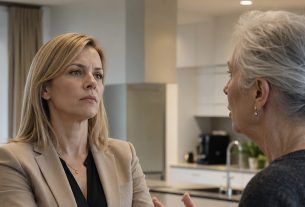
Valentina Stepanovna stood in the hallway and lectured Alisa about how young wives were supposed to respect their husbands’ mothers.
She said Alisa had always been far too independent and that independence was not an attractive quality in a woman.
She insisted that she and Boris had made a joint family decision, and Alisa had no right to create a scandal now.
“Valentina Stepanovna,” Alisa interrupted, “whose name is on the deed to the country house?”
Her mother-in-law blinked.
“Boris’s, naturally. But that was only done for convenience.”
“For convenience,” Alisa repeated. “Of course. Goodbye.”
The court case lasted several months.
Marina worked aggressively and methodically.
They proved that Boris had obtained the power of attorney through deception, that Alisa had never agreed to sell the apartment, and that the notary had violated professional procedures.
The financial damages were calculated according to the full market value of the property.
Boris became legally responsible for a debt he had almost no chance of repaying from his engineer’s salary.
But he did own one significant asset.
The country house registered in his own name.
That became the decisive point.
The court ruled that because the property had been purchased with money unlawfully obtained through the sale of Alisa’s apartment, it could be transferred to her as compensation for the outstanding debt.
Alisa read the judgment while sitting beside the window in her apartment, drinking tea as snow fell outside.
She read it twice.
Then she set the papers down, took another sip, and called Marina.
“How quickly can we complete the transfer of the country house?”
By spring, the snow had melted and the ground had begun to dry.
Alisa drove out to the property.
Boris and Valentina Stepanovna were still living there while the final legal procedures were being completed.
They had managed to settle in comfortably.
There were newly planted beds, vegetable rows, and even a small gazebo beside the fence.
Valentina Stepanovna had clearly poured all her unused energy into improving the land.
Alisa already had the ownership documents.
A court enforcement officer arrived with her.
Boris came outside looking pale, his lips pressed into a thin line.
“Alisa, please,” he began. “Mother has already made this place her home. She’s used to it. Her health…”
“Boris,” Alisa said evenly, “I had health problems too. I was in the hospital while you were selling my apartment.”
The officer handed Valentina Stepanovna the official notice.
What followed was loud enough for the entire settlement to hear.
Her mother-in-law screamed about injustice and cruelty. She shouted that women like Alisa would never understand real family or genuine love.
Neighbors emerged from behind fences and garden gates to watch.
Alisa had made sure in advance that several people living nearby knew exactly what had happened and why.
Rumors traveled quickly in country-house communities.
The bulldozer had been ordered beforehand.
It was already waiting for her instruction.
As the legal owner, Alisa had the right to do whatever she wished with the land.
The flower beds Valentina Stepanovna had created represented more than flowers.
They were part of her labor, her plans, and her belief that the property now belonged to her.
That was precisely why Alisa decided they had to be destroyed first.
Not out of cruelty.
For the sake of clarity.
The bulldozer worked steadily.
Valentina Stepanovna screamed.
Boris remained beside the car with his hands buried in his pockets.
Neighbors watched over the fences. Some lived directly across the road, some farther down, and others had come deliberately after hearing the story.
Alisa finished her coffee.
She put the cup down and looked at what remained of the garden: turned soil, broken stems, and shattered paving stones.
For the first time in many months, she felt completely calm.
It was not triumph.
It was peace.
“Alisa!” Valentina Stepanovna shouted over the roar of the engine. “You’ll regret this! You’ll end up alone! Do you hear me? Alone!”
Alisa adjusted her sunglasses.
She picked up the empty cup and placed it in her bag. She had never been the kind of person who left rubbish behind.
Then she walked toward her car.
Behind her, the bulldozer continued working.
The earth was soft.
Spring had only just begun.
And Alisa had many plans.