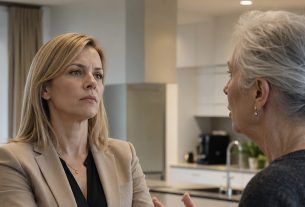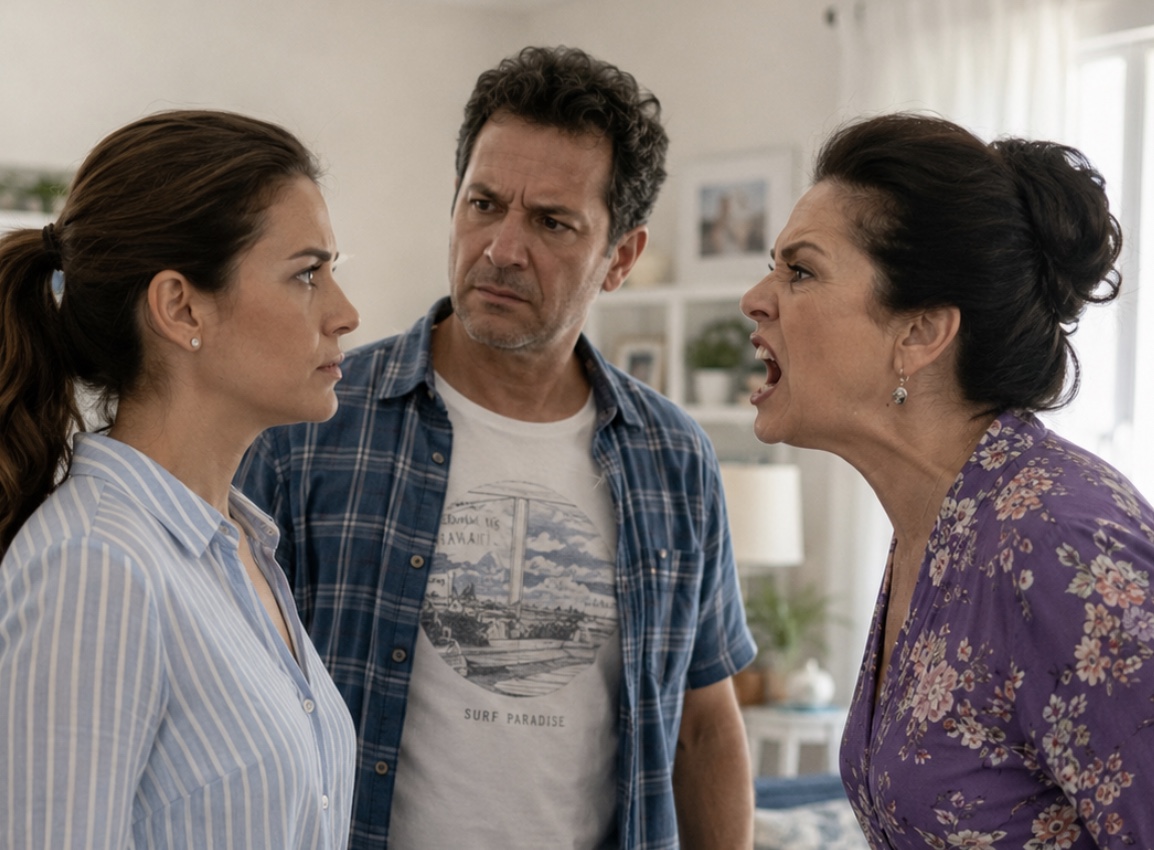
— Are you deaf or what?! I said show me the results immediately!
Lyudmila Borisovna stood in the middle of the kitchen, and there was something about her that reminded Sonya of an old fighting dog—the same firmly planted stance, the same narrowed eyes, the same barely concealed snarl hidden beneath politeness whenever outsiders were around. But there were no outsiders now. There was only Sonya—her daughter-in-law, Pavel’s wife, little Tyoma’s mother—and she silently finished washing a plate even though everything inside her had tightened into a knot.
“I heard you,” Sonya said shortly.
“Then why are you saying nothing?!”
Sonya placed the plate on the drying rack, wiped her hands on a towel, and turned around.
Lyudmila Borisovna was a tall, broad-shouldered woman, the kind of person who seemed to fill every room she entered, as though pushing all the oxygen out of it. She was sixty-two years old and had spent those sixty-two years absolutely convinced that she was right.
Always.
 
“Lyudmila Borisovna,” Sonya said evenly, “the test results will arrive in three weeks. I can’t show you something that doesn’t exist yet.”
“Did you even take the test?”
There it was.
The real question.
The one Lyudmila Borisovna had been holding back for several days, ever since Tyoma’s birthday, when something had suddenly clicked in her mind as she looked at her grandson.
Tyoma had turned three. He had been sitting in front of his birthday cake, laughing, when Lyudmila Borisovna suddenly realized that she could not see Pavel in him.
Not at all.
Tyoma had dark hair and brown eyes.
Everyone in Pavel’s family was fair-haired and light-eyed.
Apparently, that was enough to turn suspicion into certainty.
That night Sonya could not fall asleep for a long time. She lay beside Pasha, staring at the ceiling, with only one thought repeating itself in her mind:
“She won’t let this go.”
Pasha slept peacefully. He had an extraordinary ability to switch himself off whenever conflict appeared, as though there were a hidden button inside him.
A useful quality for life.
A terrible one when you were married to a man whose mother was Lyudmila Borisovna.
Sonya had met Pasha seven years earlier at the hospital where she worked as a senior nurse in the internal medicine department.
He had come to visit a colleague and somehow ended up stranded in the corridor with an armful of apples and a torn shopping bag. Sonya helped him find some tape.
A month later they were already taking long walks together.
A year later they were married.
And only after the wedding did Sonya truly get to know Lyudmila Borisovna.
Her mother-in-law managed the district archives. It was hardly a position of enormous importance, but Lyudmila Borisovna carried herself as if she governed an entire province.
She had a particular talent for speaking quietly while making every word feel like pressure from a hydraulic press.
She never shouted when strangers were present.
The worst things were always said behind closed doors—during family dinners or private phone calls.
“You do understand that my son deserves better,” she had told Sonya even before Tyoma was born. “I have nothing against you personally. It’s just that… he had other prospects.”
Those “other prospects” had a name.
Irina.
She was the daughter of one of Lyudmila Borisovna’s acquaintances and appeared in conversation regularly, like a ghost nobody had invited.
Sonya eventually took the DNA test.
Not because she was afraid.
Because she was exhausted.
It seemed easier to get an official piece of paper and end the discussion once and for all than to keep defending herself against accusations that should never have existed in the first place.
She made an appointment at a medical laboratory on Severny Prospekt. The place was spotless and efficient. Nobody asked unnecessary questions.
They took swabs from Sonya and Tyoma.
Pasha refused to participate.
 
“I’m not taking part in this,” he said. “It’s humiliating.”
Then he went to work wearing the expression of a man who considered himself morally above the entire situation.
Sonya stood alone in the laboratory, holding Tyoma by the hand while he studied the aquarium in the corner.
And she thought:
So this is rock bottom.
You carry your child for thirty-nine weeks. You feed him through the night. You spend months barely sleeping.
And now you need a document to prove something about your own family.
To prove that you are respectable.
That you are not a liar.
Tyoma tugged at her sleeve.
“Mom, there’s an orange fish and a striped one. Are they friends?”
“Probably,” Sonya replied softly. “Come on, sweetheart. Let’s go.”
She did not tell Lyudmila Borisovna that the test had already been done.
Let her wait.
Three weeks was not long, and her mother-in-law knew it. That was exactly why she had become restless.
For once, control over the situation belonged to Sonya.
And Lyudmila Borisovna sensed the loss of control the way a predator senses unstable ground beneath its feet.
Pasha came home late that evening, ate dinner, and watched football.
Sonya was collecting toys in Tyoma’s room when her husband appeared in the doorway.
“Mom called.”
“I know. She called me too.”
“Sonya, she’s just… worried. She loves Tyoma in her own way.”
Sonya picked up a small red plastic truck with one broken mirror and placed it on the shelf.
“Pasha, your mother publicly questioned whether your son is actually your son. That isn’t ‘worrying.’ There’s another word for it.”
Pasha said nothing.
He was good at that.
Standing silently until the storm passed.
Sonya had noticed long ago that he almost never openly took her side. He simply waited for conflicts to dissolve on their own.
But this time, nothing was going to disappear by itself.
Because Lyudmila Borisovna had found an ally.
His name was Viktor Borisovich, her biological brother.
He was a former military officer with a square jaw and the habit of dealing with problems directly.
He arrived from another city at the beginning of summer and planned to stay with Lyudmila Borisovna for two weeks.
That was enough time for him to hear the entire story, form his own opinion, and offer his “help.”
Sonya learned about that help by accident.
Her friend Rita, who worked at the reception desk of a city clinic, called one evening.
“Listen,” Rita said, “an older man came in today. Military posture, very confident. He was asking about you. About your medical records. Obviously I didn’t give him anything, but I thought you should know.”
Sonya stood holding the phone for several seconds after the call ended.
They had tried to get into her medical files.
This was no longer kitchen gossip.
It was something else.
Something with a different name and potentially different consequences.
She looked at the clock.
Almost eleven at night.
Pasha was changing television channels in the next room.
Tyoma was sleeping quietly behind the wall.
Sonya picked up her phone again and dialed.
“Rita,” she said, “I need your help. Not tomorrow. Now.”
Rita lived ten minutes away on foot, in an old five-story apartment building behind a small park where the summer air always smelled of linden trees and sun-warmed asphalt.
Sonya arrived around eleven-thirty.
The courtyard had already gone quiet. Only a cat sitting on a bench watched her pass with complete indifference.
Rita opened the door immediately.
She had been expecting her.
 
“Come in. I made tea.”
Rita was small and round-faced, with the habit of speaking quickly and directly—a skill developed through years behind a clinic reception desk, where every patient seemed to expect an entire life problem solved in two minutes.
She poured tea and placed a cup in front of Sonya.
“That man said he was a family friend. Very confident. He wanted a printout of your visits for the last three years. And your medical file too.”
“What exactly was he interested in?”
Rita hesitated.
“Your pregnancy. Dates. And he asked whether you had made any… separate visits elsewhere. You understand what I mean.”
Sonya understood perfectly.
They were searching for something they could use against her.
A doctor’s appointment at the right time.
A name.
A note.
Anything that could be twisted into a story.
Lyudmila Borisovna was methodical. She did not simply throw accusations into the air.
She collected evidence.
Even if she had to manufacture the meaning herself.
“Rita, did you show him anything?”
“Sonya.”
Her friend looked almost offended.
“I’ve worked in healthcare for twenty years. I know what medical confidentiality means.”
“Sorry. I just…”
“You’re scared. I understand.”
Rita covered Sonya’s hand with her own.
“But you need to understand something too. If they have already started going to clinics and asking for records, this isn’t just a family argument anymore. They’re trying to build a file on you.”
A file.
The word sounded strangely official at a kitchen table covered with a checked tablecloth beside a cup of mint tea.
But it was exactly right.
Sonya returned home after midnight.
Pasha was already asleep.
She lay beside him without even changing clothes and stared into the darkness until dawn began to brighten the windows.
By morning, she had a plan.
She said nothing to her husband over breakfast.
She fed Tyoma his porridge, left him with a neighbor who sometimes watched him during Sonya’s morning shifts, and went somewhere other than the hospital.
The legal consultation office occupied the second floor of an ordinary apartment building. There was a modest sign, a narrow hallway, and three small offices.
Sonya had made the appointment online the night before.
Her lawyer was a man named Andrei Sergeyevich, around thirty-five, neat and professional, with the tired eyes of someone who spent every working day listening to other people’s problems.
She told him everything.
The DNA test.
Viktor Borisovich’s visit to the clinic.
The suspicions.
The mother-in-law.
The lawyer listened without interrupting and made occasional notes.
“So you took the DNA test voluntarily?” he asked.
“Yes. I wanted to end the argument.”
“That matters. If the results come back the way you expect them to, that document supports you, not them.”
He tapped his pen against the desk.
“But attempting to obtain your medical information without your consent is another matter. That may constitute a violation. Is your friend prepared to confirm that the man came asking for your records?”
“Yes.”
“Good. For now, don’t do anything. Wait for the results. But if they try anything similar again, contact me immediately.”
Sonya stepped outside.
It was already intensely hot. Mid-July sunlight burned down from a cloudless sky.
She bought a bottle of water from a kiosk beside the bus stop and drank almost all of it at once.
It was strange, she thought, how normal life continued around you even when your own nerves were stretched like wire.
People went to work.
Children ate ice cream.
Buses honked at intersections.
Meanwhile, inside her, everything felt one movement away from snapping.
 
Lyudmila Borisovna called the next afternoon at three, while Sonya was working.
“I want to talk. Properly. No arguments. Come over tonight.”
Sonya was silent for a second.
“All right.”
She went alone.
Pasha stayed home with Tyoma.
Lyudmila Borisovna opened the door wearing an elegant house robe, her hair carefully arranged. The apartment smelled of roasted chicken.
Two cups had been placed on the kitchen table.
Viktor Borisovich was sitting beside the window.
So much for a private conversation.
He looked exactly as Sonya had imagined him: large, gray-haired, posture straight even in ordinary clothes.
He looked at her without smiling and gave a brief nod, the way someone might acknowledge a person entering an interrogation room.
“Sit down,” Lyudmila Borisovna said.
Sonya sat.
She picked up the cup simply to give her hands something to do.
“I am not your enemy,” her mother-in-law began in the tone people used before doing something unpleasant. “But I am a mother. And I have a duty to protect my son.”
“From what?” Sonya asked calmly.
“From making a mistake.”
A pause.
“Vitya made a few inquiries.”
Sonya looked directly at Viktor Borisovich.
He did not appear embarrassed.
“I know,” she said. “He went to the clinic.”
For the first time, Lyudmila Borisovna visibly faltered.
She had not expected Sonya to know.
“We only wanted—”
“To obtain my medical records without my permission,” Sonya finished. “That has a different name from ‘making inquiries.’ I have already spoken to a lawyer.”
Viktor Borisovich narrowed his eyes slightly.
It was his first visible reaction, and it said everything.
Not anger.
Calculation.
Lyudmila Borisovna set her cup down.
“Are you threatening us?”
“No. I’m informing you.”
Children shouted somewhere in the courtyard below. Someone was kicking a ball. Someone else was arguing over a swing.
A normal summer evening.
And yet inside this kitchen, beside untouched chicken and two cups of tea, something was changing.
Sonya stood.
“The DNA results will arrive in ten days. You will see them. But if anyone tries to access my records or my son’s records before then, I’ll handle it officially. There will be no more private conversations around kitchen tables.”
She picked up her handbag, gave a brief nod in farewell, and left.
Her hands trembled slightly inside the elevator.
But her voice had not shaken once.
And that mattered.
The results arrived ten days later.
The email came at seven in the morning, before Sonya had even made coffee.
She opened it in the kitchen while standing barefoot on the cool floor.
Tyoma was still asleep.
Pasha was in the bathroom.
Outside, the courtyard had already begun making its usual morning noise. Someone started a car. Pigeons quarreled on a ledge.
Sonya read the document slowly even though the answer was obvious immediately.
Paternity confirmed.
Probability: 99.97%.
A standard sentence.
Dry.
Precise.
Almost clinical.
She read it twice—not because she had doubted the truth, but because she expected to feel something enormous.
Relief.
Triumph.
 
Vindication.
Anything.
Instead, she felt tired.
She called Lyudmila Borisovna that afternoon.
“The results have arrived. You can come and see them yourself, or I can email them to you.”
There was a long silence.
“Send them,” her mother-in-law finally replied.
Her voice was flat.
No apology.
No softness.
Sonya forwarded the email, put her phone down, and went onto the balcony to water the flowers.
The petunias were in full bloom—pink, slightly bleached by the sun, spilling over the railing and moving gently in the breeze.
Sonya watered them carefully, trying not to think about what would happen next.
What happened next was unexpected.
Lyudmila Borisovna arrived the following morning without calling, as was her habit.
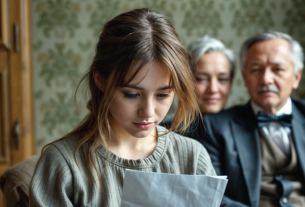
Sonya opened the door and saw her mother-in-law holding a printed copy of the test result.
The paper was crumpled, apparently from being gripped tightly during the journey.
“So I was mistaken,” Lyudmila Borisovna said.
Not “I’m sorry.”
Not “I was wrong.”
Just:
“I was mistaken.”
As though she had mixed up an address or written down the wrong telephone number.
Sonya stepped aside and let her enter.
“Tyoma’s in the kitchen. He’s having breakfast.”
Lyudmila Borisovna walked toward the kitchen and stopped in the doorway.
Tyoma was sitting with a spoon in his hand, seriously studying the way pieces of banana disappeared into his porridge.
He noticed his grandmother and brightened immediately.
“Grandma! Look! They’re sinking!”
Something changed in Lyudmila Borisovna’s face.
Only for a second.
She went over and stroked his hair.
A familiar gesture.
But Sonya noticed that this time her hand rested there slightly longer.
The three of them drank tea.
They talked about Tyoma, the weather, and the fact that the playground swing had finally been repaired.
Lyudmila Borisovna remained calm and polite.
That politeness said more than any apology could have.
It was the behavior of someone who felt ashamed but did not know how to admit it aloud.
Pasha did not interfere.
He had been unusually quiet for the last few days. He understood that something had shifted but could not yet tell in which direction.
Lyudmila Borisovna left after an hour.
That evening, Viktor Borisovich called.
Sonya answered reluctantly.
“Yes?”
“This is Viktor Borisovich.”
His voice was the same—controlled, direct, without introductions.
“I wanted to say that I went too far with the clinic. It was unnecessary.”
Not “I’m sorry.”
Not even “I apologize.”
It was “unnecessary.”
Military habits, Sonya thought.
Everything reduced to operational language.
“I already understood that,” she replied.
“Good.”
And he hung up.
Sonya stared at the phone for a while and then laughed softly.
Not because it was funny.
Because the entire situation had become absurd.
Weeks of tension.
 
A lawyer.
A clinic.
Late-night conversations with Rita.
And after all of that:
“I went too far.”
“It was unnecessary.”
The real storm came three days later.
Lyudmila Borisovna arrived again, this time accompanied by Viktor Borisovich.
Pasha was home.
That, perhaps, was what changed everything.
The conversation began quietly.
Then Lyudmila Borisovna suddenly said what she had apparently been holding inside all along.
“Pasha, you should have demanded that test yourself. As a man. As a father. Instead, you hid from the situation.”
That was when Pasha finally spoke.
Sonya stood in the kitchen doorway and listened as her husband—the man who always avoided confrontation, the man who preferred silence to conflict—said everything he should have said from the beginning.
He did not shout.
But his voice was firm.
He told his mother that he trusted his wife.
That by remaining silent, he had humiliated Sonya.
That this was his shame, not hers.
And that his mother had crossed a line that affected not only Sonya but him as well.
Lyudmila Borisovna listened.
Her expression looked as though someone had physically hurt her—not severely, but in a sensitive place.
Finally, she stood, pulled down the hem of her blouse, and said:
“Fine. Live however you want.”
Viktor Borisovich stood as well.
Silently.
With the expression of a man who had no desire to comment on somebody else’s domestic war.
They left that same day.
Two days later, Pasha casually mentioned that his mother had called.
She was going to Chelyabinsk to stay with her sister Zinaida.
For how long, she had not said.
Sonya gave no answer.
She simply moved clean plates from the drying rack into the cupboard, one by one.
Summer continued.
Tyoma learned to ride a tricycle and raced around the courtyard as though he had discovered a new continent.
Every evening Sonya took him outside.
She sat on a bench beneath a chestnut tree and watched him circle the paths, thinking about how the same sky had seemed so much heavier only three weeks earlier.
Sometimes Pasha came with them.
He would sit beside her, shoulder to shoulder, without explanations.
Sonya did not demand any.
She understood that words came slowly to people who had spent their lives staying silent.
The important thing was that when the moment truly mattered, he had finally found them.
Rita visited at the end of July carrying cherries and news from the clinic.
Viktor Borisovich had not returned.
They drank tea on the balcony among the petunias and talked about ordinary things—summer prices, Rita’s upcoming vacation in Karelia, the fact that Tyoma had finally learned to pronounce the letter “R.”
“So how are you?” Rita asked eventually.
Sonya considered the question.
“I’m okay. A little tired. But okay.”
 
“That sounds honest.”
“I don’t keep any other kind of answer.”
Rita laughed.
Sonya laughed too.
Easily.
The way people laugh when something behind them has finally closed.
Lyudmila Borisovna did not call from Chelyabinsk for three weeks.
Then she eventually did.
She asked how Tyoma was doing and whether he had caught a cold because summer weather could be deceptive.
Sonya told her everything was fine.
The conversation lasted five minutes.
And it was completely ordinary.
Perhaps that was the real result.
Not victory.
Not reconciliation.
Just an ordinary conversation.
No hidden meaning.
No pressure.
Five minutes in which nothing unnecessary was said.
At that moment Tyoma was asleep in his room, arms stretched wide as though he were trying to embrace the whole world.
There was a pillow mark on his cheek.
His breathing was even.
Sonya stood in the doorway for a moment and watched him.
Then she quietly pulled the door almost closed and went to prepare dinner.
Lyudmila Borisovna returned from Chelyabinsk at the end of August.
Quietly.
Without warning.
One evening, while Sonya was washing dishes and Tyoma was building something with construction blocks on the carpet, the doorbell rang.
Sonya opened the door.
Her mother-in-law stood outside with a small bag and another package containing what looked like jars of homemade preserves.
Her sister Zinaida was apparently famous in Chelyabinsk for making jam.
“I thought I’d stop by,” Lyudmila Borisovna said.
No introduction.
No explanation.
“Come in,” Sonya replied.
Tyoma heard her voice and came rushing out of the room, clutching a construction block in one hand, his hair messy and his face glowing with excitement.
“Grandma! Look! I’m building a tower! It’s almost as high as the ceiling!”
 
Lyudmila Borisovna crouched down in front of him right there in the hallway without even taking off her coat.
“Almost to the ceiling, you say? Come on. Show me.”
The two of them disappeared into his room.
Sonya returned to the dishes.
Through the kitchen wall she could hear Tyoma loudly explaining the engineering of his tower, interrupting himself every few seconds, while Lyudmila Borisovna answered in short, calm phrases.
Matter-of-factly.
Peacefully.
The way people speak when neither of them needs to prove anything to the other.
Pasha came home from work an hour later.
He saw his mother in the kitchen.
He saw Sonya standing beside her while the two women transferred Zinaida’s jam into jars.
Without saying a word, he put the kettle on.
The correct instinct.
All four of them sat around the table.
Tyoma told everyone about the tower, which had eventually collapsed, but which he intended to rebuild.
This time, he explained, he would make it stronger.
Lyudmila Borisovna drank her tea and listened to her grandson with the expression of someone hearing something genuinely important.
She looked at Sonya only once.
Briefly.
No unnecessary words.
But in that glance was something Sonya had stopped expecting from her a long time ago.
Something close to respect.
Not forgiveness.
Sonya had nothing to be forgiven for.
Not friendship either.
They were still far from that.
It was simply a quiet acknowledgment that the woman sitting across from her was not someone who could be bent or broken so easily.