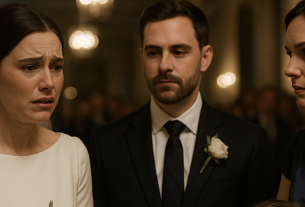
— Do you even realize what’s happening? — Igor hurled his phone onto the sofa so hard that it bounced once and slid onto the floor. — I found out who you spend all day with over there. Do you think I’m blind?
Vera stood beside the kitchen counter, looking at her husband. She was holding a knife in one hand and a half-peeled cucumber in the other. Outside, the summer heat seemed to melt everything in sight. The temperature had refused to drop for three straight weeks, and the apartment smelled of hot air and freshly cut vegetables.
— Igor, — she said evenly, — what are you talking about?
— I’m talking about this Viktor Sergeyevich you report to every single day! You come home late every evening, your phone is always on silent, and you keep smiling to yourself…
Vera put the knife down. Slowly. Carefully.
Eight years of marriage. Eight years of knowing this man — his scent, the way he scratched the back of his head whenever he lied, and his remarkable ability to turn his own anxiety into someone else’s guilt.
 
This was Igor exactly as she knew him.
— Viktor Sergeyevich is my project director, — she said. — And if you don’t understand what a quarterly report is, that doesn’t mean I have to justify my work to you.
— I don’t care about your reports! I’m calling him anyway.
Vera gave her husband a long look.
Her colleagues were slightly afraid of that look. Not because she shouted, but because she could remain completely silent in a way that made people understand everything.
— You’re going to call whom?
— Your boss. Let him explain why you’re supposedly working all these extra hours. Or maybe I’ll explain a few things to him myself.
Vera said nothing. She walked into the bedroom and firmly closed the door behind her.
 
Vera Kovalyova had worked at the Mercury advertising agency for five years. She had started as an account manager and now handled three major clients entirely on her own, without assistants or anyone to cover for her.
Viktor Sergeyevich Gromov was the agency director. He was fifty, reserved, and had a habit of drumming his fingers against the table whenever he was thinking. He disliked pointless conversation and cared about one thing above all: results.
That was exactly why Vera worked well with him.
The late nights had nothing mysterious about them. One of her clients, a major pharmacy chain, had launched a new product line and wanted its advertising campaign completed practically yesterday.
Calls. Revisions. Approvals.
Vera often returned home exhausted, but with the satisfying feeling that she had accomplished something real.
Igor did not understand that.
He worked at an auto repair shop. He left home at eight in the morning and usually came back at six. His world was simple and predictable. If his wife was home, everything was fine. If she was not, something was wrong.
He did not want explanations. He wanted her presence.
They were different people.
Vera had known that for years.
But during the last few months, that difference had started to feel less like a difference in personality and more like distance.
Not meters.
 
Kilometers.
The next morning, Igor left without saying goodbye.
Vera drank her coffee, tied back her hair, put on the white blouse that always made her feel focused and professional, and went to work.
The subway was unbearably hot. People stood shoulder to shoulder. Some read from their phones, while others dozed standing up.
Vera stared through the window at the dark tunnel walls flashing past and thought about Igor.
He really might call.
Simply out of principle.
Igor had a special talent for doing stupid things simply because he had decided not to back down.
When she reached the office, Vera went straight to her desk, turned on her computer, and opened her email.
Three messages from the client.
One from the designer.
And one from Gromov.
Subject: “Meeting at 11.”
 
That was strange.
Gromov usually scheduled meetings the day before.
When Vera entered the conference room, she saw another woman sitting beside him.
Vera had never met her before. She looked around forty-five, wore a dull gray business suit, and had the sort of face that seemed permanently marked by mild dissatisfaction.
Her name was Ella Romanovna.
She was a representative of the pharmacy-chain client.
— Vera, — Gromov said without offering her a seat, which was already a bad sign. — This morning I received a phone call from a man named Igor Kovalyov. He introduced himself as your husband.
Vera did not move.
Only something hot and sharp flashed inside her.
— He told me, — Gromov continued in his usual emotionless tone, — that he wanted to discuss your working conditions. According to him, you’ve been staying late for reasons unrelated to work. He also suggested that perhaps I was creating an… uncomfortable environment for you.
Ella Romanovna watched Vera as though she were observing an unpleasant but fascinating incident.
— Viktor Sergeyevich, — Vera said, — I apologize for that phone call.
— There’s no need to apologize.
 
Gromov finally motioned toward a chair.
— Sit down. I want you to understand that I ended the conversation immediately. But the situation is unpleasant. Ella Romanovna happened to be here when he called.
And there it was.
The real problem.
The client had heard everything.
The same client Vera had managed for eight months. The same people who trusted her to approve every advertisement, every design, every piece of copy.
Now they were seeing her through the lens of a domestic scandal her husband had created at eight in the morning.
— I’d like to understand something, — Ella Romanovna said. — Was this an isolated incident, or should we reconsider who manages our account?
Vera looked at her.
Calmly.
Almost gently.
— Ella Romanovna, in eight months of working together, we have not missed a single deadline. No requested revision has remained unresolved for longer than twenty-four hours. You personally approved our last quarterly results and marked them “excellent.” My personal circumstances have never affected my work.
— Not yet, — Ella Romanovna remarked.
— Exactly. Not yet, and they won’t in the future either.
Gromov studied Vera.
She could never tell what he was thinking. His face revealed very little.
But there was no pity in his expression.
No judgment either.
Something else.
Assessment, perhaps.
— All right, — he finally said. — Vera, the project remains yours. But I need you to resolve the situation at home. The agency cannot become a stage for family conflicts.
— Understood, — Vera replied.
 
After the meeting, she went outside.
Not to smoke — she had never smoked.
She simply needed air.
July pressed down on the city with all its weight. Heat shimmered above the asphalt. Somewhere nearby an air conditioner expelled hot air into air that was already scorching.
Vera took out her phone and found Igor’s number.
She called.
He answered immediately.
Apparently, he had been waiting.
— So, what now? Calling to explain yourself?
— No, — Vera said. — I’m calling to tell you that you nearly cost me my job this morning. And we are going to discuss what happens next tonight. Not tomorrow. Tonight.
She ended the call and went back inside.
But there were things Igor still did not know.
 
He did not know that after the meeting, Ella Romanovna had stayed behind and quietly told Gromov something while Vera was away.
And he certainly did not know that a folder was already lying on Gromov’s desk.
A folder containing documents in which the name Igor Kovalyov appeared in an entirely different context.
A very different one.
That evening, Igor came home earlier than usual.
That alone was suspicious.
Normally, he never hurried home after work. He would stay at the garage with the other mechanics, drinking tea from a metal mug and discussing other people’s cars and other people’s problems.
But that day, it was barely six-thirty when Vera found him sitting in the kitchen in a sleeveless shirt, cutting bread and pretending everything was normal.
Vera hung up her bag, changed her shoes, walked into the kitchen, and switched on the kettle.
She said nothing.
Igor was the first to lose patience.
— How long are you going to keep silent?
 
— I just walked through the door, — she replied.
— Come on, Vera. I was only trying to understand what was going on. You know what it looks like from the outside. Every day until nine, not answering your phone…
— I answer my phone.
— Not always.
— I don’t answer during meetings. That’s called having a job, Igor.
He went silent.
He chewed his bread and stared at the table.
Children were shouting in the courtyard outside. Somewhere below, a car door slammed.
It was an ordinary summer evening.
Only inside the apartment the air felt different — heavy and charged, like the minutes before a thunderstorm that refused to begin.
— You almost got fired, — Igor finally said.
There was no regret in his voice.
If anything, there was a strange hint of satisfaction, as though the possibility proved he had been right.
Vera looked at him.
 
— I wasn’t fired. And I’m not going to be.
— How do you know?
— Because I’m good at my job.
She poured boiling water into her mug.
— You called my director at eight in the morning and said ridiculous things about me in front of a client. Do you understand what you did?
— I just wanted to talk to him man-to-man.
— About my job. With my boss. Without me.
Igor shrugged.
It was his favorite gesture when he had nothing sensible left to say but still refused to admit he was wrong.
— Fine, — he muttered. — Maybe I overreacted. But you drove me to it.
Vera placed her mug on the table.
Quietly.
 
Without slamming it.
— You know what? Let’s not talk about whose fault this is right now. Let’s talk about something else.
She went into the other room, opened a desk drawer, and brought back a printed sheet of paper.
She placed it in front of Igor.
He looked down and frowned.
— What’s this?
— A statement from our joint bank account. The last three months.
Igor went slightly pale.
Barely noticeable.
But Vera noticed.
Eight years was a long time.
Eventually you learned to read someone like a familiar book, even when you no longer liked the story.
— So what? — he asked.
— Seventy-four thousand. Withdrawn little by little, always in cash, almost always during working hours. I’m not an accountant, Igor, but I can add numbers.
She sat opposite him.
— Where is the money going?
— Some of it is mine too.
— Ours, — she corrected him. — It’s our money. We were saving it for renovations. I have a right to know.
Outside, the sky had darkened.
The children had gone home. The courtyard was quiet now, and only the refrigerator hummed monotonously in the corner.
— A debt, — Igor finally said. — I owe someone money. I’ll deal with it.
— Who?
— None of your business.
Something inside Vera suddenly clicked into place.
Because she had heard those exact words far too many times during the last six months.
None of your business.
When she asked why he had been so nervous lately.
None of your business.
When she asked why he had stopped answering his mother’s calls.
 
None of your business.
When he had gone outside in the middle of the night once and stood in the courtyard for half an hour.
None of your business.
Yet that very morning, Igor had called her director and decided that her career was somehow his business.
The next day, Vera did not go directly to work.
She went first to the bank branch on Bolshaya Pushkarskaya Street, where they had opened their joint account.
She requested a complete six-month statement.
The bank employee, a young woman with a ponytail and a very serious expression, printed several pages and handed them over.
Vera sat in a chair by the window and began reading.
People walked past her. A child cried in the corner. The air smelled of air conditioning and plastic.
The picture that emerged was ugly.
Cash withdrawals appeared every two or three weeks. The amounts varied, but they were always round figures.
At the same time, small transfers had been coming into the account from several names Vera did not recognize.
She photographed every page with her phone.
As she left the bank, her old university friend Oksana called.
 
Oksana was a lawyer, sharp-tongued and incapable of sugarcoating anything.
— Where are you? — Oksana asked.
— Just leaving the bank. Listen, I need to talk to you.
— Come over. I’ll be at the office until three.
Oksana’s law office occupied the second floor of an old building on the Petrograd Side. There were wooden stairs and windows facing a narrow enclosed courtyard.
Inside, the rooms smelled of coffee and paper.
Oksana herself was short, energetic, with cropped hair and a habit of looking directly into people’s eyes.
She listened to Vera without interrupting once.
She simply nodded and studied the photographs of the bank statements on Vera’s phone.
— Clear enough, — she said eventually. — Do you know what this looks like?
— I have an idea.
— He owes somebody money. A serious amount. And he’s taking it from the joint account because he doesn’t have enough of his own anymore.
Oksana took a sip of coffee.
— Have you checked whether anything has been taken out in your name? A loan guarantee, for example?
Vera went silent.
— No. I haven’t.
— Then start there.
They spent another hour talking.
Oksana explained everything in her usual calm, precise way: what Vera should check, whom she should contact, and which documents she should gather just in case.
Not because disaster was inevitable.
Because knowing the truth was always better.
When Vera stepped outside, the sun was already high.
She walked along the embankment past tourists eating ice cream, cyclists, and an elderly man feeding pigeons beside the railing.
The city continued around her, loud and bright and carefree.
One thought kept circling in her head.
 
Gromov had mentioned a folder.
He had said Igor’s name appeared in it in a completely different context.
He had not explained what that meant.
Now Vera wondered whether she should ask.
Or perhaps she should first discover on her own exactly what her husband had been doing while she stayed at work until nine every night thinking the biggest problem in her life was a difficult quarter.
The following morning, Vera went directly to Gromov’s office.
She knocked, entered, and closed the door behind her.
He was sitting at his desk looking at his monitor, but as soon as she entered, he pushed the keyboard away.
A small gesture.
But meaningful.
— Viktor Sergeyevich, you mentioned a folder yesterday. I want to know what’s in it.
Gromov was silent for a moment.
Then he stood, walked to a cabinet, and removed an ordinary gray cardboard folder tied with string.
He placed it on the desk in front of Vera.
— Sit down.
She did.
— About a month ago, a man contacted me. He introduced himself as a friend of your husband. He told me Igor Kovalyov had gotten into trouble. Apparently, Igor borrowed money from a private lender and signed an IOU, but failed to repay it on time. The man said he could make the problem disappear if our agency agreed to take his company on as a client.
Vera stared at the folder.
— Without a tender, — Gromov continued. — No competition. We were simply expected to give him the contract.
— And you refused?
— Of course. But I recorded the conversation, just in case. Then I looked into the company. It appears to be registered through nominees, it has existed for less than a year, and the tax authorities are already interested in it.
— You knew all of this yesterday when you spoke to me?
— Yes.
 
— Why didn’t you tell me immediately?
— I wanted to see how you would handle the situation.
He said it without apology, merely as a fact.
— You didn’t make excuses, and you didn’t ask me to overlook anything. That matters.
Vera opened the folder.
Inside were printouts, photocopies, and one page containing several names.
One of them was Igor Kovalyov.
Beside it was another name.
Denis Ryashin.
Vera had heard that name once, almost in passing, about a year earlier.
Igor had described Denis as an old acquaintance.
He had never mentioned him again.
— What am I supposed to do with this? — Vera asked.
— That’s no longer a professional matter, — Gromov replied. — But if you need a lawyer, I know a good one. Not cheap, but dependable.
Vera nodded and closed the folder.
She did not hurry home that evening.
Instead, she walked to the Fontanka embankment and sat on a bench beside the water.
A sightseeing boat passed nearby. People on the deck laughed, holding glasses in their hands.
The setting sun painted the water pink and copper.
Beautiful, if you could stop thinking.
Vera could not.
Eight years.
She and Igor had met when she was twenty-six. She had just landed her first decent job. Igor had seemed dependable, calm, grounded.
The kind of man beside whom life did not seem frightening.
Later she discovered that calmness and stability were not the same thing.
Sometimes what looked like composure was not strength at all.
 
Sometimes it was simply a refusal to think ahead.
Strangely, Vera was not angry.
She expected anger.
But it never came.
Instead, she felt something heavy and tired, like a backpack she had carried for so long that she could no longer remember why she had picked it up in the first place.
Her phone vibrated.
Oksana.
— Well? Did you find anything?
— I did, — Vera said. — Can you come over tomorrow morning? I have some documents you need to see.
— What time?
— Nine. I’ll make coffee.
Igor was unusually quiet that evening.
He sat in front of the television, but he was not really watching it. His eyes seemed fixed somewhere beyond the screen.
When Vera came in, he turned his head.
— You’re late.
— Yes, — she said.
She walked into the kitchen, opened the refrigerator, then closed it again.
She was not hungry.
She poured herself a glass of water and drank it standing beside the sink.
Igor followed her into the kitchen.
He stood in the doorway, large and awkward, like someone who desperately wanted to say something but had no idea where to begin.
— Vera, — he finally said. — I’m in trouble. Serious trouble.
She turned around.
— I know.
He blinked.
 
That was clearly not the answer he had expected.
— How?
— It doesn’t matter. Tell me everything.
And he did.
Slowly.
Confusedly.
With long pauses.
A year earlier, Denis had suggested that Igor invest in “a business opportunity.”
It had seemed safe.
Igor borrowed money from a man named Ruslan, someone he barely knew, and signed an IOU.
The venture collapsed.
Ruslan began calling.
At first politely.
Then less politely.
Denis disappeared.
The debt remained.
Seventy thousand had eventually become one hundred and twenty thousand after interest and penalties.
— You tried to solve it through my director, — Vera said.
Igor lowered his head.
— Denis came up with the idea. He said if the agency became a client of his company, he’d get paid, repay Ruslan, and the whole thing would disappear.
— And you agreed.
— I didn’t know what else to do.
Vera looked at him.
At the man who had slept beside her for eight years.
 
Who had eaten at the same table.
Who sometimes made her laugh until tears ran down her cheeks and sometimes annoyed her so badly she wanted to grind her teeth.
He had called her director not because he hated her.
He had done it because he was afraid.
In some ways, that was worse.
— You could have told me, — Vera said.
— I was ashamed.
— Ashamed, — she repeated. — But calling a stranger about my career wasn’t embarrassing?
Igor said nothing.
There was nothing to say.
Oksana arrived the following morning wearing linen trousers and carrying takeaway coffee.
The three of them sat around the kitchen table: Vera, Oksana, and Igor, who looked like a patient waiting for a diagnosis he knew he needed but still did not want to hear.
Oksana reviewed the documents and asked brief, precise questions.
Igor answered honestly.
Apparently, he no longer had the energy to evade anything.
— All right, — Oksana said, closing the folder. — The IOU was drafted badly, and the interest has been calculated improperly. That does not mean the debt disappears. The debt is real. But the amount is different. I’ll handle it.
— Is this going to cost… — Igor began.
— A lot, — Oksana interrupted. — But less than what you’ve already gotten yourself into.
Igor nodded.
He glanced at Vera quickly, almost apologetically.
She stood, gathered the cups, and placed them in the sink.
Outside, the courtyard was noisy. A neighbor’s child kicked a ball around, and somewhere music was playing — light summer music that demanded nothing from anyone.
— I’m going to work, — Vera said.
— Vera, — Igor called after her.
She turned.
— What happens to us now?
She thought about it for a moment.
Really thought.
— I don’t know, — she said. — First we deal with the debt. Then we talk about us.
It was not cruelty.
 
It was simply the truth.
And truth was the only answer Vera knew how to give when life became complicated.
At the office, Gromov stopped her beside the coffee machine.
— How are you?
— Working, — Vera replied.
He nodded, poured himself coffee, and started to leave.
Then he turned back.
— Vera. Ella Romanovna sent an email this morning. They’re extending the contract for another year. She wrote that she values stability in the team.
Vera smiled faintly.
— Good.
— Good, — Gromov agreed.
Then he disappeared down the corridor, stirring his coffee as he walked.
Vera remained beside the window with her mug in her hands.
Below, pedestrians moved along the street. Cars passed. A kiosk owner arranged newspapers.
The city never stopped.
Indifferent and alive at the same time.
Her life had not suddenly become easier.
There were still conversations ahead. Decisions. Exhausted evenings. Questions without quick answers.
But right then, standing beside that window, Vera felt something solid beneath her feet.
Something that belonged to her.
Something no one else controlled.
For the moment, that was enough to keep moving forward.
Oksana resolved the debt situation within three weeks.
Ruslan turned out to be far less terrifying than Igor had imagined during his sleepless nights.
 
He was simply a man who wanted his money back.
No drama.
No threats for the sake of threats.
Oksana met with him, explained the problems with the IOU, calculated the legitimate amount owed, and presented the figure.
He was not pleased, but he agreed.
They gathered the money.
Some came from their savings.
Vera borrowed the rest from her mother, giving only a brief explanation.
Denis never appeared again.
Igor stopped looking for him.
In August, Vera and Igor finally had the conversation they had been postponing.
They sat at the kitchen table for a long time, without television and without their phones.
Vera spoke calmly.
Not because she had forgiven everything.
Because shouting was unnecessary.
Her words reached him perfectly well without it.
Igor listened.
He did not interrupt.
He did not make excuses.
That was unusual.
And in its own way, important.
They did not solve everything in one evening.
But they agreed on one thing.
No more closed doors.
No more “none of your business” when it came to shared money.
And no more calling strangers to interfere in someone else’s career.
Simple rules.
Almost embarrassingly obvious ones.
But sometimes people only understand the obvious after going through something difficult enough to force them to see it.
In the autumn, Vera was promoted.
Gromov offered her the position of department head in his usual brief, unemotional manner, almost as though the decision had been made long ago.
Vera accepted just as simply.
That evening, she and Igor drove to the embankment for no particular reason.
They ate ice cream and watched the water.
They talked about meaningless little things.
It felt good.
Not perfect.
But good.
And sometimes, good is already a great deal.