The orange had been lying on the windowsill for three days already. Mom had brought it with her when she came to visit, set it down “for later,” and then forgotten it there when she left in a hurry. I only picked it up now, in the evening, after coming home from work and finding the apartment filled with a strange, ringing emptiness.
Mom’s suitcase, which usually stood in the hallway closet, was gone. Dad’s slippers, always placed to the right of the doormat, were gone too. The soft plush cushion Mom used to put behind her back when she sat on my sofa had disappeared as well. She had brought it from home because her back hurt, and without it she could not sit comfortably.
I stood in the middle of the living room with the orange in my hand, feeling something cold and heavy begin to rise inside my chest.
“Mom?” I said when she answered the phone. I had pressed the call button so hard my fingertip turned white.
The line rang once. Twice. Three times.
“Anya,” Mom’s voice sounded strange and muffled, as though she was speaking into a pillow or trying to cover her mouth with her hand. “Anya, are you home?”
“I just walked in. Where are you? Where are your things?”
“We’re… we’re at a hotel. On Gagarin Street. We got a room.”
I sank down onto the sofa — the very sofa where Mom usually sat with her cushion tucked behind her back.
“What hotel? Mom, what happened?”
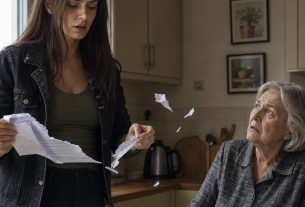
“Larisa Petrovna threw us out,” Mom said very quietly, and I heard her voice break in the middle of the sentence. “She said her son pays for the apartment, and while you’re not home, she’s the one in charge.”
Larisa Petrovna. My mother-in-law. The mother of my husband, Denis.
“She threw you out? Physically? Out of my apartment?”
“She came while we were having lunch. She had her own key. Maybe Denis gave it to her once, just in case. She came in without ringing the bell. We didn’t even have time to react. She said we had to pack our things immediately because we were living there ‘with no clear right to be there,’ and since Denis rents the apartment, she had the right to decide who stayed in it.”
I started shaking. Not from cold, but from anger — a boiling, rising fury that seemed ready to spill over.
“Mom, this apartment is mine. I bought it. Denis simply lives here with me. What does it matter who pays for what?”
“I told her that,” Mom sobbed. “And she said, ‘Documents are documents, but order in the home is decided by the person who supports the family.’ She said we had ‘shown up from nowhere’ and turned the place into a hotel for relatives. She said your father was ‘sitting in front of the television and taking up space.’”
I pressed my hand over my mouth.
Dad.
My father was seventy-two. Six months earlier, he had undergone heart surgery, and he had come to stay with us precisely because I wanted him nearby, under supervision, while he recovered. He was not “sitting in front of the television and taking up space.” He was resting because his doctor had ordered him to rest.
I remembered that February day when Mom called me from the hospital. Her voice alone told me everything before she even finished speaking. “Coronary artery bypass surgery,” the surgeon said when I arrived two days later, after dropping everything at work and taking unpaid leave. Dad was lying in intensive care, gray-faced, surrounded by tubes, and I held his hand, terrified that I was seeing him for the last time.
He survived. But the cardiologist was very clear afterward: “At least six months of rest. No stress, no physical strain, and ideally someone nearby to monitor his routine and medication.”
My parents had no one in their town except each other. A neighbor stopped by sometimes, but that was not the same as having their daughter close by. I did not hesitate for even a second then. “Come stay with me, at least for a while.”
Denis supported me at the time. He even offered to rearrange the furniture in the guest room so Dad would be more comfortable. He bought him an orthopedic pillow. That was why my mother-in-law’s words about him “taking up space” felt not merely rude, but cruel. They erased half a year of fear, sleepless nights, morning calls asking, “How’s Dad? Did he check his blood pressure?” As if none of it had happened. As if I had brought two unnecessary people into my home out of spite.
“Where is Dad now?”
“Here with me, at the hotel. He… Anya, after that scene, his blood pressure went up. I got scared and gave him a pill. It seems better now, but he’s completely crushed.”
“I’m coming right now,” I said, getting to my feet.
“No, sweetheart, don’t. Don’t argue with anyone. We’ll spend the night here and decide what to do tomorrow.”
“Mom. I’m coming. Give me the hotel address.”
I wrote down the address, said goodbye, and ended the call. The orange was still in my hand. I had not even noticed that my nails had dug into it, splitting the peel and releasing a sharp citrus smell into the warm, motionless air of the apartment.
Denis came home from work half an hour later, just as I was getting ready to leave.
“Did you know?” I asked him from the doorway, without taking off my coat.
He stared at me in confusion.
“Know about what?”
“Your mother threw my parents out of the apartment. Physically. While I was at work.”
Denis’s face went pale. It was not the guilty look of a man who had been hiding something. It looked more like genuine shock.
“What? When? How did she even get inside?”
“She had a key. Did you give her a key?”
He hesitated. It lasted only half a second, but it was enough.
“I… yes. I gave her one a year ago, when we went on vacation, so she could water the plants.”
“And you never took it back?”
“I forgot.” He sat down on the chair in the hallway as though his legs could no longer hold him. “Anya, I didn’t know anything. I swear to God.”
“Good thing you didn’t,” I said coldly. “Because if you had known and stayed silent, it would have been much worse.”
“What should I do? Tell me what to do.”
“To begin with, call your mother and ask her if she’s lost her mind.”
Denis took out his phone. I watched his fingers tremble as he dialed her number.
“Mom?” he said, putting her on speaker without asking me, as if he instinctively understood that I needed to hear every word.
“Denisik,” Larisa Petrovna’s voice was cheerful, almost bright, as if nothing had happened. “How was work?”
“Mom, did you throw Anya’s parents out of the apartment?”
There was a pause. Short, but heavy.
“I didn’t throw anyone out. I asked them to gather their things and stay somewhere else temporarily. Those are different things, son.”
“This is my apartment,” I said, snatching the phone from Denis without asking. “Larisa Petrovna, this is my apartment. I bought it before I married your son. What right did you have to walk in and decide who could live there?”
“Anna,” her voice instantly turned icy and formal, “as far as I know, Denis pays half the utilities and buys groceries for this home. That means he supports this household no less than you do. And therefore, his mother has the right to express her opinion about who lives there.”
“Expressing an opinion is one thing. Throwing elderly people out of the house and threatening them is something entirely different. My father is seventy-two. He had heart surgery. His blood pressure rose because of your visit.”
“Perhaps you shouldn’t have brought a sick old man into someone else’s home without warning,” Larisa Petrovna snapped. “I only found out when I came in to water the plants and discovered strangers acting like they owned the kitchen.”
“They are my parents! They are not strangers!”
“To me, they are,” she said evenly. “I didn’t invite them. I didn’t approve them. I knew nothing about any of this. It was unpleasant for me too, by the way, to walk in and find unfamiliar people there.”
I took a deep breath. Blood roared in my ears so loudly I could barely hear my own thoughts.
“Larisa Petrovna. My parents are sitting in a hotel right now because you threw them out of my own apartment. This is not up for debate. It has nothing to do with who pays for groceries. I am asking you never — do you hear me, never — to use a key to my apartment again without my permission.”
“Are you giving me orders?” Her voice trembled, and something vicious slipped into it.
“I am stating a fact. This is my apartment. If you enter it again without being invited, I will change the lock.”
She was silent for several seconds.
“Denis,” she finally said, addressing her son as if I did not exist, “do you hear how she is speaking to me?”
“Mom,” Denis said quietly, taking the phone from me, “you shouldn’t have done this. This is serious.”
“I was protecting our home!” her voice rose, tears appearing in it — rehearsed, almost theatrical tears. “I am a mother, and I have the right to care about my son’s well-being!”
“Caring about my well-being does not mean throwing my wife’s parents out,” Denis said more firmly than I expected. “Apologize to Anya’s parents. Please.”
“Apologize?” she gasped in outrage. “I did nothing wrong!”
“You did, Mom. Believe me. You did.”
Larisa Petrovna hung up.
In the silence that followed, I could hear only my own breathing.
Denis sat with his head lowered, turning the phone over in his hands as if that could change anything.
“She has always been like this,” he said at last, without looking at me. “Since I was a child. If something doesn’t go the way she wants, she finds a way to prove that she’s right.”
“I’m not asking about her childhood, Denis,” I said sharply. “I’m asking what we’re going to do now.”
“What can we do? I can’t forbid my mother from being who she is.”
“You can forbid her from entering my apartment,” I cut in. “That is within your power. More than mine, in fact, because you were the one who gave her the key.”
He nodded slowly, as if it pained him to admit his guilt.
“I’ll get the key back from her tomorrow.”
“Today,” I corrected him. “Call her and tell her you’re coming today.”
“Anya, she won’t hand it over just because I ask. She’ll make a scene.”
“I don’t care what kind of scene she makes. I care that strangers do not have access to my home.”
Denis looked at me for a long moment. There was fatigue in his eyes, and understanding, and something that looked very much like shame.
“All right,” he said. “I’ll go to her now.”
He left, and I remained by the window, staring down at the empty parking lot below, thinking that marriage was not only about love. It was also about whose parents were allowed to have a voice in your own home. Until today, I had been sure everything was clear between us. It turned out the clarity had existed only in my own head.
At the hotel on Gagarin Street, Mom opened the room door wearing a robe. Her eyes were red from crying. Dad was lying on the bed, pale, with a blood pressure monitor on the nightstand.
“My girl,” Mom said, hugging me. I felt her trembling. “You didn’t have to come. We’re fine.”
“You are not fine,” I said. I went over to Dad, sat on the edge of the bed, and took his hand. It was cold. “Dad, how are you?”
“I’ve been worse,” he tried to smile, but the smile came out crooked. “Don’t worry about me, Anya. The pressure is already one-thirty over eighty. Normal.”
“What exactly did she say? Tell me everything.”
Mom lowered herself into the armchair and wrapped her arms around herself.
“We were having lunch. I made soup from the vegetables I brought from home. There were some potatoes and carrots left, and I thought there was no point wasting them. Suddenly the door opened — no bell, no knock — and she walked in with a key.”
“I dropped my fork,” Dad added.
“She stood there in the doorway, looked at us, and said slowly, so every word would land: ‘And what kind of lunch is this in my kitchen?’ I said, Larisa Petrovna, we’re just staying with Anya, she knows we’re here. And she said, ‘You have your own apartment. Go there and have your lunches there.’”
“Our apartment is in another city,” Dad said quietly. “She knew that perfectly well.”
“I reminded her that we were staying only temporarily, that Anya herself had invited us after the operation so she could be nearby,” Mom continued. “And she said, ‘Temporary means what? A month? Two? Six? My son pays half the money for this apartment, and I don’t want him supporting someone else’s old people too.’”
I clenched my fists so tightly my knuckles turned white.
“And then?”
“Then she said we had to pack because she ‘would not allow this to continue.’ I started arguing. I said this was not her decision, it was Anya’s. And she said, ‘Anya is at work. And while she is at work, I will be the one running her home, because I am older, more experienced, and I know what is best for the family.’”
“She also said I…” Dad stopped and looked away.
“What, Dad?”
“That I was ‘an ordinary pensioner eating away the rest of my life on someone else’s back,’” he said in a flat voice, staring at the ceiling. “That was when my blood pressure jumped.”
I felt tears fill my eyes, but I forced myself not to cry. Not here. Not now.
“I’m sorry,” I breathed. “I’m so sorry I allowed her to have a key to my apartment. This is my fault.”
“It isn’t,” Mom said, taking my hand. “You couldn’t have known she was capable of this.”
“I’m taking you home right now,” I said, standing up. “And tomorrow morning I’m changing the locks.”
“What about you and Denis?” Mom looked at me anxiously. “I don’t want our presence to cause a split in your family.”
“Denis is on my side,” I said. “He told his mother himself that she was wrong.”
“That’s good,” Dad nodded, still looking at the ceiling. “At least there’s that.”
I began gathering the few things they had with them. Mom had only managed to grab the essentials when they were essentially being put out the door. As I packed Dad’s medication into a bag, I noticed that one of the pill packages was almost empty.
“Dad, are you running out of these?”
“Yes, there are enough for a couple of days,” he tried to sit up, but Mom immediately stopped him with a gentle gesture.
“Lie down. I’ll bring you water.”
“Tomorrow morning, first thing, we’re going to the pharmacy,” I said, making a note in my phone. “And you need to see a doctor, just in case, after this kind of stress.”
“No need for a doctor,” Dad waved it off. “It’ll pass.”
“Dad,” I looked at him sternly, “you had heart surgery six months ago. ‘It’ll pass’ is no longer something you get to say. We’re going to the doctor tomorrow, and that’s not up for discussion.”
Despite his exhaustion, he chuckled.
“There’s my daughter. The commander.”
“I got it from Mom,” I said, smiling through the tears threatening to rise again.
The hotel receptionist, a pleasant young woman of about twenty-five, was understanding when Mom went down to pay for extending the room for one more night, just in case Dad was too tired to move right away.
“Family conflict?” the receptionist asked quietly as she handed Mom the receipt.
“With my daughter’s mother-in-law,” Mom sighed. “I don’t want to go into details.”
“I understand,” the young woman nodded with the expression of someone who had seen such things more than once. “Many people stay here for that exact reason. Mothers-in-law, if you ask me, are a separate category of natural disaster.”
For the first time that difficult day, Mom smiled.
When we finally loaded their things into the car and drove home — not back to the hotel, but to my place, where they should have been all along — Dad sat in the back seat and silently watched the city pass outside the window. I caught his gaze in the mirror and saw not anger in it, but a tired sadness. The sadness of a man who was used to being needed, used to being someone’s support, not a burden who could be pushed out the door at another person’s whim.
“Everything will be all right, Dad,” I said, though I was not completely sure of it myself.
“I know, sweetheart,” he replied. “With you, it will be.”
That night, after my parents had gone to sleep in the guest room — after Dad finally calmed down and his blood pressure returned to normal — Denis and I sat in the kitchen. A bottle of wine stood between us, untouched.
“What am I supposed to do with my mother?” he asked, staring at the table. “I can’t just stop talking to her. She’s my mother.”
“I’m not asking you to stop talking to her,” I said. “I’m asking you to make her understand that this apartment is my territory, and she has no right to make decisions here. Ever. Under any circumstances.”
“She’ll apologize,” Denis said, though he did not sound very sure. “I’ll make her apologize.”
I looked at him closely.
“And if she doesn’t?”
He fell silent, unable to answer.
“Denis, I’m serious. What happens if she doesn’t apologize? I don’t want to go to her house anymore. I don’t want her coming here. What do we do on holidays? Birthdays?”
“Don’t corner me right now, Anya,” he said, rubbing his face with his hands. “Give me time to figure it out.”
“You have until the weekend,” I said firmly. “On Saturday, we were all supposed to go to your aunt’s birthday party. If your mother does not apologize to my parents by then — personally, not through you — I am not going. And you should think about whether you’ll go alone.”
The next afternoon, I could not hold it in any longer and called Olya. We had been friends since school, and she always knew how to say something that made me feel at least a little lighter, even if the situation itself did not change.
“Are you serious?” Olya asked after I finished telling her everything. “She actually walked into your apartment and kicked your parents out? Just like that?”
“With words. But the result was the same.”
“Listen, my sister had a similar situation with her mother-in-law. Remember Sveta? That woman was also a special kind of gifted. She kept coming over to ‘check on the grandchildren,’ and one day, while Sveta was at work, she rearranged all the furniture in the children’s room. Said it was ‘better for the feng shui.’”
“And what did Sveta do?”
“She put everything back and changed the locks. Her husband sulked for two months because of his mother. Then he got over it.”
“Denis isn’t sulking,” I said, though my voice carried no real certainty. “He seems to be on my side.”
“Seems to be, or definitely is?”
I thought for a moment, replaying his words in my head: “Don’t corner me right now, Anya.” It was not resistance, but it was not unconditional support either.
“I don’t know for sure,” I admitted. “I want it to be for sure.”
“That’s normal,” Olya said gently. “But look at actions, not words. If he goes to his mother and gets the key today, he’s on your side. If he stalls and makes excuses, he’ll keep stalling about everything else too.”
I remembered how Denis had indeed gone to his mother the previous evening and returned an hour later with the key. He had placed it silently on the table in front of me and said nothing about how the conversation had gone. I had been too exhausted to ask. But after Olya’s words, I suddenly wondered what that conversation had cost him.
“Thank you for listening,” I said.
“Call me if anything happens. And tell your parents I’m hugging them. Poor Dad.”
After hanging up, I felt the tension that had been holding me upright for the past twenty-four hours loosen a little. Not completely, but enough to breathe.
On Thursday evening, the doorbell rang.
I opened the door and found Larisa Petrovna standing there in a strict coat, wearing the expression of a person who had thought a great deal and come to some decision — though the decision clearly did not please her.
“May I come in?” she asked. For once, there was not a trace of confidence in her voice.
I stepped aside and let her in.
Mom came out of the kitchen, saw my mother-in-law, and froze in the doorway, unsure how to behave.
“I…” Larisa Petrovna stopped in the middle of the living room and looked around, as if seeing the room for the first time. “I came to talk.”
“I’m listening,” I said, crossing my arms.
“Denis told me you were planning not to attend his aunt’s birthday party,” she said, looking somewhere toward the window instead of at me. “And that he might not attend either. Because of me.”
“Because of you,” I confirmed.
She pressed her lips together, and for a second I thought she would turn around and leave without saying what she had come to say. But she took a deep breath.
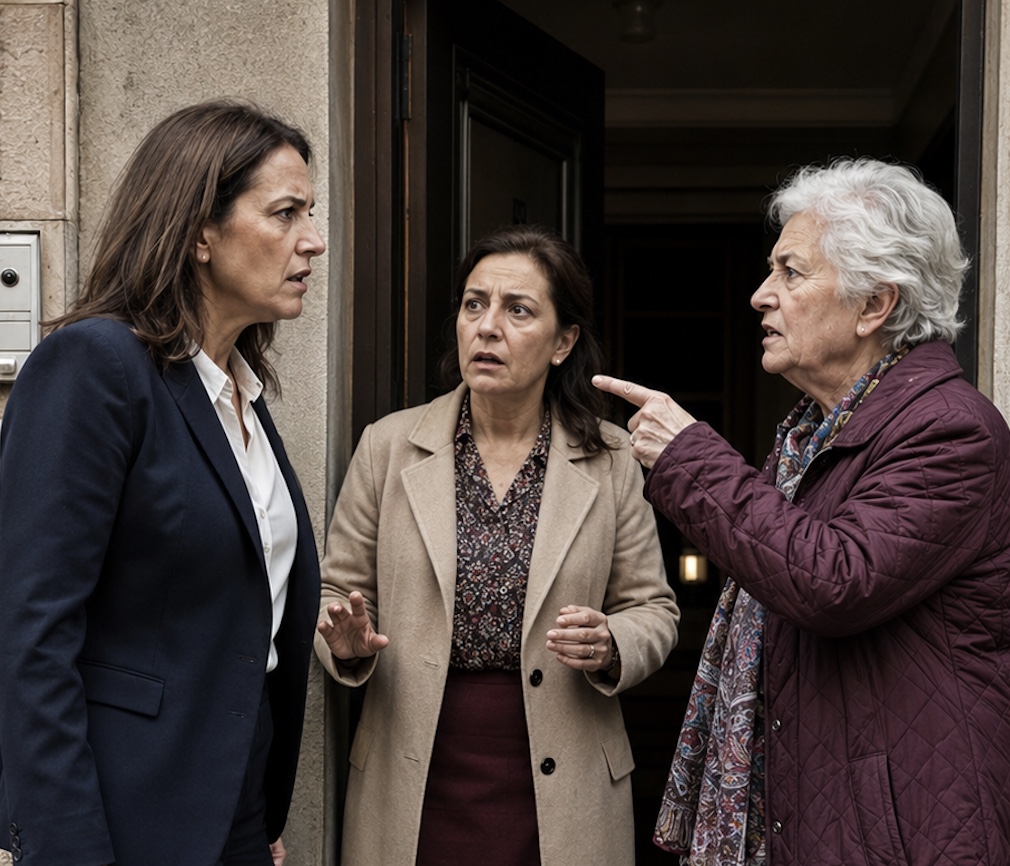
“Tamara Sergeyevna,” she said, addressing my mother, who was still standing in the doorway, “I want to tell you… that I was wrong.”
Mom did not move.
“I was upset,” Larisa Petrovna continued, and it was obvious that every word came with difficulty, as though she was pulling them out of herself with pliers. “I came into the apartment and saw unfamiliar people in the kitchen, and it felt like… an intrusion. I didn’t think about the fact that you are Anya’s parents, that you were guests in her own home, not in mine.”
“You threw my husband out of the house after heart surgery,” Mom said very quietly, but firmly. “I don’t know how that can be explained by being upset.”
Larisa Petrovna tightened her fingers around her handbag.
“I didn’t know about the surgery.”
“You could have asked,” I said. “Instead of immediately demanding that they leave.”
“I was wrong,” she repeated. This time her voice shook more noticeably. “I apologize. To Sergey Anatolyevich as well. Personally, if he is willing to see me.”
Silence settled over the room.
Dad, as it turned out, had been standing in the hallway the entire time, hearing every word.
“I accept the apology,” he said, stepping forward. “But you will not have a key again. That is not up for discussion.”
Larisa Petrovna looked at him, then at me, and something shifted in her face. It was not so much remorse as the realization that the old balance of power in this family no longer existed.
“All right,” she said quietly. “I understand.”
She left a few minutes later without even drinking the tea Mom automatically offered her out of habit and hospitality. The door closed behind her, and the apartment became quiet again. But this quiet was different. It was not the ringing emptiness that had greeted me on the day I found the missing suitcase and the forgotten orange on the windowsill.
Dad sat down in the armchair, rubbing his chest — a habit he had developed after the surgery, even though the pain was long gone.
“You know,” he said, looking at the closed door, “I almost feel sorry for her.”
“Sorry?” Mom asked, sitting beside him. “After everything she did?”
“Not for what she did. But because she seems to have lived her whole life this way — putting people in their places, testing boundaries, demanding obedience. And she doesn’t understand that this is exactly how a person ends up alone.”
I said nothing. It was difficult for me to feel sympathy for the woman who had caused my father’s blood pressure to spike. But there was truth in Dad’s words. Bitter truth, but truth all the same.
We all went to Denis’s aunt’s birthday party together — Denis, me, and, to everyone’s surprise, even my parents. I persuaded them to come so we could show that we had not been frightened, that no one had managed to push us out of our own lives.
At the table, Larisa Petrovna was carefully polite with my parents. Too polite, with the kind of politeness that felt like thin ice underfoot, ready to crack at the slightest wrong step. She asked about Dad’s health, asked Mom about her work, and even offered him more potato salad.
“How is your blood pressure, Sergey Anatolyevich?” she asked at one point, handing him the salad bowl.
“Normal. Thank you for asking,” Dad replied dryly, but without malice.
“I’m glad,” she said. And this time, I think she truly was glad. At least a little.
Denis’s aunt, who did not know all the details of the conflict, chatted about her grandchildren, and gradually the usual kind of meaningless table conversation began — about the weather, summer cottages, and who planned to go where during the summer. I watched it all and thought that normal life sometimes returned not with a grand gesture, but quietly, through potato salad and a question about blood pressure.
But Larisa Petrovna no longer had a key.
And when, a month later, she again mentioned that “it would be nice to come by sometimes and check that everything is all right in the young couple’s apartment,” I simply shook my head. To my relief, Denis did not argue on her side.
“Mom,” he said then, “everything is already fine at Anya’s. You don’t need to come by.”
Larisa Petrovna said nothing, looked away, and never raised the subject again.
A few more months passed. Dad fully recovered, had a follow-up examination with his cardiologist, and Mom and I decided that my parents would finally return home to their town. Dad was eager to get back to his garage and garden. He said he could no longer sit around doing nothing.
We said goodbye at the train station with tears, but they were no longer anxious tears. They were the kind that come after people have survived a shared disaster and come through it whole.
“Call if anything happens,” Mom said, kissing me goodbye. “And don’t let anyone into your home without permission again. Not relatives, not neighbors, not even the mailman.”
“I won’t, Mom,” I promised, smiling through my own tears.
Sometimes I think that if Larisa Petrovna had not slammed the door that day with such an expression of arrogant superiority, if she had tried to ask even one question before making demands, perhaps everything would have been different. Perhaps she would still have had a key, and trust, and a place at our table not only on holidays.
But what is done is done.
And the orange that Mom forgot on the windowsill that day — I ate it a week later, when one side had already begun to dry out. It was sweet, a little tired, but still good. Just like the peace we rebuilt after everything that happened: not perfect, slightly bruised, but ours. Truly ours. With no stranger’s key waiting in the lock.