Marina sliced the tomatoes into thin rounds, arranging them neatly in a fan on a serving plate. Little Anton sat at the table in his high chair, smearing porridge around his plastic bowl and occasionally slapping it with his palm. From the other room came the muffled sound of Dmitry talking on the phone and laughing at something.
She waited until he finished the call, then called to him from the kitchen.
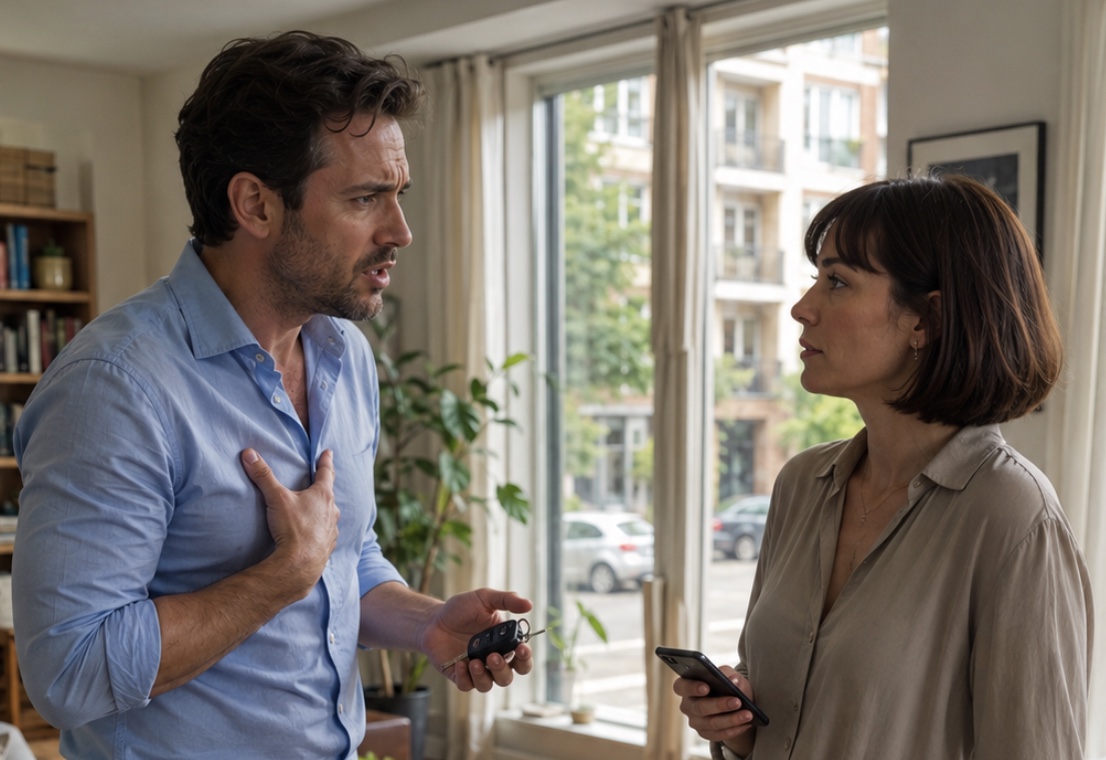
“Dima, I need the car tomorrow. Anton has a doctor’s appointment at ten in the morning, and afterward I need to stop by the store for groceries.”
Dmitry walked into the kitchen, scrolling through something on his phone. He opened the refrigerator, took out a bottle of water, drank straight from it, and only then looked at his wife.
“Tomorrow won’t work. I promised Sergey I’d help him. He bought a computer part and can’t install it himself. We already agreed.”
“Can’t you reschedule?” Marina tried to keep her voice calm. “I waited two weeks for this appointment. Anton needs to be examined.”
“Marina, just call a taxi. What’s the big deal?” Dmitry shrugged. “I’m driving my car to Sergey’s. I bought it before we got married. You know that.”
Marina slowly put the knife down on the cutting board. Then she turned toward her husband and looked directly into his eyes.
“Two years. For two years you’ve been repeating the same sentence. ‘My car.’ Every time I need it, suddenly it becomes yours. But when you need me to help carry your boxes or pick something up from the hardware store, suddenly we’re a family and everything belongs to both of us.”
“Oh, here we go,” Dmitry said, rolling his eyes. “I’m just stating a fact. I bought the car before the wedding. That’s an objective reality.”
“The objective reality is that your son needs to see a doctor. And you’re going to your friend’s place to mess around with a computer part that could easily wait another week.”
“Marina, I promised Sergey. A man keeps his word.”
“And what did you promise me? At the altar. Don’t you remember?”
Dmitry snorted, finished the water, and placed the bottle on the table. Anton reached for it, but Marina gently moved it away.
“You make everything into a drama,” Dmitry said, already turning toward the door. “Just call a taxi. Problem solved.”
“Wait,” Marina said, raising her voice. “I’m talking to you.”
“And I’ve already said everything I have to say.”
He left the kitchen. A second later, the door to the other room slammed shut.
Marina stood beside the cutting board, staring at the tomatoes, which had already begun releasing their juice. Anton started whining, and she automatically stroked his hair.
That evening, after the child had fallen asleep, Marina called Nastya.
“Nastya, we had another fight.”
“About the car?” her friend asked, sounding tired but not surprised. “The whole ‘mine and yours’ thing again?”
“Word for word. Like a broken record. He needs to go to Sergey’s to install some computer part, but I’m supposed to take the child and walk if I have to.”
“Marina, I’ve told you a hundred times. I told you even before the wedding. You remember.”
“I remember. You said I shouldn’t have had children with a man like him.”
“And I haven’t changed my mind. But Anton already exists. So something has to change. Either you keep putting up with this, or you stop. There’s no middle ground.”
“I don’t want to keep tolerating it, Nastya. But I’m scared of destroying everything.”
“Then don’t be afraid. Just once, tell him exactly what he deserves to hear. Don’t scream. Don’t make a scene. Say it calmly, in a way that goes right through him.”
“Do you think it’ll help?”
“I don’t know. But things can’t get much worse.”
Marina ended the call and remained sitting in the kitchen for a long time. Anton’s night-light glowed softly in his room, casting round patches of light across the wall.
She thought about how, only three years ago, she had been convinced everything would eventually improve. That her husband would mature. That he would stop dividing everything into his and hers.
For three days they lived in the same apartment like two strangers sharing a train compartment. In the mornings they exchanged only short practical phrases.
“The porridge is on the stove.”
“Pick Anton up from daycare at five.”
In the evenings there was silence, broken only by the sound of the television coming from separate rooms. Dmitry made a point of sleeping on the living room sofa, and every time he walked past Marina, he looked at her as though she were personally responsible for a global crisis.
On the fourth day, he walked into the kitchen with the expression of a man about to announce a matter of national importance.
“Marina, something came up. Aunt Galina Petrovna is coming to the city. She needs some medical examinations and has several doctor appointments. She’ll stay with us for a couple of weeks.”
Marina slowly lowered her cup onto the table.
“Wait. Are you serious?”
“Completely. She called yesterday. I told her it was no problem.”
“No problem? You decided that for both of us without even asking me?”
“What is there to ask?” Dmitry frowned. “She’s family. She’s been friends with my mother since they were young. We can’t refuse her.”
“‘Can’t’ is when there’s a fire and nowhere else to go. In this case, you simply didn’t want to think about me.”
“Marina, enough. It’s two weeks. Fourteen days. You can survive it.”
“I can survive it?” Marina stood up. “And can you survive hearing something I’d like to remind you of?”
“What now?”
“We live in my apartment, Dmitry. My apartment. I inherited it from my grandmother. If you can spend three years waving your car in my face, then allow me, just once, to remind you whose home we sleep in, eat in, and raise our child in.”
Dmitry froze. Something flickered across his face as though an invisible string inside him had suddenly snapped.
“You… Why are you bringing that up?”
“Because if you’re going to make decisions for both of us, you should at least take the other person’s opinion into account. And if you don’t want to, then remember whose doorstep you’re standing on.”
“Wow,” he said, shaking his head. “I’m talking about a relative, and you’re turning it into a property issue.”
“And when you talked about the car, what kind of issue was that? An automotive one? It’s convenient, isn’t it, Dima? Very convenient to separate things whenever it benefits you.”
“She’s coming the day after tomorrow,” Dmitry said sharply. “End of discussion.”
“Fine.” Marina nodded. “Let her come. But remember this conversation.”
Dmitry walked out, and Marina heard him furiously typing something into his phone.
She immediately called Nastya.
“Nastya, things just got even more interesting. One of his aunts is moving in with us for two weeks.”
“What aunt?”
“Galina Petrovna. A relative from his mother’s side. Supposedly she’s coming for medical appointments. He didn’t even ask me. He just announced it as a done deal.”
“Marina, you’re killing me. Tell me something. Does this man ever ask for your opinion?”
“When he wants me to cook something specific for dinner, he asks.”
“That’s not funny.”
“I’m not laughing.”
“Listen, hold your ground. If this aunt starts acting entitled, don’t stay silent. You’re in your own home. Literally.”
Galina Petrovna arrived on Sunday morning.
She was a woman in her early sixties, carrying a heavy bag and wearing the expression of a fire-safety inspector. The moment she entered the apartment, she looked around and pursed her lips as though someone had invited her to sleep in a barn.
“Dima,” she said while taking off her coat, “your balcony isn’t enclosed?”
“No, Aunt Galya. Haven’t gotten around to it.”
“That’s not good. And when were these curtains last washed? They look gray.”
Marina stood in the hallway with Anton in her arms. She smiled with difficulty, but politely.
“Hello, Galina Petrovna. Come in. We’ve prepared a room for you.”
“Oh. Yes, thank you,” the older woman replied, barely glancing at her and hardly bothering to return the greeting. “Dima, take my bag. It’s heavy.”
The first day passed relatively peacefully. Galina Petrovna settled in, made phone calls, and loudly told various people about her trip.
By evening, Marina noticed that her kitchen towels—the new turquoise ones she had bought only a month earlier—were gone.
“Dima, have you seen my kitchen towels?”
“What towels?”
“The turquoise ones. One was hanging by the stove and the other by the sink.”
“Oh. Aunt Galya said they looked faded, so she threw them away. She put up her own cotton ones. She brought them from home.”
“She threw away my towels?”
“Marina, they’re towels. Not bars of gold. Relax.”
On the second day, Marina discovered that the shower curtain had disappeared from the bathroom. The mint-green one with the delicate pattern had been replaced by a plain, translucent white curtain.
Then she discovered that the linens in the bedroom dresser had been rearranged. Things that had been on top were now underneath, and the stacks had been reorganized according to some system Marina couldn’t understand.
“Galina Petrovna,” Marina said when she found her in the hallway, carefully keeping her voice even, “did you rearrange the linens in my dresser?”
“My dear, it was complete chaos in there. I organized everything. Sheets with sheets, pillowcases with pillowcases. That’s what any proper housewife does.”
“I am the housewife. This is my apartment. And I liked the way it was.”
“Well, if you prefer living in disorder, that’s your choice. I thought you’d be grateful.”
“I’ll be grateful when you ask before touching my things.”
Galina Petrovna pursed her lips and walked away.
That evening Marina discovered that all the magnets had disappeared from the refrigerator.
The same magnets they had brought back from trips together, or received as gifts from people they loved. The tiny ceramic house Anton adored touching. The glass fish from Anapa. The wooden owl Nastya had given her.
“Dima,” Marina said quietly so she wouldn’t wake their son. “She removed the magnets. All of them.”
“So what? She says magnets scratch the enamel.”
“They were gifts. They mean something to me. Some of them came from people I care about.”
“Then put them back. What’s the problem?”
“The problem is that a stranger is taking control of my home, while my husband pretends it’s perfectly normal.”
“Marina, she’s an older woman. She’s struggling. She has medical appointments. She needs care.”
“And me? Do I need care?”
“What you need is patience.”
Marina looked at him for a long moment. He had already lowered his eyes back to his phone.
“You know, Dima,” she said, “patience doesn’t mean allowing people to walk all over you while you stay silent. Patience means giving someone a chance. I gave her one. More than one. Now we’ll see.”
“What does that mean?”
“It means exactly what I said. We’ll see.”
Everything finally exploded on Friday evening.
Marina cooked dinner—chicken with vegetables and an open meatloaf. She put Anton to bed earlier than usual because he was teething and had been fussy all day.
She set the table carefully, placing three plates and arranging the cutlery.
Galina Petrovna was the last to come to dinner. She looked over the food without saying anything, then took a seat.
Dmitry had already started eating, picking up pieces of chicken with his fork.
“This is good, Marina,” he said casually.
“Thank you.”
Galina Petrovna served herself, then took one of the smallest slices of meatloaf and dropped it onto Marina’s plate.
“This is enough for you, dear. Don’t take too much. You should lose some weight. Your figure isn’t what it used to be. Of course, every woman puts on weight after giving birth, but you still need to look after yourself. Otherwise your husband might start looking at other women.”
Dmitry lowered his head, but Marina noticed the corners of his mouth twitch.
He was trying not to laugh.
He didn’t defend her.
He didn’t tell his aunt to stop.
He stayed silent and almost laughed.
Marina stared at the small piece of meatloaf on her plate.
Then she looked at the aunt.
Then at her husband.
Calmly, she put down her fork.
She stood up and pushed her chair back without any sudden movement.
“Galina Petrovna,” Marina said evenly, but there was something in her voice that made even Dmitry stop chewing. “Tomorrow morning, you are packing your belongings and leaving my apartment.”
“What?” The older woman raised her eyebrows. “What are you talking about?”
“I’m talking about the fact that you crossed the line. You threw away my towels. You rearranged my linens. You removed things from my refrigerator. And now you’re telling me how much I’m allowed to eat at my own table. You are a guest here, but you behave as though everything belongs to you.”
“Dima!” Galina Petrovna turned toward her nephew. “Are you hearing what she’s saying?”
Dmitry leaned back in his chair.
“Marina, stop it. Aunt Galya was joking. She cares about you.”
“Cares about me?” Marina gave a bitter smile. “Caring means asking. Not humiliating.”
“No one is humiliating you,” Dmitry said, raising his voice. “You’re blowing everything out of proportion. Like always.”
“Like always?” Marina stepped toward him. “Maybe ‘like always’ means you haven’t defended me once this entire week. Maybe it means you almost laughed when she told me to lose weight. Maybe it means being her nephew is more comfortable for you than being my husband.”
“That’s enough!” Dmitry stood up. “She’s family! And she’s staying!”
“No.”
“What do you mean, no?”
“I mean she’s not staying. This is my home. My apartment. You spent two years reminding me about your car. Now I’m reminding you about my apartment. Doesn’t feel good, does it? Welcome to my world.”
Galina Petrovna rose from the table.
“Well, listen here, young lady,” she snapped, pointing a finger at Marina. “I’ve seen plenty of women like you in my life. Shameless, arrogant, ungrateful—”
Marina turned toward her.
One step forward.
Galina Petrovna never finished the sentence.
A sharp slap cracked through the room.
It wasn’t especially hard, but it was precise. The kind of slap that hurt pride more than skin.
The older woman froze. Her eyes widened. Her mouth fell open. She pressed a hand to her cheek and took a step backward.
“You…” she whispered. “You hit me?”
“Yes.” Marina held her gaze. “And I’ll do it again if you ever call me shameless in my own home. Pack your things. You’re leaving in the morning.”
Dmitry stood completely still.
His mouth opened, but no words came out.
For the first time in his life, his wife had done something he had never expected. She hadn’t cried. She hadn’t run away. She hadn’t called her friend.
She had answered.
Directly.
Physically.
Without hesitation.
“Marina, you’ve lost your mind,” Dmitry finally managed.
“No, Dmitry. I’ve finally found it. For the first time in two years. Take your aunt away. Right now. I don’t want to see her inside these walls again.”
“And where are we supposed to go?”
“That’s your problem. You brought her here. You figure it out.”
Dmitry stood there for another second.
He looked at his aunt, who was still holding her cheek.
Then he looked at his wife—calm, firm, her eyes burning with determination.
Without another word, he picked up the keys, helped Galina Petrovna pack her bag, and took her out of the apartment.
The door closed.
Marina was alone.
She went into Anton’s room, leaned over his crib, and kissed his warm forehead. The little boy smacked his lips in his sleep and rolled onto his side.
Then Marina returned to the kitchen, cleared the table, and washed the dishes.
After that, she opened a drawer and took out the refrigerator magnets.
Every single one.
She silently placed them back where they belonged.
The house.
The fish.
The owl.
The little lighthouse from Crimea.
It was midnight when she finally went to bed.
Sleep wouldn’t come.
She lay there listening to the silence, but the silence no longer felt empty.
It belonged to her.
Just like the apartment.
Just like her life.
Her phone rang at two in the morning.
It was Nastya.
“I know you’re awake. Dmitry messaged Sergey, Sergey told his girlfriend, and she told me. Did you really slap his aunt?”
“I did.”
“Marina…” There was a pause. “I’m proud of you.”
“Don’t be proud of me, Nastya. I’m scared. I have no idea what’s going to happen tomorrow.”
“Tomorrow will be better. Because today you finally stopped being convenient.”
Dmitry came back the next morning.
Alone.
Without his aunt.
He entered quietly, took off his shoes in the hallway, and walked into the kitchen.
Marina was already feeding Anton.
“Hi,” he said in a dull voice.
“Hi.”
“She’s staying at a hotel. I paid for ten days. She said she’ll never come back here.”
“Good.”
Dmitry sat across from her and rubbed his hands together while staring at the table.
“Marina…”
“Yes?”
“I’m not going to make excuses. I’m not going to tell you that you were wrong. Because you were right. Not about everything, maybe, but about the most important part.”
Marina looked at him silently.
Anton began tapping his spoon on the table, and she gently caught his hand.
“For three years, I kept reminding you about the car,” Dmitry continued. “Every time you needed it. I knew it annoyed you, and I still kept saying it. Because somehow it gave me a feeling of… I don’t know… importance? Like I had contributed something to this family too.”
“You did contribute. But you also took something away. You took away my dignity, Dima. Every time you said ‘my car,’ what I heard was: you’re nobody here. You’re only here because I allow it. You’re using something that belongs to me.”
“That’s not what I meant.”
“But that’s how it made me feel.”
He fell silent.
Anton reached toward his father, and Dmitry picked him up. The boy wrapped his arms around his neck and laughed.
“Last night I sat in the car outside the hotel,” Dmitry said quietly. “Aunt Galya went upstairs, but I stayed there thinking. Do you know what she said before getting out?”
“What?”
“She said, ‘Your wife is a savage. Women like that need to be taught a lesson.’ And suddenly I understood that this was the moment I should defend you. Not yesterday at dinner. Not sometime during the week. Right then. When she said that. And I did.”
“You defended me?”
“Yes. I told her, ‘Aunt Galya, my wife is the only person in that apartment who had the courage to tell the truth. I’m the coward who kept hiding behind politeness.’ She slammed the car door.”
Marina lowered her eyes.
“Dima, I didn’t want to hit her.”
“I know.”
“But she called me shameless. In my own home. In front of my husband. And my husband stayed silent.”
“I won’t stay silent again. I can’t promise I’ll become a completely different person overnight. But I can promise I’ll never use the word ‘mine’ as a weapon again.”
“And the car?”
“The car is ours. Like everything else.”
Marina remained silent for a moment.
Then she stood, walked to the window, and pulled the curtain closed because the sunlight was shining directly into Anton’s eyes.
“I need to take Anton to the doctor today. Then I need to go grocery shopping. We’re running out of food.”
“I’ll drive you. I’ll pick you up. I’ll wait in the car if I need to. And afterward, we can visit your family. We haven’t seen them in a while.”
“Who?”
“Your family. Anton’s grandmother hasn’t seen him in a month.”
Marina turned around.
Dmitry sat there holding their son, and for the first time in a long while, there was no challenge in his eyes, no resentment, no familiar wall behind which he always hid.
“All right,” she said. “Let’s go.”
The three of them left the apartment together.
Dmitry carried Anton.
Marina carried the bag.
When they reached the car, Dmitry opened the passenger door for her—for the first time since they had started dating.
“Dima,” Marina said, stopping beside him. “You understand this isn’t the end of the conversation, right?”
“I understand.”
“And I’m not going to forget.”
“I won’t forget either. But maybe we can try, together, not to live inside the memory of it.”
Anton laughed and slapped his father lightly on the cheek with his little hand.
Dmitry winced.
Marina suddenly smiled.
“There you go,” she said. “Even your son knows who deserves a slap around here.”
“I earned that one,” Dmitry said with a faint grin. “From both of you.”
They got into the car.
Dmitry turned the key, and the engine started.
Marina buckled Anton into his child seat, then sat down beside her husband.
Their relationship was far from perfect. Cracks don’t disappear in a single day, and resentment is a heavy burden that cannot simply be dropped because two people agree to move on.
But both of them had chosen that fragile, uncertain path—not because of some grand romantic love, but because they understood that on the other side there might be nothing except emptiness and loneliness.
A week later, Marina learned something that changed everything.
Nastya called her that evening, and there was something strange in her friend’s voice—a mixture of anger and triumph.
“Marina, sit down.”
“I’m sitting. What happened?”
“Remember how Galina Petrovna said she was coming for medical examinations? To see doctors?”
“Yes.”
“Well, a friend of my neighbor works at the hotel where Dmitry put her up. Galina Petrovna hasn’t been to a single doctor. Not once. Every day she’s been going to furniture stores and home décor shops. She’s been choosing curtains, carpets, dishes. Do you know why?”
“Why?”
“She was planning to move in with you permanently. She sold her room back in her hometown. Her belongings are already packed and sitting in storage. She wasn’t coming for medical treatment, Marina. She was coming to move into your apartment. Forever.”
Nastya paused.
“And Dmitry knew.”
Marina slowly lowered the phone onto the table.
Then she looked toward the living room.
Dmitry was sitting there reading a book to Anton.
He noticed her staring at him and smiled—warmly, almost guiltily.
“Dima,” Marina called in an even voice. “Come here.”
He walked over.
The moment he saw her face, his smile vanished.
“You knew she wasn’t coming for medical treatment?”
Silence.
Long and heavy, like a railway bridge stretching toward the horizon.
“I knew,” he finally said.
“And when exactly were you planning to tell me?”
“I… wasn’t.”
Marina stood up.
She walked directly toward him.
She raised her hand.
Dmitry instinctively flinched backward.
But she didn’t hit him.
Instead, she reached for his hand and pulled the wedding ring from his finger in one quick, precise movement, like a magician pulling a scarf from an empty cage.
“My apartment,” she said.
“Your car.”
“Drive.”
Dmitry stood there with his bare hand hanging uselessly at his side and his mouth slightly open.
Somewhere in the hotel, Galina Petrovna was calling his number again and again.
But he didn’t answer.
Because there was no longer anyone left for him to answer to.
The family he had spent three years dividing into “mine” and “yours” had finally been divided for real.
And the most frightening part was that Dmitry had received exactly what he had chosen.