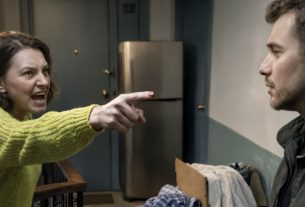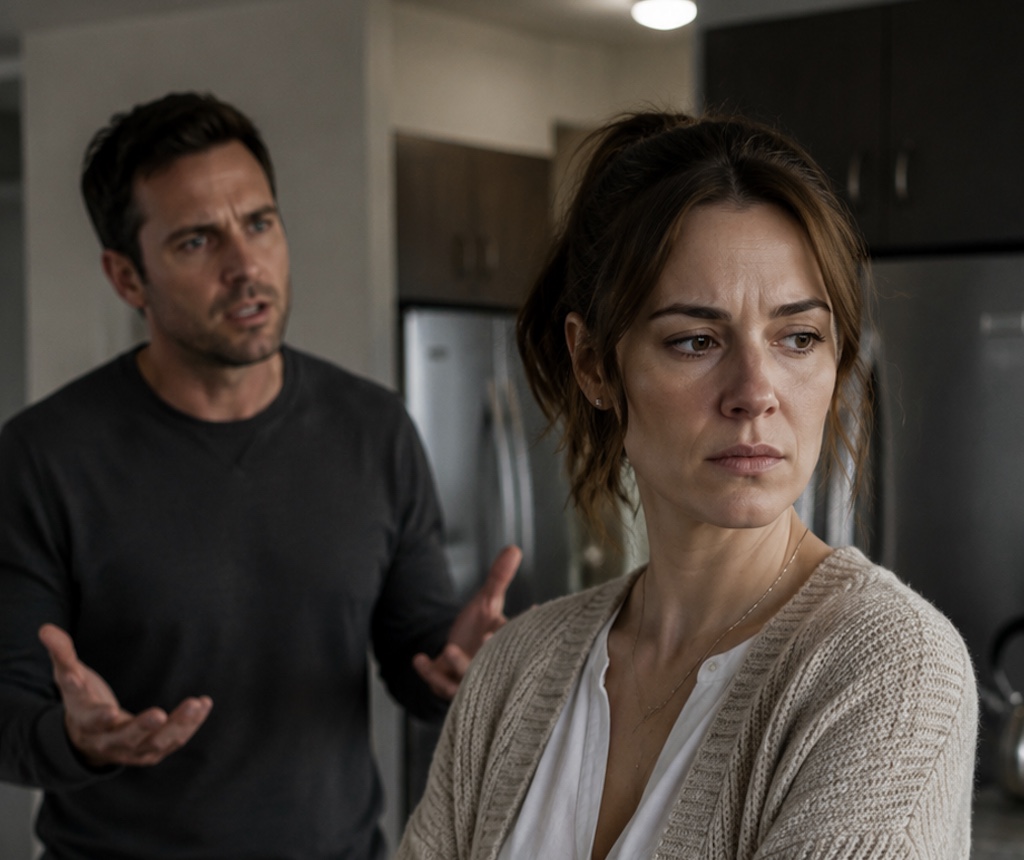
The refrigerator door clicked shut softly, and that ordinary household sound suddenly seemed louder than all the words that had been flying out of the living room before.
Darina stood in the kitchen with an empty shopping bag in her hand. On the countertop lay apples, a pack of cottage cheese for her daughter, grains, chicken fillet, children’s yogurt, a pack of napkins, and two cartons of milk. Everything she had bought after work, after stopping by the store on the way home from kindergarten. Everything that disappeared in this house quickly, silently, and without a single question about where it had come from.
From the living room, Pavel and his mother, Valentina Sergeyevna, were watching her.
Her mother-in-law sat on the edge of the sofa, holding her handbag on her knees. She had come over, as usual, “just for an hour,” but that hour had long since stretched into the entire evening. Over the past few months, Valentina Sergeyevna had been showing up at their place almost every day. Sometimes she needed to bring her son jars of homemade preserves, sometimes she wanted to check whether Pavel had lost weight, and sometimes she simply wanted to “spend time with family.” In reality, she entered the apartment as if everything there had been arranged for her convenience: she judged the cleanliness, opened cupboards, looked inside the refrigerator, and asked why they had bought one thing instead of another.
And every time, Pavel stayed silent.
No, not even silent.
He agreed with her.
“Mom, don’t start,” he would sometimes say lazily, but in a tone that made it clear: don’t start too loudly, but in general, I agree with you.
Today, Valentina Sergeyevna had started before dinner. First, she disliked the fact that Sonya’s little jacket was lying in the hallway. Then she noticed laundry hanging on the drying rack. Then she asked why there was one mug in the sink.
One mug.
Darina had even stopped by the kitchen cabinet and looked at that mug. White, with a little cat drawn on it. Sonya had drunk cocoa from it that morning and had not managed to put it away. Darina had planned to wash it later, once she finished unpacking the groceries.
But Valentina Sergeyevna had already managed to turn that mug into a family tragedy.
“A woman should keep the house in order,” she said to her son loudly enough for Darina to hear. “But here, everything looks like a train station. You come home, and there isn’t even a proper dinner waiting for you.”
Darina tightened her fingers around the handles of the bag. The plastic crackled, leaving red marks across her palm.
Pavel did not ask whether his wife was tired. He did not ask how her day had gone. He did not remember that in the morning it was she who had taken Sonya to kindergarten, then managed to go out for a work matter, then picked up their daughter, then bought groceries, then carried heavy bags up to the fourth floor because the elevator had stopped between floors again.
He only snapped irritably:
“Mom is right. You always act as if you’re carrying everything alone, but in reality, all we get from you at home is complaints.”
Darina slowly turned toward him.
“From me?” she asked.
Pavel had been lounging comfortably, but after her question, he straightened up. He looked displeased, like a man who had just been pulled out of the comfortable role of victim.
“Yes, from you. This bothers you, that bothers you. Mom comes over, and your face is already sour. I say one word, and you immediately start. Because of you, it’s impossible to feel calm in this house.”
Valentina Sergeyevna nodded eagerly.
“Exactly. I’ve been telling him for a long time: his wife has too much character. But what good is that character? The family only suffers because of it.”
Darina placed the bag on the floor, took out the last apple, and put it into the lower drawer of the refrigerator. Her movements became very precise. No fuss. No trembling. Suddenly, she saw the whole picture clearly, as if from the outside.
Here was her apartment. Bought before the marriage. Registered only in her name. Here was her kitchen, where every evening she checked what there was for the child. Here was the refrigerator, filled mostly by her own hands. Here were the utility bills she paid without making a report out of it. Here were the child’s boots, jackets, toys, medicine, gifts for kindergarten events — everything that seemed to appear on its own.
And there, in the living room, were two grown adults discussing her as if she had wandered in from the street and was disturbing their lives.
Darina closed the refrigerator.
And then she said it.
“If I’m unnecessary here, then the refrigerator, the utilities, and the groceries are no longer my problem either.”
Valentina Sergeyevna fell silent. Even her fingers loosened around her handbag.
At first, Pavel smirked.
“What kind of performance is this?”
“It’s not a performance,” Darina replied. “It’s the new rules.”
“What rules?” He stood up from the sofa.
“Simple ones. I buy groceries for myself and Sonya. I pay for expenses that concern me and the child. Everything that concerns you as a grown man, you provide for yourself. Everything your mother feels entitled to control, she can also pay for herself.”
Her mother-in-law’s face flushed.
“What exactly are you implying?”
“I’m not implying anything. I’m saying it directly.”
“Pavel, do you hear this?” Valentina Sergeyevna sharply turned to her son. “She’s throwing money in your mother’s face!”
“No,” Darina said, taking her bag off her shoulder and placing it on a chair. “I’m not throwing money in anyone’s face. I’m reminding you that someone pays for comfort. For some reason, everyone in this apartment got used to that someone being me.”
Pavel frowned.
“Dasha, don’t start.”
Darina did not even correct him, although she hated when he shortened her name during arguments. As if that little “Dasha” could make her objections smaller.
“I’ve already finished, Pavel.”
“Finished what?”
“Being convenient.”
The room went quiet. From the children’s room came Sonya’s thin little voice: the girl was talking to her doll, putting it to bed. Darina turned her head toward the sound, and her face softened. Then she looked back at her husband.
“We will not continue this in front of the child. Your mother can finish her water, if she wants, and then she will go home.”
“Why is that?” Valentina Sergeyevna stood up. “I came to see my son.”
“You came into my apartment, Valentina Sergeyevna. You can visit your son when the owner of the apartment invites you. Today, that invitation has ended.”
Her mother-in-law opened her mouth but did not immediately find a reply. She was used to Darina arguing, explaining herself, proving things. But now a woman stood before her with an even voice and a face that gave her nothing to grab onto.
Pavel stepped closer.
“You have no right to throw my mother out.”
“I do. She is not registered here, she is not the owner, and she was not invited to live here.”
“Now you’re talking law?”
“What did you expect me to speak in? Hurt feelings? I’ve already heard enough of those.”
Valentina Sergeyevna lifted her chin.
“Son, get ready. Let’s go to my place. Let her sit here alone with her precious character.”
In the past, Darina might have been frightened at that moment. Not because she was afraid of being alone, but because family life had trained her to smooth over every sharp edge. Now she only nodded.
“Excellent idea. Pavel is an adult. He can go to his mother, or he can stay. But don’t pack any groceries to take with you. They were bought for Sonya.”
Pavel spun around sharply.
“Have you completely lost it?”
“Completely.”
“This is my family too!”
“Family is when adults take responsibility, not when one person pays for the household while two others discuss her flaws.”
Sonya peeked out of the children’s room.
“Mom, are you fighting?”
Darina immediately crouched down to be level with her daughter.
“No, sweetheart. We’re just speaking louder than we should. Go wash up, I’ll come in a moment.”
The girl looked at her grandmother, then at her father, then back at her mother. She was six, but children sometimes read the atmosphere more accurately than adults. She asked nothing, only nodded and went to the bathroom.
Darina stood up.
“That’s enough. Not another word in front of the child.”
Valentina Sergeyevna snorted, but she did lower her voice.
“You’ll regret this.”
“Possibly. But not today.”
Pavel grabbed his sweater from the back of the armchair.
“Mom, let’s go.”
He clearly expected Darina to stop him. To say, “Pavel, don’t.” To start explaining, pleading, smoothing things over. She had done it so many times that he no longer doubted the usual ending.
But Darina walked over to the shoe cabinet, took out her mother-in-law’s keys — the ones she had left “just in case” — and held out her hand.
“Valentina Sergeyevna, leave the keys to my apartment.”
Her mother-in-law pressed her handbag against herself.
“What keys?”
“The ones you took from Pavel in the spring. You said yourself that it was more convenient for you to come in if we were busy.”
Pavel frowned.
“Darin, don’t be petty.”
“This is not petty. This is my door.”
Her mother-in-law turned blotchy pink.
“I’m his mother! I’m not a stranger!”
“That is exactly why I tolerated it for so long. But you will return the keys anyway.”
For several seconds, they stared at each other. Then Valentina Sergeyevna noisily unzipped her bag, pulled out the keychain, and threw the keys onto the cabinet. The metal struck the surface sharply, angrily.
“Take them. Live with your locks.”
“Thank you.”
“There is nothing to thank me for!” her mother-in-law snapped. “We’ll see how you sing when Pavlik realizes who he got involved with.”
Pavel put on his shoes, opened the door with exaggerated force, and left after his mother. The door slammed so hard that the mirror in the hallway trembled.
Darina remained standing in the silence.
Her hands were not shaking. On the contrary, her whole body seemed collected and firm, as if preparing for something important. She picked up the keys, put them in a drawer, then took out her phone and wrote to a locksmith from the building chat. Not a complaint. Not a request. Just a message: the lock cylinder needs to be replaced tomorrow morning.
Then she went to her daughter.
Sonya sat on the edge of the bathtub, tugging at the sleeve of her pajamas.
“Did Dad leave?”
“Yes. He went to Grandma’s.”
“Will he come back?”
Darina sat down beside her and tucked her daughter’s hair behind her ear.
“I don’t know, my sunshine. Sometimes adults need time to think.”
“Is it my fault?”
Darina exhaled sharply through her nose, as if someone had placed a heavy stone on her chest. But she kept her voice gentle.
“No. You are not to blame for anything. This is an adult conversation. It has nothing to do with you.”
Sonya wrapped her arms around her neck. Darina hugged her daughter more tightly than usual. She did not cry. She simply sat like that for several seconds, feeling the warm little hands on her back, and for the first time in a long while, she did not think that she had to save the whole world around Pavel right now.
The next morning, Pavel did not return.
Darina woke up before the alarm. The apartment was surprisingly peaceful. No one grumbled from the bathroom, no one asked where a clean T-shirt was, no one demanded that she quickly hand over the phone charger he himself had tossed somewhere the night before. Sonya sleepily came into the kitchen, climbed onto a chair, and asked for porridge with berries.
Darina made breakfast, got her daughter ready for kindergarten, and checked her little backpack. Everything moved calmly. Even more easily than usual.
At half past eight, the locksmith arrived. The man quickly changed the lock cylinder, handed Darina the new keys, and left behind only a bit of metal dust near the door. Darina wiped it up with a napkin, tested the lock twice, and only then allowed herself to breathe more freely.
Pavel called closer to lunchtime.
“You changed the lock?” he asked without greeting her.
“Yes.”
“Are you serious? I live there.”
“You left yesterday. You can get the new keys when we calmly discuss the rules of living here.”
“What rules? I’m your husband!”
“For now, yes. That is why the conversation will be calm and adult. Without your mother.”
There was a hiss on the other end of the line. Valentina Sergeyevna was probably standing nearby, because Pavel suddenly started speaking louder.
“Darina, don’t embarrass yourself. Give me the keys, and we’ll end this circus.”
“The circus ended yesterday.”
“I’m coming over tonight.”
“Call in advance. If you come with your mother, I won’t open the door.”
“You can’t forbid me from bringing my mother!”
“I can when it comes to an apartment that belongs to me.”
Pavel went quiet. In the past, whenever she said “my apartment,” he immediately became angry. He seemed to think that Darina humiliated him by the very fact that she owned it. Even though before the wedding, he had assured her that he did not care where they lived, as long as they were together.
But somehow, “together” had quietly turned into his mother having keys, his habits becoming law, and Darina being expected to feel grateful that she was tolerated in her own home.
“You’ve changed,” he finally said.
Darina looked at the utility bills stacked in a folder beside her laptop.
“No, Pavel. I simply stopped pretending that I was fine.”
That evening, he came alone. Without his mother. That alone was already an achievement.
Darina opened the door and immediately stepped aside.
“Sonya is in her room drawing. Don’t raise your voice.”
Pavel came in, took off his shoes, and stopped in the hallway. He wanted to go into the kitchen, but Darina pointed toward the living room.
“We talk first.”
He sat down in the armchair, looked around, and grimaced.
“It feels like I’ve come as a guest.”
“Then behave like one until we come to an agreement.”
“Darina, you’re going too far.”
She took out a sheet of paper. Not a notarized document, not some absurd “decree,” but an ordinary handwritten list of household rules.
“Look. First: your mother comes only by prior agreement. Not every day. No keys. Second: grocery expenses are shared. I am not buying food for three adults, including your mother, if she decides to come and have dinner here. Third: we discuss utility payments in advance, and you contribute to them regularly. Fourth: we split expenses for the child as parents. Fifth: no one discusses what a terrible mother Sonya has in front of her.”
Pavel stared at the sheet as if Darina had placed a court summons in front of him instead of rules.
“You actually wrote this down?”
“Yes.”
“What are we, roommates?”
“Right now, we live like roommates, except for some reason one roommate serves the other.”
“I work, by the way.”
“So do I.”
“I get tired.”
“So do I.”
“Mom is just worried about me!”
Darina nodded.
“Let her worry at her own home.”
Pavel stood and walked to the window. Then he turned sharply.
“And what if I don’t agree?”
“Then we stop living together. Divorce through court, because we have a child. The apartment remains mine. The question of contact with Sonya will be handled separately. Expenses for our daughter too.”
He did not go pale immediately. First he gave a short laugh, as if to show that he was unaffected. Then he ran his hand over his face and sat back down.
“So you’ve already decided everything?”
“I have decided only one thing: the old order is over.”
“Because of one argument?”
Darina looked at him in surprise.
“One?”
She stood, went to the hallway cabinet, and took out a folder. Inside were receipts, bills, and expense notes. Not for court. For herself. Darina had always kept track, because otherwise money disappeared unnoticed, and then Pavel sincerely wondered why they needed to buy something again.
She placed the folder on the table in front of her husband.
“Here are the utilities for the past few months. Here are the purchases for Sonya. Here is household cleaning supplies. Groceries. Pharmacy expenses. Here is the repair of the child’s chair, which you promised to take to the repairman, but in the end I called someone myself. Here is payment for the drawing class Sonya attends on Saturdays. Here are gifts for kindergarten. Here are winter boots.”
Pavel opened the folder, flipped through several pages, and frowned even harder.
“You collected all this on purpose?”
“No. I simply noticed a long time ago that it was convenient for this family not to notice me.”
“And what, I do nothing?”
“You did. Sometimes. After being asked three times.”
He wanted to object, but no quick words came to him. His fingers touched the edge of the folder, then pushed it away.
“Mom says you’re turning me against her.”
“Pavel, you are thirty-eight years old. If someone can still turn you for or against anyone, the problem is not me.”
He raised his eyes.
“Don’t say it like that.”
“How should I say it? Quietly unpack groceries while the two of you discuss my character?”
Pavel fell silent.
At that moment, Sonya came out of her room with a drawing.
“Dad, look, I drew a house.”
Pavel took the sheet. In the drawing there was a house with a large yellow window and three people beside it. Above one little figure, Sonya had written in crooked letters: “Mom.” Above another: “Me.” Above the third: “Dad.” There was no grandmother in the picture.
“It’s beautiful,” Pavel said hoarsely.
“Grandma said Mom is angry,” Sonya suddenly said. “But Mom isn’t angry. Mom just does a lot.”
Darina closed her eyes for a second. Not from weakness, but because the child had heard more than the adults thought.
Pavel looked at his daughter, then at his wife. For the first time, there was no irritation on his face. Only confusion, discomfort, and something that resembled shame.
“Sonya, go finish drawing the flowers, okay?” he said quietly.
“Okay.”
The girl ran back to her room.
Darina took the drawing from the table and carefully placed it on a shelf.
“That is why there will be no more conversations like that in front of her.”
Pavel nodded. Without arguing.
For the first two days, he tried to behave as though nothing had changed. He would open the refrigerator and ask:
“Where’s the cheese?”
Darina would answer:
“I didn’t buy any.”
“What is there?”
“For Sonya, food for tomorrow. For me, what I’ll cook for myself. The store is open for you.”
He took offense, slammed cabinet doors, searched for something quick to eat, but soon realized that the house no longer had an endless supply that replenished itself without his involvement. Familiar things disappeared. The pack of coffee ran out and no new one appeared. His shower gel ran out, and the empty bottle remained there because he himself had put it back. His clothes lay in the laundry basket, but they did not magically become clean.
On the third day, Pavel went to the store himself.
He returned with a huge bag and proudly laid out grains, bread, cheese, frozen cutlets, tomatoes, bananas for the child, and for some reason three packs of toilet paper.
Darina looked at the groceries.
“Did you keep the receipt?”
“What for?”
“So we can understand the expenses.”
He smirked.
“Accounting again?”
“Yes. Adult life sometimes looks boring.”
Pavel wanted to say something, but changed his mind. He pulled the receipt from his pocket and placed it on the table.
Darina did not praise him like a child. She did not say, “See, well done.” She simply nodded.
“You can put Sonya’s bananas on the lower shelf.”
And for some reason, that stung Pavel more than if she had started a scandal. He had done a normal thing, but he did not receive applause for it. That, perhaps, was how Darina had lived for years.
Valentina Sergeyevna lasted four days.
On the fifth day, she came without calling. She rang the doorbell for a long time, insistently. Darina looked through the peephole and saw her mother-in-law standing there with two bags and the expression of a person who had arrived to restore justice.
Pavel was home. He came out of the kitchen, where he had been trying to figure out why the rice had stuck to the pot.
“Mom?”
“Don’t open it,” Darina said.
“Are you serious?”
“She didn’t warn us.”
“She’s my mother.”
“Then go out to the landing and talk to her.”
Pavel looked at his wife for several seconds. Then he opened the door, stepped out into the stairwell himself, and pulled it shut behind him.
Darina remained in the hallway. Their voices were muffled, but separate phrases still reached her.
“She’s practically thrown you out already!”
“Mom, keep your voice down.”
“She’s pinned you down with a list of rules! Are you a man or not?”
“Mom, I said lower your voice.”
“I brought you food because that woman has apparently decided to starve you!”
Darina gave a faint, tired half-smile. Not amused. Exhausted.
Then she returned to the kitchen, turned off the stove, and saved Pavel’s rice by adding water and covering the pot with a lid. Not for his sake. She simply could not stand the smell of burning.
Ten minutes later, Pavel came back inside alone. Without the bags.
“Mom left.”
“The bags?”
“I didn’t take them.”
Darina looked up at him.
“Why?”
He leaned his shoulder against the doorframe.
“Because she didn’t bring food. She brought an excuse.”
For the first time in several days, Darina looked at him without that inner shield.
“You understood that?”
“I did.”
He walked into the kitchen and saw the pot.
“You saved the rice?”
“It started smoking.”
“Thank you.”
“You’re welcome.”
He sat down at the table and remained silent for a long time. Darina wiped the countertop, then put the sponge by the sink.
“I really didn’t see it,” Pavel suddenly said. “Not all of it, anyway. I saw some of it. But I pretended those things were minor.”
“Why?”
He rubbed the bridge of his nose.
“Because it was convenient. Mom was satisfied, I seemed like a good son. You were managing, so everything seemed fine.”
“And me?”
“And you…” Pavel did not continue right away. “You’re strong. For some reason, I decided strong people don’t hurt.”
Darina glanced at him briefly.
“Strong people simply don’t have time to fall apart. They’re holding a grocery bag, a child’s hand, and opening the door with their elbow.”
Pavel lowered his head.
“I’m guilty.”
Darina did not soften immediately. She knew this moment too well: a man admits he is wrong, the woman feels relieved, and everything rolls back onto the old tracks. A week later, there would be his mother again, the comments, the full shopping bags, unpaid bills, irritation, and another remark about her difficult character.
“Admitting it isn’t enough,” she said. “Things have to change.”
“I’ll try.”
“No, Pavel. You won’t try. You either change, or we separate. Without loud scenes. Through court, as it should be when there is a child involved. I will not let Sonya be dragged into our conflicts.”
He nodded.
“I understand.”
But life rarely changes because of one conversation. Darina understood that too.
The following week became a test.
Pavel paid part of the utility bills and, for the first time, sent Darina the confirmation himself without waiting for a reminder. Then he picked Sonya up from kindergarten because Darina’s meeting ran late. Then he called his mother himself and told her she should not come over without being invited.
After that, Valentina Sergeyevna launched a real phone assault. She called Pavel, sent messages, left voice recordings. Darina heard fragments:
“She’s cutting you off from your family!”
“You’ll regret this!”
“I’m your mother, I gave my life for you!”
After each call, Pavel walked around the apartment looking gloomy, but he did not take it out on Darina. Still, one time he lost control.
“Maybe you could call her yourself and explain it properly?”
Darina, who was checking Sonya’s craft project for kindergarten at that moment, raised her head.
“I’ve already explained it. From here on, she is your mother and those are your boundaries.”
Pavel tightened his grip around the phone.
“She’s crying.”
“Sonya cried too when she heard that her mother was a problem for everyone. Why did that worry you less?”
He froze. Then he silently went into the kitchen.
That evening, he wrote to his mother himself: “Mom, I love you, but you can’t come to our apartment without agreeing it with us first. We don’t discuss Darina in front of Sonya. If you want to see Sonya, you ask both of us beforehand.”
Darina had not asked to see the message. Pavel brought her the phone himself.
She read it and handed it back.
“That’s fine.”
“Only fine?”
“Pavel, this isn’t a heroic act. It’s an adult position.”
He smiled crookedly.
“You’ve become harsh.”
“No. Clear-headed.”
Two days later, Valentina Sergeyevna came again. This time, she called Pavel in advance and said she wanted to see her granddaughter. Darina agreed to one hour, on the condition that they meet in the park near the building. Not in the apartment.
Her mother-in-law appeared at the park with the face of an insulted queen. Sonya ran to her, because she loved her grandmother despite the adults’ conflicts. Darina did not interfere. She stood nearby and watched carefully.
“Sonyechka, Grandma missed you,” Valentina Sergeyevna said sweetly. “They don’t let me come to see you anymore.”
Darina immediately stepped closer.
“Valentina Sergeyevna.”
Her mother-in-law shot her a quick look.
“What?”
“No hints in front of the child.”
“I simply told the truth.”
“No. You are pulling the child into an adult conflict. One more time, and the visit ends.”
Pavel was standing nearby. In the past, he would definitely have said, “Darin, why are you starting again?” Now he cleared his throat and added:
“Mom, really, don’t.”
Valentina Sergeyevna looked at her son as if he had betrayed not only the family name, but the entire bloodline and the whole apartment building at once.
“You too?”
“I just want to have a peaceful walk with my daughter.”
The word “daughter” was not accidental. Not “your granddaughter,” not “the child,” but his daughter. Darina noticed it, but said nothing.
The walk was uneven. Valentina Sergeyevna tried several times to jab at Darina, but each time she ran into a calm look and a short warning. Sonya went down the slide, collected tiny stones in her palm, and at one point asked for ice cream. Pavel went to the kiosk himself and bought his daughter a cup of ice cream, and Darina a coffee.
She took the cup.
“Thank you.”
“I remembered how you take it.”
“That isn’t difficult.”
“For me, apparently, it used to be.”
Darina did not answer. But she did not return the coffee either.
The most unpleasant conversation happened a week later.
Pavel came home looking dark and immediately said:
“Mom wants me to live with her for a while. She says it would be better for everyone.”
Darina was folding Sonya’s clean clothes into a drawer. Hearing this, she stopped, straightened a small T-shirt, and only then turned around.
“Do you want that?”
“I don’t know.”
“Then decide. Honestly. Not because your mother said so. Not because I’m pressuring you. But because you understand where you should be.”
Pavel sat down on the edge of the bed.
“I’m afraid nothing will work out between us anymore.”
“It might not.”
He lifted his eyes.
“You say that so calmly.”
“I’m not calm. I’m tired of being afraid out loud.”
Pavel looked at her for a long time. Then he said:
“I don’t want to leave for my mother’s place. I want to stay here. But not as a tenant, and not as a son whose mother allows him to spend the night with his wife. I want to be a husband. A proper one. If it isn’t too late.”
Darina sat down opposite him.
“A proper husband doesn’t become one through a pretty sentence.”
“I know.”
“Then we’ll start with something simple. On Saturday, you’re taking Sonya to the dentist. The appointment is at eleven. After that, you’ll buy her spare shoes for kindergarten. I’ll write down the size. In the evening, you’ll make dinner. Without asking me every five minutes where everything is.”
Pavel blinked.
“Is this a test?”
“This is life.”
Unexpectedly, he smiled. Tired, guilty, but without his former mockery.
“All right. Life it is.”
On Saturday, he did not handle everything perfectly. He forgot to take shoe covers, bought Sonya shoes one size too big because “her foot will probably grow soon anyway,” and made pasta with chicken for dinner, though the chicken turned out a little dry. But Sonya was happy because her father had spent the whole day focused only on her. And Darina, for the first time in a long while, sat at the kitchen table in the evening not like household staff, but like a person who had also been served a plate.
Pavel asked cautiously:
“Is it okay?”
Darina tasted it.
“Not enough salt.”
He tensed.
She added:
“But it’s edible.”
Sonya clapped her hands happily.
“Dad, Mom said it’s edible! That’s almost praise!”
Pavel laughed. Darina smiled too, although she tried to hide it.
It might have seemed that everything could end in a quiet reconciliation. But Valentina Sergeyevna had no intention of giving up her position.
Three days later, she came to Darina’s building with Pavel’s sister, Larisa. Larisa lived in a nearby district, was raising two sons, and had always believed that her brother had ended up with a wife who was “far too independent.” She went upstairs with her mother and rang the doorbell.
Darina was home alone at that moment: Pavel had taken Sonya out for a walk. She looked through the peephole and did not open the door.
Her phone immediately rang. It was Pavel.
“Darin, are Mom and Larisa at the door?”
“Yes.”
“Don’t open it. I told them we weren’t home.”
“I wasn’t planning to.”
From behind the door came Larisa’s voice:
“Darina, we know you’re home. Open up and stop embarrassing yourself.”
Darina turned on the recorder on her phone and calmly approached the door.
“Larisa, Valentina Sergeyevna, you were not invited. Leave.”
“You hear that, Mom?” Larisa said loudly. “She won’t even open the door to family anymore!”
“Family is standing behind the door because they came without agreement,” Darina replied. “Pavel knows. You will not enter the apartment.”
Larisa slapped the door with her palm.
“Have you completely lost your shame? This is my brother’s apartment too!”
Darina straightened.
“No. This is my apartment. Pavel lives here as my husband. He is not the owner. The documents are in order.”
It became quieter behind the door.
Still, Larisa found something to say.
“Then choke on your apartment!”
“Thank you for the advice. Goodbye.”
“We’re not leaving!”
Darina looked at her phone screen. The recording was still running. Then she called Pavel.
“Your mother and sister are refusing to leave the door and are knocking. I’m calling the police if they don’t leave within one minute.”
Pavel answered quickly:
“Let me talk to them on speaker.”
Darina switched the call to speakerphone, but she did not open the door.
“Mom. Larisa. Leave. Now.”
Larisa was outraged:
“Pash, do you even understand what she’s doing?”
“I understand. She is protecting her home. I didn’t invite you. Leave.”
“You’re under her heel!”
“No, Larisa. I’m at home. And you are standing outside someone else’s door making a scene.”
Valentina Sergeyevna suddenly began to cry. Not quietly, not sincerely, but loudly, calculated for the neighbors to hear.
“My son has abandoned his mother!”
The door across the hall opened slightly. Their neighbor, Irina Gennadyevna, looked out onto the landing. Darina had known her for a long time: a calm woman who disliked scandals but liked order.
“What is going on?” the neighbor asked.
Darina opened her door on the chain.
“Irina Gennadyevna, sorry for the noise. My husband’s relatives came without invitation and are refusing to leave.”
The neighbor looked at Valentina Sergeyevna, then at Larisa.
“Then leave. Why are you disturbing the whole building?”
Larisa flushed.
“No one asked you!”
“I heard it myself,” the neighbor replied dryly. “There’s a child living here, and you’re putting on a concert in the hallway.”
Darina closed the door. A minute later, the footsteps outside moved away. Pavel called back.
“Did they leave?”
“Yes.”
“I’m sorry.”
“Apologies are accepted if this doesn’t happen again.”
“It won’t happen again.”
“That depends not on them, Pavel. It depends on you.”
He was quiet for a moment.
“I understand.”
After that incident, something truly changed. Not instantly, not magically, and not as if Pavel woke up a completely different person. But he stopped hiding behind his mother. He stopped throwing Darina’s words into the general pile labeled “women’s complaints.” He began to notice that a full laundry basket was not a natural phenomenon, but a task. That groceries did not appear with a click. That a child needed not only to be loved, but also to be remembered: when she had physical education, when she needed a craft project, when she had a doctor’s appointment, when she had run out of clean tights.
One evening, he sat down beside Darina himself and placed a sheet of paper in front of her.
“I wrote out the expenses for next month. Take a look. Is this all right?”
Darina picked up the sheet. It listed groceries, utilities, child-related expenses, and small household items. It was not perfectly precise, but it was practical.
She looked at the list for a long time. Then she raised her eyes.
“Now this looks like a conversation between adults.”
Pavel smirked.
“Is that praise?”
“Almost.”
He nodded toward the refrigerator.
“By the way, I bought groceries. And I put a note on the yogurt shelf that says ‘Sonya’s,’ so I don’t accidentally eat them.”
Darina could not help smiling.
“Progress.”
“And Mom called.”
The smile disappeared.
“And?”
“She wanted to come on Sunday. I said we were busy. Then I offered to meet her separately at a café. Without you and without Sonya.”
“Did she agree?”
“She was offended at first. Then she said she’d think about it.”
“Good.”
“Darin.”
“What?”
He looked at her carefully.
“I’m not promising that I’ll become perfect overnight. And I don’t want to say beautiful words right now. But I understood one thing. All this time, I thought you were fighting me. But it turns out you were simply trying not to disappear inside your own family.”
Darina looked away toward the window. Beyond the glass, the courtyard was growing dark. Down below, someone was walking a dog, and the swings on the playground moved in the wind.
“Yes,” she said. “Exactly.”
Pavel carefully covered her hand with his. He did not grab it, did not pull it toward himself, did not pretend everything was now forgiven. He simply placed his palm there, leaving her the chance to pull away.
Darina did not pull away.
But she did not squeeze his fingers either.
Some changes still had to prove they were real.
A month later, Valentina Sergeyevna did come to their home. By invitation. For two hours. Darina suggested it herself, because Sonya missed her grandmother, and Darina was not going to forbid her child from loving relatives.
But before the visit, the rules were discussed in advance.
“No comments about the house, no discussions about our marriage, no reproaches in front of the child,” Pavel told his mother over the phone. “If you start, I will ask you to leave myself.”
Darina heard the conversation from the kitchen and did not interfere.
Her mother-in-law arrived cautiously. She had a bag of tangerines and a coloring book for Sonya in her hands. She entered, took off her shoes, looked around, but said nothing. Even when she saw two unwashed plates in the kitchen, only her cheek twitched, and she turned away.
Sonya was delighted and dragged her grandmother off to show her new drawings. Pavel made ordinary black tea. He put cookies and fruit on the table. He actually put them out — neatly, on a plate. Darina noticed it and marked it silently: he is learning.
The first half hour passed calmly.
Then Valentina Sergeyevna still could not hold back.
“Sonyechka, so does your daddy do everything himself now? Has Mommy completely worn him out?”
Pavel immediately raised his head.
“Mom.”
Darina silently looked at her mother-in-law.
Sonya stopped coloring.
“Grandma, Daddy isn’t worn out. He’s an adult.”
Valentina Sergeyevna was taken aback.
Pavel leaned back in his chair and unexpectedly laughed. Not maliciously, but like a man who had suddenly heard a simple truth from a child’s mouth.
“There, Mom. Even Sonya understands.”
His mother tightened her fingers around the handle of her cup.
“I was only joking.”
“Bad joke,” Pavel said. “Don’t joke like that again.”
Darina calmly drank her tea. Inside, she felt no triumph. Only a strange, almost unfamiliar feeling: she had not been forced to defend herself. No one had hidden behind her. No one had left her alone against someone else’s family.
After the visit, Valentina Sergeyevna left without a scandal. Pavel walked her down to the entrance and came back five minutes later.
“Was she offended?” Darina asked.
“Of course.”
“And what are you going to do about it?”
“Nothing. Let her be offended. She’s an adult.”
Darina nodded. That was probably the most important answer of all.
Later, when Sonya had fallen asleep, she and Pavel sat in the kitchen. On the table lay that same list of expenses, next to new bills and a notebook with the child’s schedule for the week. There was no romance in the usual sense. But there was more hope in that domestic honesty than in all the promises Pavel had once given easily and forgotten even more easily.
“You know,” he said, looking at the refrigerator, “that was when I really thought about it for the first time.”
“When?”
“When you said the refrigerator, the utilities, and the groceries were no longer your problem. At first, I got angry. I thought you were being petty. Then I opened Mom’s refrigerator at her place and realized everything there appears because she buys it herself. At our place, it appeared because of you. And I never once properly asked whether it was hard for you.”
Darina ran her finger along the edge of the notebook.
“It wasn’t hard for me to buy groceries, Pavel. It was hard to be invisible.”
He nodded.
“I know.”
“No. You are only beginning to understand.”
“Fair enough.”
She looked at him. The man sitting in front of her was not a hero who had suddenly changed because of one phrase, and not a villain it would feel satisfying to punish. He was an ordinary man who had lived too comfortably for too long. The son of a mother used to giving orders. The husband of a woman who had stayed silent for too long because she wanted to preserve the home.
But a home, as it turned out, is not preserved through silence. A home is preserved through boundaries, respect, and participation.
“I’m not promising I’ll start trusting you again quickly,” Darina said.
“I’m not asking for quickly.”
“And if everything goes back to the way it was, I will finish the divorce. Through court. Without threats or performances.”
Pavel calmly held her gaze.
“I understand.”
“I will not allow Sonya to be divided like an object.”
“Neither will I.”
“We will not discuss the apartment. It is mine.”
“I know.”
“We are not letting your mother into our household life anymore.”
“Yes.”
Darina was silent for a moment.
“Then we can try.”
Pavel slowly exhaled. Relief appeared on his face, but he did not reach to hug her as he once would have, as if one embrace could cover every unpleasant topic.
He simply asked:
“Would you like tea?”
Darina looked at her cup.
“I would.”
He stood up, poured boiling water, and placed a few pieces of cheese and an apple on a plate for her. Awkwardly, simply, without any beautiful presentation. But he did it himself.
Darina looked at those little things and thought that this was exactly what real change was made of. Not promises about a new life. Not words of love spoken after a scandal. But the moment when an adult person finally sees another adult person beside him.
In the morning, Pavel got Sonya ready for kindergarten himself. He mixed up her socks, but noticed and fixed it. He put her drawing into her backpack. He checked whether the water bottle was closed. Then he turned to Darina.
“I’ll stop by for groceries this evening. Write down what we need.”
Darina raised her eyebrows.
“Check the refrigerator yourself.”
Pavel looked confused for a second, then opened the door and began studying the shelves.
“All right. Milk, we have. Eggs, we have. Cottage cheese is almost finished. We need vegetables. Sonya’s yogurts too.”
Sonya stood beside him and nodded seriously.
“Daddy is learning the refrigerator.”
Darina laughed. For the first time, lightly, without bitterness.
Pavel smiled too.
“Yes, Daddy is learning.”
And in that moment, Darina suddenly understood: that phrase she had said in the kitchen that evening had not really been about groceries. Not about utilities. Not about receipts and shopping.
It had been about the convenient wife disappearing.
And in her place remained a woman who knew the value of her labor, her home, her money, and her peace. A woman who no longer intended to earn the right to be the mistress of a place where she had already been the mistress all along.
Pavel took the trash bag, Sonya’s backpack, and the apartment keys — the new ones, given to him after a conversation, not taken by default. At the door, he stopped.
“Darin.”
“Yes?”
“Thank you for not staying silent back then.”
She looked at him carefully.
“Don’t thank me. Just remember.”
“I will.”
The door closed quietly behind him.
Darina walked into the kitchen, opened the refrigerator, and saw a note on the lower shelf, written in Pavel’s uneven handwriting: “Sonya’s. Do not touch.” Next to it lay the shopping list he had made himself.
She took a pen and added at the bottom: “Coffee for Mom.”
Then she stopped, thought for a moment, and added one more line: “And respect — without reminders.”
The paper remained on the refrigerator.
At first glance, it was an ordinary household list.
But for this family, it became the beginning of a completely different life.