“A stranger doesn’t sell my parents’ house,” Svetlana said, placing her palm firmly on the folder Denis had already opened on the kitchen table.
Denis froze.
Not because of the words themselves. Because of her tone. Svetlana almost never spoke so evenly. Usually, she explained things, chose gentle phrases, and always left people a way to step back without shame. Even at the small pharmacy counter in their district town, she spoke to patients that way: calmly, without irritation, even when someone asked for the third time whether it was safe to take someone else’s blood pressure pills.
Now photographs of her parents’ house lay on the table.
The sagging veranda.
The window with curtains patterned in tiny blue flowers.
The apple orchard.
The well.
The shed where her father used to keep his tools.
The photos had not been taken by her.
In one of them, Denis’s shadow was even visible, phone in hand. He stood by the gate as if he were photographing not the house of his wife’s late parents, but an old wardrobe he was preparing to sell.
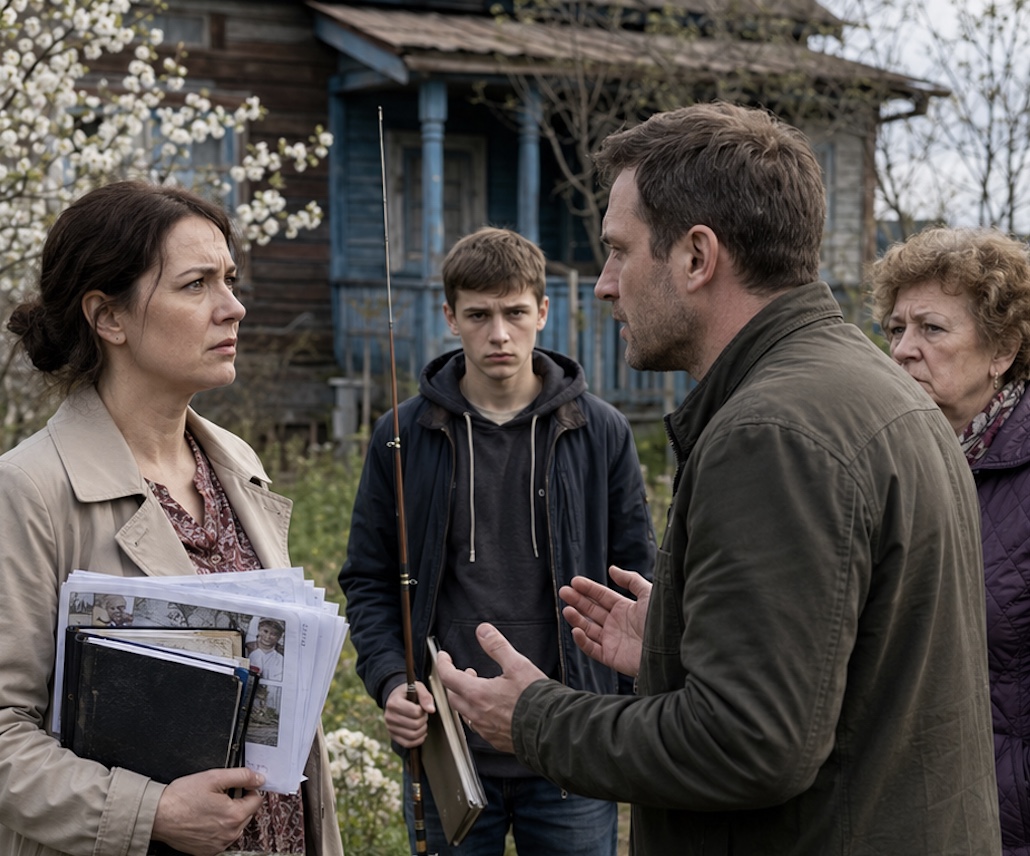
Nina Arkadyevna sat beside him in a gray jacket, neat, dry, with the expression of a woman who had not come to argue but to accept a sensible decision. Her cup of tea had gone cold untouched.
Pavel, the sixteen-year-old son of Svetlana and Denis, stood near the kitchen door holding his grandfather’s old fishing rod. He had brought it back from the village the previous weekend and had still not put it away in his room.
“Svet, you’re starting with hurt feelings again,” Denis said.
“I’m starting with a fact.”
“The fact is that the house is empty. The roof leaks. The veranda has sunk. The garden is overgrown. It needs more money than it’s worth.”
“You invited someone to look at the house without me.”
“I just showed it.”
“To whom?”
Denis looked away.
Nina Arkadyevna intervened.
“Svetlana, don’t be like this. Denis only wanted to understand the price. A reasonable man first looks at what he has in his hands.”
“In whose hands?”
Her mother-in-law pressed her lips together.
“The family’s.”
Svetlana looked at her.
“My parents’ house was never in your family’s hands.”
Denis slammed the folder shut.
“There it is. Already dividing everything. Your parents, my house, her apartment. But when my mother is cramped, all of you suddenly pretend not to hear.”
“Your mother is cramped in her apartment, so my parents’ house has to be sold?”
“Old things should be turned into money. Otherwise, they rot.”
Pavel raised his eyes.
“It won’t rot if it’s repaired.”
Denis turned toward him.
“Nobody asked you.”
“And did anyone ask Grandpa when you were photographing his shed?”
The silence in the kitchen became so thick that Svetlana heard the first June gnat hit the windowpane. The evening was bright, almost summery. Their city apartment smelled of dust, tea, and paper. But in Svetlana’s memory, everything smelled different at that moment: apples, old wood, cold water from the well, and her mother’s starch, which she once used to smooth the curtains.
The village house had come to her in spring.
Three years had passed since her mother’s death, five since her father’s. The paperwork had taken time: one certificate, then an archive request, then a trip to the district center. Svetlana had delayed not because she did not want to deal with it. It had simply felt as though, while the papers were not finalized, her parents were still somewhere nearby. Not legally. Humanly.
The house stood forty kilometers from town.
The village was small, the road broken in places, and the bus came only twice a day. The house was old, with a veranda that leaned slightly toward the garden, as if tired of holding up summer conversations. Her father had always planned to rebuild it.
“I’ll put up a new veranda,” he used to say, tapping the boards with his boot. “A proper one, so you can sit there in summer and complain about mosquitoes.”
Her mother would laugh.
“First clean out the shed. You’ve got more metal in there than a workshop.”
The shed still stood.
It smelled of wood shavings, rusty metal, and her father’s tobacco, which he hid as if Svetlana, at forty, did not understand that a grown man smoked for reasons unrelated to the neighbors. A plane hung on the wall. Beneath it was a box of nails, a jar of screws, and an old hammer with the letter “Z” burned into the handle.
Zhuravlyov.
Her maiden name had also been Zhuravlyova. After the wedding, she had not changed it because Denis had said:
“As you wish. I don’t need extra paperwork.”
Back then, it had sounded like freedom.
Now the surname on the house documents seemed like a thin thread tying her not to her husband, but to those who could no longer defend what had been theirs.
“We are not selling the house,” Svetlana said.
Denis exhaled in irritation.
“We will think about it.”
“I already have.”
“You’re emotional.”
“No.”
Nina Arkadyevna picked up her cup.
“Svetlana, I live on the fifth floor without an elevator. The bathroom is so small I can barely turn around. I worked my whole life. I raised my son. Am I asking for so much? Your parents’ house is empty. The dead don’t need it anymore.”
Pavel flinched.
Svetlana slowly turned toward her mother-in-law.
“Do not say that in front of my son.”
“I told the truth.”
“No. You said what was convenient.”
Denis tapped his fingers against the table.
“Mom needs decent housing.”
“Buy it.”
“With what?”
“With your money.”
“We are a family.”
“When it’s your debt, we’re a family. When it’s my memory, it’s junk for sale.”
He jumped to his feet.
“We’ll sell your parents’ house. Mom needs it more. Enough clinging to the past!”
That was when she called him a stranger.
Not with a scream.
Not through tears.
Quietly.
“You are speaking like a stranger right now.”
Denis went pale.
“Say that again.”
“A stranger.”
“I’m your husband.”
“A husband does not measure his wife’s pain by the price of an old veranda.”
Nina Arkadyevna stood up sharply.
“I will not allow you to speak about my son that way.”
“And I will not allow you to speak about my parents as if they were empty walls.”
Pavel left the kitchen.
A second later, the door to his room closed. Not loudly, but sharply enough that Denis turned his head.
“Now you’ve turned the child against me too.”
“Were you planning to sell his grandfather’s fishing rod as well?”
“Don’t talk nonsense.”
“Then stop selling what is still alive to him.”
Denis grabbed the folder.
“I’ve already arranged a meeting. On Sunday, people are coming to look. We’ll just listen.”
“No.”
“Svetlana.”
“No.”
“I said we’ll only hear their offer.”
“And I said no.”
He smirked.
“You’ve become stubborn.”
“I’ve become the owner.”
“The owner of a ruin?”
She stood up.
“Leave with that folder.”
“It’s my house too now, if we’re a family.”
“No. It is my inherited house. And my memory. A memory you approached with a buyer and your mother.”
Nina Arkadyevna gasped.
“A buyer? Denis, you told me they were just acquaintances who would estimate it.”
Svetlana looked at her husband.
He turned away.
“I didn’t want to upset you.”
“You didn’t want to hear me refuse.”
That evening, she barely spoke.
Denis went out to walk his mother home. Pavel sat in his room with the door half-open. Svetlana did not go to him right away. First, she gathered the photographs from the table and put them into her bag. Then she took the house documents out of the shared folder: the certificate, the registry extract, old papers, the notary documents. Everything that had been lying in the cupboard beside utility bills and the internet contract, as if it were just another ordinary piece of household paperwork.
Not anymore.
She moved the documents into a separate folder and placed it in her bag.
Then she knocked on her son’s door.
“May I?”
Pavel sat on the floor. The fishing rod lay in front of him. Beside it was an old squared notebook with yellowed pages.
“Where did you get that?”
“In the shed. In Grandpa’s box. I wanted to show you on Sunday.”
“What is it?”
He handed her the notebook.
On the first page, in her father’s handwriting, was written: “Veranda. Measurements. Materials.” After that came drawings. Uneven, but clear. Posts, railings, steps, a bench along the wall. Notes in the margins: “Corner for Svetka’s armchair,” “Box for Pavel’s fishing tackle,” “Socket by the window — kettle.”
Svetlana sat down on the bed.
“He wrote this when I was already grown.”
“Did Grandpa want us to come there?”
She ran her finger over the line about the fishing tackle box.
“Yes.”
Pavel said dully:
“Dad doesn’t understand.”
“No.”
“And Grandma Nina understands. She just doesn’t care.”
Svetlana looked at her son.
At his age, it was easy to be cruel in judging adults. But now there was no teenage contempt in his words. Only pain.
“Maybe.”
“If they sell the house, it will be like Grandpa disappears a second time.”
Svetlana closed the notebook.
“The house will not be sold.”
“Dad said people are already coming.”
“I’ll cancel it.”
“He’ll be angry.”
“Yes.”
“Are you scared?”
She could have said no. She could have played the strong mother. But her son had already grown out of the age when a parent’s lie sounded like protection.
“I am.”
“Then I’ll go with you.”
“Where?”
“To the village. Before Sunday. So we’ll be there.”
She nodded.
“We’ll go.”
The next day, Svetlana worked at the pharmacy as if through glass.
People came in for blood pressure pills, nasal drops, bandages, joint ointment. She rang up purchases, explained dosages, answered questions, but her thoughts kept returning to her father’s notebook. “Corner for Svetka’s armchair.” As if her father had left her not a drawing, but permission to take up space in the house.
After lunch, Fyodor Matveyevich came in.
Tall, thin, gray-haired, wearing an old cap. A former shop teacher and a friend of her father’s. Years ago, he had taught boys how to plane wood, never chased girls out of the workshop, and always said:
“Hands are not male or female. They are either lazy or smart.”
He bought iodine and adhesive bandages, then lingered by the counter.
“Svetlana, did Denis go to the house yesterday?”
She looked up.
“How do you know?”
“A neighbor called me. Said people were walking around, taking pictures, and some man with a measuring tape was there. I thought maybe you had started repairs.”
Svetlana felt irritation rise in her again.
“No. Not repairs.”
Fyodor Matveyevich looked at her attentively.
“Selling?”
“Denis wants to.”
“And you?”
“No.”
He silently put the bandages into his pocket.
“Your father would have said no too.”
Svetlana swallowed.
“Are you sure?”
“A month before the hospital, he told me, ‘The house isn’t rich, Fedya, but it’s a root. As long as a person has somewhere to return to, they’re not completely orphaned.’ He wasn’t thinking about money.”
“Denis says old things should be turned into money.”
Fyodor Matveyevich gave a dry smile.
“That’s what people say when they haven’t left anything of themselves in the old things.”
“The veranda is falling apart.”
“A veranda can be fixed.”
“The roof.”
“The roof too.”
“There isn’t extra money.”
“Nobody has extra money. Memory often gets repaired slowly. The important thing is not to hand it over to people who find it inconvenient.”
He took a small wrapped object from his bag.
“I wanted to bring this to you in the summer. But since things are like this…”
Inside the wrapping lay an old metal sign: “Zhuravlyovs.” Rusty, with little holes in the corners.
“I took it down when your father wanted to make a new gate. It ended up staying in my shed. Put it back where it belongs.”
Svetlana took the sign.
The metal was cold and heavy.
“Thank you.”
“Don’t thank me. Just don’t sell it for someone else’s cramped life.”
That evening, Denis was waiting for her at home.
Pavel was packing a backpack in his room: his grandfather’s notebook, the fishing rod, a flashlight, a sweatshirt. In the kitchen, Denis sat at the table with his phone in front of him. His face looked tired and angry.
“Mom cried,” he said instead of greeting her.
“That’s unfortunate.”
“That’s all?”
“What do you want me to say?”
“That you’ll at least think about it.”
“I have thought about it.”
“Svet, it’s hard for her. You know what her apartment is like.”
“I know.”
“She’s getting old.”
“My parents are already dead. That does not turn their house into a free cash register.”
“Big words again.”
“They are quiet words. Yesterday you were the one who loudly arranged a sale.”
He picked up his phone.
“I haven’t canceled Sunday.”
“You will.”
“No.”
“Then I will.”
“You have no right.”
Svetlana almost smiled.
“To my own house?”
He jumped up.
“Does our marriage mean nothing to you anymore?”
She looked at the wedding ring on her finger. Thin, simple, bought from a small jewelry counter the year they married. Back then Denis had been nervous, checking the size, joking that he was more accurate with rings than with stools.
“Marriage does not give you the right to sell my parents’ house.”
“I wanted to solve a problem.”
“Whose?”
“Ours.”
“No. Your mother’s.”
“You hate my mother?”
“No. I’m simply not obligated to buy her an apartment at the cost of my parents’ home.”
Denis fell silent.
Then he said quietly, dangerously:
“You chose the dead over the living.”
Svetlana felt the phrase strike the one place inside her that was still soft. Slowly, she took off her ring.
Denis went pale.
“What are you doing?”
“Removing the symbol from the hand you wanted to use to sign away my parents’ house.”
“Don’t put on a show.”
“This is not a show.”
She placed the ring on the table.
“A stranger has no right to sell my memory. A husband has no right either. But at least with a stranger, I don’t owe explanations.”
“You really think I’m a stranger?”
“In this matter, yes. And what scares me is that in this matter, you revealed yourself more clearly than anywhere else.”
Pavel came out into the hallway with his backpack.
“Mom, I’m ready.”
Denis turned toward him.
“Where are you going?”
“To the village.”
“No one is going anywhere.”
“I’m going with Mom.”
“Pavel.”
“Dad, you wanted to sell Grandpa’s house without even asking me.”
“The house isn’t yours.”
“It’s Mom’s. And Grandpa’s. And Grandma’s. Yours is only the buyer at the gate.”
Denis stepped toward his son, but Svetlana stood between them.
“Don’t touch him.”
“You’re turning him against me.”
“You chose the wrong side all by yourself.”
They left after dark.
The road to the village stretched between black strips of forest and scattered lights. Pavel was silent for almost the entire drive, holding his grandfather’s notebook and fishing rod on his knees. Svetlana drove, feeling exhaustion press down on her shoulders, but she did not want to turn back.
The house greeted them with the smell of grass and damp wood.
The veranda really had sunk. One step shifted under her foot. Her mother’s curtains still hung in the window — faded, but whole. Svetlana ran her palm across the windowsill. Dust stayed on her fingers. Pavel opened the shed and switched on a flashlight.
“Mom, shall we hang the sign tomorrow?”
“Yes.”
“On the gate?”
“On the gate.”
“And will we repair the veranda?”
Svetlana looked at the house.
Before, that question had always sounded like, “Where will we get the money?” Now it sounded like, “Where do we begin?”
“We will. Not all at once. First, the steps.”
“I can help.”
“You’re studying.”
“I can study and fix steps.”
She smiled.
“Grandpa would have appreciated that.”
Inside the house, they turned on the light.
The bulb in the kitchen flickered, then brightened. Old clocks hung on the wall, stopped at half past two. On the shelf stood two cracked mugs — not the kind people write sentimental stories about, just old mugs that had survived more conversations than many people. Svetlana took them down and put them in the sink.
Pavel spread a sleeping bag on the sofa.
“I’ll sleep here.”
“It’s dusty.”
“It’s fine.”
“The word ‘fine’ from a teenager covers everything from hunger to the end of the world.”
He smiled.
“Then — livable.”
Svetlana went out onto the porch.
There were almost no stars; the sky was covered with hazy summer clouds. The apple trees stood dark in the garden. Jasmine grew under the window — her mother’s jasmine. It had not bloomed yet, only gathered buds. Her mother had planted it when Svetlana was eleven.
“It will smell like a holiday,” her mother had said then, pressing soil around the thin bush.
Later, holidays had smelled different: pies, rain, medicine, hospital sheets. But the jasmine had survived.
Her phone vibrated.
Denis.
She did not answer.
Then came a message:
“Don’t do anything stupid. I’ll come tomorrow.”
She wrote back:
“The meeting with the buyer is canceled. I have the documents. The house is not for sale.”
The reply came almost immediately:
“You’re destroying the family because of a ruin.”
Svetlana stared at the screen.
Then she typed:
“A family is destroyed by the person who calls someone else’s pain a ruin.”
She sent it.
In the morning, Fyodor Matveyevich arrived.
On an old bicycle, with a bag over his shoulder and a small set of tools.
“I knew you’d be here,” he said. “Denis was making noise in town yesterday.”
“It’s already spread?”
“In small places, news travels faster than the bus.”
Pavel came out of the shed with a plane.
“Fyodor Matveyevich, do you know how to fix a step?”
“I do. But first, tea. Repairing things on an empty stomach isn’t work. It’s punishment.”
They sat on the veranda while the boards creaked softly under their feet. Fyodor Matveyevich told them how Svetlana’s father had made birdhouses with schoolboys, how he scolded crooked nails, how he had once brought little Pavel a wooden car.
“He didn’t keep the house like a museum,” Fyodor Matveyevich said. “He wanted people to live here. To make noise, repair things, argue about mosquitoes. A house without people gets sick too.”
“What if I can’t manage it?”
“You’ll manage it in pieces. Nobody is demanding that you cover the roof in gold by tomorrow.”
“Denis demands that I sell it.”
“Denis doesn’t need the house. He needs a sum. You have to be careful with sums. They get spent quickly, and the empty place remains for a long time afterward.”
Svetlana looked at the garden.
“Nina Arkadyevna says the living must be helped.”
“A good phrase. Many things are taken away with that phrase.”
Pavel silently planed a piece of wood, carefully but unevenly.
Fyodor Matveyevich nodded toward him.
“There’s someone living. Help him not lose his roots.”
By noon, they had hung the “Zhuravlyovs” sign on the gate.
Pavel held it straight, Fyodor Matveyevich tightened the screws, and Svetlana stood beside them. The sign was old and worn, but on the gate it looked as if it had come home.
Denis arrived an hour later.
The car stopped sharply by the fence. He got out and slammed the door. Nina Arkadyevna was with him. When Svetlana saw her in the passenger seat, she understood: he still had not come to talk. He had come with support.
“What is this?” Denis pointed with his eyes at the sign.
“A surname,” Pavel said.
“I can see that.”
“Then why ask?”
Nina Arkadyevna got out of the car.
“Svetlana, you’ve put on quite a performance.”
“I returned my father’s sign.”
“We are all struggling, and you’re nailing bits of metal to a gate.”
Fyodor Matveyevich rose from the bench.
“Nina Arkadyevna, bits of metal are sometimes more honest than people. At least they say who they belong to.”
She narrowed her eyes.
“And who invited you?”
“The late owner of this house invited me for forty years. I think the invitation hasn’t expired.”
Denis stepped toward Svetlana.
“The buyer is coming tomorrow. I didn’t have time to cancel.”
“I canceled it.”
“You couldn’t have.”
“I could. His number was in your messages with your mother on the printout you brought home yourself. He was surprised that the owner objected. He understood very quickly.”
Denis turned red.
“You were digging around?”
“You placed photos of my house and a price discussed without me on my table. After that, I looked at who I needed to stop.”
Nina Arkadyevna said:
“Svetlana, you’re thinking about the wrong thing. I’m not a young girl. I’ll soon be seventy. I want to live decently.”
“Then live decently. But not at the cost of the house where my mother sewed curtains and my father drew plans for a veranda for his grandson.”
“The dead are neither cold nor cramped.”
Pavel’s head snapped up.
“Grandma Nina, enough.”
She stopped.
“Pavlik…”
“Don’t say that. Grandpa died, but he is still my grandpa. Grandma died, but her curtains are still here. If you need an apartment, that doesn’t make their house garbage.”
Denis stepped toward his son.
“Don’t shut adults up.”
Fyodor Matveyevich said quietly:
“He isn’t shutting anyone up. He’s defending his right to remember.”
Denis turned on him.
“And you stay out of it.”
“Then don’t bring a sale here.”
Svetlana raised her hand.
“That’s enough. This conversation is short. The house is not for sale. I have the documents. The meetings are canceled. No one is to be brought onto this property without my consent.”
“You’ve lost your mind,” Denis said.
“No. I’ve come back to myself.”
“Because of this shed, you’re ready to ruin our marriage?”
She looked at the house.
At the crooked veranda.
At the window with her mother’s curtains.
At her son by the gate with his grandfather’s fishing rod.
At Fyodor Matveyevich, standing near the old bench not as witness to a deal, but as witness to memory.
Then she looked at her husband.
“A marriage where the husband sees my parents’ house as bargaining money for his mother has already cracked. I simply refuse to cover the crack with a curtain.”
Nina Arkadyevna sighed.
“So much anger.”
“No. Yesterday was anger. Today is clarity.”
Denis noticed her bare hand.
“You took it off?”
“Yes.”
“Because of the house?”
“Because of you beside this house.”
He looked as if he wanted to answer sharply, but his voice failed him.
“Svet, I wanted what was best.”
“For whom?”
He said nothing.
“There,” she said. “Even now, you can’t say, ‘for you.’”
Nina Arkadyevna grabbed her son by the sleeve.
“Let’s go. Let her sit here with her boards.”
Denis did not move.
“Pavel, home.”
Pavel looked at his mother.
“I’m staying.”
“I’m your father.”
“And Grandpa was a father too. His house is not being sold.”
Denis clenched the keys in his hand.
“Fine. Enjoy yourselves.”
He turned back toward the car.
Nina Arkadyevna got in first. Denis paused by the gate and looked at the sign: “Zhuravlyovs.”
“One day you’ll understand that an old house won’t keep you warm.”
Svetlana replied:
“But at least it won’t sell me for someone else’s comfort.”
The car drove away, lifting dust behind it.
Pavel watched it for a long time.
“Mom, is everything going to be bad?”
Svetlana did not promise something easy.
“It will be different.”
“Will Dad come back?”
“I don’t know.”
“And us?”
“We’ll fix the step.”
Fyodor Matveyevich cleared his throat.
“That is a proper plan. Enough for one day.”
They repaired the step until evening.
The board turned out worse than they had thought. The nails were rusty, one split the edge, Pavel swore, Svetlana told him to leave out words from garage pits, and Fyodor Matveyevich showed him how to place a support block. The work was awkward, slow, and real.
That evening, Svetlana took down her mother’s curtains, shook them outside, and soaked them in a basin. The water quickly turned gray. Pavel brought an old brush from the shed.
“Will they wash clean?”
“I don’t know.”
“If not, will we sew new ones?”
“I don’t know how.”
“We’ll learn.”
She smiled.
Her son spoke the way her father once had about the veranda: without proof, but with the certainty that a house answers those who stay in it.
A week later, Svetlana arranged to store the documents separately from the city apartment. She took all originals out of the shared cupboard, made copies, and wrote down repair expenses. Not for Denis. For herself. So she could see not fear, but a plan.
Denis called rarely.
At first, with accusations.
“Mom’s blood pressure rises because of you.”
“Find her a doctor, not my house.”
“You’ve become a stranger.”
“I called you a stranger when you were selling what was mine.”
Then he went silent.
Then he sent a message:
“We need to talk.”
She replied:
“After you admit the house is not for sale.”
There was no answer for three days.
One day, Nina Arkadyevna called herself.
“Svetlana, I didn’t think you were so hard.”
“You thought I was convenient.”
“You could have helped an old woman.”
“I could have. But you didn’t ask for help. You asked me to tear out a root.”
“You speak too dramatically.”
“Because when I spoke quietly, you didn’t hear me.”
Her mother-in-law hung up.
In July, the jasmine bloomed.
Svetlana came to the village after her shift at the pharmacy. It had been a long day: heat, patients, a woman with a child’s rash, a man with an illegible prescription, a supplier who had mixed up the boxes. She was so tired that she sat in the car by the gate for several minutes without getting out.
Then she smelled it.
Jasmine beneath her mother’s window.
She stepped out.
Pavel was already there. He had come by bus after practice and opened the house with his own key. A new step stood on the veranda. Not perfect, a little lighter than the other boards, but strong. His grandfather’s notebook lay on the bench, a pencil beside it. On the page, Pavel had drawn his own version of the fishing tackle box.
“Hi,” he said.
“You came alone?”
“Fyodor Matveyevich stopped by. He said I hold the saw crookedly, but I have potential.”
“That’s almost praise.”
“I understood.”
Svetlana sat down on the step.
“Did Denis write to you?”
“To me? Yes.”
“What did he say?”
“He asked when I was coming home.”
“And you?”
“I wrote: in the evening. Then he asked why I was hanging around here. I wrote: because Grandpa wanted a tackle box.”
Svetlana closed her eyes.
“Did he answer?”
“No.”
They sat silently on the veranda.
Not empty silence. The house made sounds around them: a branch creaked, somewhere a bird tapped, something fell in the shed from a draft, mosquitoes began to circle near the porch. Her mother’s curtains dried on the line. They had not washed completely white, but they had become brighter.
“Mom,” Pavel said, “if you and Dad… well…”
“If we separate?”
“Yes.”
“I don’t know what will happen.”
“But the house will stay?”
“Yes.”
He nodded.
“Then not everything has fallen apart.”
Svetlana looked at her son.
Perhaps that was what made it worth going through the folder of photos, the secret plans, the word “we’ll sell,” the ring on the kitchen table. Not for the old boards themselves. But so her son would still have a place where the past was not sold at the first need of an adult.
At the end of summer, Denis came alone.
Without his mother.
Svetlana was in the garden picking early apples. Pavel was painting the bench by the veranda. Denis’s car stopped quietly at the gate. He got out, stood for a moment, then opened the gate and immediately stopped by the sign.
“May I?” he asked.
Svetlana looked at him.
That word was worth hearing.
“Come in.”
He walked toward the house. He looked at the new step, the washed curtains, the bench with wet paint, the garden.
“You’ve done a lot.”
“We’ve started.”
“Mom is still offended.”
“I’m not surprised.”
“She’s moving in with her sister for a couple of months. Then she’ll think about exchanging her apartment.”
Svetlana said nothing.
“I wanted to say…” Denis faltered. “I was cruel.”
Pavel stopped painting.
Svetlana stood with a basket of apples.
“Continue.”
Denis swallowed.
“I saw the house as money. I didn’t see what it was to you.”
“Because you didn’t want to.”
“Yes.”
“And to Pavel too.”
He looked at his son.
“I’m sorry.”
Pavel lowered the brush.
“For what exactly?”
Denis gave a pained half-smile.
“You’re all your mother.”
“No. Grandpa too.”
“For deciding to sell the house where it matters to you to be. For calling it a ruin. For not asking.”
Pavel nodded.
“I’ll think about it.”
Denis turned to Svetlana.
“And you?”
She set the basket on the ground.
“The ring is still in my drawer.”
“I saw the empty place on your hand.”
“It is more honest than a ring beside your plans.”
“I understand.”
“For now, you hear me.”
He accepted that.
He did not argue. He did not ask to be forgiven quickly. That was already something new. Or very tired old. Svetlana did not know.
“Can I help with the veranda?” he asked.
Fyodor Matveyevich, who had just come from the shed with a jar of nails, said:
“First let him learn to ask the owner which board to take.”
Denis looked at Svetlana.
“Which one?”
She pointed to the boards stacked by the wall.
“This one first. But no more decisions behind my back.”
“All right.”
They worked awkwardly.
Denis was quieter than usual. Pavel answered in short phrases. Fyodor Matveyevich gave instructions without anger. Svetlana made tea and sorted apples. There was still no beautiful corner on the veranda with an armchair, but there was already a board one could step on without fear.
By evening, Denis drove back to town.
He did not stay.
There was not yet enough trust for him to stay.
Before leaving, he said:
“The house really isn’t just walls.”
Svetlana replied:
“For those who still have someone left in it.”
He nodded.
In autumn, the apple trees gave many small sour apples.
Svetlana and Pavel gathered several crates, gave some away, and took some to town. Svetlana left one bag at Fyodor Matveyevich’s door. A note hung from the handle: “For the sign and the step.” Later he called.
“The apples are sour, but honest.”
“They grew as they grew.”
“That’s exactly what’s needed. Sweet things are forgotten quickly.”
In the city apartment, the ring still lay in the drawer.
Sometimes Svetlana took it out, held it in her palm, and put it back again. She was in no hurry. After someone tries to persuade you to sell your root, you cannot simply put a ring back on and pretend the conversation was about the price of boards.
The village house remained.
With its crooked veranda, now being repaired piece by piece.
With jasmine beneath the window.
With curtains washed not to whiteness, but back to life.
With the shed where her father’s plane still hung in its old place.
With the notebook where, beside her father’s drawing, Pavel’s tackle box had appeared.
With the sign “Zhuravlyovs” on the gate.
Not real estate.
Not merchandise.
Not a way to improve someone else’s apartment.
A root.
And Svetlana no longer intended to apologize for holding on to it with both hands.