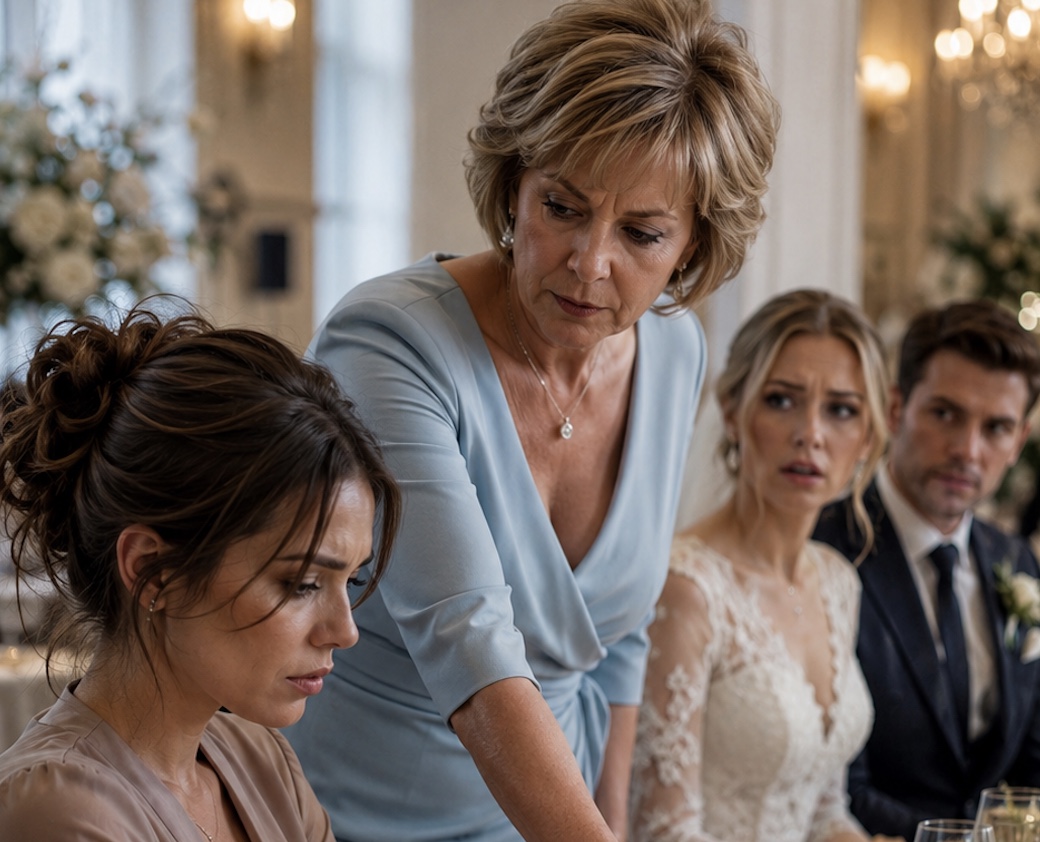
“Olesya, you don’t have to come to my daughter’s wedding,” Galina Stepanovna announced while already arranging the seating plan without her.
At that moment, Olesya was holding a cup of coffee in her hands. She was not drinking it, just mechanically wrapping her fingers around the warm ceramic, because all evening she had felt that something was coming. Her mother-in-law had been trying too hard to pretend everything was calm. For too long, she had been moving her pen across the printed layout of the banquet hall, circling guests’ surnames, crossing out empty seats with a pencil, and not once looking at her daughter-in-law.
The conversations around the table immediately died down.
Pavel, Olesya’s husband, was sitting to her right. At first, he did not even understand that his mother had said it out loud. He raised his head, looked at Galina Stepanovna, then at his wife, then back at his mother. His face became confused, like a man who had just heard someone else’s sentence, except for some reason it had sounded in his own home.
“Mom, what do you mean, she doesn’t have to come?” he asked.
Galina Stepanovna carefully placed the pen beside the seating chart, as if she had just finished an important business meeting.
“I mean exactly what I said. It is Svetlana’s wedding. A special day. No unnecessary people.”
Olesya slowly set her cup down on the table. She did not bang it, spill it, or start grasping for words. She simply placed her palm on the edge of the table and looked at her mother-in-law so intently that, for a second, the older woman looked away.
“Unnecessary?” Olesya clarified calmly.
“Don’t start,” Galina Stepanovna warned at once. “I said it as it is.”
That evening, there were six people sitting in Galina Stepanovna’s kitchen: Galina herself, her husband Viktor Pavlovich, Pavel and Olesya, the bride Svetlana, and her fiancé Kirill. The dinner had been meant to be a family gathering, without guests or unnecessary noise. Svetlana had asked everyone to discuss the final wedding details because less than a month remained before the celebration. But it quickly became clear that there was almost nothing left to discuss. Galina Stepanovna had already decided everything.
She had chosen the restaurant. She had made arrangements with the host. She had approved the flowers, the music, the cake, the photographer, the seating, the timing of the bride’s ransom tradition, the route for the wedding walk, even the shade of the napkins. Svetlana sat beside Kirill and, every few minutes, cautiously said:
“Mom, but we wanted it a little differently…”
Galina Stepanovna waved it off.
“You’ll thank me later. Young people have their heads full of feelings, but a wedding is about organization.”
From the beginning, Olesya had kept quiet. She did not interfere with advice, argue, or try to take control of the celebration away from her mother-in-law. Svetlana was Olesya’s sister-in-law, Pavel’s younger sister, and their relationship was neutral. They were not close, but they were not enemies either. They could congratulate each other on holidays, exchange messages, and choose gifts for the parents together. Sometimes Svetlana asked Olesya’s opinion about clothes or decorations because Olesya had good taste. But she was not truly her friend.
Galina Stepanovna, however, had never hidden the fact that she considered her daughter-in-law a stranger.
From the very first day they met, she had looked at Olesya as if she were some temporary misunderstanding in her son’s life. Pavel had brought her to his father’s birthday back then. Olesya had been nervous, had bought a beautiful set of glasses, had found out in advance that Viktor Pavlovich loved board games, and had brought him a rare edition of a chess puzzle. Her father-in-law appreciated the gift, smiled, and asked where she had found such a thing. But Galina Stepanovna spent the whole evening calling her either Alyona or Larisa, even though Pavel corrected her three times.
“Olesya, Mom. Her name is Olesya.”
“Yes, I understood,” Galina Stepanovna would say. “It’s just such a slippery name, not easy to remember right away.”
Olesya smiled back then. Not because she found it funny, but because she did not want to ruin Pavel’s father’s birthday. In general, she had chosen silence many times for the sake of her husband’s peace. Too many times, as she now understood.
Over seven years of marriage, Galina Stepanovna had managed to make everything she thought perfectly clear. She believed Olesya was not gentle enough, not domestic enough, not grateful enough. What irritated her most was that the apartment where Pavel and Olesya lived belonged to Olesya. She had inherited it from her grandfather before the marriage, and Olesya had told Pavel from the start: the apartment was hers, but they could build a home together through respect, care, and normal conversations. Pavel accepted that. He had never claimed what was not his.
But his mother returned to that subject from time to time with unpleasant persistence.
“It is still strange when a man lives in his wife’s place,” she would say, as if by accident. “It’s not very manly.”
“Pavel lives with his wife, not in his wife’s place,” Olesya once replied.
Galina Stepanovna smirked then.
“So clever.”
After that, Olesya understood that arguing was pointless. Her mother-in-law did not want to understand anything. She wanted to keep the right to sting. So Olesya learned not to expose herself unnecessarily. At family gatherings, she sat beside Pavel, answered politely, helped set the table, but did not take on obligations that were not hers.
In the family chats where Svetlana’s wedding had been discussed over the past months, Olesya’s name appeared rarely. Galina Stepanovna wrote there from morning until night: sometimes sending photos of the restaurant hall, sometimes asking who would pick up the bouquets, sometimes demanding confirmation of the number of guests. Pavel usually answered briefly. Svetlana sent hearts. Kirill posted funny pictures, trying to ease the tension.
Olesya read the messages but almost never joined in. No one directly asked her for anything, and she did not like imposing herself.
Once, Svetlana wrote to her privately:
“Oles, please look at these two invitation options. Which one is better?”
Olesya opened the images. The first option was overloaded, with golden swirls and huge letters. The second was calmer, lighter, and neater. She answered honestly:
“The second one looks more expensive and cleaner. I would only make the date larger.”
Svetlana thanked her. Half an hour later, Galina Stepanovna sent the first option into the group chat and wrote:
“Approved. It looks more festive.”
Olesya simply closed the chat. Pavel noticed her putting the phone aside.
“Mom again?”
“No. Your mother has simply already decided everything.”
“She’s worried. Her daughter is getting married.”
“I understand.”
Olesya really did understand. But understanding did not erase the unpleasant aftertaste. With each passing day, Galina Stepanovna behaved more and more demonstratively. She sent guest lists into the group chat, assigning everyone a role: who would meet relatives, who would help grandmother, who would go with the newlyweds for photos, who would keep an eye on the gifts. Pavel was listed everywhere: “bride’s brother,” “help with the car,” “close family member nearby.” Olesya was nowhere.
When Pavel asked his mother if they needed to buy anything for the wedding, she replied:
“You don’t need anything. Just find yourself a proper suit. As for Olesya, let her decide for herself what she wants to do.”
The phrase was strange, but not openly rude. Olesya said nothing.
A week before the family dinner, Galina Stepanovna called Pavel and said that everyone needed to gather so they could finalize the seating arrangements in the hall. Pavel told Olesya:
“Mom invited us on Saturday. She said we must come.”
Olesya looked up from her laptop. She worked as a packaging designer for a small cosmetics company and had just been reviewing the layout of a new product line. She had had a tiring day, but she nodded.
“All right. We’ll go.”
“Just don’t tense up. We’ll sit for an hour and go home.”
Olesya gave a faint smile.
“With your mother, an hour rarely stays just an hour.”
Pavel wanted to answer something, but he did not. He did not like conversations about his mother. Not because he did not see her character. He did. But every time Olesya tried to explain that Galina Stepanovna was crossing boundaries, he seemed to find himself between two doors, unable to close either one. He wanted everyone to simply tolerate one another. For his mother not to be offended, for his wife not to be upset, for Svetlana to get married without scandals, and for him to remain good in everyone’s eyes.
And now that desire to be good for everyone cracked right there at the family table.
“Mom,” Pavel said, his voice firmer now, “Olesya is my wife. How can she be unnecessary at my sister’s wedding?”
Svetlana sat motionless. Her ears had turned red. She was looking at the papers in front of her mother and seemed to be trying to find Olesya’s name there too. Kirill quietly placed a hand on her shoulder.
Galina Stepanovna straightened her back.
“Pavel, don’t make a scene. I am not obliged to invite a person who does not know how to be part of the family.”
Olesya tilted her head slightly.
“And what exactly did I do for you to decide this in front of everyone?”
“You always keep yourself apart. Always so proper, so cold. You sit there and look as if you’re judging everyone. I don’t need faces like that at the wedding.”
“So this is about my face?” Olesya asked.
Viktor Pavlovich coughed awkwardly.
“Galya, maybe there’s no need…”
“Don’t interfere,” his wife snapped. “I’ll handle it myself.”
Svetlana finally raised her head.
“Mom, I never said Olesya shouldn’t come.”
“And you shouldn’t have to think about that,” Galina Stepanovna replied. “I am freeing you from unnecessary problems.”
“It is my wedding,” Svetlana said quietly.
“Exactly. That is why I want it to go properly.”
Olesya looked at her sister-in-law. For the first time that evening, she felt not hurt for herself, but sorry for Svetlana. The girl was a bride only by title. In reality, her own celebration had long ago been taken out of her hands, leaving her only the dress and the obligation to smile.
“Galina Stepanovna,” Olesya said, “am I understanding you correctly? You have decided that your son should come to his sister’s wedding without his wife?”
“If he respects his mother and sister, he will come.”
Pavel pushed his plate away.
“No.”
His mother turned sharply toward him.
“What do you mean, no?”
“I won’t go without Olesya.”
The kitchen fell silent again. Even the refrigerator in the corner seemed to hum louder than usual.
For several seconds, Galina Stepanovna stared at her son as if he had said something completely indecent. Then she smiled, not warmly and not in confusion, but with pressure.
“Pavlik, you’re speaking out of emotion right now.”
“I am speaking normally.”
“You will regret this later. A sister gets married only once.”
“Then it is especially strange to start her wedding by humiliating my wife.”
Olesya turned her head toward her husband. She had not expected him to answer immediately. Usually, Pavel would ask later: “Don’t pay attention,” “Mom didn’t mean it badly,” “Let’s not make it bigger than it is.” But now he sat upright, fingers locked together in front of him, and it was clear that he himself felt disgusted by how long he had tried to smooth over something that should never have been smoothed over.
Galina Stepanovna tapped her fingernail against the seating chart.
“So because of her, you are ready to ruin your sister’s celebration?”
“Olesya is not the one ruining it,” Pavel said.
Svetlana inhaled sharply and spoke louder for the first time:
“Mom, enough. I don’t want this.”
“Do you even understand what you are saying?” Galina Stepanovna turned to her daughter. “I have been dealing with this for two months. I have worn myself out. I negotiated, called, searched, chose everything. And now you have all decided to make me the guilty one?”
Kirill carefully said:
“Galina Stepanovna, no one is arguing that you have done a lot. But inviting or not inviting the brother’s wife is still not a small detail.”
“And you keep quiet,” she cut him off. “You haven’t even entered our family yet.”
Olesya gave a short laugh. Not loud, almost soundless. That phrase was so revealing that there was no point arguing with it.
“Now everything is clear,” she said.
Galina Stepanovna narrowed her eyes.
“What is clear to you?”
“That this wedding is not about Svetlana and Kirill. For you, it is about who has the right to put whom in their place.”
She got up from the table. The movement was calm, without theatrics. Olesya took her bag from the back of the chair, checked that her keys and phone were inside, and then looked at Pavel.
“I’m going home. You decide for yourself where you need to be tonight.”
Pavel stood up too.
“I’m coming with you.”
“Don’t slam the door because of me,” Olesya said. “This is your family. Finish the conversation.”
“I’ve already finished it.”
Galina Stepanovna went pale with anger. Red patches appeared on her cheekbones. She picked up the seating chart, then immediately put it back down because her hands had started trembling visibly.
“Pavel, if you leave now, I will not forget it.”
“And I will not forget that you called my wife unnecessary in front of everyone,” he replied.
Viktor Pavlovich stood up after him.
“Pavel, son, wait. Don’t be so harsh.”
“Dad, I’m not arguing. I’m just leaving.”
Svetlana looked at her brother as if she wanted to say something, but did not dare in front of her mother. Olesya had already reached the hallway when her sister-in-law suddenly jumped up.
“Olesya, wait.”
Galina Stepanovna turned sharply.
“Sit down.”
But Svetlana did not sit down. She followed Olesya into the hallway, pressed a hand to her chest, and spoke quickly, stumbling over her words:
“I really didn’t know. I didn’t see the final list. Mom said she would print everything herself.”
Olesya looked at her. Svetlana was close to tears, but she held herself together. She blinked often and ran her fingers along the chain around her neck, as if looking for support in a small habit.
“Sveta, this is your wedding. Don’t sort this out with me. Sort it out with the person who decided for you.”
“I will.”
“Then do it now, while it’s not too late.”
Svetlana nodded, but she did not return to the kitchen right away. Olesya saw her standing in the corridor, looking at the closed bathroom door, at the old chest of drawers, at the pile of wedding magazines her mother had neatly placed under the mirror. There was more truth in that pause than in all the discussions about the restaurant.
Olesya and Pavel drove home in silence. Not because there was nothing to say, but because they both understood that the conversation would be difficult. In the car, Pavel opened his mouth several times, then clenched his jaw again. Olesya looked out the window. The evening city drifted past in bright patches of signs and headlights. People hurried about their own business, and everything around seemed too ordinary for what had just happened.
Near their building, Pavel turned off the engine.
“Oles…”
“Not now,” she said.
“I have to say this.”
“Then say it here.”
He exhaled and ran a hand over his face.
“I’m guilty.”
Olesya turned toward him. Not with reproach, not waiting for an apology. She simply looked at him.
“Of what exactly?”
Pavel was silent for a moment.
“For pretending before that these were small things. When she picked at you. When she talked about the apartment. When she called you a stranger. I thought if I didn’t answer, she would calm down.”
“She wasn’t calming down, Pasha. She was checking how far she could go.”
“I know.”
“No, you didn’t know. You hoped I would endure it.”
The words hit exactly where they needed to. Pavel lowered his eyes to the steering wheel.
“Yes. Probably.”
Olesya unfastened her seat belt.
“I am not going to divorce you because of one dinner. But I will no longer play the role of a convenient woman who can be hurt and then made to look as if she imagined everything.”
“I understand.”
“Make sure you really do. Because the next conversation with your mother will happen without my attempts to help everyone save face.”
They went up to the apartment. Olesya took off her shoes, went into the kitchen, and poured herself some water. Pavel stayed in the hallway for a moment, then carefully placed his keys on the cabinet and followed her. He wanted to hug his wife, but he did not do it immediately. Too often before, he had tried to smooth over with a touch what should have been spoken about in words.
“I’ll go to Sveta tomorrow,” he said. “Without Mom. I’ll talk to her and Kirill.”
“That’s right.”
“And as for the wedding… if you are not on the list, I won’t be there either.”
Olesya nodded.
“That is already your choice.”
That night, she could not fall asleep for a long time. She did not toss around, did not cry, did not write angry messages. She simply lay on her side and remembered all the small episodes she had once dismissed as insignificant. How Galina Stepanovna had given everyone gifts last New Year, while Olesya received a set of kitchen towels with the words, “These will be useful for you.” How, at Viktor Pavlovich’s birthday, she had seated Olesya at the edge of the table near distant relatives, while keeping Pavel beside herself. How once, in front of Svetlana, she had said:
“Pavel needed a simpler wife. One without all these endless boundaries.”
Olesya had answered then:
“Everyone has boundaries. Some people just don’t like being reminded of them.”
After that, Galina Stepanovna did not speak to her son for a week, then presented everything as if Olesya had been rude.
In the morning, Pavel went to Svetlana’s place. Olesya stayed home and took care of ordinary things. She did not call her friends and retell yesterday’s dinner. Not because she did not care. On the contrary, there was an unpleasant clarity inside her. But Olesya knew that if she started discussing every phrase now, she would once again be pulled into the swamp of other people’s emotions.
She opened her laptop, finished the work layout, and sent an email to the production manager. Then she took a box from the wardrobe where the apartment documents were kept, simply checked the folders, and put it back. Not out of fear. Out of the habit of keeping important things within reach. The apartment was hers, and she had always held that line firmly. There had already been people in her life who tried to convince her that someone else’s property became shared through frequent visits and loud words.
Around lunchtime, Svetlana called.
Olesya looked at the screen for a while. Then she answered.
“Yes, Sveta.”
“Can I come over? Alone.”
“Come.”
Forty minutes later, Svetlana was standing at the door. No makeup, in a simple jacket, her hair tied back. She did not look like a bride before a wedding, but like someone who had been forced to grow up faster than she wanted overnight.
Olesya let her in and offered her water. Svetlana went into the kitchen, sat down on a chair, and immediately said:
“I canceled Mom’s seating plan.”
“That was fast.”
“Kirill helped. This morning we went to the restaurant. We spoke with the administrator. It turned out Mom had listed herself as the main contact person. All questions went through her.”
“And you and Kirill?”
Svetlana smiled crookedly.
“We were supposed to simply make a beautiful entrance into the hall.”
Olesya did not pity her out loud. Sometimes pity only humiliates.
“And what now?”
“Now the restaurant will call me and Kirill. I told Mom that if she tries one more time to decide things instead of us, we will move the wedding somewhere else. Even if it has to be more modest.”
Olesya looked at her sister-in-law carefully.
“Are you really ready for that?”
Svetlana clasped her fingers together.
“Yesterday, when she told you not to come, I was scared at first. Then I felt ashamed. And then I realized any of us could have been in your place. Today she crossed you out. Tomorrow she will start teaching Kirill whom he should consider family. Then she’ll decide when we should have children, where we should live, who we should talk to. And if I stay silent now, it will no longer be only her fault.”
For the first time in twenty-four hours, Olesya felt genuine respect for Svetlana.
“That is a good conclusion.”
“I want you to come. Not out of politeness. I really want you there.”
“Sveta, I will not go somewhere where I am tolerated just for the picture.”
“I am not asking you to tolerate it. I am asking you to give me a chance to fix what happened.”
Olesya was silent. Svetlana continued:
“I know we are not close. I often stayed aside because it was easier not to argue with Mom. She has been like this since childhood: first she decides, then she explains that it is better this way. I got used to it. Pavel got used to it. Dad has been silent for years because otherwise a storm starts at home. But yesterday, for the first time, I saw from the outside what it looks like.”
“An unpleasant sight?”
“Very.”
Olesya stood up, took a glass from the cabinet, and poured herself some water. Then she said:
“I’ll think about it.”
“Of course.”
Svetlana stood up, but stopped at the door.
“One more thing. Mom invited Liza to the wedding.”
At first, Olesya did not understand who she meant. Then she remembered. Elizaveta was Pavel’s ex-girlfriend. They had dated before Olesya for almost two years and had parted calmly, without drama, but Galina Stepanovna had sighed for a long time that “Liza was one of us.” That same Liza had once worked with Galina Stepanovna at the district administration and knew how to please older people: bringing treats, listening to advice, agreeing even when she thought differently.
“Why?” Olesya asked.
Svetlana grimaced.
“Mom said Liza was like a niece to her. But I didn’t invite her. Kirill didn’t invite her either. She appeared on the list next to Pavel.”
Olesya slowly placed the glass on the table.
Now the picture was complete. Not simply to cross out the daughter-in-law. To seat the son next to his ex. At the daughter’s wedding. In front of the whole family. Under the appearance of caring about a beautiful seating arrangement.
“I see,” Olesya said.
“I removed her,” Svetlana added quickly. “Already. Really.”
“You don’t have to justify yourself to me.”
“I do. Because it is my wedding, and the ugliness turned out to be mine, even if I wasn’t the one who invented it.”
After Svetlana left, Olesya stood by the window for a long time. She did not stare dramatically into the distance. She did not wipe away tears. She simply stood there and counted her breaths. One, two, three. Then she picked up her phone and wrote to Pavel:
“Sveta came to see me. She told me about Liza. Did you know?”
The answer came almost immediately:
“No. I’m on my way home now. We’ll talk.”
Pavel returned angry. Not with loud anger, not shouting. He came in, took off his jacket, carefully hung it up, but his movements were sharp. The muscles in his jaw were tense.
“I didn’t know,” he said from the doorway. “I swear, I didn’t know.”
“I believe you.”
“Mother said Liza ended up on the list by accident because she has known Sveta for a long time. Sveta answered in front of me that she had seen Liza twice in her life.”
Olesya sat down on the edge of a chair.
“And what happened next?”
“Then Mom said you still wouldn’t have come normally, that you would have sat there with an unhappy face, and that she was tired of adapting to a woman who doesn’t respect her elders.”
“Convenient wording.”
“I told her that until she apologizes to you, I am not discussing the wedding with her.”
“Will she apologize?”
Pavel gave a bitter smile.
“She said she has nothing to apologize for.”
Olesya was not surprised.
In the following days, the family chat turned into a field of quiet war. At first, Galina Stepanovna wrote general messages as if nothing had happened:
“Pavel, the ribbons for the cars need to be picked up.”
Pavel replied:
“Let whoever Svetlana asks pick it up.”
Then she wrote to Svetlana:
“You’ll regret listening to outsiders.”
Svetlana answered:
“Mom, Kirill and I are organizing the wedding.”
Viktor Pavlovich tried to smooth things over:
“Let’s not fight. It’s supposed to be a celebration.”
But this time, no one rushed to save Galina Stepanovna from the consequences of her own words.
Olesya did not write anything in the chat at all. She did not want to become part of an argument where her name would be twisted into a convenient excuse. But one evening, she received a private message from Galina Stepanovna.
“I hope you’re satisfied. Because of you, the children are fighting with their mother.”
Olesya read it. She placed the phone face down. A minute later, she picked it up again and wrote:
“No one is fighting because of me. Everyone is responsible for their own words.”
Her mother-in-law replied quickly:
“You will ruin Pavel’s relationship with his family.”
Olesya typed:
“Pavel is an adult. His relationship with his family does not depend only on me.”
She wrote nothing else. Galina Stepanovna sent several more long messages, but Olesya did not open them right away. She read them later, without letting herself get pulled in. They contained the usual accusations: ingratitude, coldness, arrogance, influence over Pavel. Not a single word about what had happened at dinner.
Two weeks before the wedding, Svetlana came over again — this time with Kirill. They brought a new seating plan. On it, Olesya and Pavel were seated at the same table as the couple’s young friends, next to Kirill’s brother and his wife. Not in the center of family control, not pushed to the edge, but normally — like guests who were genuinely expected.
“I’m not seating you next to Mom,” Svetlana said honestly. “That wouldn’t be a celebration. It would be a test of everyone’s nerves.”
“That’s the right decision,” Olesya replied.
Kirill added:
“We also told the host that there would be no spontaneous toasts without approval. Galina Stepanovna had already planned a special segment called ‘a mother’s word.’”
Svetlana covered her face with her hand.
“Don’t remind me.”
For the first time in all that time, Olesya laughed. Quietly, but sincerely.
“Svetlana, are you sure you’re getting married and not escaping management?”
Svetlana looked at her and smiled too.
“It seems like both.”
But Galina Stepanovna was not planning to give up. A few days before the wedding, she called Olesya herself. When Olesya saw the name on the screen, she was hardly surprised. She did not answer immediately. She let the phone ring a few times.
“I’m listening.”
“Olesya,” her mother-in-law’s voice was even, too even. “Let’s talk like adults.”
“Let’s.”
“I lost my temper at dinner.”
Olesya remained silent.
“But you must understand my position too. I’m a mother. I worry. I want everything to be perfect for my daughter.”
“And that is why you decided to cross your son’s wife out and seat his ex-girlfriend next to him?”
There was a pause on the other end.
“Liza has nothing to do with this.”
“Of course.”
“Don’t be sarcastic. I’m not calling to argue.”
“Then speak plainly.”
Galina Stepanovna sighed wearily, but even that weariness sounded like another tactic.
“Come to the wedding. Since the children want it so much. I only ask one thing: behave calmly. Don’t ruin Svetlana’s day. Don’t show your character. Don’t put on a demonstration. Come, smile, sit there, congratulate them, and leave.”
Olesya listened carefully. The longer her mother-in-law spoke, the clearer it became: there would be no apology. There would only be permission to enter the celebration under the condition of good behavior.
“You are not inviting me right now,” Olesya said. “You are giving me instructions.”
“Lord, it’s impossible to talk to you!”
“It is possible. Just not from above.”
“Who is talking down to you?” Galina Stepanovna’s voice rose. “I am making a concession, and you are unhappy again!”
Olesya walked over to the window. In the courtyard, a woman was leading a little boy by the hand. He was dragging a toy truck along the pavement and telling her something excitedly. Ordinary life went on without family ultimatums or someone else’s authority.
“Galina Stepanovna, I will come to Svetlana’s wedding only if the invitation comes from Svetlana and Kirill. Not from you. And only if you stop discussing me as if I am the problem.”
“So I’m supposed to humiliate myself before you?”
“No. You are supposed to stop humiliating others.”
Her mother-in-law hung up.
On the day of the wedding, Olesya woke up early. It was light outside. Pavel was still asleep, turned toward her. His dark suit hung over a chair. Her dress hung on the wardrobe door: deep blue, simple, beautiful, without unnecessary extravagance. Olesya had bought it before the scandal, when she thought she was going to an ordinary family wedding. After the dinner, she had wanted to return it to the store, but then changed her mind. The dress was not guilty of anything.
Pavel opened his eyes and saw that his wife was awake.
“How are you?”
“Fine.”
“Are you sure you want to go?”
Olesya sat up and brushed her hair away from her face.
“I want to see Svetlana get married at her own wedding, not at her mother’s.”
Pavel smiled slightly.
“Sounds like a plan.”
They arrived at the restaurant twenty minutes before the start. Guests were already gathering at the entrance: relatives from Kirill’s side, Svetlana’s friends, cousins, and several of Galina Stepanovna’s neighbors, whom she had somehow also added to the guest list. Olesya immediately noticed her mother-in-law. She was standing near the administrator’s desk in a light-colored suit, tensely saying something to a girl with a tablet.
Viktor Pavlovich stood beside her. He saw Pavel and Olesya, looked slightly confused, then approached them.
“You came,” he said, as if stating an important fact.
“We came, Dad,” Pavel replied.
His father looked at Olesya. There was embarrassment in his eyes.
“Olesya, you… look nice.”
“Thank you, Viktor Pavlovich.”
He wanted to add something else, but could not find the words. He simply nodded and stepped away.
Svetlana appeared from a side door. She was in her wedding dress, holding a bouquet, a little pale, but no longer lost. When she saw Olesya, she visibly exhaled and quickly came over.
“You came.”
“You invited me.”
Svetlana took her hand.
“Thank you.”
Galina Stepanovna saw the scene. Her face hardened, but she said nothing. Perhaps because the photographer was standing nearby. Perhaps because Svetlana had warned her in advance. Or perhaps, for the first time, she understood that if she started something now, she would be stopped.
The ceremony was beautiful. Without excessive grandeur, without anyone else’s orders, with the genuine nervous excitement of the couple. Kirill’s vows were not perfect; he stumbled halfway through, Svetlana laughed, and the hall laughed with her. Olesya watched them and thought that real moments were always a little uneven. They could not be arranged according to a seating chart.
After the ceremony, the guests moved into the hall. Olesya immediately saw the tables. The names were written neatly on the cards. Her card lay next to Pavel’s. It was simple. No emphasis, no demonstration. Just a place beside her husband.
Galina Stepanovna passed by and paused for a second.
“So you came after all,” she said quietly.
Olesya turned her head toward her.
“Yes.”
“I hope the day goes calmly.”
“That depends on everyone present.”
Her mother-in-law wanted to answer, but one of Kirill’s relatives approached them, and Galina Stepanovna immediately changed her face into a festive one.
For the first half hour, everything really did go calmly. Guests congratulated the newlyweds, took photos, laughed. The host turned out to be tactful, without crude contests or pushy jokes. Svetlana gradually relaxed. Kirill stayed close to her the entire evening, not letting her dissolve into other people’s expectations.
But closer to the middle of the banquet, Galina Stepanovna could not hold back after all.
When the host announced the parents’ toast, Kirill’s mother spoke first. She was brief and warm: she wished the children to cherish each other, ignore unnecessary noise, and build their home so that it would be peaceful. The guests applauded.
Then Galina Stepanovna took the microphone.
Svetlana tensed immediately. Kirill placed a hand on her back.
“My dear daughter,” Galina Stepanovna began, “today is not only a joyful day for me, but also a difficult one. I am giving you away to another family…”
Olesya noticed Svetlana wince almost imperceptibly.
“…and I sincerely hope that they will value you there as much as you were valued at home. Because blood family is the most important thing. No one can replace a mother, a brother, a father. All kinds of things happen in life. Different people come along; some stay, some try to become the most important…”
The hall became a little quieter. Pavel slowly put his fork down on his plate.
Galina Stepanovna continued:
“But I wish you, Svetochka, to always remember who your true loved ones are. Who was there from the very first day. Who didn’t appear later with their own rules, demands, and grievances…”
Svetlana stood up sharply.
“Mom, that’s enough.”
Guests turned their heads. Galina Stepanovna froze with the microphone in her hand.
“I haven’t finished yet.”
“You have,” Svetlana said.
Her voice trembled, but she did not sit down.
Kirill stood up too.
“Galina Stepanovna, please give the microphone back to the host.”
Her mother-in-law looked astonished, as if she had been stopped in the middle of a rescue mission.
“How dare you?”
Pavel stood up next. Olesya remained seated, but straightened her back. She did not need to jump up to be noticeable.
“Mom,” Pavel said, “don’t.”
“Don’t what?” Galina Stepanovna was no longer trying to smile. “I am her mother! I have the right to say parting words to my daughter!”
Svetlana stepped out from behind the table. Her dress rustled softly against the floor.
“Parting words are when you wish someone happiness. You are trying once again to show who does not belong here.”
“What nonsense are you talking about?” her mother-in-law turned pale. “I’m talking about family!”
“No, Mom. You’re talking about power.”
That sentence rang out clearly and loudly. Some guests lowered their eyes. Others exchanged glances. Galina Stepanovna’s relatives sat with tense faces. Viktor Pavlovich stood up, approached his wife, and quietly said:
“Galya, give back the microphone.”
“You too?” she hissed.
“Give it back.”
He did not shout. But for the first time that evening, there was firmness in his voice.
Galina Stepanovna held the microphone for a few more seconds, then sharply placed it in the host’s hand and left the hall. The door closed behind her not with a slam, but with a dense, heavy sound.
Svetlana stood in the middle of the hall. Her cheeks were burning, her fingers gripping the bouquet so tightly that one of the stems cracked. Kirill came over, gently took the bouquet from her, and placed it on the table.
“It’s all right,” he told her.
Svetlana shook her head.
“No. But it will be.”
She took the microphone from the host.
“Please forgive us,” she said to the guests. “We’ve had a small family awkwardness. But the wedding continues. And I want to say one thing. There are no unwanted people here today. Everyone here is someone Kirill and I wanted to see. Thank you for coming.”
At first, the hall was silent. Then someone clapped. Then another person, then a third. A few seconds later, almost everyone was applauding. Not loudly, not triumphantly, but supportively. Svetlana exhaled, looked at Olesya, and gave a barely noticeable nod.
Olesya nodded back.
Galina Stepanovna returned about twenty minutes later. This time, without her former confidence. She sat beside her husband and silently took a glass of water. No one rushed to comfort her, no one tried to persuade her to smile. And perhaps that was the most unexpected thing for her: the world had not collapsed because she had left the hall. The wedding continued. People talked, ate, laughed, and congratulated the newlyweds. Svetlana danced with Kirill. Pavel sat beside Olesya and held her hand.
Later, when the guests went outside to watch a small fireworks display, Galina Stepanovna approached Olesya. It did not happen without witnesses — Pavel and Viktor Pavlovich were nearby — but apparently, she decided that this was better than nothing.
“Olesya,” she said dully.
Olesya turned around.
“Yes?”
Her mother-in-law spent several seconds gathering her thoughts. For the first time, Olesya saw her not as the frightening mistress of the family, but as a tired woman who had confused love with control for too long and now did not know how to look without that familiar armor.
“I was wrong when I said you could stay away.”
Pavel said nothing. Viktor Pavlovich said nothing either.
Olesya did not help her mother-in-law. She did not suggest the right words or soften the pause.
Galina Stepanovna swallowed.
“And with Liza… that was ugly.”
“It was not just ugly,” Olesya said. “It was intentional.”
Her mother-in-law lowered her eyes.
“Yes.”
That short “yes” was worth more than long excuses.
“I am not asking you to love me,” Olesya said. “And I am not going to prove that I am worthy of your family. I am Pavel’s wife. That is enough for me to be spoken to respectfully. If you cannot do that, then we will communicate rarely and only when necessary.”
Galina Stepanovna looked up.
“Do you always speak so harshly?”
“No. Only when softness is not heard.”
Pavel squeezed Olesya’s hand a little tighter.
Her mother-in-law said nothing. She turned around and went toward her husband, who was waiting for her by the entrance. Viktor Pavlovich handed her coat to her, and for the first time that evening, she did not start giving instructions about exactly how he should hold the sleeve.
After the wedding, not everything changed at once. Galina Stepanovna did not turn into an affectionate relative overnight. She still tried to send Pavel reproachful messages, still complained to acquaintances that the children had become too sharp, and still began a couple of phrases with, “This never happened before…” But now she was stopped.
Pavel no longer brought other people’s complaints home in the form of requests to endure them. If his mother called and began discussing Olesya, he said:
“Mom, I’m not going to listen to this.”
If Galina Stepanovna invited him alone, he answered:
“Olesya and I are a family. Either invite us properly, or I won’t come.”
Olesya did not gloat. She did not need a victory over her mother-in-law. Victories in stories like this are rarely beautiful. More often, they are simply the moment when a person stops agreeing to humiliation for the comfort of others.
She and Svetlana began communicating more often. Not closely right away, but more honestly. A month after the wedding, Svetlana invited Olesya over. They sat in the kitchen of the newlyweds’ apartment, eating baked fish with vegetables, discussing appliance repairs, funny wedding photos, and how Kirill had stepped on the edge of Svetlana’s dress during the dance.
“You know,” Svetlana said while clearing the plates, “I used to envy you back then.”
“When?”
“Always. You could tell Mom no. I only argued with her inside my head.”
Olesya smiled faintly.
“I didn’t learn right away either.”
“But you learned.”
“Because one day I realized: if someone does not see your boundaries, they will treat your patience as permission.”
Svetlana nodded.
“I understand that now too.”
Galina Stepanovna came to Pavel and Olesya’s home for the first time only three months later. She called in advance and asked whether it was convenient. That alone was already an event. Olesya opened the door calmly. Her mother-in-law brought a box of chocolates and a bouquet for the woman of the house. Not for “Pavlik,” not “for the table,” but specifically for Olesya.
“This is for you,” she said awkwardly.
“Thank you.”
Pavel later admitted that his mother had spent half an hour choosing the bouquet and arguing with herself over whether it would look like weakness. Olesya only shook her head. For Galina Stepanovna, even a simple sign of respect was an internal battle.
They did not become best friends. They did not start hugging at every meeting or calling each other every evening. But a distance appeared between them where they could exist without constant jabs. Galina Stepanovna still sometimes forgot herself, but now she corrected herself quickly. Olesya did not pretend not to notice. Pavel no longer hid behind silence.
One winter evening, the whole family gathered at Svetlana and Kirill’s place. There was no special occasion, just dinner. Galina Stepanovna brought a salad, Viktor Pavlovich brought homemade pickles, and Pavel helped Kirill bring folding chairs from the storage room. Olesya arrived after work and paused in the hallway, unbuttoning her coat.
From the kitchen came her mother-in-law’s voice:
“Leave a place for Olesya next to Pavel.”
Olesya froze for a second. Then she took off her coat and walked in to join the others.
Plates, forks, and napkins were already laid out on the table. Svetlana smiled at her without unnecessary words. Pavel pulled out the chair beside him.
Galina Stepanovna pretended to be very busy with the salad, but still raised her eyes.
“Sit down, Olesya. The hot dish will be ready soon.”
There was nothing extraordinary in those words. Just an invitation to the family table. Without a trap. Without a test. Without a demonstration.
And that was exactly why, for the first time in a long while, Olesya sat among her husband’s relatives without being internally prepared to defend herself.
She was not deceiving herself: people’s characters are not rewritten in one evening, or even in one wedding. But some moments become a boundary after which the old order can no longer return. Galina Stepanovna had once decided that she had the right to appoint who mattered in the family and who did not. At her daughter’s wedding, she saw for the first time that a family was not a guest list under her hand and not a seating chart where an inconvenient name could be crossed out.
Olesya had not shouted, proved anything, or fought for a chair at the festive table. She had simply refused to be someone who could be erased with a pencil.
And that was enough for the others to finally see: when people stay silent for the sake of peace, peace belongs only to the person applying pressure. Everyone else is left swallowing hurt and pretending that this is how things should be.
Olesya did not do that anymore.
And Pavel, as they were driving home from Svetlana’s place that evening, suddenly said:
“You know, I keep thinking about that dinner at Mom’s. If you had stayed silent then, I probably would have tried to smooth everything over again.”
Olesya looked at him.
“Possibly.”
“I’m ashamed of that.”
“Shame is useful if a person changes afterward.”
Pavel chuckled.
“Sometimes you speak like a strict teacher.”
“At least it’s clear.”
He laughed and took her hand.
“I understand now.”
Olesya looked out the car window. The city was wet after the snow, streetlights reflected in puddles, people hurried toward apartment buildings, someone carried bags, someone held a child by the hand. Ordinary life. Without loud victories, without beautiful final full stops. Just life, where every day one has to choose: stay silent for someone else’s convenience, or calmly remind them that you also have a place.
And Olesya now knew for certain: she would never again allow anyone to cross out her place.