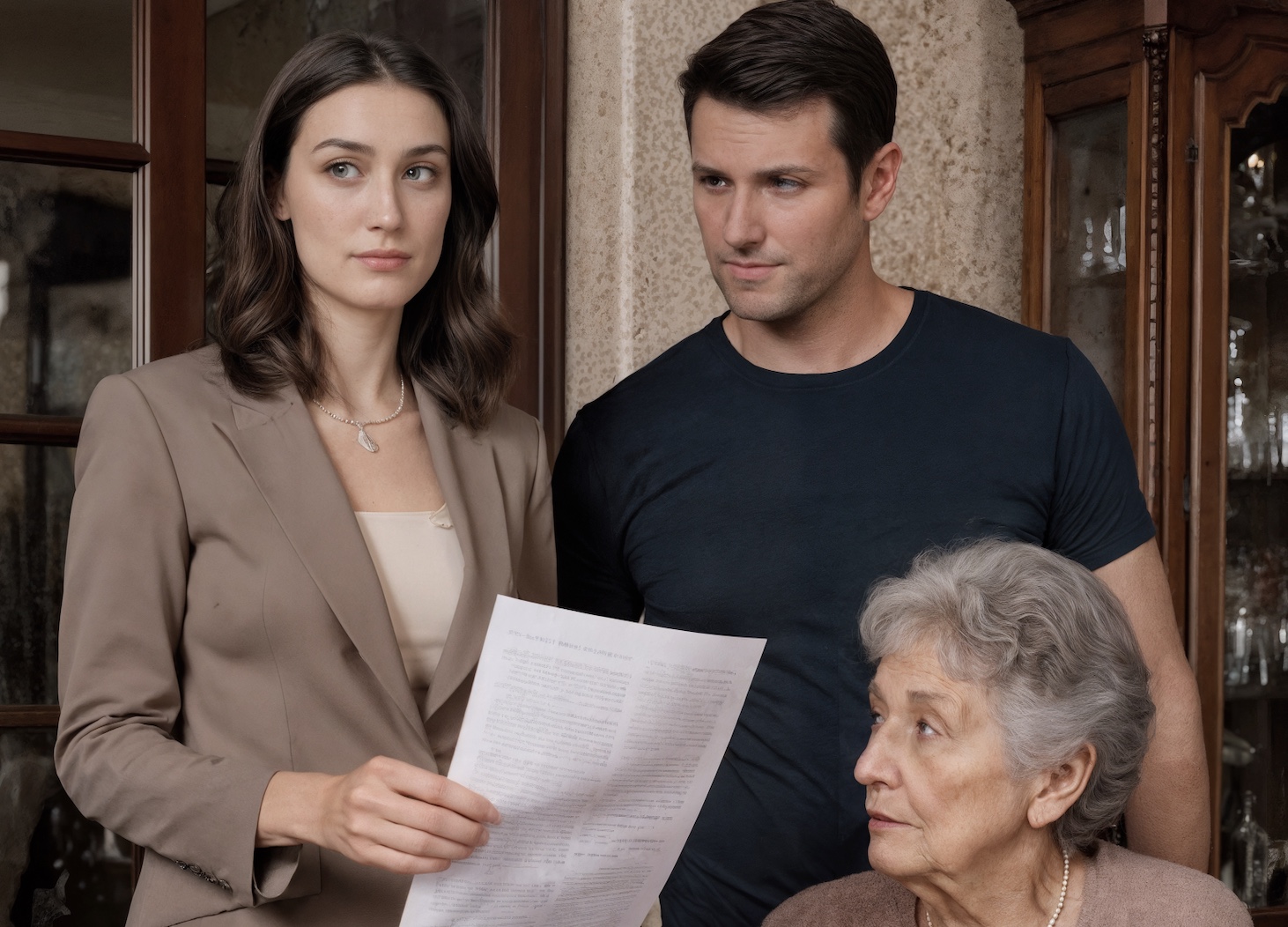
The last rays of autumn sunlight slipped timidly through the kitchen window, staining the walls in warm, honeyed shades. The air carried the comforting scent of just-finished borscht and freshly brewed tea. Irina, settled comfortably in her chair, enjoyed the last mouthful from her cup. The evening felt as ordinary as hundreds before it—quiet dinner with her husband, then tea and small talk.
Alexey sat across from her, hunched over his phone. He scrolled through something, his face intent. A minute earlier they’d been discussing his mother, Valentina Petrovna. She had been complaining that her angina had flared up again, and that it had become too hard to manage a large private house in the suburbs alone.
“We should go out there this weekend—help her split some firewood,” Alexey said, finally looking up from the screen. “The old woman’s really gone downhill.”
“Of course, we’ll go,” Irina answered lightly. “We could even bring her with us for a week—let her rest from the stove and the garden.”
“There’s nowhere for her to rest, Ira. There’s nowhere for her to live,” Alexey snapped. “The house is falling apart, and she can’t handle the land anymore. She needs something small, but hers—out in a settlement where things are civilized.”
Irina nodded, frowning with sympathy. Her mother-in-law was strict and domineering, but even so, an elderly woman with illnesses and a household to run truly had it rough.
“Maybe we should look for options,” Irina suggested. “Small houses in Gotovye aren’t that expensive right now.” She meant the cozy settlement not far from the city.
Alexey set his phone down, took a sip of tea, and looked at his wife with the calm, managerial gaze he usually reserved for subordinates when he was issuing instructions.
“That’s exactly where I’m going with this. We already found one. A great little place—almost new. Mom’s thrilled.”
“That’s wonderful!” Irina brightened. “But where did she get the money? She doesn’t have that kind of cash.”
“We’ll find the money,” Alexey waved it off as if they were talking about a couple thousand. “Mom will live with us until we sell your apartment and buy her that house in Gotovye.”
He said it in a flat, matter-of-fact tone. No request, no discussion. Just an announcement—like telling her it would rain tomorrow.
Irina went still. For a moment she honestly thought she’d misheard. Silence rang in her ears, and the familiar ticking of the wall clock suddenly sounded painfully loud.
“What?” she forced out, feeling the blood drain from her face.
“What’s not clear?” Alexey lifted his eyebrows in surprise. “Your one-room on Lenin Street—the one you got from your grandma. It’s basically sitting empty. We rent it out for peanuts. Makes more sense to sell it, put the money into property for Mom. She’ll be close, under supervision. We’ll have peace of mind.”
Every word struck her mind like a hammer: “your apartment.” “we’ll sell it.” “makes more sense.” Irina stared at his calm, confident face and couldn’t believe what she was hearing. That apartment—her small one-room place in an old building, inherited from her beloved grandmother—was her last untouchable reserve. Her safety net. Her little fortress. It smelled of her grandmother’s pies and old books. Her girlhood dreams and memories lived there.
“Alexey…” Her voice cracked. “That’s my apartment. My inheritance.”
“So what?” He truly didn’t understand. “We’re family. What’s yours is mine. Or is it not? Are you seriously against helping my mother? Her heart grabs her at night, and she’s alone in that wreck of a house! Do you want something to happen to her?”
His voice rose, and a metallic edge of accusation appeared. A classic move—make her the guilty one, paint her as selfish, as someone putting her own “wants” above an elderly person’s health.
Irina said nothing, her trembling hands clenched tight on her knees. In a single instant the cozy evening collapsed, and through the rubble she no longer saw a husband—she saw a stranger: cold, calculating, someone who had just declared he had the right to control the most important part of her life. Without even asking. He hadn’t discussed it. He had simply ruled.
She stared at him and understood: a war had just begun in her life. A war for her past, her memories, and her future.
The ticking clock no longer felt homey—it felt ominous. It measured out the seconds of the heavy silence hanging between them. Irina still sat there, fingers stiff with cold, trying to process what she’d heard. The word “we’ll sell” boomed in her head like a church bell.
“Do you hear yourself?” she finally whispered, looking at Alexey with wide eyes. “That’s my apartment—Grandma’s. You didn’t even ask me. You just… decided.”
Alexey sighed like a man forced to explain the obvious to a stubborn child. He pushed his cup aside and folded his hands on the table.
“Ira, let’s not do emotions. Use your head. What does it matter who it belonged to? Right now it’s an unused asset. It’s just sitting there. And we’re stuck in this mortgaged two-bedroom while Mom suffers out in the middle of nowhere. The solution is obvious.”
“Obvious?” Irina’s voice trembled, the first sparks of outrage breaking through. “Obvious to who? To you? Do you have any idea what that apartment means to me?”
“What’s there to mean?” he scoffed, flicking his hand dismissively. “Old wallpaper and cracked parquet? Sentiment is cute, sure, but you have to look at reality. We’re helping Mom—my mom. Isn’t that the right thing? Isn’t that what family does?”
He said it with such syrupy venom that Irina shivered. He knew exactly where to hit—her idea of family, duty, decency.
“Helping means offering for her to stay with us. Looking for other options. Taking out a loan for her, if it comes to that. Not selling the one thing that belongs only to me!”
“And what’s the difference?” Alexey leaned closer, his stare hard. “If Mom lives with us, it’s forever. Do you get it? Forever. But this way we solve it properly. She gets her own place, everyone’s happy. And you’re clinging to your ‘grandma’s shack’ like it’s elvish gold. What, you don’t love my mother? You want her heart to stop out there in that backwater?”
Irina recoiled as if he’d slapped her. “You don’t love my mother” landed like a sentence. A familiar, nauseating tactic.
“This has nothing to do with love, Lyosha!” she snapped. “It has to do with my rights! You can’t just decide what to do with my property!”
“Our shared apartment is on a mortgage,” Alexey’s voice went cold and perfectly even—the tone he used in meetings when he wanted to put someone in their place. “And I’m the one paying it. I provide for this family. And you… you’re clinging to junk instead of thinking with me about solving a problem. You know what that’s called? Selfishness.”
The word “selfishness” hit so hard Irina felt a flash of guilt. What if he was right? What if she really was greedy—refusing to help a sick old woman? That split second of weakness didn’t go unnoticed.
“We’re a family, Ira,” he continued, softer now, shifting to persuasion. “Everything should be shared—problems, solutions, money. Your apartment is basically our money, sitting dead weight. We’ll put it to work. For a good cause. It’s logical.”
He watched her, confident he had won—sure his iron “male logic” would crush her “silly female sentiment.”
Irina lowered her gaze. Words wouldn’t come. Her arguments about personal space, memory, and boundaries crashed against his wall of “logic” and manipulation. She felt cornered—like a traitor, like a bad wife and an ungrateful daughter-in-law.
“I… I need to think,” she said quietly, staring at the pattern on the tablecloth.
“Sure. Think,” Alexey patted her shoulder with patronizing approval, as if granting her a minor concession. “You’re a smart girl—you’ll get it. By the way, Mom’s moving in tomorrow. I already arranged everything.”
He stood, carried his cup to the sink, and made it clear the conversation was over. The decision was made.
Irina sat alone at the table, in the middle of a comfort that had been smashed to pieces. She heard him turn on the TV in the living room. A football match began—normal sounds of a normal evening. But nothing was normal for her anymore. Her world had cracked, and through the crack blew the icy wind of someone else’s decision—one that threatened to destroy everything she held dear. She felt not like a wife, not like a partner, but like a resource. Like property that could be used without permission.
Morning began with a loud, insistent buzz of the doorbell. Irina, who had barely slept, flinched and looked at her husband. Alexey calmly finished his eggs.
“Probably Mom,” he said as if it were the most natural thing in the world, and went to open the door.
Irina froze in the kitchen, mug clenched in her hand. Tomorrow, her mind repeated. He’d said “tomorrow,” but some part of her hadn’t believed it would truly happen the very next morning.
From the hallway came Valentina Petrovna’s brisk, lively voice.
“Finally, son! Drag the suitcases in—I already paid the taxi drivers. Oh, I nearly died hauling these bags!”
Irina walked slowly into the corridor. The sight made her heart tighten. Alexey was pulling in two huge, battered suitcases. Behind him, taking off her coat and inspecting the entryway with brisk authority, stood her mother-in-law. Valentina Petrovna was a sturdy woman with a short, severe haircut and a piercing gaze.
“Hello, Mom,” Irina said, quietly, automatically.
“Hello, hello, Irochka,” her mother-in-law tossed her a quick look and continued her assessment. “Right… The hallway’s a bit small. Where’s the wardrobe supposed to go? Whatever, we’ll manage.”
She strode into the living room, scanning the furniture, the books, the framed photos on the shelves with a critic’s eye.
“Oh, this room’s cramped. And dark. But Irochka’s apartment on Lenin Street,” she turned to her son, “that one’s bright, I remember. Better layout, too. We’ll rent it out for good money—I already called a few realtors, got some contacts. We need to go there soon and show it off.”
Irina stood as if paralyzed. Her breath caught. They hadn’t simply brought luggage. They had already decided everything. They’d already contacted realtors. They were discussing her apartment—her grandmother’s apartment—like an item on an auction block.
“Mom, maybe tea first?” Alexey tried to insert, but there was no protest in his voice, only a faint attempt to impose order on the process.
“Tea can wait,” Valentina Petrovna waved him off. “You’d better put the bags in that room like we agreed.”
Alexey obediently dragged the suitcases into the guest room—also used as an office and storage space for Irina’s things. The very room where her grandmother’s old vanity stood, along with Irina’s sewing machine.
Meanwhile, Valentina Petrovna marched into the kitchen. Her eyes landed on the pot of borscht that wasn’t finished.
“Yesterday’s borscht?” she asked, lifting the lid. “You can’t eat it on the second day—carcinogens come out. It should be thrown away right away. Don’t take it personally, Irochka, but you have to watch nutrition. Alexey works hard—he needs fresh, healthy food.”
Her tone was smooth and instructive, leaving no room for argument. Every word, every glance, asserted her new place in the home: not a guest, but the woman in charge.
Irina silently watched as a stranger took over her kitchen, criticized her borscht, rearranged her space, and planned to sell her past. She felt like a ghost in her own home—transparent, voiceless.
Alexey returned and tapped her shoulder.
“You’ll get used to it. Mom’s just caring.”
But in his eyes Irina read not support, but a warning: Don’t you dare make a scene. Accept the rules.
Rules where she had no voice—and no right to her own memories. Someone else’s will, blunt and shameless, had walked into her life, unpacked its suitcases, and looked down at her from the height of maternal authority. The war declared the night before had shifted into a new phase—tangible, suffocating, unbearable.
Three days later, life in the apartment felt like living in an aquarium: behind glass, strange indifferent fish drifted around. Irina moved in silence along the same route—kitchen, bathroom, her own room—trying not to be seen. Valentina Petrovna had entrenched herself in the living room, rearranged vases and photos to her taste, and watched TV at full volume all day, commenting on news and soap operas. Alexey seemed not to notice the tense, oppressive atmosphere. He left for work, returned, ate dinner, then disappeared back into his phone or laptop. Whatever warmth had once existed between them had vanished without a trace.
Irina felt her will—her identity—slowly dissolving in that toxic vacuum. Her arguments were ignored, her feelings mocked. She was inches from despair, ready to agree to anything just to reclaim a single drop of peace.
The idea of a lawyer came suddenly, like a life ring tossed into dark water. It surfaced from a fragment of memory—something her friend Olga had once mentioned about a good acquaintance of hers, a family attorney. “He helped her keep the apartment when she divorced,” Olga had said then.
With shaking fingers, Irina found her friend’s number. In the kitchen, Valentina Petrovna clattered dishes, humming.
“Olya… hi,” Irina whispered, locking herself in the bathroom. “You remember that lawyer you mentioned? Can you give me his contact?”
“Ira, what happened?” Olga’s voice sharpened immediately.
“Nothing. I just… need a consultation. Urgently.”
Once she had the number, Irina called right away and booked the nearest appointment, claiming she had an urgent work meeting. Alexey only nodded when she told him she had errands—he didn’t even look up from the screen.
The lawyer’s office was small, but formal and businesslike. Behind the desk sat a man in his forties—Andrey Petrovich—with calm, attentive eyes. He listened as Irina, stumbling and bitter, told him about her husband’s “plan,” her mother-in-law’s invasion, and their intent to sell her apartment. She spoke while holding back tears, feeling completely powerless.
Andrey Petrovich listened without interrupting, occasionally jotting down notes. When she finished, he set his pen aside and folded his hands.
“Irina, let’s put this in order,” he began, measured and clear. “The apartment you inherited after your grandmother’s death is your personal property. That’s regulated by the Family Code.”
Irina stared at him, hardly believing it.
“But we’re married…” she murmured.
“It doesn’t matter,” he said. “Property acquired through a gratuitous transfer—inheritance or a gift—does not become marital property. It belongs only to the spouse who received it. Your husband has no rights to that apartment. Not morally, and not legally.”
The room seemed to go very quiet. The words “no rights” struck Irina like thunder.
“So… he can’t sell it?”
“He can’t,” the lawyer said firmly. “Any transaction involving that property—sale, gift, mortgage—requires your personal, notarized consent. Without your signature, no sale contract will be registered. Even if he somehow finds a buyer and attempts to push a deal through, it can be declared void.”
Irina drew a deep breath. For the first time in days, she felt something strange—almost forgotten—spread through her body: relief. She wasn’t powerless. She had protection. The law was on her side.
“And if… if they pressure me? Try to force me to sign?”
“No one can force you to sign under pressure,” Andrey Petrovich looked at her directly. “That becomes a different matter entirely—potentially criminal. You are the sole owner. Your decision is the only one that matters. Remember that.”
He handed her several printed pages with excerpts from the law and his notes.
“Take these. Sometimes confidence needs paper behind it.”
When Irina stepped outside, she paused and let the cool autumn wind touch her face. It didn’t feel hostile anymore—only fresh and cleansing. In her hand she gripped the folder, heavier than it looked. It carried the weight of her rights. Her shield.
She walked home with a clear, steady feeling she hadn’t had in a long time: she knew what to do. She wasn’t a victim anymore. Soon they would understand. All of them.
Friday evening should have been calm. Irina set the table—salad, a hot dish. Valentina Petrovna, as usual, claimed the seat at the head of the table—the place that used to be Alexey’s. Alexey sat opposite Irina, lost in thought. The air was thick, tight, like the moment before a storm.
Dinner passed in near silence, broken only by the clink of cutlery. Irina ate without tasting much, feeling her mother-in-law’s heavy, appraising stare. She waited, coiled inside herself. The folder lay in the next room inside her bag, and simply knowing it was there gave her an odd calm.
“So,” Valentina Petrovna set down her fork and dabbed her lips. “Tomorrow morning my realtor is coming—Anatoly Ivanovich. We’re going to look at your apartment, Irochka. I’ll need the keys and the documents. Where do you keep the ownership papers?”
Irina raised her eyes slowly. She saw Alexey stop chewing and look at her too. This was it.
“My apartment is not being sold,” Irina said softly, but with perfect clarity. Each word dropped into the silence like a stone into water.
Valentina Petrovna froze, napkin in hand. Her face showed pure disbelief, as if she’d just been told the earth was flat.
“What do you mean, ‘not being sold’?” she hissed. “We decided everything!”
“You decided,” Irina corrected, her pulse quickening. “I didn’t.”
Alexey’s brow tightened.
“Ira, we talked it through. Stop acting up. Give Mom the keys.”
“No,” Irina looked him straight in the eye. “It’s my inheritance. My personal property. And you have no rights to it.”
Valentina Petrovna snorted, her cheeks flushing crimson.
“What property? What rights? We’re family! Are you out of your mind? Alexey, do you hear what your wife is saying?”
“I hear it,” Alexey’s voice dropped, dangerous. He pushed his plate away. “Ira, cut the circus. The family needs money. Mom needs a house. Nobody cares about your childish ‘memories.’”
“They aren’t childish,” Irina sat up straighter. Her hands clenched under the table, but her voice stayed even. “It’s the law. An inherited apartment is personal property. Selling it requires my notarized consent. Without my signature, no sale will be registered. A lawyer explained that to me.”
The word “lawyer” cracked through the air like a whip. Alexey stared at her, startled—his certainty faltering. Valentina Petrovna went silent, her mouth slightly open.
“You… you went to a lawyer?” Alexey said with genuine shock, as if she’d flown to the moon. “You dragged our family problem to some outsider?”
“This isn’t our family problem, Lyosha,” Irina replied. “It’s your problem and your mother’s—one you decided to solve at my expense. And yes, I went to a lawyer. To learn my rights. And now I know you can’t do anything to my apartment. Nothing.”
Valentina Petrovna sprang up so abruptly her chair scraped loudly.
“How dare you talk to me like that! I’m old enough to be your mother! You’ve ruined my whole life with your greedy antics!”
“I haven’t ruined anything,” Irina answered coldly. “I’m protecting what is mine by right. You will not sell my apartment. Period.”
Alexey stood too. Rage twisted his face. He stepped close, looming over her.
“Do you understand what you just did?” he hissed. “You put some paper-pusher above your family? Above me?”
“I put the law above your tyranny,” Irina said, not looking away. “And now, if you’ll excuse me.”
She stood, pushed her chair back, and walked out of the kitchen without turning around. Behind her she heard Valentina Petrovna’s furious, helpless shriek and Alexey’s low, angry voice trying to quiet her.
In her room Irina shut the door and leaned against it. Her heart hammered in her throat, her body trembling with adrenaline. But beneath the fear and strain, another feeling broke through—sharp, dizzying: victory. Small, but essential. She had said “no.” And she had held the line.
She knew it was only the beginning. But the first battle was hers.
The silence that followed that evening was heavy and ominous. It wasn’t the absence of sound—it was sound chosen with precision. The next days unfolded under a banner of icy quiet and small, razor-sharp humiliations.
Alexey stopped speaking to her. He left for work without saying goodbye, returned without greeting her. He answered direct questions in single syllables, avoiding her eyes. His presence felt like a wall erected through the middle of what had once been their shared life. In the evenings he sat on the couch next to his mother, and together they watched TV, forming the image of a cozy circle from which Irina had been permanently excluded.
Valentina Petrovna, by contrast, acted like the unquestioned mistress of the house. Her remarks grew pointed and barbed.
One morning Irina put on a new dress she’d bought before this nightmare began. She simply wanted to feel like herself again—even for a moment.
“Oh, look at you, dressed up,” her mother-in-law purred with fake sweetness, scanning her from head to toe. “That must be an expensive little dress. Wonder whose money that is? The money my son earns working day and night? But for a house for your mother-in-law—suddenly it’s too much.”
Irina said nothing, teeth clenched. She understood the rule: any reaction would be used against her.
One evening she couldn’t find her sketchbook where she always kept it. She did interior design as freelance work, and that notebook held ideas and drafts for a new project. After half an hour of searching, she found it in the trash, smeared with coffee grounds. On top lay a torn-out sheet with Valentina Petrovna’s scrawl: “Sorry, bumped it by accident. Thought it was just scrap.”
Irina pulled it out with shaking hands. It wasn’t an accident. It was a strike—precise and deliberate.
The worst moment came on Saturday morning. Alexey was heading out to meet friends. He stood in the hallway tugging on his jacket.
“Lyosh, could you put a little toward groceries?” Irina asked carefully. Her freelance savings were thinning, and new work wasn’t coming—she had neither the strength nor the focus to chase it. “Money’s tight for me right now.”
Alexey turned slowly. The fury he’d been holding back for days flared in his eyes.
“Tight?” His voice was quiet and terrifying. “Seriously? But you had money for a lawyer to whisper against your own family. And money for new dresses.”
He stepped toward her, and Irina involuntarily stepped back.
“You want money, Ira?” he said through clenched teeth, his face contorting with contempt. “Then hear this. If you live on my money, you live by my rules. You eat what I decide to buy. You wear what I allow. And you won’t have any ‘personal’ apartments or ‘personal’ opinions. Got it? As long as you’re sitting on my neck, your job is to keep quiet and obey.”
He spun on his heel, slammed the door, and left.
Irina stood in the hallway as if doused in ice water. From the living room she heard a restrained, pleased little giggle. Valentina Petrovna had been watching, enjoying every second.
That night Irina cried into her pillow so no one would hear. She felt trapped. They were methodically erasing her—her confidence, her right to respect under her own roof. The legal win felt hollow. On paper she had protected the apartment, but she was losing herself. Psychological warfare was worse than open shouting. It exhausted her, made her doubt her own mind, drove her toward despair. And she understood—it couldn’t go on. Either she would break completely, or she would find the strength for one final blow.
It happened on one of those bleak mornings when even the air in the apartment felt thick and poisonous. Alexey hurried around the entryway searching for his keys, irritable, muttering under his breath. Finally he swore, grabbed his briefcase, and rushed out—forgetting his phone on the table by the mirror.
Irina watched from the kitchen window, empty cup in hand. She no longer expected morning coffee together, or a casual “bye.” Her life had become the anticipation of the next sting, the next insult.
About twenty minutes passed. The phone still lay there, dark and silent. Irina was about to walk past it on her way to the bathroom when the screen lit up with a new notification.
“Sis, waiting for the report on Irka. She broken yet?”
The message was from “Lenka,” his sister. Irina’s heart stopped for a beat. The word “report” sliced straight through her nerves. What “reports” could there be about her?
Her hands reached for the phone before she even thought. She knew the passcode—her dog’s birthday, from the happy days when they’d chosen the dog together. Her fingers shook as she entered it. The phone unlocked.
She didn’t hesitate. She opened the messenger app. The chat with his sister sat at the top.
The first message, from Lena, was from yesterday: “So, how’s the awesome plan? Mom’s obsessed with the little house.”
Alexey replied: “We’ll break Irka, she’ll agree. She’s dumb—she’ll believe it all went to the house. We split the money: Mom gets the house, I get a new car, you get to finish that balcony for your husband.”
Lena: “Yeah, his tools are always underfoot. She won’t suspect anything?”
Alexey: “She’s like a kid. We’ll press guilt, pity, the whole thing. Her lawyer is just talk—he won’t help her. Main thing is don’t let up. I’ll crush her quietly and it’ll be fine.”
Lena: “When do we call the realtor?”
Alexey: “As soon as she caves. Two or three weeks and she’ll melt. She’s almost there.”
Irina stood in the hallway staring at the bright screen. She reread the lines again and again, and with every pass something inside her tore and died. “We’ll break Irka.” “She’s dumb.” “We split the money.” “New car.”
This wasn’t just a plan. It was a cynical, calculated conspiracy. They didn’t just disrespect her—they despised her. They saw her as a stupid object to be broken and used. All his speeches about family, duty, love for his mother—everything had been a lie. A blunt, ugly lie. The man she’d shared a life with was coolly discussing how to rob her, calling her stupid, and buying himself a car with her inheritance.
She didn’t notice the tears rolling down her cheeks. They were hot and bitter, but they weren’t pain anymore—only pure, freezing rage. Rage that burned everything else away: despair, fear, doubt.
She didn’t delete anything. Carefully—hands trembling—she took screenshots of the entire conversation. Sent them to herself. Removed the evidence of sending from his phone. Then placed the phone back on the table.
After that she walked to the mirror and stared at her reflection—pale, cheeks wet with tears, eyes dry and blazing.
“Stupid?” she whispered. “Fine. Now this ‘stupid’ woman will show you what she can do.”
She wiped her face, squared her shoulders, and went to her room—straight to her laptop. The screenshots needed printing. The real war was only beginning, and she had the strongest weapon possible: the truth. Bitter, ugly, undeniable truth.
She waited until evening—not because she was afraid, but because she wanted them together at the same table where it had all begun. This time Irina didn’t help set anything out. She stood by the living-room window, watching city lights ignite in the dusk, and waited. A stack of printed pages was clenched in her hands.
Alexey and Valentina Petrovna sat down at the table. On it stood cold tea and half-unpacked groceries—no one had cooked.
“So, where’s our queen?” her mother-in-law said loudly, making sure Irina could hear. “Pouting in her room again? Maybe she’s finally come to her senses and is ready for an adult conversation.”
Irina turned and walked into the dining area. Her face was calm, almost detached. She didn’t sit. She stepped up to the table and placed the printed screenshots right in front of Alexey, on the clean tablecloth.
“An adult conversation?” she said quietly. “Let’s have one.”
Alexey looked down at the pages, confused. His eyes slid over the lines—and his face began to shift. First surprise, then recognition, then a rising wave of panic and fury. He went white.
“What is this?” he rasped, trying to shove the papers away.
“This?” Irina’s voice turned icy. “This is a report. A report on how you and your sister planned to ‘break the idiot.’ How you were dividing the money from selling my apartment. You—new car. Lena—balcony. And Mom—an old house in Gotovye, just for show.”
Valentina Petrovna lunged to snatch the sheets.
“What nonsense are you spewing now? What reports? Alexey, what is this?!”
But Alexey didn’t look at his mother. He stared at Irina, and in his eyes churned rage and animal fear.
“You went through my phone?” he hissed. “You—”
“Yes,” Irina said coldly. “And I found everything I needed. If I’d waited for honesty from you, I’d have waited forever.”
She paused, letting it settle. The air thickened.
“Now listen to my decision. I won’t repeat myself. You will remain in my apartment until tomorrow morning. By twelve o’clock I want your things packed—and both of you out the door.”
Valentina Petrovna made a sound somewhere between a shriek and a laugh.
“Have you lost your mind? Throwing us out? Your husband and his mother? Who do you think you are?”
“I’m the woman paying the mortgage on this place right alongside your son,” Irina replied evenly. “And I’m done sheltering thieves and scammers under my roof.”
“You can’t prove anything!” Alexey shouted, slamming his fist on the table. “These are fake!”
“Don’t shout,” Irina said. “They aren’t fake. And I’m not here to prove anything to you. In the morning I send these screenshots to your father, to Lena and her husband. And to your management at work. I’m sure your company values employees with spotless reputations—and doesn’t appreciate schemes to defraud a wife of her property. And I’ll file a police report as well—for psychological pressure and blackmail aimed at taking my property.”
Her voice stayed quiet, but every word hit its mark. Alexey stared at her, sweat beading on his forehead. He could see she wasn’t bluffing.
“You… you wouldn’t dare…”
“I will,” Irina cut in. “Now excuse me. I have a big day tomorrow. In the morning I’m meeting a realtor. I’m renting out my apartment. I’ll need the money for a strong lawyer—for the divorce.”
She turned and walked out of the dining room. Behind her came the storm—Valentina Petrovna’s shrieking insults, and Alexey’s low, furious attempts to calm her down.
But Irina wasn’t listening anymore. She moved down the hallway, and she wasn’t shaking. For the first time in weeks, her soul felt quiet. Let their world of lies and betrayal collapse behind her. Ahead was freedom.
And this—finally—was her victory. Total, final, and lawful.