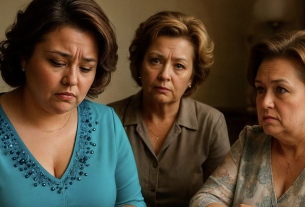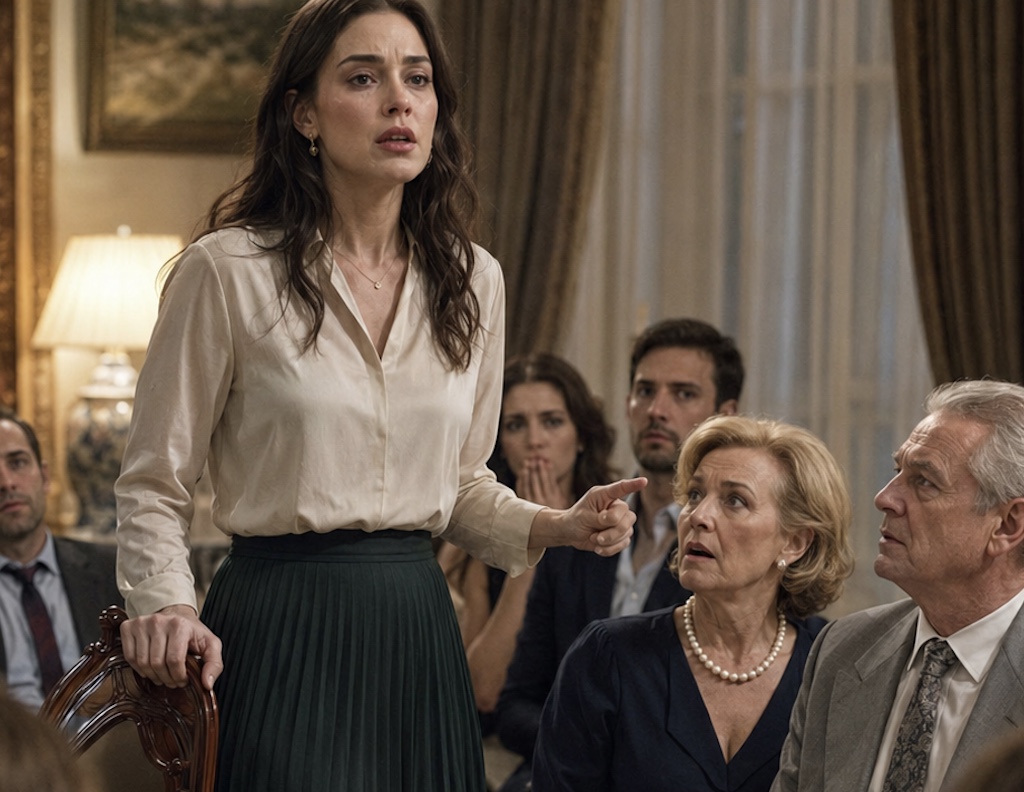
The silence at the festive table became so deep that the rustling of leaves outside the window could be heard. Eight pairs of eyes froze on Marina. She stood upright, her cheeks burning, her hands gripping the back of the chair so tightly that her knuckles had turned white. The words she had just spoken still rang in the air like shards of a shattered wine glass.
“If you want to humiliate me in front of everyone, then I won’t stay silent either!”
Antonia Borisovna, her mother-in-law, sat at the head of the table with the expression of a woman who had just been slapped in the face. In a single second, her face passed through several shades — from pale confusion to crimson embarrassment. Beside her, Boris Ignatievich, Marina’s father-in-law, had gone completely still, his gaze moving slowly, very slowly, from his daughter-in-law to his wife.
Nobody moved.
Marina exhaled. Deeply, quietly, almost soundlessly. And in that breath was all the exhaustion of the past two years.
But it had all started long before that evening. Long before the festive tablecloth, before the roasted goose on the platter, before the guests arrived with bottles of champagne and bouquets of flowers.
When Marina first stepped into Antonia Borisovna’s home — back when she was still only Alyosha’s girlfriend, with no wedding ring on her finger and still full of hope — her future mother-in-law greeted her with a smile that a more experienced person might have recognized as a verdict. But Marina was young, in love, and inclined to believe the best of people.
“You baked this pie yourself?” Antonia Borisovna asked then, lifting the corner of the foil that covered Marina’s homemade gift. A pause followed. “One can tell you made it with heart. Though, to be honest, my dough always turns out lighter.”
Marina smiled. Alyosha took her hand. It was nothing serious.
Then they got married. And from that moment on, Antonia Borisovna seemed to gain official permission to say exactly what she thought.
Remarks began falling on Marina for every possible reason. At dinner, when Marina visited: “Your borscht is a little pale, dear. Beets should be rich and juicy.” During family walks: “Marinka, what are those heels for? You’re not on a runway. You’re my son’s wife.” During chance meetings at the store: “Frozen meals again? Alyosha never ate such things as a child.”
At first, Marina endured it with a smile. Then she endured it without a smile. Then she stopped visiting unless there was a serious reason.
She tried talking to Alyosha. She would sit beside him, take his hand, and explain calmly.
“Your mother humiliated me in front of everyone again.”
“You know what she’s like. Don’t pay attention. She’s like that with everyone.”
“She’s like that only with me.”
“Marin, don’t make things up. She’s only trying to help.”
Alyosha said it without malice, not even with indifference — simply with the blindness of someone who had grown up beside something and no longer noticed it. To him, Antonia Borisovna was just his mother. A little sharp, a little too direct, but familiar, understandable, safe. And therefore — normal.
Marina learned to keep her face still. It cost her strength, but she learned.
The fateful evening began like an ordinary family celebration. It was Boris Ignatievich’s birthday, and he had reached the sort of age that made everyone at the table joke about a milestone. The guests arrived by seven: Alyosha’s brother and his wife, Antonia Borisovna’s cousin and her husband, the Petrovs — old family friends and neighbors — and another couple, business acquaintances of Boris Ignatievich, younger than the others and unfamiliar to Marina.
They set the table together. Marina had brought her salad and an apple pie she had spent three hours baking, and which, in her opinion, had turned out well. At least Alyosha had tasted it in the kitchen and called it delicious.
Antonia Borisovna appeared in the dining room just as Marina was arranging the plates.
“Oh, you brought a pie. Well done,” she said in the tone one uses to praise a child for effort rather than result. Then she picked up the pie and smelled it. “Cinnamon?”
“Yes, just a little.”
“Alyosha doesn’t like cinnamon. I always make it without.”
Marina said nothing. Alyosha did like cinnamon. She knew that for certain — he had personally asked her to add more. But she chose not to argue in front of the guests.
They sat down at the table. Boris Ignatievich was in a cheerful mood, joking and pouring wine. The guests relaxed, and the conversation began to grow warmer. Marina almost allowed herself to breathe.
Antonia Borisovna began closer to the main course.
“Marinka, I’m looking at you sitting there so dressed up,” she said with a smile, glancing at the guests as if inviting them to share her observation. “The dress is beautiful. Though for a family dinner, it’s a little provocative, isn’t it?”
One of the guests lowered their eyes awkwardly to their plate.
“I like her dress,” Alyosha said briefly, though without much force.
“Of course you like it. You’re her husband,” Antonia Borisovna laughed. “I’m only saying there is a home style, and then there is… another kind.”
Marina lifted her glass and took a small sip. Her cheeks were hot.
Then came a comment about the salad. Then another about how Marina had placed the forks on the wrong side while setting the table. Antonia Borisovna said all of it lightly, in passing, weaving each remark into the general conversation so smoothly that objecting felt almost impossible. After all, they were only comments. She was only trying to help. She meant it lovingly, didn’t she?
Marina stayed silent. She counted to herself. That had become her strategy over the past few months — count, breathe, wait until her mother-in-law stopped picking at her.
But her mother-in-law did not stop. She only grew bolder.
By the time the guests had reached dessert and the conversation had become loud and general, Antonia Borisovna suddenly raised her voice slightly, as if remembering something important. Loud enough for everyone to hear.
“I look at you and Alyosha and keep wondering: when will we finally have grandchildren?” she said with the intonation of heartfelt maternal concern. “You’ve been together long enough, and still nothing. Maybe, dear, you should see a doctor? Have your health checked?”
The silence around the table became a little heavier.
“Mom,” Alyosha began.
“I’m not trying to offend anyone,” Antonia Borisovna spread her hands. “I’m thinking about the family. It’s time for Alyosha. Time keeps passing. I’m simply speaking as a mother…”
And that was when something inside Marina snapped. Quietly, almost invisibly — but it snapped.
This was different territory. One thing was pie and dresses. Quite another was this. In public, at a festive dinner table, in front of her father-in-law’s business acquaintances, neighbors, and relatives — discussing her ability to have a child. As though she were damaged goods that needed to be returned or repaired.
Marina set her glass on the table. Slowly. Carefully.
Then she stood up.
“If you want to humiliate me in front of everyone, then I won’t stay silent either!”
And then came that very silence. The same silence with which this story began.
Eight pairs of eyes. Antonia Borisovna with her mouth open.
Alyosha looked at his wife with the expression of a man who had only now, right this moment, realized that the situation had long ago gone far beyond “Mom just talks like that.”
Marina drew in a breath. And began to speak.
Her voice was calm. Too calm.
“Antonia Borisovna, I have been silent for two years. Through all your comments about pies, dresses, how I place forks, and how I cook borscht. I stayed silent because you are my husband’s mother, and I respected you. But today, you crossed the line.”
She paused. Nobody at the table moved.
“We don’t have children yet. That is between Alyosha and me. Only us. Discussing it in front of guests is not motherly concern. It is humiliation.”
Antonia Borisovna opened her mouth.
“And while you are still silent,” Marina continued, her voice becoming quieter, but sharper because of it, “I want to say something else. Three weeks ago, I was at the shopping center on Sadovaya Street. I was choosing a gift for Alyosha. And I saw you there, Antonia Borisovna. In the restaurant on the second floor. With a young man. You were speaking very animatedly. Then he carried your boutique bags for you.”
A pause.
The air around the table seemed to turn cold.
“I wasn’t following you. I simply happened to be there. And I saw it. I said nothing then because I decided it was none of my business. But since today we are saying everything out loud, in front of everyone,” Marina looked around the table, “then let this be said out loud too.”
Boris Ignatievich slowly turned his head toward his wife.
Antonia Borisovna turned white.
It was not the blush of embarrassment. It was real paleness. Sharp and immediate.
Someone at the table quietly placed a fork onto a plate. Alyosha’s brother suddenly found something very interesting in his wine glass. Mrs. Petrova placed her hand on her husband’s knee and did not remove it.
“Marina,” Boris Ignatievich said.
One word. But there was so much inside it.
“Borya, that… that is not true,” Antonia Borisovna said. Her voice was dry and cracked. “He is a friend. My friend’s son. I have known him since he was a child.”
“Of course,” Marina said calmly. She had already said everything. She had no intention of finishing her off. “I only described what I saw.”
She picked up her handbag. Then she looked at Alyosha.
“Shall we go?”
Alyosha stood up without a word. His face looked as if he were trying to assemble a puzzle and could not understand which piece belonged where.
They left first. Fifteen minutes later, the others began to leave as well — quickly, with awkward goodbyes and the uneasy feeling that they had witnessed something they were never meant to see.
Antonia Borisovna and Boris Ignatievich remained alone at the emptied table.
What happened between them that night, Marina did not know and did not want to know. Alyosha called his mother the next morning and spoke to her for a long time from the balcony. Marina sat in the kitchen with a cup of tea and looked out at the gray autumn sky.
When he came back inside, he sat beside her and stayed silent for a long time.
“Why didn’t you tell me?” he finally asked. “About what you saw at the shopping center.”
“Because I thought it was none of my business.”
“And now?”
“Now she made it everyone’s business when she started talking about you and me in front of everyone.”
Alyosha fell silent again.
“I didn’t know you were suffering so much from all of it. From Mom’s remarks.”
“Alyosha.”
“Yes.”
“You didn’t want to know. I told you.”
He did not argue. That was honest. Perhaps it was the most important thing that had come out of everything that happened at that table.
Antonia Borisovna called three days later. Marina answered the phone herself.
The conversation was short. Her mother-in-law spoke dryly, without the usual smooth intonation with which she normally wrapped every word. She simply said she had been wrong. That she should not have said what she had said in front of everyone. That it had been her mistake.
She said nothing about the young man with the shopping bags.
Marina did not ask either. It truly was none of her business. She said only one thing:
“I hear you, Antonia Borisovna. Thank you.”
Boris Ignatievich and Antonia Borisovna did not divorce. What happened between them during those days remained behind closed doors. Marina saw her father-in-law only once after that evening, by chance, at a store. He looked older. Or perhaps simply tired. He nodded to her, and she nodded back.
Her mother-in-law changed. Not immediately, not dramatically — but she changed.
The next family dinner was her idea, a month later. She set the table herself, cooked everything herself, and asked Marina only to bring her signature pie — the one she had never once praised before. When Marina arrived, Antonia Borisovna met her in the hallway and said quietly:
“That dress is beautiful.”
Marina looked at her. There was something new in her mother-in-law’s eyes. Something like a cautious attempt.
“Thank you,” Marina replied.
They went into the kitchen. At the table, Boris Ignatievich was already pouring tea, and Alyosha was telling some story and laughing. An ordinary evening.
Antonia Borisovna placed Marina’s pie on the table and said:
“Try it. She bakes wonderfully.”
No reservations. No “but.” Just — wonderfully.
A small detail. Tiny. But Marina remembered it.
Later, Antonia Borisovna thought about that day for a long time. She returned to it in her mind at different moments — while cooking, while looking out the window in the mornings, while catching her husband’s gaze, where the question she had never answered still remained.
She thought about how words spoken aloud in front of others live for a long time. How jokes and remarks that seem light to one person can wound another. How you can spend years believing you are right — and then, in a single moment at a festive table, find yourself exposed as foolish.
Antonia Borisovna was a woman used to keeping everything under control: the family, the table, the conversation. And she did not immediately understand that, on that evening, control had passed to another person precisely because that person had been silent for too long.
She no longer made comments in front of guests. And, in truth, she became more careful even in private. It was difficult for her — the habit of saying whatever she thought had taken deep root. But she was learning.
Marina never found out who the young man was. A friend’s son — or someone else.
She had her own life. A husband who, after that evening, began to hear her a little better. Her own work. Her own plans, which she was not yet ready to speak aloud.
In spring, she and Alyosha went away together for a week — to a small seaside town where there were no family dinners, no festive tables, and no remarks about cinnamon or heels.
There, on a balcony overlooking the water, Alyosha said:
“I want you to know something. You were right. That evening, and before it.”
Marina looked at the sea. The waves moved steadily, one after another.
“I know,” she answered.
It was not a reproach. It was simply the truth.
Beyond the horizon, the sunset was fading. Somewhere back in the city, Antonia Borisovna was probably making dinner and thinking about what to say.
And about what was better left unsaid.