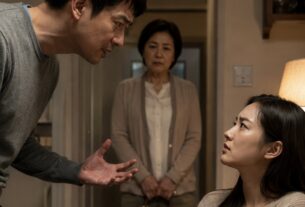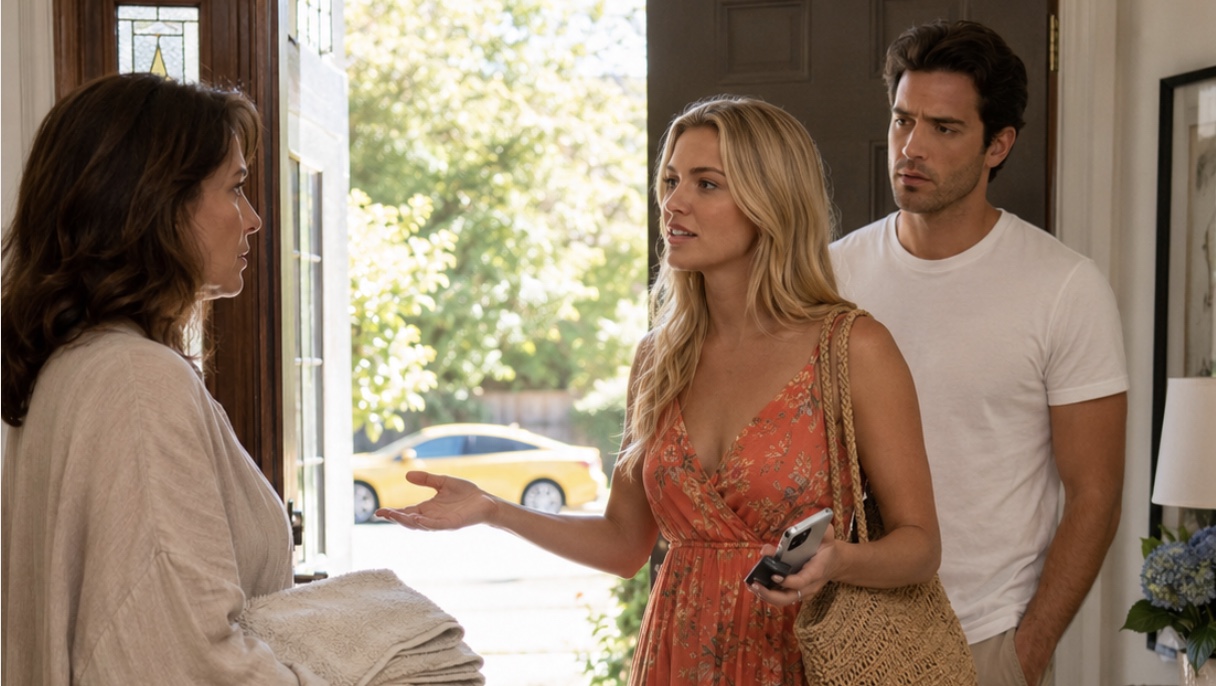
Irina stopped in the middle of the kitchen, a dish towel still clutched in her hands. The kettle hissed on the stove. Across the table lay printed booking confirmations, directions to the railway station, a first-aid checklist, and a slim folder of documents she had spent three evenings putting together. Hot July air drifted through the open balcony door, carrying the shrieks of children playing near the sandbox below. Yet inside the apartment, everything had suddenly gone so quiet that it felt as though someone had switched off the entire building.
“Say that again,” Irina said.
Not because she had failed to hear. She had caught every word. She merely wanted to see whether her daughter had enough courage to repeat it without the dramatic sharpness, without Maxim sitting beside her and pretending to study the label on a bottle of lemonade.
Alyona turned around. She was twenty years old, with straight blonde hair, a perfect manicure, and a new summer dress bought only a week earlier with the money Irina had given her “so you’ll look beautiful at the seaside.” Her face was tense, but stubborn.
“We want to go with our own group. Me, Maxim, Ksyusha, and Artyom. You really would be in the way. You control everything—where we stay, what we pack, where we go, what time we leave. I’m not five years old anymore.”
Maxim gave a barely noticeable smirk before quickly arranging his face into a serious expression.
Irina noticed.
She noticed many things.
She had noticed how confidently Maxim had begun speaking in their apartment during the past few months, even though he came there as a guest. She had noticed how Alyona’s answers became shorter after his phone calls. She had noticed how often “I decided” had been replaced with “we think.”
Irina had never forbidden her daughter from dating him. She had never read her messages or subjected her to interrogations. She had simply observed and drawn her own conclusions.
“All right,” she said, placing the towel over the back of a chair. “Then you’re going without me.”
Alyona had clearly expected a different reaction. Hurt accusations, shouting, perhaps a long lecture about ingratitude. She had already prepared herself to fight back. Her shoulders were raised as though she were standing before a committee preparing to revoke her right to adulthood rather than before her own mother.
“You don’t understand, Mom. I don’t want you to get offended later.”
“I understand perfectly. You said I was a burden. I’ve taken note of it.”
Maxim finally looked up.
“Irina Sergeyevna, we didn’t mean anything bad. Young people just want to relax without restrictions.”
Irina looked at him so calmly that his smile immediately thinned.
“Maxim, it is perfectly normal for a person to speak for himself. But when you start explaining what my daughter wants, you are overstepping.”
Alyona flushed.
“Mom!”
“What do you mean, ‘Mom’? You’re an adult. Adults make decisions and accept the consequences. You’re traveling without me, which means I will not be involved in your trip. No advice, no financial support, and no emergency rescue missions when someone discovers they failed to read the booking conditions.”
“We can handle it ourselves,” Alyona said quickly.
“Wonderful.”
Irina picked up the folder and removed the documents. There was the guesthouse reservation, the train tickets, the packing list, and copies of the insurance policies. She separated the papers issued in Alyona’s name and placed them in front of her.
“Here is your insurance, your ticket, and a copy of your passport. I’ll cancel the accommodation.”
Alyona spun toward her.
“Why would you cancel it?”
“Because the reservation is in my name, the deposit was paid from my bank card, and the owner is expecting me as the responsible guest. You’ve decided to travel independently, so you can make an independent reservation.”
Maxim sat up straighter.
“Wait a minute. But that place has already been chosen. It’s a good property close to the sea.”
“Yes. I chose it.”
“Could you transfer the deposit to us?” he asked much too quickly.
Irina raised one eyebrow.
“No.”
“But the money was for Alyona’s trip,” her daughter protested.
“It was for a trip you and I were taking together, during which I was responsible for the accommodation, documents, and safety arrangements. The format has now changed. The money will be refunded to me, minus whatever cancellation fee applies. You can find another place and pay for it yourselves.”
Alyona opened her mouth, then closed it again.
She was not stupid. She had already understood that the simple phrase “we’re going without you” was not nearly as attractive in reality as it had sounded in her head.
Removing her mother from the trip meant losing more than an unwanted figure on the beach. It meant losing all the invisible work: verified addresses, agreements with the property owner, backup routes, the first-aid kit, someone to contact the hostess, and someone who knew what to do if the train was delayed or a payment card failed.
“You’re doing this on purpose,” Alyona said.
“Yes,” Irina answered calmly. “I am deliberately refusing to finance a vacation where I have been described as an inconvenience.”
Maxim cleared his throat.
“We’ll pay for it ourselves.”
“Excellent,” Irina said, closing the folder. “Then the matter is settled.”
The evening was thoroughly ruined.
Alyona went to her room and slammed the door. Maxim remained for another ten minutes, attempting to look dignified, before finally gathering his things. In the hallway, he muttered something about how “young people need to be trusted sometimes.”
Irina replied that trust did not cancel arithmetic and closed the door behind him.
She did not cry that night.
She did not pace through the apartment, peek into her daughter’s room, or try to restart the conversation. She sat down at her laptop, canceled the reservation, sent the guesthouse owner a polite message, and checked the refund conditions.
Then she opened her banking application and transferred the remaining money she had planned to spend on the vacation into a separate account.
She did not do it out of spite.
Money simply belonged where it could be managed by the person who had earned it.
Alyona entered the kitchen silently the next morning. There were shadows beneath her eyes, but she carried herself defiantly. She poured herself a glass of water while typing rapidly on her phone, most likely messaging Maxim.
“We found another place,” she eventually announced. “It’s perfectly normal. It’s even cheaper.”
“Good.”
“Our tickets are still valid.”
“Your ticket is. I returned mine.”
Alyona froze.
“You’re really not going?”
“Yesterday, you made it very clear that my presence would ruin the vacation.”
Her daughter tightened her grip on the phone.
“I thought you would still… you know… change your mind.”
“And I thought it would be useful for you to understand the difference between ‘Mom is interfering’ and ‘Mom organized everything.’”
Alyona said nothing.
She left the following day wearing a light linen outfit, carrying a new suitcase, with enormous sunglasses pushed onto her head. Maxim arrived in a taxi and helped carry her belongings downstairs, although he dragged the suitcase as if he were performing a tremendous personal favor.
Irina stood in the hallway. She did not fuss over her daughter, check the documents for the fifth time, or slip extra tissues into her handbag.
“Do you have your documents?” she asked.
“Yes.”
“Your charger?”
“Yes.”
“Did you keep enough money for the return ticket separate from your spending money?”
Alyona looked away.
“Mom, stop.”
Irina nodded.
“Then have a good trip.”
Her daughter hesitated for a moment, as though expecting a hug. But she did not step forward, and Irina did not force herself upon her.
She simply opened the door and calmly watched Alyona follow Maxim toward the stairs.
After the door closed, Irina entered her daughter’s room.
Not to search through her belongings. She merely wanted to close the window Alyona had left wide open and pick up the wet towel abandoned on the floor.
Irina’s packing list was lying on a chair. Half the items had been crossed out by Alyona, with comments written beside them:
“Not needed.”
“Old-fashioned.”
“I know what I’m doing.”
Irina looked at the sheet, folded it in half, and threw it away.
The first photographs appeared that evening.
Alyona on the platform.
Alyona beside the train.
Alyona and Maxim holding coffee in plastic cups.
Alyona standing against the sea at dusk.
The caption read:
“Freedom begins where control ends.”
Irina pressed the like button.
She left no comment.
The next day, she did something she had postponed for months. She drove to a garden center, bought large planters for the balcony, and selected bright petunias and a small pot of lemon basil.
Then she stopped at a bookstore and purchased a novel and a notebook.
When she returned home, she switched on the fan, sliced a cold watermelon, and ate dinner for the first time in months without someone else’s irritation filling the room.
Her friend Vera called that evening.
“Well, how is the mother of a free and independent adult daughter doing?”
“Calmly.”
“You’re lying.”
“No. Yesterday I was angry. Today I’m calculating.”
“Calculating what?”
“How much money I saved by not going on a vacation where they were planning to tolerate me.”
Vera laughed.
“That’s exactly why I love you.”
Irina smiled too.
She was not cold. Her daughter’s words had hurt her deeply. But pain did not require her to become convenient.
She had raised Alyona alone since the girl was twelve, after divorcing her father. The divorce had gone through court because they had a minor child and disagreed about visitation arrangements. At first, her ex-husband had appeared with beautiful promises. Then he came less and less often.
Irina had never presented herself as a victim. She worked, managed the household, paid for extracurricular activities, treated every cold, and patiently attended parent-teacher meetings.
But she had never intended to become a free accessory to her adult daughter—someone who could be removed from the photograph while her money and organizational skills remained conveniently in place.
On the third day, Alyona sent a message.
“Everything is fine here. It’s hot. The sea is great.”
Irina replied:
“Keep your documents safe and don’t leave your phone unattended on the beach.”
No answer came.
On the fourth day, a photograph appeared online from a café. Alyona was smiling while Maxim held her around the shoulders. Ksyusha and Artyom sat beside them. Lemonades, pizza, and a plate of shrimp covered the table.
Irina noticed that her daughter’s smile looked slightly strained, but she did not invent explanations. An adult had the right to experience both happiness and mistakes.
On the fifth morning, Alyona called.
Irina was watering the plants on the balcony.
“Mom, are you busy?”
Her daughter’s voice sounded cheerful—much too cheerful.
“Go ahead.”
“Do you happen to remember the name of the guesthouse you originally booked?”
“I do.”
“Could you send it to me?”
“Why?”
There was a pause.
“I’m just curious. The place we’re staying in turned out to be… not exactly like the pictures.”
“What’s wrong with it?”
Alyona sighed.
“The room is tiny. The air conditioner works only sometimes. The walk to the beach isn’t ten minutes—it’s almost forty. And the landlady is strange. She says the kitchen is shared, but she only allows the stove to be used until nine in the evening. Maxim says it’s fine because at least it’s cheap.”
Irina set the watering can on the floor.
“Did you sign an agreement? Or at least keep your messages with the owner?”
“Mom…”
“Alyona, this isn’t a lecture. It’s a question.”
“We kept the messages. There’s no contract. Maxim found the place through someone Artyom knows. We had to send the deposit quickly before someone else took it.”
Irina closed her eyes for a second.
Not out of despair.
The entire situation had been predictable to the point of boredom.
Quickly.
Cheaply.
Through an acquaintance.
No written agreement.
And then the astonishment when reality failed to match the promises.
“Take pictures of the room. Save all the messages. Don’t send them any more money. If the situation is truly bad, look for an official property through a booking service with verified reviews.”
“Could you look?”
“I can. But the decision will be yours.”
Alyona remained silent.
“Send me the area and the amount you can afford,” Irina said. “I’ll look at some options. But I’m not paying for them.”
“I understand,” her daughter replied quickly.
She had not become offended.
That was already progress.
Irina spent forty minutes searching and found three suitable alternatives. She sent the links and briefly explained the advantages and disadvantages of each.
Alyona read the messages but did not answer. She was probably discussing the choices with the others.
That evening, a reply finally arrived:
“Maxim says we’re not going to waste money by paying more. We’re staying here.”
Irina wrote:
“Your choice.”
The following day, Ksyusha called.
Not Alyona, but her friend.
Her voice was fast and tense.
“Hello, Irina Sergeyevna. Please don’t worry.”
“When someone begins with that sentence, it is usually already too late not to worry. What happened?”
“Alyona and Maxim had a terrible argument. Artyom and I went to the beach, and they stayed behind to sort things out. Later Alyona came alone and said Maxim had gone off with some guys he met. His phone is switched off. And he was holding the accommodation money because he was the one paying the landlady.”
“Where is Alyona?”
“In the room. She’s crying… I mean, she’s angry. She didn’t want to call you.”
“Give her the phone.”
There was rustling on the line. Then Irina heard her daughter breathing.
“Mom, everything is fine.”
“Don’t begin by lying to me. What happened to the money and the documents?”
“I have my documents. The money… Maxim has some of it. He said it was more convenient because I might waste it on stupid things.”
Irina slowly walked across the kitchen.
For a moment, she did not see a defiant adult woman. She saw a seven-year-old girl who had lost a hair clip in a store and was too frightened to admit it.
But her voice remained firm.
“How much money do you have on your card?”
“Not much.”
“Enough for a ticket home?”
“Probably, if I get one of the cheap open-plan sleeper berths.”
“Did Maxim threaten you? Push you? Take your documents?”
“No. He just said horrible things. He said I wouldn’t even be able to find accommodation without him. He said you made me spoiled and helpless.”
“And are you helpless?”
Alyona did not answer.
“Alyona, that wasn’t a decorative question. What are you?”
“I’m not helpless,” she said quietly.
“Then act accordingly. First, keep your documents and your bank card with you. Second, do not transfer any more money to Maxim. Third, speak to the landlady yourself and find out exactly how much has been paid and until what date. Fourth, if Maxim returns drunk or starts causing trouble, do not argue with him in the room. Go to Ksyusha and Artyom or move to a public place. Do you understand?”
“Yes.”
“Now wash your face. Take pictures of your documents with your phone, but keep the originals in your possession. Then send me the complete address. I’ll stay available.”
“Are you coming?”
The question came quickly and sounded almost childlike.
Irina looked at the flowers on her balcony, the patch of sunlight on the floor, and the folder containing her personal documents, arranged neatly where they belonged.
She could abandon everything.
She could buy a ticket, rush there, embrace her daughter, pay the bills, and bring her home.
And Alyona would learn nothing except that she could push her mother away and later summon her like an emergency service.
“No,” Irina said.
The line went silent.
“Why?”
“Because you’re not in immediate danger. You’re in an unpleasant situation that you helped create. I’ll assist with advice, routes, and tickets, but you will deal with the situation on the ground.”
“I understand,” Alyona said, her voice becoming dull.
“Don’t waste time being offended. You can be angry later. Right now, you need to act.”
Irina stayed on the phone until her daughter sent the full address, a picture of the room door, the messages exchanged with the landlady, and the remaining accommodation balance.
It turned out the room had already been paid for another two days.
Maxim returned late that night, no longer carrying his former confidence. He announced that he was “tired of all the complaints” and might leave because he had supposedly been urgently called back to work.
Alyona did not argue.
She messaged her mother:
“He’s packing. He says I have to reimburse him for half the café and taxi expenses.”
Irina replied:
“Transfer nothing. Tell him to provide a written list of expenses. You can review it later. Your immediate priorities are your safety and your journey home.”
Maxim left the next morning.
Not because work had urgently called him back.
That emerged later.
He had simply realized the vacation was no longer comfortable for him. The accommodation was poor, the money was running low, Alyona no longer gazed at him admiringly, and Ksyusha and Artyom treated him coldly after the previous night’s argument.
He slammed the room door and threw one final remark over his shoulder.
“Let’s see how well you manage by yourself with all those suitcases.”
Alyona did not answer.
She merely removed the spare room key from his key ring—the one the landlady had inexplicably given them to share—and placed it inside her own handbag.
It was the first genuinely adult thing she had done during the entire vacation.
That afternoon, she called her mother again.
“I want to come home.”
Irina was sitting at the table with her laptop. Ticket websites were already open on the screen.
“There’s a train tonight. The available berth isn’t particularly comfortable, but it will get you home. Order a taxi to the station through an official app. Don’t tell the driver unnecessary details. Share your live location with me and Ksyusha. At the station, wait inside the waiting hall, not near the entrance.”
“You’re not going to say, ‘I told you so’?”
“Why would I? You’ve already heard it without me saying anything.”
Alyona exhaled loudly.
She was not crying. Irina could hear that her daughter was trying to hold herself together.
“Mom, I behaved horribly.”
“You did.”
“You could have said that more gently.”
“I could have. But I don’t want to pretend that cruelty becomes sweet merely because the person who said it is now upset.”
“I understand.”
“Good. Then I’m buying the ticket. You’ll repay me in installments when you can.”
Alyona fell silent.
“You’re serious?”
“Completely. It isn’t a punishment. This was your adult trip.”
“Fine,” her daughter said after a pause. “I’ll pay you back.”
Irina purchased the ticket.
Then she sent her daughter detailed directions to the station, the train number, the boarding time, a screenshot of the ticket, and a brief set of instructions.
No panic.
No lamenting.
No excessive tenderness that would blur the seriousness of the situation.
Alyona did not need pity.
She needed support.
And support could be firm.
Late that evening, Alyona sent a photograph from the waiting hall. Her face looked exhausted, her hair had been tied back carelessly, and her backpack rested on her knees.
The caption said:
“I’m sitting here. Forty minutes until boarding.”
Irina replied:
“Did you buy water?”
“Yes.”
“Your documents?”
“In my bag. The bag is on me.”
“Good.”
The train departed shortly before midnight.
Irina stayed awake until Alyona sent another message.
“I’m lying down. There’s a woman with a child next to me. Everything is fine.”
Only then did Irina switch off the light.
The next day, she met her daughter at the station.
Summer heat had taken complete control of the city. The pavement near the entrance seemed to melt beneath the sun. Travelers passed carrying suitcases, shopping bags, inflatable swimming rings, and exhausted expressions.
Alyona was the last person to leave the carriage.
She did not have the golden tan of a happy vacationer, nor did she carry her former defiance. But she was not completely broken either.
She carried her suitcase herself.
When she saw her mother, she stopped for a moment before approaching.
“Hi.”
“Hi.”
They did not embrace immediately.
Too many things had been said and left unsaid between them.
Irina took only the small bag containing a bottle of water. She did not touch the suitcase.
“Can you manage?”
Alyona nodded.
“I can manage.”
They traveled home in silence.
Alyona looked through the taxi window while Irina checked her work messages.
At the apartment, Alyona removed her shoes, carried the suitcase into her room, and returned to the kitchen.
“Can I have some water?”
“Pour yourself a glass.”
In the past, Irina would have stood up and done it for her.
This time she remained seated.
Alyona poured the water, drank half the glass, and placed it on the table. Then she set both palms beside it as though gathering her thoughts.
“I want to talk.”
“Go ahead.”
“I truly believed you ruined everything. That you interfered too much. That Maxim was right and that I would finally become an adult if I traveled without you.”
Irina sat opposite her.
“And how was adult life?”
Alyona gave a weak smile.
“Expensive. Hot. And equipped with a terrible air conditioner.”
Irina did not smile, but her eyes softened.
“Continue.”
“I was furious when you canceled the reservation. I thought you were taking revenge. But then, when I saw that room… at first, I still defended Maxim. I told myself it didn’t matter because at least we had done everything ourselves. Then I realized that ‘ourselves’ somehow meant that he made every decision while I adjusted to whatever he wanted.
“He chose the cafés because he ‘knew better.’ He held the money because I supposedly might waste it. He spoke to the landlady because ‘women aren’t taken seriously there.’ And when problems started, everything became my fault because I was complaining too much.”
Irina listened without interrupting.
Alyona spoke faster, but she was not hysterical. She laid out the events like clothing removed from a suitcase—creased, unattractive, but entirely her own.
“He isn’t stupid, Mom. He notices very quickly when someone doubts themselves. I doubted myself because I wanted to prove to you that I was an adult. He used that. Not like some villain in a film. He simply made himself comfortable. I allowed him to.”
“That is the most important thing you’ve said.”
Alyona looked up.
“That I allowed him?”
“That you recognized the mechanism. If you decide that the entire lesson is simply ‘Maxim is a bad person,’ another Maxim will appear next time—with a different voice, a different haircut, and the same hands reaching for control over your decisions.”
Her daughter nodded.
Her expression tightened, but she did not become defensive.
“I’ll repay you for the ticket too.”
“You will.”
“You’re not even going to argue?”
“No.”
“In the past, you would have said, ‘Don’t worry about it, I’m your mother.’”
“In the past, I did many things for you. Then I wondered why you considered them automatic.”
Alyona lowered her eyes to the table.
“I didn’t want to hurt you.”
“Yes, you did. At that moment, you did. You wanted to strike hard enough to make me step aside and give you freedom together with my resources.”
The words were harsh.
Alyona turned pale, but she did not look away.
“Yes,” she finally admitted. “I suppose that’s what I wanted.”
Irina stood, took a pitcher from the refrigerator, and refilled her own glass.
“I love you. But love does not mean I will finance my own humiliation.”
Alyona covered her face with her hands, then quickly lowered them. Tears shone on her eyelashes, but she maintained control.
“I’m sorry.”
“I accept your apology. But trust will not return because of words. It will return through your behavior.”
“What should I do?”
“To begin with, unpack your suitcase, wash your clothes, write me an acknowledgment of the amount you owe for the ticket, and repay it gradually. Then call the landlady yourself and ask whether any debts or complaints remain connected with your stay. If Maxim demands money, tell him to specify in writing exactly what it is for. Do not send him anything emotionally.
“And one more thing: you will not bring him into this apartment again without my permission.”
Alyona raised her head sharply.
“You’re forbidding me from seeing him?”
“No. Your personal life is your responsibility. But this apartment belongs to me. I decide who enters it. I do not want a man here who taught you to view me as an obstacle and took control of your money.”
Alyona seemed ready to object, but restrained herself.
After several seconds, she nodded.
“That’s fair.”
Irina noticed the word.
Not “fine.”
Not “whatever you say.”
Not “you’re doing it again.”
Fair.
The trip had not been entirely wasted.
The following days were quiet.
Alyona slept for long hours, unpacked her belongings, did laundry, called Ksyusha, and replied briefly to Maxim’s messages.
At first, he wrote as though he were the wounded party.
Then his messages became aggressive.
Then, abruptly, they turned tender.
He sent a long text explaining that “all couples argue,” that he had “simply been tired,” and that Irina was “putting pressure on her.”
Alyona showed the message to her mother.
“What should I answer?”
“Nothing, unless you know what you want.”
“What if he comes here?”
“No one has invited him into the building. Don’t open the door. If he makes a disturbance, we’ll call the police.”
“You would actually call them?”
“Of course. I don’t collect scandals outside my door.”
Maxim arrived two days later.
It was evening, and the heat had finally begun to weaken.
He rang the doorbell, then rang again.
Alyona stood in the hallway, pale but composed.
Irina approached the door and looked through the peephole.
“Who is it?” she asked.
“It’s Maxim. I need to speak with Alyona.”
“She did not invite you.”
“Irina Sergeyevna, don’t turn this into a circus. We can handle our relationship ourselves.”
“Then handle it over the phone.”
“Alyona!” he shouted more loudly. “Come out and talk to me like a normal person!”
Alyona flinched, but moved closer to the door.
“I don’t want to talk right now,” she said loudly enough for him to hear.
There was silence on the other side.
“So your mother managed to turn you against me after all?”
Irina looked at her daughter but did not interfere.
She allowed Alyona to answer for herself.
Alyona clenched her hands into fists, then relaxed them.
“No. I remembered on my own how you abandoned me in a strange city and left with my money.”
“I didn’t abandon anyone! I was called back!”
“You told Artyom yourself that you were tired of dealing with my complaints. He forwarded me the voice message.”
Silence fell outside the door.
For the first time that evening, the corner of Irina’s mouth lifted.
Alyona could draw conclusions too—once she stopped defending someone else’s attractive version of events.
“Return the remaining accommodation money,” Alyona continued. “I sent you the calculations. If you disagree, explain in writing what you believe is incorrect.”
“Are you serious?”
“Yes.”
“Fine! Stay with your precious mommy, then!”
“Fine,” Alyona answered and stepped away from the door.
Maxim remained outside for another moment before finally leaving.
Irina waited until his footsteps faded, then turned toward her daughter.
“That was good.”
“My whole body is shaking,” Alyona admitted.
“That isn’t dangerous. The important thing is that you didn’t open the door.”
Her daughter suddenly laughed.
It was brief and nervous, but honest.
“You’re so tough.”
“No. I simply learned long ago that softness without boundaries is quickly turned into a doormat.”
Alyona looked at her mother differently then.
Not as a person who prevented her from living, but as a woman who had survived her own lessons and never felt the need to shout about them.
The sea continued to fill everyone’s social-media feeds throughout August.
Ksyusha and Artyom stayed until the end of the vacation. They moved to different accommodation and later said that the trip improved considerably after Maxim left.
At first, Alyona reacted painfully whenever she saw their photographs. Eventually, she stopped looking.
She found temporary work at a flower kiosk near the apartment so she could repay her mother for the ticket and cover her own expenses.
Irina did not praise her for every step as though she were a small child.
She simply accepted each transfer and recorded the remaining balance in a notebook.
One evening, Alyona placed the final payment on the table.
“That’s everything.”
Irina counted the money and nodded.
“Received.”
“You could have refused to take it.”
“I could have. But then the lesson would have cost only my money. This way, it also cost you effort.”
Alyona sat opposite her.
“Do you know what the worst part is? I honestly thought I was an adult. To me, adulthood meant saying something cruel to you and leaving for the seaside with my boyfriend. But it turned out I only began acting like an adult when I called the landlady myself, counted my own money, and sat alone at the station at night.”
“People rarely grow up on a beach,” Irina said. “More often, it happens in a waiting room.”
Alyona smiled.
“Mom.”
“What?”
“I’ll never tell you again that you’re in the way.”
“Don’t promise something that life hasn’t tested. Next time, simply think before you speak.”
Her daughter nodded.
Then she stood, went to the sink, rinsed her glass, and returned.
“Would you travel somewhere with me in the autumn? Not as my rescuer. Just… together.”
Irina studied her carefully.
“I would. On one condition.”
“What condition?”
“We plan the trip together. We each pay our own share. And if you want to spend a day without me, you tell me respectfully instead of humiliating me.”
Alyona extended her hand across the table.
“Agreed.”
Irina shook it.
Not theatrically.
Not as part of some dramatic reconciliation.
She shook her daughter’s hand as she would the hand of an adult with whom honest agreements could now be made.
Outside, a late-summer evening had settled over the city. The air was thick and warm, carrying the smell of sun-heated leaves and dust after a long day.
A partially unpacked bag of seaside souvenirs still lay in Alyona’s room: a shell, a refrigerator magnet, and a bracelet made from cheap beads.
Alyona never placed the magnet on the refrigerator.
She said it was ugly.
Irina understood that the magnet was not really the problem.
Some vacations were not meant to remain on display.
But something had remained after that journey.
Alyona stopped throwing out careless phrases she had once used to hide from responsibility.
Irina stopped catching everything her daughter had failed to consider, verify, or calculate.
Their relationship did not suddenly transform into a fairy-tale bond over a single evening. But something appeared between them that had been missing before:
Respect for boundaries.
Irina was no longer a free travel agent, wallet, therapist, and emergency landing strip combined into one person.
She remained a mother.
But Alyona had begun to understand that a mother was not someone who could be removed from the trip while everything she had contributed remained available for use.
That evening, after her daughter had gone to bed, Irina stepped onto the balcony. She adjusted the planter filled with petunias and looked up at the dark summer sky.
She felt peaceful.
She had not defeated her daughter.
She had not punished her.
She had not broken her.
She had simply stepped back at the right moment so Alyona could finally see the truth:
Freedom without responsibility quickly became an expensive room with a broken air conditioner, missing money, and a lonely night at a railway station.
And genuine care did not always look like an embrace.
Sometimes it sounded like a firm voice saying:
“You made the decision yourself, so now you must act for yourself. I’m here beside you—but I will not do it in your place.”