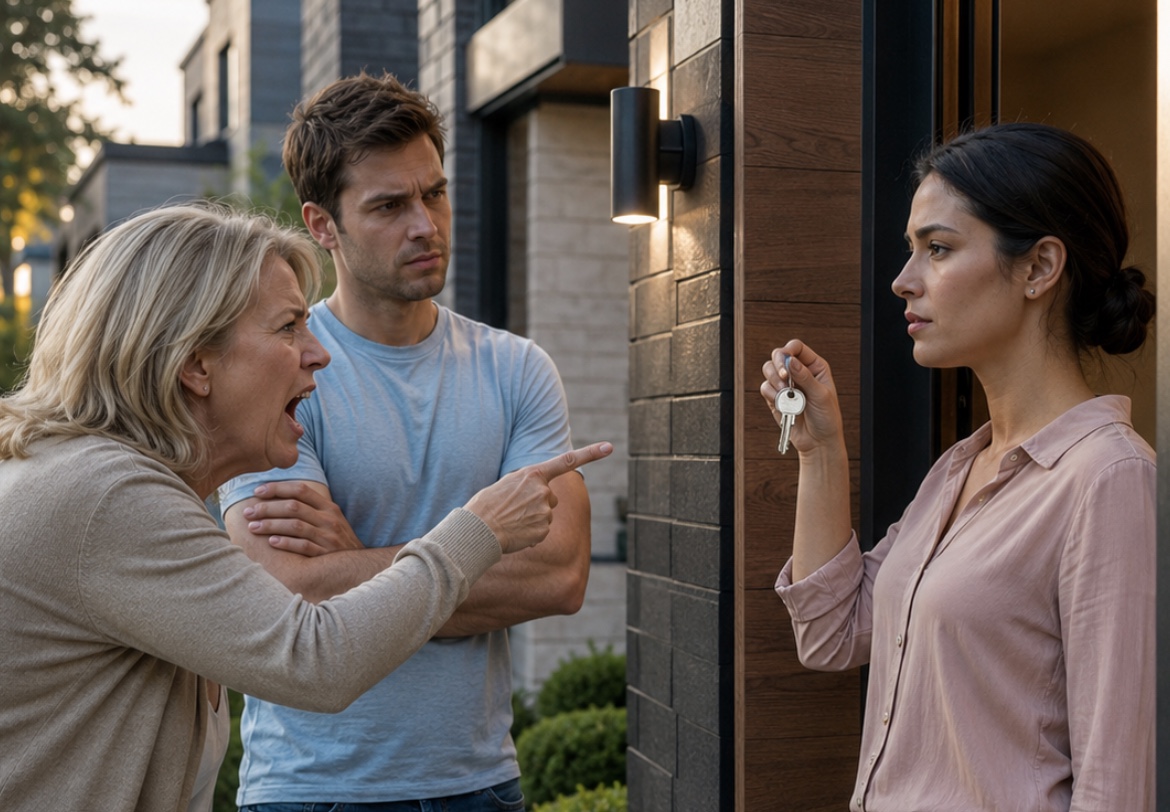
“Clear out this house. My children are moving in here,” Galina Stepanovna ordered, pointing toward the gate as though she were showing movers where to carry the furniture.
Lida stopped at the entrance to the yard with two shopping bags in her hands. One contained groceries; the other held a new garden lamp she had bought on her way home. The July evening was hot, the air shimmering above the paving stones, while tall dahlias swayed lazily in the flower bed.
Everything looked almost peaceful—except for the unfamiliar suitcases standing beside her porch.
“Could you repeat that?” Lida asked.
Galina Stepanovna almost looked pleased. She assumed her daughter-in-law was confused and was about to start asking for details, as though the decision had already been made.
“What is there to repeat? Oksana and Igor sold their apartment. They need somewhere to stay with the children until they find another place. Your house is big. You won’t die from living alone in two rooms. Kirill knows everything.”
Kirill stood near the apple tree, studying the grass beneath his feet with exaggerated concentration. He did not approach his wife, take the bags from her, or tell his mother to stop.
His sister Oksana hovered nearby in a white sundress, holding a phone in one hand. Her husband, Igor, had already placed a box marked “Dishes” on the pathway and was now opening the trunk of a second car. Their two children sat on folding chairs in the shade, eating ice cream.
The calm expressions on the adults’ faces made one thing obvious: they had not come to ask permission.
They had come to move in.
Lida placed the bags on the paving stones beside the gate and removed her sunglasses. She did it slowly and carefully, as though preparing for an important meeting at work.
She was an occupational safety engineer at a manufacturing plant and had long been accustomed to dealing with people who broke the rules first and then acted surprised when someone confronted them. Raising your voice with such people was pointless. You had to speak briefly, clearly, and in a way that allowed every word to be repeated later in front of witnesses.
“Kirill, come here.”
Her husband raised his head. Irritation flashed across his face, but he quickly concealed it behind a weak smile.
“Lida, let’s not make a scene. Mom just expressed herself badly.”
“I’m not speaking to your mother right now. I called you.”
He walked toward her reluctantly.
That was when Lida noticed the spare set of keys in his hand—the same set she had left in the dresser drawer a month earlier in case she ever misplaced her own.
Only now there was an unfamiliar keychain attached to it, shaped like a red high-heeled shoe.
Oksana had already managed to claim even that small detail as her own.
“Did you know about this?” Lida asked.
“I knew Oksana temporarily had nowhere to live. Don’t act as though some catastrophe has happened.”
“How long does ‘temporarily’ mean?”
Kirill rubbed the back of his neck.
“Well… a month. Maybe two. They’ll find something.”
“Yesterday, your mother said on the phone, ‘You’ll definitely stay until autumn, and by then Lida will get used to it.’ Does that sound like one month to you?”
Kirill looked sharply at her. This time, the smile was gone.
“Were you eavesdropping?”
“I came back from the garden to get my pruning shears and heard you talking through the open window. You were sitting on the veranda, telling your mother that I would be angry at first but eventually accept it. Your exact words were: ‘The important thing is to arrive with all their belongings. She won’t throw them out in front of the children.’”
Galina Stepanovna adjusted the handbag on her shoulder and stepped closer.
“And he was right. You’re not a monster. You wouldn’t put children out on the street.”
Lida turned toward her mother-in-law.
“The children were put out of their own apartment by their parents when they sold it without arranging another place to live. Do not make that my responsibility.”
Oksana’s face flushed bright red. She stepped forward, holding her phone like a weapon.
“Do you even understand what you’re saying? We’re not strangers! I’m your husband’s sister!”
“I remember the family relationships perfectly well. That is exactly why I am surprised that not one adult here thought to call the owner of this house and ask for permission.”
“Kirill gave us permission!” Oksana snapped.
Lida looked at her husband.
“Kirill does not own this house.”
The words were spoken calmly, yet the entire yard suddenly fell silent. Even the children stopped rustling their ice-cream wrappers.
Igor closed the trunk and pretended to inspect the strap around one of the boxes, although he was listening to every word.
The house truly belonged to Lida.
It was not “basically theirs together,” not “the family home,” and not something “everyone had contributed to.” She had purchased it a year before she met Kirill.
Back then, the small brick house in the suburbs had been neglected, with an overgrown yard and an old bathhouse. Lida had spent three years restoring it. She replaced the wiring, repaired the roof, ordered a new kitchen, selected the tiles for the porch, and taught herself how to prune shrubs and control weeds.
Kirill had appeared later, when the house had already begun to resemble a place where someone could live rather than merely sleep among construction dust.
After they married, he moved in without much discussion. He called his room in his mother’s apartment a “temporary base” and insisted that the two of them would have more space in Lida’s house.
Lida had not objected. At the time, she liked watching him prepare food on the grill, carry soil for the flower beds, and choose lights for the terrace.
She had never intended to give him ownership of the property, but she had not hidden her life from him either. She gave him keys, made space for him in the wardrobe, and welcomed him into her home.
As it turned out, some people quickly confused hospitality with the right to take control.
The first warning signs had appeared in the spring.
Oksana would visit on weekends and spend far too long walking through the rooms, looking inside the pantry and counting the available sleeping spaces.
“If you think about it, you could put another bed in here,” she said one day.
“What for?” Lida asked.
“Well, you never know. For guests.”
“We are not planning to turn the house into a guesthouse.”
Oksana laughed, but her gaze became calculating.
Then Galina Stepanovna began talking about how the house was “going to waste,” as though a house was required to serve every member of her son’s family or its unused square footage might become offended.
Kirill always laughed it off.
Lida did not argue at the time, but she took note of how frequently the subject was being raised.
Then, a week earlier, she heard the most important conversation of all.
Kirill had been talking to his mother on the veranda, believing Lida had gone shopping. Lida returned through the side gate because she had forgotten her pruning shears.
The kitchen window was open, and her husband’s voice carried clearly.
“Mom, I’ll tell her on the day they move in. It’ll be easier that way. If I mention it in advance, she’ll dig in her heels. But once Oksana is already here with the children, Lida won’t make a scene.”
“And the keys?”
“I have the spare set. If necessary, we’ll go inside ourselves. She’ll be home in the evening.”
Lida did not storm onto the veranda.
She did not slam the door, demand explanations, or allow herself to be subjected to another round of, “You misunderstood everything.”
Instead, she quietly picked up the pruning shears, left through the gate, and drove to the nearest hardware store.
That same day, she called a locksmith. He replaced the lock cylinders on both entrance doors and the gate.
There was no need to file any official reports. Replacing the locks in your own house was simple: you purchased new ones and had them installed.
She placed the old keys in a bag and left them in the trunk of her car.
Then Lida calmly gathered Kirill’s spare belongings from the storage room: his fishing equipment, old sneakers, a box of magazines, and his winter jacket.
She did not throw anything away, damage anything, or indulge in petty revenge. She packed everything into clean storage containers and placed them in the garage.
She kept the most important things with her: the ownership documents, the property register statement, their marriage certificate, receipts for major renovations, and the folder containing all the repair contracts.
Not because she intended to rush anywhere immediately.
Lida simply preferred to know that, in a critical moment, every necessary document was exactly where it belonged.
And now her husband’s relatives stood beside her porch while their old keys no longer fit the locks.
“So it was you who changed them?” Kirill finally asked.
“Yes.”
“And you didn’t warn me?”
“Did any of you warn me that six people were planning to move into my house?”
“Five,” Igor corrected her. “Galina Stepanovna isn’t staying.”
“What a relief,” Lida replied dryly. “Only five strangers with suitcases, then.”
Oksana spun toward her husband.
“Did you hear that? We’re strangers to her!”
“As far as my house is concerned, yes,” Lida answered. “You have your own documents, your own decisions, and your own consequences. My house has nothing to do with them.”
Galina Stepanovna threw up her hands.
“Lida, you’ve become completely arrogant! You got yourself a house, and now you’re acting like some kind of queen!”
Lida slowly turned toward her.
“I did not simply ‘get’ this house. I bought it. And even if I had inherited it, that still would not make it yours. But you are welcome to keep shouting if you believe it will help the suitcases find somewhere to live on their own.”
Oksana’s chin trembled, but she did not cry.
She was not an innocent victim of circumstance. She was a woman who had sold her apartment while already knowing she intended to force her way into her sister-in-law’s house.
Igor did not look deceived either. He was remaining silent too deliberately, clearly waiting for the women to pressure Lida into surrendering while he stayed safely on the sidelines.
“All right,” he finally said. “Let’s avoid getting emotional. We honestly need somewhere to stay temporarily. We’ll contribute toward the utilities and buy our own food. The children need somewhere to sleep. You understand how difficult the housing market is right now. Finding something quickly isn’t easy.”
“Where have you been staying since the sale?” Lida asked.
“With friends for a couple of days.”
“The money from the apartment sale is in your account?”
Igor frowned.
“That’s none of your business.”
“Correct. And allowing you to live in my house is not my responsibility. Rent somewhere.”
Oksana gave a short, bitter laugh.
“Rent somewhere? Have you seen the prices? Why should we waste money paying strangers when my own brother has a house sitting empty?”
Lida looked at Kirill.
“There it is. She finally said the important part. It isn’t that they have nowhere to go. They simply don’t want to pay.”
Kirill clenched his jaw.
“You’re humiliating my sister.”
“No. I am describing what is happening. Humiliation is when adults arrive at someone else’s house with boxes and children because they expect the owner to feel too embarrassed to refuse them.”
Galina Stepanovna marched toward the front door and pushed the old key into the lock.
It went in only halfway.
She jerked the handle forcefully, then tried again.
The door did not move.
Lida watched in silence.
“Kirill!” Galina called sharply. “What is this?”
“Mom, step away from the door,” he said quietly.
“You said you had the keys!”
“You did,” Lida answered. “Now you don’t.”
Her mother-in-law turned around.
For the first time, her expression showed not outrage but confusion.
Until that moment, she had apparently believed the plan would still succeed. That all they had to do was arrive, place the boxes beside the house, and begin giving orders.
Lida might argue, but eventually she would open the door.
“You have no right to keep your husband out of his own home,” Galina said, more cautiously now.
“Kirill is officially registered at your apartment, Galina Stepanovna. He lived in my house with my permission. I have not taken his personal belongings. They are intact and stored in the garage. He may collect them today. But he cannot move you, Oksana, Igor, or the children into this house. And after what happened today, he will also remain outside the gate until we decide what happens next.”
Kirill raised his head sharply.
“So you’re throwing me out?”
“I am revoking access to my home from a person who attempted to move his relatives into it through deception.”
“I’m your husband!”
“That is the only reason I am still speaking to you instead of immediately calling the police.”
Oksana gasped.
“The police? On us? Over a family matter?”
“This is not a family matter. It is an attempt to enter a private residence and impose occupants without the owner’s consent.”
Igor finally abandoned his performance as the reasonable peacemaker.
“Who told you we intended to do anything illegal? Kirill invited us.”
“Kirill could invite you for tea if I agreed to open the door. He could not invite you to live here.”
“And if the children have to spend the night in the car?” Oksana asked. “Will you sleep peacefully after that?”
Lida looked at the children.
The boy, who appeared to be around seven, was smearing melted ice cream across his fingers. The older girl watched the adults with tense curiosity.
Lida took a packet of wet wipes from her handbag and offered it to the girl.
“Here. Clean your hands.”
The girl looked uncertainly at her mother. Oksana appeared ready to object, but Igor nodded.
The child accepted the wipes and quietly thanked Lida.
Lida turned back to the adults.
“The children should not sleep in the car. That means you will book a hotel tonight or go to Galina Stepanovna’s apartment. If you need help finding a room for one night, I will help you search. But you will not enter this house.”
“I have a one-bedroom apartment!” her mother-in-law protested.
“Then you will be crowded. But this is your family and the result of your decisions.”
Galina Stepanovna pressed a hand against her chest.
“I never liked you from the first day. You’re cold. Everything has to be documented and done according to your rules. Kirill can’t breathe when he’s around you.”
Lida picked up the bags and carried them closer to the garage so the groceries would not remain in the sun. Then she returned to the gate.
“Kirill could have left any day if he could not breathe here. Strangely enough, he managed to breathe for three years while using my bathroom, kitchen, garden, garage, and peace and quiet. Now he has apparently decided that, along with the air, he also received the right to control my house.”
Fortunately, there were no neighbors nearby.
Lida’s property stood at the end of the street. On one side was an abandoned old house, and on the other lived an elderly couple who spent their summers with their daughter.
Even so, Lida continued speaking calmly.
Not for the neighbors, but for herself.
She had no intention of turning her yard into a marketplace.
Kirill moved closer.
“Let’s go inside and talk privately.”
“No.”
“Lida.”
“No, Kirill. You are not going inside. We will speak here.”
He frowned.
“Are you seriously willing to destroy our marriage because I wanted to help my sister?”
Lida smiled without amusement.
“You did not want to help your sister. You wanted to help her with my house, my peace, and my consent—which you planned to replace with your silence.”
“Don’t be dramatic.”
“I am being extremely practical. You are the ones who arrived with suitcases, children, and a commanding mother so that I would look like the villain if I refused to open the door.”
Oksana raised her phone again.
“I’m going to record you throwing children out onto the street.”
“Go ahead. But begin by explaining how you sold your apartment, failed to rent another place, and brought your children to the home of a woman who never agreed to let you live there. You can also show the old key my husband gave you without my permission.”
Oksana slowly lowered the phone.
Igor swore under his breath.
“That’s enough,” Kirill said. “Lida, I’m asking you properly. Let them stay for two weeks. Just two weeks. Then they’ll leave.”
“No.”
“I promise.”
“Your promise means nothing after the conversation you had with your mother yesterday.”
Kirill did not turn pale immediately.
First, his cheek twitched. Then he abruptly turned toward the apple tree.
Perhaps only now did he understand that Lida was not merely offended.
She had known everything in advance and had prepared herself.
His usual strategy—applying pressure, persuading her, turning it into a joke, or accusing her of cruelty—was no longer working.
“What do you want?” he asked hoarsely.
“Today, I want your relatives to take their belongings and leave. You will collect your things from the garage. Tomorrow, we will meet somewhere neutral and decide how we are going to separate.”
“Separate?”
“Yes.”
Galina Stepanovna immediately reacted.
“You’re destroying a family over something so trivial?”
Lida looked at her for a long moment.
“Families are not destroyed by locks. They are destroyed when one person secretly decides who will live in the other person’s home.”
“You’ll regret this,” Oksana said. “Kirill might still have been useful to you.”
“For what? Giving my keys to someone else again?”
Oksana clenched her teeth.
Igor took her by the arm.
“Let’s go,” he said.
“Where?” she hissed.
“Away from here. She isn’t letting us in.”
“She isn’t letting you in?” Galina Stepanovna raised her voice again. “Who does she think she is, refusing to let my son enter?”
Lida took out her phone.
“The owner. And if you continue pulling at the door or refuse to leave my property, I am calling the police.”
Kirill quickly stepped toward his mother.
“Mom, that’s enough.”
“You’re going to remain silent?” she attacked him. “Your wife is throwing you into the street!”
“I said that’s enough.”
It was the first time that evening Kirill had attempted to stop his mother.
It was late and unconvincing, but it was still an attempt.
Lida felt no relief.
Important words had an expiration date.
His had expired while he was sitting on the veranda.
Igor began loading the boxes back into the cars. He moved sharply and irritably but made no further comments.
Oksana stood beside the children, repeatedly opening and closing her phone.
Galina Stepanovna refused to move away from the front door until Kirill picked up her handbag himself and carried it to the car.
“Lida,” he said when he returned to the gate. “My things.”
“The garage is open. I’ll remain here.”
“You won’t even let me pack them myself?”
“I packed everything I found. Make a list of anything missing, and I will hand it over in front of witnesses. Your documents are in a separate bag.”
He looked at her as though seeing her for the first time.
Previously, Kirill had considered Lida calm, convenient, and perhaps a little too rational.
He called it “being obsessive” whenever she recorded renovation expenses, kept contracts organized in folders, or refused to sign documents without reading them.
Today, that supposed obsessiveness had become a wall against which his family’s confidence had shattered.
Kirill entered the garage and saw the containers.
Each one had been labeled: “Clothing,” “Tools,” “Fishing,” and “Documents.”
Nothing had been thrown carelessly onto the floor. Nothing was broken.
Lida had even packed his winter boots in a separate bag.
Her careful organization made him feel worse.
If she had thrown his belongings into the dirt, he could have shouted.
Instead, what lay before him was not rage.
It was a decision.
“How long have you been preparing this?” he asked.
“Long enough not to be caught unprepared.”
“I never thought you could be this ruthless.”
“You thought I was soft whenever it was convenient for you.”
He said nothing.
By the time Oksana’s last boxes had been returned to the cars, the sun was setting behind the neighboring rooftops.
The heat was fading, but the air in the yard still felt heavy.
Galina Stepanovna sat in the front passenger seat of Kirill’s car, deliberately refusing to look at Lida.
Oksana slammed the car door so violently that her daughter flinched in the back seat.
Igor started the engine, but before driving away, he lowered the window.
“Do you even understand what you’ve just done?” he asked.
“Yes,” Lida replied. “I refused to let people into my home who wanted to save money at the expense of my life.”
Igor opened his mouth to argue but changed his mind.
His car drove away first.
Kirill followed with his mother.
Lida remained beside the gate until the red taillights disappeared around the corner.
Only then did she lock the gate with the new lock, pick up her bags, and enter the house.
Inside, everything was silent.
Kirill’s coffee cup, forgotten since morning, stood on the kitchen table.
Lida picked it up, washed it, and placed it in the cupboard.
She did not do it angrily. Dirty dishes simply did not belong on the table.
Then she put the groceries in the refrigerator, removed the garden lamp from its bag, and placed it on the cabinet in the hallway.
Her hands moved with precision.
She did not allow herself even one unnecessary moment of weakness.
First came order.
Decisions would come afterward.
That evening, Kirill sent her a message.
“Mom is crying. Oksana is in shock. You could at least have allowed them to stay for one night.”
Lida replied:
“You could at least have asked me beforehand.”
A minute later, another message appeared.
“I was trying to do what was best.”
She typed:
“You were trying to do what was easiest for you.”
He did not write again.
The following day, they met at a roadside café.
Lida had deliberately chosen a busy, neutral place with no shared memories.
Kirill arrived looking exhausted, wearing a wrinkled shirt. He sat across from her and placed his phone face down on the table.
“I spent the night at my mother’s,” he said.
“I didn’t ask.”
“It’s impossible there. Oksana and the children are staying there too. Everyone is on edge. Mom refuses to speak to me, then speaks to me, and then refuses again.”
“Those are your family’s problems.”
He frowned.
“You say that so easily, as though I’m a stranger.”
“After what you did, you’ve moved significantly closer to becoming one.”
Kirill gripped the edge of the table, then quickly released it. Apparently, he had decided not to argue.
“Lida, let’s be honest. I made a mistake. Yes, I should have told you beforehand. But I was afraid you would refuse.”
“So you decided to take away my opportunity to refuse.”
“I hoped that when you saw the children…”
“I would become easier to manipulate.”
He looked away.
“I didn’t want to hurt you.”
“This is not about hurt feelings. If you had forgotten to buy groceries, I might have felt hurt. If you had answered me harshly, we might have argued. But you planned to move other people into my home behind my back. That is not an emotion. It is a fact. And after facts like that, trust cannot be repaired with words.”
Kirill remained silent.
A fly crawled across the outside of the café window.
The room smelled of coffee, warm pastries, and gasoline drifting in from the parking lot.
“What happens now?” he finally asked.
“You remain with your mother or rent somewhere. You do not return to the house. If you need anything, send me a list. You can collect it from the garage at an agreed time. Without your mother and without Oksana.”
“And our marriage?”
“I will file for divorce. If you agree and there is nothing to divide, we can do it through the civil registry office. We have no children, the house was purchased by me before the marriage, and we have no joint property that requires a court case. If you decide to challenge anything, we will go through court.”
Kirill looked up.
“So you’ve already decided everything.”
“Yes.”
“There’s no chance?”
Lida leaned slightly forward.
“You had your chance a week ago. You could have said, ‘My sister is in a difficult situation. Let’s discuss it.’ I would not have agreed to let them live in my house, but I might have helped them find a short-term rental, shared useful contacts, or considered other options. Instead of having a conversation, you chose to set a trap.”
“I knew you would refuse.”
“I would have refused.”
“There, you see?”
“No, Kirill. The difference is that refusing was my right. You decided that my right was an inconvenience to your family.”
He gave a bitter smile.
“You always knew how to phrase things beautifully.”
“And you always knew how to avoid the point.”
The conversation lasted less than half an hour.
Kirill attempted twice to steer the discussion toward reconciliation, once toward pity, and once toward blame.
Each time, Lida returned to the same facts: the trust was gone, access to the house was revoked, his belongings would be handed over according to a list, and the divorce would proceed legally.
When they stepped into the parking lot, Kirill stopped beside her car.
“Mom said you’re going to end up without a family.”
Lida opened the car door and looked at him across the roof.
“Yesterday, I finally learned the difference between a family and a house. It was a very useful lesson.”
He wanted to answer but could not find the words.
Lida got into her car and drove away.
The following two weeks were unpleasant but not chaotic.
Oksana sent several long messages. In one paragraph, she called Lida heartless; in the next, she begged her to “show some humanity and understand their situation.”
Lida replied only once:
“Living in my house is not possible. Contact Kirill regarding any other matters.”
After that, she stopped responding.
Galina Stepanovna called from different phone numbers.
Lida answered only once.
“You destroyed my son!” her mother-in-law declared.
“No. I prevented your son from destroying my home.”
“He’s a man! He needs support!”
“Then support him. He is registered at your address.”
After that, Lida blocked every unfamiliar number.
Not because she was offended.
Because she valued her time.
Kirill came to collect his belongings twice.
The first time, he arrived alone, as agreed. Lida opened the garage, stood beside the gate, and checked off each item as he collected it.
The second time, he brought a friend—a calm, quiet man named Artyom.
Lida did not object. A witness was even better.
Kirill collected his bicycle, a box of tools, and an old portable speaker.
He did not enter the house once.
On his third visit, he attempted to start a conversation at the gate.
“I found somewhere to live. I’m renting a room for now.”
“Good.”
“Oksana and Igor rented a house in the next village too. For one month.”
“So there was an available option.”
Kirill smiled crookedly.
“An expensive option.”
“At least they are finally paying for the consequences of their own choices.”
He looked at her tiredly.
“Don’t you miss me?”
Lida locked the garage.
“Kirill, I spent three years living with someone I believed was my partner. Then, in one evening, I learned that during the first serious conflict, he would choose neither me, nor honesty, nor even compromise. He would choose pressure from a crowd. I don’t miss you. I miss the version of you that may never have existed.”
He lowered his head.
“That’s harsh.”
“It’s honest.”
At the end of August, they submitted their divorce application to the civil registry office.
Kirill agreed.
There was nothing to divide, they had no children, and he did not attempt to challenge ownership of the house. The documents were undeniable.
Even Galina Stepanovna, despite all her efforts, could not invent a convincing reason why her son might be entitled to property Lida had purchased before the marriage.
On the day they submitted the application, Kirill appeared calmer.
Perhaps he was tired.
Perhaps, for the first time, he understood that loud family decisions sometimes ended quietly in a line beside a government office window.
“Do you honestly regret nothing?” he asked outside.
Lida looked at the linden trees lining the sidewalk. Although summer had not yet ended, the edges of the leaves were already beginning to turn yellow.
“I have regrets.”
Kirill immediately looked hopeful.
“Really?”
“Yes. I regret that I did not notice the smaller things earlier. The way your mother always said ‘your house’ in the plural even though she knew it belonged to me. The way Oksana chose where the ‘guests’ would sleep. The way you always asked me to give in because ‘it would be easier.’ Major betrayals rarely appear out of nowhere. Usually, they spend a long time practicing through small ones.”
Kirill stood silently.
Then he nodded and walked toward the bus stop.
That autumn, Lida changed more than the locks.
She changed the structure of her life.
She did not do it dramatically or out of revenge. She simply removed everything from the house that represented someone else’s presence without respect.
She cleared the hallway shelf where Kirill’s belongings had been kept.
She installed a new storage rack for tools in the garage.
On the veranda, she hung the lights she had bought long ago but had continually postponed installing.
She planted hydrangea bushes along the fence.
One day, her neighbor Vera Petrovna stopped by after returning from her daughter’s home. She brought a bucket of plums and immediately noticed the new lock on the gate.
“You installed a strong one,” she said.
“Stronger than the old one.”
“Kirill doesn’t live here anymore?”
“No.”
Vera Petrovna did not ask unnecessary questions. She simply placed the bucket beside the porch and said:
“A house listens to a woman when strangers are not allowed to give orders inside it.”
Lida smiled.
“That’s a good way to put it.”
“It comes from experience.”
The divorce was finalized without drama.
Kirill arrived on time, signed the paperwork, collected his document, and left almost immediately.
Galina Stepanovna did not appear at the registry office, although Lida would not have been surprised to see her waiting in the hallway with another prepared speech.
Oksana disappeared from her life as well.
Only once did Lida notice a message in a local community group:
“Family seeking long-term house rental. Cleanliness and order guaranteed.”
She read it and closed the post.
Sometimes order begins precisely where the opportunity to live at someone else’s expense ends.
At the end of September, Kirill sent one final message:
“I understand now that what I did was despicable. Forgive me.”
Lida stared at the screen for a long time.
Not because she was unsure whether to answer.
She was simply checking herself to see whether it still hurt.
It almost did not.
Only a faint mark remained, like a burn that served as a reminder to be more careful.
She wrote:
“Apology accepted. But there is nothing to restore.”
Then she deleted their conversation.
The house remained quiet, clean, and hers.
It was not a fortress against the world, a monument to resentment, or proof that she had been right.
It was simply a place where the owner made the decisions.
A place where no one could arrive with boxes and announce that they would now be living there because it was more convenient for the family.
Lida often remembered that July evening.
She did not remember it as a scandal, but as a test.
Suitcases had been standing on the pathway. Her mother-in-law had been beside the door. Her husband had been waiting for her to surrender. The children had been eating ice cream.
And the old key had refused to turn inside the new lock.
That was the moment Lida finally understood something simple:
Boundaries should be established before someone else’s belongings end up in your bedroom.
Because a home is more than walls, a roof, and a garden filled with summer flowers.
A home is a place where your “no” should open more doors than someone else’s declaration that “we have already decided.”