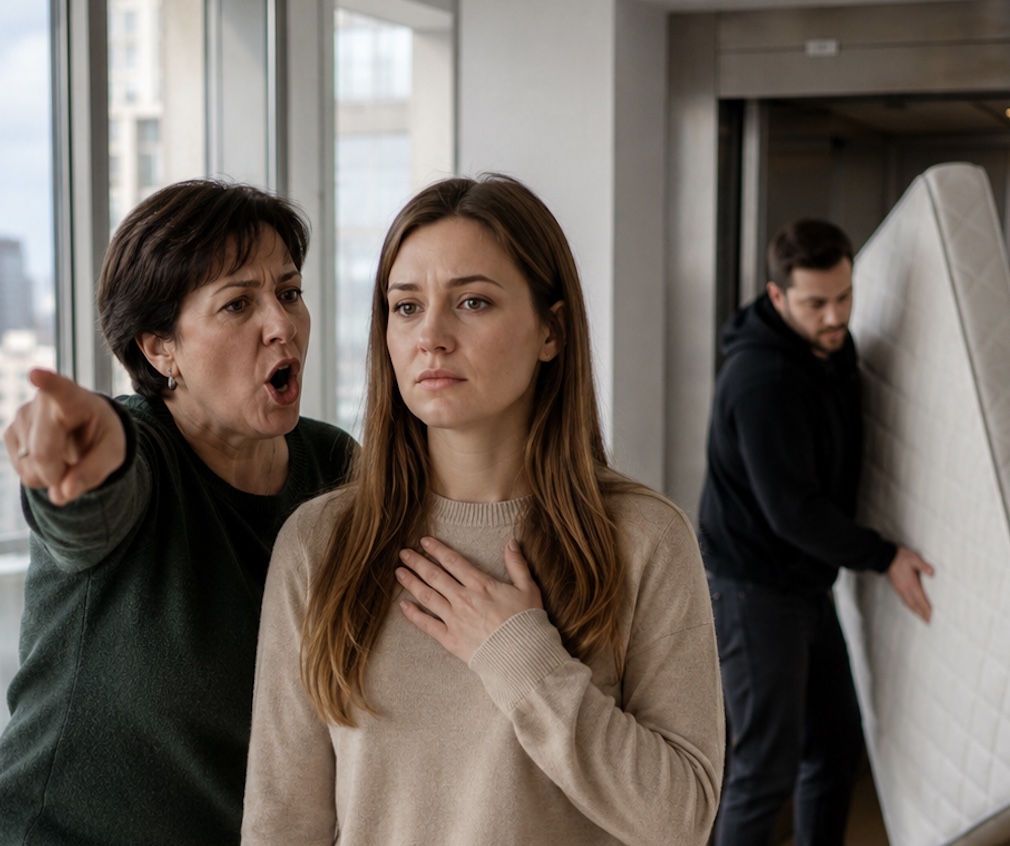
“You don’t even need to start, Marina. Denis is going to live here, and that’s final,” Aunt Zhanna said while the mover carried a gaming chair into my studio apartment.
I stood in the doorway with a folder of documents in my hand and watched as someone else’s mattress, boxes of cables, and two bags of clothes were dragged across the threshold of my apartment. One box had “Den. Tech” written on it in black marker. Another said “Shoes.” The third simply said “Miscellaneous,” though judging by its size, half of my cousin’s life was inside it.
“Who gave you permission to bring all this here?” I asked.
Denis, who was twenty-nine, did not even turn around. He was holding a monitor and telling the mover not to scratch the corner. Zhanna looked at me as if I were the one causing an awkward scene in her apartment.
“We’ve already decided everything,” she said. “You have your own one-bedroom place, and this studio is just sitting empty. Family helps family, Marina. Don’t be selfish.”
I had inherited the studio in April after the paperwork was finalized. It was small, 26.8 square meters, on the eighth floor, with a decent entrance and a balcony that could fit two folding chairs. I planned to fix it up and rent it out so it could cover part of the mortgage payment on my own apartment. I had never invited the family to vote on that plan, but Zhanna had decided otherwise.
The first time she called was three days after she found out about the documents.
“So you can rent it to strangers, but not let your own Denis live there?” she asked, in a tone that made it sound as if she had caught me doing something shameful.
Back then, I still tried to speak calmly. I explained that the apartment was registered in my name, that the utilities and taxes were my responsibility, and that Denis was a grown man who could find his own place to live. Zhanna listened only until I said the word “no.”
“We’re family,” she interrupted. “You have two apartments all to yourself, while my son is forced to squeeze into corners.”
Denis was not squeezing into any corners. He lived with Zhanna, occupied the largest room, and had spent the last three years talking about projects that were supposedly about to start making money. No one had ever seen any income from those projects, but his chair, monitor, and boxes of equipment were taking up more and more space in his mother’s apartment.
A week later, Zhanna came over “just to look at the studio.” She brought a tape measure, walked from one wall to another, and started figuring out where to put a desk.
“Denis will be comfortable working here,” she said. “We’ll move the boxes to the balcony, put a wardrobe along that wall. It’s fine for one man.”
“For which man?” I asked, though I already knew the answer.
“Don’t nitpick. Denis needs to get on his feet.”
“On my square meters?”
Zhanna pressed her lips together.
“You have a strange way of speaking to relatives. This apartment didn’t come to you through hard work. You could share.”
After that conversation, I took all the documents out of the studio and left only wallpaper samples and a shopping list for the renovation. I thought my aunt would get offended, call a few more times, and eventually leave me alone.
I was wrong.
That day, the studio door was slightly open. Zhanna’s voice came from inside as she told the mover where to put the boxes. Denis had already managed to lay the mattress against the wall, place his monitor on the windowsill, and leave his car keys on the new cooktop.
“Denis is not living here,” I said.
“Not yet,” Zhanna corrected me. “Starting today, he will. It’s too cramped for him at my place, and you only need this studio for money anyway.”
Denis finally looked up from his phone.
“Marina, honestly, it won’t be for long. A month, two at most. I’ll get settled and move out.”
“Did you ask me?”
He winced as if I were making a fuss over nothing.
“Mom said you’d understand.”
Zhanna immediately stepped in.
“What is there to understand? We’re not taking it away. We’re handling it as a family. You don’t live here anyway.”
I looked around the studio. His socks were already hanging on the radiator, chargers were lying near the outlet, a bag of food stood on the floor, and a toothbrush had appeared by the sink. This was not someone “bringing in a few boxes for a minute.” They had come with a plan to stay and force me to accept it.
“Pack everything back up,” I said. “I did not give permission for anyone to live here.”
Zhanna folded her arms across her chest.
“Don’t order me around. I am your aunt.”
“And I am the owner of this apartment.”
“Don’t hide behind papers. Conscience matters more than papers.”
After that sentence, arguing became completely pointless. A person who had already occupied someone else’s apartment was not going to read my documents. She was going to press on my guilt until I got too tired to resist.
I picked up the wallpaper samples from the table, checked my folder of documents, and said their belongings had to be gone by the next evening. Zhanna smirked and replied:
“We’ll see. You’ve always been soft. You’re just acting tough right now.”
I left, but not because I had given up. I needed a solution that would work faster than another family scandal. I kept calling the police as my backup option, but I understood how it would go: explanations would begin about who was whose aunt, who was only staying temporarily, who misunderstood what, and meanwhile Denis would continue living in my apartment.
Outside the building, I texted Pavel. He worked at a drama theater, and we had been friends since university. I briefly explained the situation: my relatives had moved things in without permission, they did not intend to leave, and I needed a firm but safe performance that would make them fear for their belongings and remove everything immediately.
Pavel called back almost at once.
“Do you have the apartment documents?” he asked.
“Yes.”
“Is anyone registered there?”
“No.”
“Then listen. No real stamps, no IDs, no words about bailiffs or police. Only theater props and a private visiting group within a fictional property dispute. We don’t touch anyone, we don’t take anything. We simply create a situation where they will want to carry their own things out.”
He spoke calmly, and that helped me think clearly. We were not going to stage anything dangerous. I did not need a fight or real-looking documents. I needed a scene built around Zhanna’s own logic: if she believed she could barge into someone else’s apartment by sheer pressure, then she would believe in pressure coming from someone else too.
The next day, Pavel invited Irina and Roman. At the theater, Irina played women with dry, businesslike voices that made people immediately want to look for their passports. Roman barely spoke, but he knew how to stand nearby in a way that made any conversation shorter. Pavel brought an ordinary gray folder from the theater with prop papers inside: no emblems, no stamps, no real official details. The top sheet had large printed words: “On-Site Inspection Report.” For the scene, that was enough.
“Remember,” Pavel said before we went. “We do not say we have the right to take anything. We say we are recording the presence of property at a disputed site. If they demand real documents, we stop, and you call the police as the owner. Understood?”
I nodded. I hated the fact that I had to invent a performance in my own apartment at all, but Zhanna had left no room for a normal family conversation. She had already decided for me who would live on my property.
That evening, I went up to the eighth floor first. Music was playing behind the door. Denis did not open immediately. He was wearing sweatpants and holding a plate. When he saw me, he stepped back with irritation.
“Marina, are you here to check on me again?” he asked. “I’m not bothering anyone.”
In just one day, the studio had become even more cramped. A desk had appeared against the wall, with a monitor, keyboard, and two cans of energy drink on top. His boxes were already on the balcony. Zhanna was sitting on a folding chair with her phone, sending someone a voice message that “the matter was almost settled.”
“The matter is not settled,” I said when she stopped recording. “You need to remove your things.”
Zhanna waved her hand irritably.
“Again with the same thing. Denis will stay for a month, maybe two. You won’t go broke.”
“I did not give my consent.”
“And I am not going to watch my son squeeze into a corner while my niece has an empty apartment sitting unused.”
Denis put his plate on the windowsill and tried to sound conciliatory.
“Marina, come on, let’s not make this about principles. I’ll help you with the renovation later.”
He said this from inside the room he had already occupied without asking. At that point, the conversation was over. I took out my phone and sent Pavel one word: “Now.”
A minute later, the doorbell rang. Denis frowned.
“Are you expecting someone?”
“Yes,” I said. “Open it.”
He opened the door, and Pavel, Irina, and Roman appeared on the threshold. Pavel held a gray folder under his arm, Irina had a tablet with a blank screen, and Roman stood slightly behind them. They did not push their way in or enter by force. I was the one who said they could come in, because the apartment was mine.
Pavel stopped near the doorway and looked at Denis.
“Good evening. Are you currently residing in this property?”
Denis looked confused.
“And who are you?”
“An on-site group for a property dispute connected to the previous owner of the premises,” Pavel replied in a low, even voice. “We need to record the property currently located inside.”
Zhanna jumped up from the chair.
“What dispute? Marina, what does this mean?”
I looked at her and said calmly:
“I warned you that no one was allowed to live here. I don’t know what debts the previous owners had.”
That sentence was part of the performance. Zhanna immediately latched onto the word “debts.”
“What debts? She inherited this studio!”
Irina opened the folder and flipped through the prop pages without showing them up close.
“Transfer through inheritance does not cancel the need for inspection under the internal register of a private claimant. We are interested in the property located at the site at the time of the visit.”
“These are my son’s things!” Zhanna said, though her voice had already become quieter.
“Then they will be listed as the belongings of the person actually occupying the premises,” Irina answered.
Denis quickly glanced at the monitor.
“Wait, my computer too?”
Pavel did not look at me, did not raise his voice, and did not move closer to the belongings. He simply said:
“Electronic equipment, furniture, and household items are recorded first. If you have a rental agreement, registration, written consent from the owner, or any other legal basis for being here, please show it immediately.”
Zhanna was silent. So was Denis. All their talk about family, blood, and conscience suddenly ran into one simple question: on what basis had they occupied the apartment?
They had no basis.
“We are relatives,” Zhanna said after a pause.
“Kinship is not a property document,” Irina replied dryly.
Denis grabbed his phone.
“Mom, I’m going to text a lawyer.”
Pavel looked at his watch.
“Do that. We’ll begin with the equipment.”
That was too much for Denis. He jumped up and started pulling cables out of the extension cord.
“Don’t begin anything. I’ll take everything out right now.”
Zhanna turned to him.
“Denis, don’t panic. No one has the right to touch your things.”
“Mom, do you understand they’re going to inventory them?” he snapped. “You said she’d just yell and calm down.”
That sentence sounded better than any confession. Zhanna really had expected me to yell, get tired, and back down. Only this time, I was standing at my own door, and beside me were people who did not allow her to turn the conversation into the usual family pressure.
Pavel said calmly:
“We can allow fifteen minutes for voluntary removal of the property. After that, we record the items in the inspection report.”
Those fifteen minutes worked better than all my arguments from the previous two weeks. Denis began packing cables, the keyboard, cans, clothes, and shoes into boxes. At first, Zhanna tried to give orders. Then she started grabbing bags herself and throwing his things inside. The mattress was folded in half, the chair got stuck in the doorway, the drying rack was caught by the door, but within minutes, all of it was already in the hallway.
“Are you satisfied?” Zhanna asked when Denis carried out the monitor, clutching it with both hands.
“No,” I answered. “I simply want you to leave my apartment.”
She wanted to say something about ingratitude, but Pavel looked at his watch again. Denis understood the hint faster than his mother and started carrying out the last bags. His plate was still on the windowsill. Pavel glanced at it, and Denis silently took the plate too.
In the hallway, boxes stood crookedly, the chair blocked the passage, and the neighbor from the apartment across the hall opened her door slightly and then immediately closed it again. Zhanna, already near the elevator, turned to me.
“We will talk again.”
“Only in writing,” I said. “And only about the matter itself.”
“You’ve forgotten who we are to you.”
“No. That’s why I tolerated it for so long.”
The elevator came on the third try. First it beeped because it was overloaded, and Denis had to take out some of the boxes and go down in two trips. Zhanna stood beside the chair the entire time in silence. For the first time during the whole conflict, she was not giving commands.
When the elevator doors closed, Pavel became regular Pavel again. He put the folder into his bag and said:
“No more performances now. Tomorrow, send her a dry message. Say you never gave permission for Denis to live here, that any repeated attempt to bring in belongings will be documented, and that you are keeping the documents separately. If they try again, call the police as the owner.”
I thanked them, and they left. The studio was left with the smell of someone else’s food, marks from the chair wheels on the floor, and a sticky circle on the windowsill. I collected a receipt, an empty can, torn packaging, and a cable tie into a bag. Then I took the folder from my purse and checked the documents: the will, the ownership certificate, the extract, the receipts, and the agreement with the handyman for small repairs. Everything was in place.
The next morning, Zhanna wrote: “You crossed the line.”
I did not answer.
Then came a second message: “Denis spent the whole night unpacking his things.”
I did not answer that either.
When she sent a third one — “I hope you feel good alone with your precious square meters” — I wrote back briefly, without explanations:
“The studio belongs to me. I did not give permission for Denis to live there. Any repeated attempt to bring in belongings or enter without my consent will be documented. All further questions must be handled in writing.”
Zhanna read the message and typed for a long time. Then she stopped. Denis did not write at all.
Two days later, the neighbor from the eighth floor gave me two packs of instant noodles someone had left near the elevator. “Den” was written on the packaging in marker. I thanked the neighbor and threw them away at home.
A week later, the studio was ready to rent. I did not turn it into a magazine picture. I simply washed the floor, hung thick curtains, placed a proper mattress, added a shoe shelf, and put a small table by the wall. The new tenant signed the agreement, transferred the deposit, and immediately asked whether she could put two pots of herbs on the balcony.
I gave her permission.
That evening, I received a message from Denis from an unknown number: “Mom said not to write, but I wanted to ask. Was it really impossible for just one month?”
Before, I would have started explaining that “one month” with people like that turns into a year, and that the word “just” often means “you won’t be able to get rid of me later.” This time, I answered with one sentence:
“No, it was not possible.”
Denis wrote, “I see,” and never appeared again.
Zhanna did not call after that either. Not on holidays, not through relatives, not with her usual speeches about family being more important than documents. She had lost the main thing she had been counting on: my willingness to justify myself.
Now the studio is occupied by someone who pays on time, sends photos of the meter readings, and asks permission even for pots of herbs. And Zhanna and Denis carried out, in fifteen minutes, everything they had tried to place on my square meters without asking.