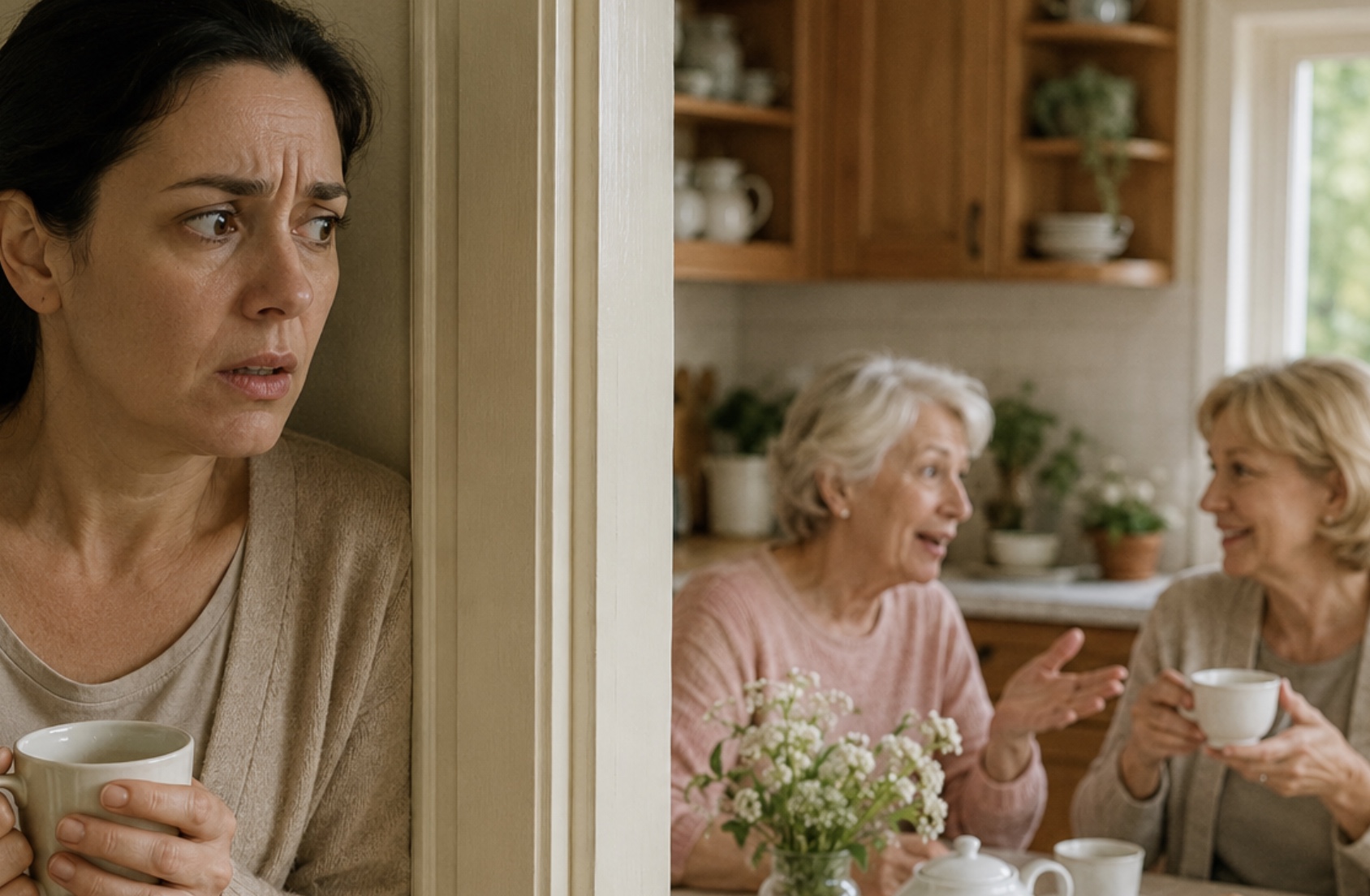
“Now that my daughter-in-law is earning good money, there’s no reason for me to keep working,” Tamara Lvovna announced with such satisfaction that she sounded as though she had just received official permission to retire for the rest of her life.
Oksana froze behind the half-open door of the summer kitchen. She was holding a bag of peaches in one hand and her car keys in the other. The plastic handle stretched tightly and dug into her fingers, but she did not even try to shift the weight.
She had arrived at the country house two hours earlier than planned.
A meeting in the city had unexpectedly been canceled. Oksana had been supposed to meet the owner of a hotel for which her workshop was producing decorative wooden panels. Instead of returning to the office, she decided to drive straight out of town.
That morning, her husband, Artyom, had told her that he was helping his mother repair the awning and would stay until evening. Oksana had planned to pick him up and bring groceries for dinner.
She had left the car outside the gate so that it would not block the neighbors’ driveway. Tamara Lvovna and Artyom had not heard her arrive. A lawn mower was roaring somewhere in the garden, while a small electric fan hummed inside the kitchen.
“Mom, don’t rush to hand in your resignation yet,” Artyom replied. “We need to talk to Oksana first.”
“What is there to discuss with her?” his mother asked in surprise. “You told me yourself that her business is doing better. One order after another. She even replaced her car recently.”
Oksana looked through the gaps in the fence at the white body of her car.
She had not bought it because she had suddenly become rich. Repairing the old vehicle had become financially pointless, and she needed a reliable car for work—to transport samples, tools, and smaller finished pieces. Oksana had used part of her savings for the down payment and was paying the rest in installments.
Artyom knew all of this. He had even gone with her to choose the model and had argued with the salesman over the available features.
“She has a steady income now,” Tamara Lvovna continued. “It’s not as if I’m taking the last piece of bread from your table. I don’t need much. Groceries, utilities, medicine from time to time. I already have everything else.”
“What do you mean, you have everything else, if you stop working?”
“I have the house and the vegetable garden. I can sell whatever I don’t use. And the two of you will help me. I’ve spent my entire life on my feet. I have the right to rest.”
“You do,” Artyom agreed. “But Oksana may refuse.”
His mother laughed quietly.
“Are you her husband or some neighbor from the next apartment? Explain it to her properly. Money in a family belongs to both spouses. Today she earns more, tomorrow you might. And you only have one mother.”
Oksana slowly lowered the bag onto a bench beside the wall. The peaches knocked dully against one another.
She did not walk in immediately.
It was true that Oksana had begun earning more over the past several months. Her small workshop, which restored wooden doors, antique dressers, and decorative elements for private homes, had received several large contracts.
The work was exhausting and the deadlines were strict. Oksana woke up earlier than her husband and returned home later. She personally inspected materials, negotiated with subcontractors, and corrected her employees’ mistakes.
Artyom worked as an engineer at a manufacturing plant. He had never shown much interest in how her business operated beyond occasionally asking, “So, is everything all right?”
He saw the finished results but never noticed the days when Oksana drove from warehouse to warehouse in the heat, revised estimates late at night, and argued with customers who wanted extra work without paying for it.
Now it turned out that her husband had not only noticed her success but had already decided how it should benefit other people.
“What if she says no?” Artyom asked.
“Then you didn’t present the matter correctly,” Tamara Lvovna answered. “You don’t ask her. You tell her that I’m leaving my job in the fall. You’ll transfer money to me every month, and I’ll come to your place more often and help around the house. Oksana is busy all day. It will be convenient for her.”
“She doesn’t like strangers touching things in her kitchen.”
“I’m not a stranger.”
“To her, everyone who touches her belongings is a stranger.”
“She’ll get used to it. When people start living well, it’s useful for them to remember their relatives.”
Oksana looked at the door and smiled faintly, though only the corners of her mouth moved.
Tamara Lvovna worked as an administrator at a small medical center. The job was not effortless, but it could hardly be described as physically exhausting. She sat at the reception desk, scheduled appointments, answered phone calls, and left early twice a week.
She did not complain about her health. Every summer, she grew vegetables on a six-hundred-square-meter plot, painted the garden benches herself, and could argue with the neighbor across the fence for half a day without running out of breath.
Her desire to quit had not appeared because she was exhausted.
Tamara Lvovna had long been jealous of a friend who was financially supported by her grown son. The woman frequently visited health resorts, bought new clothes, and liked to repeat that children were obligated to repay their parents for everything they had received while growing up.
Until that day, Tamara Lvovna had limited herself to hints.
She complained that work kept her from spending enough time at the country house. She described how difficult it was to wake up to an alarm clock. She asked how much a seaside vacation in September might cost.
Oksana listened without interfering. Every adult had the right to change jobs, take time off, move somewhere else, or make whatever plans they wished—provided they paid for those plans themselves.
Tamara Lvovna, however, was preparing to purchase her freedom with her daughter-in-law’s money without even informing her.
Oksana picked up the bag, pushed the door open, and walked inside.
“I won’t get used to it,” she said.
Artyom spun around sharply. Tamara Lvovna fell silent with her mouth open. A notebook lay on the table in front of her, filled with months and various expenses. She quickly snapped it shut, but Oksana had already seen the words “groceries,” “house,” and “vacation,” as well as a heavily circled line that read “starting in October.”
“When did you get here?” Artyom asked.
“Long enough ago to hear the completed plan for my future.”
She placed the peaches on the table and carefully slipped the keys into her handbag.
“Oksana, we were only discussing it,” her husband began.
“You weren’t discussing anything. Your mother was announcing that she intended to resign, while you were trying to figure out how to make me pay for her decision.”
“No one is going to make you do anything.”
“Then tell me how much you personally intend to give your mother every month from your own money.”
Artyom frowned.
“What does the amount have to do with anything?”
“You said your mother had the right to rest. I’m not arguing with that. I’m asking how much you are prepared to pay for that right.”
“We have a shared budget.”
“We did, until you started adding other people to it without my agreement.”
Tamara Lvovna straightened in her chair.
“What other people? I’m his mother.”
“For Artyom, you are his mother. For our budget, you are an additional adult who has voluntarily decided to give up her income.”
“You make it sound as though I intend to live off you!”
“You just listed groceries, household bills, and medicine. You also mentioned vacations and helping in our home when no one asked you to. That is exactly what financial support means.”
Tamara Lvovna’s face reddened. She turned toward the window, ran her fingers several times along the edge of the notebook, and then turned back sharply.
“I didn’t raise my son so that I would have to beg him for help in my old age.”
“Then don’t beg.”
Artyom struck the table with his palm. It was not a hard blow, but the cups rattled.
“Stop speaking to my mother like that.”
Oksana looked at him without fear.
“How should I speak to someone who has decided to leave her job at my expense?”
“She hasn’t resigned yet!”
“Because she is waiting for you to prepare me.”
“Why are you obsessing over one sentence?” Artyom raised his voice. “Mom is tired. I wanted to help her.”
“Then help her yourself. But instead, you began talking about my contracts and my car.”
“I’m your husband. I have the right to know how your business is doing.”
“You have the right to know. You do not have the right to promise my money to other people.”
Tamara Lvovna stood up and began clearing the table with exaggerated dignity. She collected two cups, carried them to the sink, and then turned to her son.
“Artyom, don’t humiliate yourself. I’ll call my manager tomorrow and tell her I’m staying. I’ll work until my legs can no longer carry me. At least your wife will feel at peace.”
Oksana gave a brief laugh.
“Excellent solution. Just don’t pretend that I’m forcing you to work yourself to death. You are fifty-eight, healthy, and you were the one who decided to give up your job.”
“You know nothing about my illnesses.”
“Name them.”
Her mother-in-law went still.
“I don’t have to report my health problems to you.”
“Of course not. But I don’t have to pay for unknown illnesses either.”
Artyom stepped closer to his wife.
“You are deliberately turning this conversation into something absurd.”
“No. I’m removing the attractive wrapping. Underneath, the situation is very simple. Your mother wants to relax, and I’m expected to pay for it.”
“We both are!”
“Have you already calculated how much money you will have left after your mandatory expenses?”
Her husband looked away. That was enough of an answer for Oksana.
She knew that Artyom was repaying a loan for a motorcycle he had bought in the spring despite her suggestion that he wait. He also regularly spent money on fishing equipment, trips with friends, and expensive tools, half of which he barely used.
He had enough money for his hobbies, but he could not support a healthy mother who had voluntarily left her job entirely on his own.
That was why his wife’s income had become the primary source of assistance in his plan.
“I’m not going to argue with you here,” Oksana said. “We’ll go home and review our budget. As for you, Tamara Lvovna, you may resign tomorrow if you wish. Just understand that there will be no regular transfers from me.”
“Are you forbidding my son from helping his own mother?”
“No. I’m forbidding him from using my money without discussing it with me.”
“Money earned by spouses belongs to both of them,” her mother-in-law declared confidently.
Oksana looked at Artyom.
“Did you tell her that?”
He remained silent for several seconds.
“Everything in a marriage is shared.”
“Not everything. But this is not even about the law. We had an agreement: large or recurring expenses were to be discussed in advance. You broke that agreement before the first payment was even made because you offered help without speaking to me.”
“I didn’t offer anything.”
Oksana nodded toward the notebook.
“Then open it.”
Tamara Lvovna pressed the notebook against her chest.
“This is private.”
“Of course it is. Just like my income.”
Oksana picked up her handbag and headed toward the exit.
“Where are you going?” Artyom asked.
“Home. Come with me if you want. Continue the meeting if you prefer. You can make your own way back.”
“We haven’t finished repairing the awning.”
“Then finish it.”
Oksana walked out into the yard, sat in her car, and turned on the air conditioning. She did not wait for her husband or expect him to run after her.
She needed time to think without shouting, offended expressions, and speeches about a son’s duty to his mother.
A minute later, the front door of the country house opened. Artyom stepped onto the porch, stopped, and looked at the car. Oksana started the engine.
Her husband did not move.
She drove away alone.
On the way home, Oksana did not call her friends or rehearse the argument that would happen later. Instead, she thought about the past several months.
Artyom had been asking too often when her customers would make their next payments. Several times, he had suggested keeping the workshop’s income in their shared account, even though he had previously treated the business finances as entirely her responsibility.
Recently, he had asked her to connect his bank card to one of the accounts, claiming that it would be useful in case of an emergency.
Oksana had refused.
It was not because she distrusted him. The workshop’s money belonged to the business. It paid for materials, rent, employees, and deliveries.
Artyom had taken offense and accused his wife of not trusting him.
Now she understood why he had wanted access.
At home, Oksana opened her laptop and carefully reviewed the family expenses from the previous three months.
They both contributed to a shared account. It covered groceries, utilities, household purchases, and trips they took together. Each of them paid for personal expenses independently.
At first, she saw nothing suspicious.
Then she found several transfers to Tamara Lvovna.
The amounts were not large, but they were regular. Artyom had left the payment descriptions blank.
Oksana checked the dates.
The first transfer had been made immediately after her workshop secured a large contract. The second followed two weeks later. The third had been sent at the beginning of July.
She took screenshots and sent her husband a single message:
“I expect an explanation for these transfers this evening. Until we speak, I will not add any money to the shared account.”
Artyom called almost immediately.
Oksana did not answer.
He called again, then sent a message.
“That was my money.”
She looked at the screen and replied:
“There is no ‘your money’ and ‘my money’ in the shared account. There is money for agreed expenses. You used it without discussing it.”
His response arrived a minute later.
“Mom needed help with the country house.”
Oksana opened the photographs Tamara Lvovna had posted in the family chat.
One showed a new garden swing. Another featured a large inflatable swimming pool. In the third, her mother-in-law posed beside a set of wicker chairs.
Oksana did not bother asking which purchase had qualified as emergency assistance.
From her personal account, she transferred exactly half the amount needed to cover essential expenses until the end of the month. Then she disabled the automatic transfer to their shared account.
Afterward, she made a list.
It did not contain threats or demands. It contained specific changes.
First: each spouse would transfer an agreed amount into the shared account.
Second: money given to relatives would come only from personal funds.
Third: information about the workshop’s income would no longer be discussed with outsiders.
Fourth: Tamara Lvovna would not receive keys to their apartment or come to “help around the house” unless invited.
The final point had not appeared without reason.
Her mother-in-law had stayed with them for several days on two previous occasions, and both times she had immediately begun taking control of the household. She rearranged food, searched through drawers, and threw away belongings she considered unnecessary.
Once, Oksana discovered that Tamara Lvovna had given a neighbor a set of wood-carving tools because she assumed they were old.
Oksana managed to retrieve them, but her mother-in-law never admitted that she had done anything wrong.
That evening, Artyom returned home angry and exhausted. He threw his cap onto the entryway cabinet, walked into the kitchen, and found a printed expense report waiting for him.
“You conducted a financial investigation?” he asked.
“Yes.”
“Over a few transfers to my mother?”
“Over the fact that you made them secretly.”
“I didn’t do anything secretly. I simply didn’t report every step I took.”
“Transfers from a shared account require discussion.”
“I put money into that account too.”
“Then you may spend your share of whatever remains after the essential bills are covered. Show me which portion was actually available.”
Artyom picked up the report, glanced over it, and tossed it back onto the table.
“I’ll return the money.”
“You already have? From your personal account?”
“I’ll do it tomorrow.”
“Good. After that, your access to the shared account will remain unchanged. But there will be no more automatic transfers.”
“You’ve decided to control me?”
“On the contrary. I’m separating your decisions from my money.”
He paced through the kitchen, then stopped in front of his wife.
“Mom wasn’t planning to live at your expense.”
“She was. She said so directly.”
“She expressed herself badly.”
“She made a list of expenses beginning in October.”
Artyom rubbed his face with one hand.
“All right. Suppose Mom really wanted to quit. What is so terrible about that? We could have helped her a little.”
“You could have helped her. With your money.”
“Why do you divide everything?”
“Because you already divided it. You kept your own money for yourself, assigned her expenses to us, and expected my business to pay.”
Her husband opened the refrigerator, took out a bottle of water, and drank several mouthfuls.
Oksana watched him in silence.
She was not going to rescue the conversation. Artyom was an educated adult. He understood exactly what had happened.
He was not searching for the truth. He was searching for a way to preserve his dignity and maintain the previous arrangement.
“You have always been hard,” he finally said.
“That is why the workshop still exists.”
“You could be softer at home.”
“Home is where being too accommodating is most dangerous. People get used to it very quickly.”
“Mom helped me all her life.”
“Then repay that help yourself.”
“We’re married, Oksana. We can’t live like roommates.”
“I agree. Roommates do not promise each other’s money to their mothers.”
Artyom set the bottle down noisily.
“Do you want me to choose between you and my mother?”
“No. I want you to decide what you are personally willing to pay for. Do you understand the difference?”
He said nothing.
Oksana pushed the sheet containing the new rules toward him.
“Read it.”
“What is this?”
“The terms under which I’m willing to continue maintaining a shared budget.”
“You brought me a contract?”
“Yes. You interpret verbal agreements too freely.”
Artyom read the first point and then the second. He paused at the fourth.
“What do the keys have to do with anything?”
“Your mother said she would come more often and help around the house. I’m making it clear in advance that she will not have keys.”
“She doesn’t have keys now.”
“And she won’t get them.”
“You’re exaggerating.”
“I’m closing every obvious route at once so that I don’t come home in a month and find her in my kitchen with a suitcase.”
Artyom sat opposite her.
“You’ve already decided everything.”
“I’ve decided only for myself. You may support your mother, pay for her vacations, and repair awnings every weekend. I won’t interfere. But my money and my time are not included in that package.”
“What if she has a genuine problem?”
“Then we will discuss specific assistance. Illness, emergency repairs, an unexpected crisis. Voluntarily leaving a job is not a crisis.”
Her husband stared at the paper for a long time.
“She’ll be offended.”
“She already is.”
“And that doesn’t bother you?”
“What bothers me is that you told her about my income and created expectations that you did not intend to finance yourself.”
Artyom leaned back in the chair.
“I was proud of you.”
“Being proud means respecting someone’s achievements. You used mine as an argument for why your mother should no longer have to work.”
The sentence struck its target. His cheek twitched, and he looked away.
For several minutes, neither of them spoke.
Cars moved along the street outside. Someone watered the lawn in the courtyard, and the damp scent of soil drifted up to their fifth-floor apartment. It was already late, but the summer light still lingered between the buildings.
“All right,” Artyom finally said. “I’ll talk to Mom.”
“About what?”
“I’ll tell her not to resign.”
“No. That is her decision. Explain something else. If she leaves her job, you will support her only within your personal means.”
“You really want me to say it like that?”
“I want you to stop hiding behind the word ‘we.’”
The next morning, Artyom returned every ruble he had transferred to his mother. Then he left for work without saying anything.
Tamara Lvovna called Oksana shortly before lunchtime.
“Are you happy now?” she asked without greeting her.
“About what exactly?”
“Artyom said he wouldn’t be able to support me completely.”
“Then he assessed his financial situation honestly.”
“You turned him against me.”
“I asked him not to control my money.”
“In the past, women understood that a husband’s mother was not a stranger.”
“In the past, many women silently supported able-bodied adult relatives. I’m not one of them.”
“You measure everything in money.”
“No, I don’t. That is why I don’t charge you for your advice about my marriage.”
Her mother-in-law inhaled sharply.
“Because of you, Artyom spoke to me as though I were an outsider.”
“What exactly did he say?”
“He said that if I quit, I would have to rely on my savings. And that he would only be able to help from time to time.”
“That is the truth.”
“His wife earns good money!”
“A wife’s income does not belong to her husband’s mother.”
Tamara Lvovna fell silent. Then she spoke more quietly.
“I thought you were more decent than this.”
“And I thought you would ask before making plans at my expense. It appears we were both mistaken.”
Oksana ended the call and locked her screen.
That evening, Tamara Lvovna posted a long message in the family chat about ungrateful children and daughters-in-law who destroyed the bond between generations.
Oksana did not respond. Artyom remained silent as well.
His older sister, Irina, left a question mark beneath the message and called her brother a few minutes later.
Their conversation lasted almost an hour.
Afterward, Artyom came to see Oksana at the workshop. She was inspecting a wooden lattice made for a country restaurant.
The room smelled of oil, sawdust, and heated metal. Fans pushed hot air around without providing any relief.
“Irina said Mom suggested the same arrangement to her in the spring,” Artyom announced.
Oksana set down the measuring tape.
“What arrangement?”
“Mom wanted to quit, and Irina and I were supposed to transfer money to her equally. Irina refused. Then Mom decided that your new contracts had solved the problem.”
“So the conversation at the country house wasn’t emotional or spontaneous.”
“No.”
“And it wasn’t just an unfortunate choice of words.”
“No,” he repeated.
Artyom no longer looked like a guilty boy. He looked like a man who had finally recognized his role in someone else’s scheme.
Oksana valued that more than any apology.
“Mom told Irina that I had already agreed,” he continued. “And she told me that Irina was willing to help.”
“Convenient.”
“I understand how it looks.”
“This is not about how it looks. It’s about what you are going to do next.”
Artyom nodded.
“I told her that there would be no regular payments. Not from you, not from me, and not from Irina. If she wants to leave her job, she needs to calculate whether she can afford it first.”
“Good.”
“I also asked her not to discuss your business anymore.”
Oksana picked up the measuring tape and checked the distance between the wooden slats again.
“That is also good.”
Her husband stood beside her for a moment before asking:
“Are you ever going to forgive me?”
“For what exactly?”
“For trying to get into your money.”
“You didn’t get into it yet. You were planning to.”
“I don’t see much difference.”
“There is a difference. If you had already arranged regular transfers or given your mother access to the account, the conversation would have been different.”
“How different?”
Oksana looked up at him.
“Shorter.”
Artyom understood. It was obvious from his expression.
“I didn’t want to use you.”
“But you thought you could persuade me.”
“Yes.”
“Why?”
He did not answer immediately. He walked over to the workshop window and looked down into the yard, where workers were unloading wooden boards.
“Because you usually solve problems,” he said. “Quickly and without complaining. I’ve become accustomed to the fact that whenever something is missing, you find a solution.”
“So you decided to make me the solution to your mother’s problem.”
“That is what happened.”
Oksana closed the measuring tape.
“That habit will have to disappear.”
“It will.”
“Don’t promise. Show me.”
Tamara Lvovna did not call for the next several weeks.
Artyom visited her alone. He helped prepare the greenhouse after a period of intense heat and repaired the water pump.
Oksana did not ask how much money he spent. It was his money and his decision.
They now funded the shared account manually. At first, Artyom viewed the new rules as a demonstration of distrust. But he quickly noticed how much he had been spending on things that previously disappeared among general household expenses.
He decided against buying a new fish finder without Oksana saying a word.
At the end of August, Tamara Lvovna unexpectedly came to their apartment on a Saturday. She rang the doorbell while holding a basket filled with tomatoes and zucchini.
Oksana opened the door but did not step aside immediately.
“I won’t stay long,” her mother-in-law said. “Is Artyom home?”
“He went to the store. Did something happen?”
“No. I wanted to talk.”
Oksana let her into the apartment.
Tamara Lvovna walked into the kitchen, placed the vegetables on the table, and looked around. For the first time, she did not open any cabinets or ask why the dishes were stored where they were.
“I’m staying at my job,” she announced.
“That is your decision.”
“My manager offered me a different schedule. I’ll work fewer days.”
“That sounds like a good option.”
Her mother-in-law sat down and rested her hands on her knees.
“You probably think I’m a freeloader.”
“I think you tried to arrange a comfortable life for yourself at my expense.”
Tamara Lvovna grimaced.
“You could have said it more gently.”
“You could have asked first.”
Her mother-in-law lowered her eyes. For a while, she stared at the basket, from which a long green zucchini was protruding.
“Nina’s son helps her every month,” she said. “She goes on vacation and buys nice things. I watched her and kept wondering why I deserved less. I raised a son too.”
“You do not deserve less. But Artyom is not required to imitate your friend’s son.”
“He would help me if you hadn’t interfered.”
“With my money.”
“Yes, I understand that now!” Tamara Lvovna raised her head sharply. “Irina explained everything too. She said I had decided to arrange an early pension for myself at my children’s expense.”
“That is an accurate description.”
“You two are exactly alike.”
“That is why the plan failed.”
A weak smile unexpectedly appeared on her mother-in-law’s face. It disappeared almost immediately, but Oksana noticed it.
“Artyom said you could have closed the shared account completely.”
“I could have.”
“Why didn’t you?”
“Because he returned the money and admitted that he was wrong. Sometimes people can be given the opportunity to correct their mistakes. Once.”
Tamara Lvovna nodded slowly.
“You are a hard woman.”
“At least everyone knows exactly where they stand with me.”
A key turned in the front door.
Artyom had returned. When he saw his mother, he stopped and looked at Oksana.
“Is everything all right?” he asked.
“So far,” his wife replied.
Tamara Lvovna stood.
“I was just leaving. I brought vegetables.”
“Mom, you could have warned us.”
“I will next time.”
She said it without sarcasm.
In the entryway, she put on her shoes by herself, refused her son’s offer to walk her to the bus stop, and left.
Artyom returned to the kitchen and looked into the basket.
“Peace?”
“A truce.”
“That is already a lot.”
“We’ll see.”
In the fall, Tamara Lvovna did switch to a reduced work schedule. She spent her free time at the country house and sold some of the vegetables she grew to acquaintances.
Several months later, she told Oksana that she had saved enough money for a seaside trip with her friend.
Oksana congratulated her but did not offer to contribute.
Her mother-in-law did not ask.
Artyom no longer discussed his wife’s income with relatives. When the workshop received another large order, he told his mother only that Oksana had a lot of work.
There were no details, financial projections, or conclusions about who could now afford to stop working.
Their family life did not become perfect.
Tamara Lvovna still enjoyed giving unsolicited advice. Artyom occasionally tried to smooth over disagreements rather than address them directly. Oksana continued checking the numbers and refused to trust promises until she saw action.
But after that summer day, a new rule appeared in their family.
No one wrote it down or discussed it around a holiday table.
Every adult had the right to decide how to live their own life.
And every adult had to pay for that choice themselves.