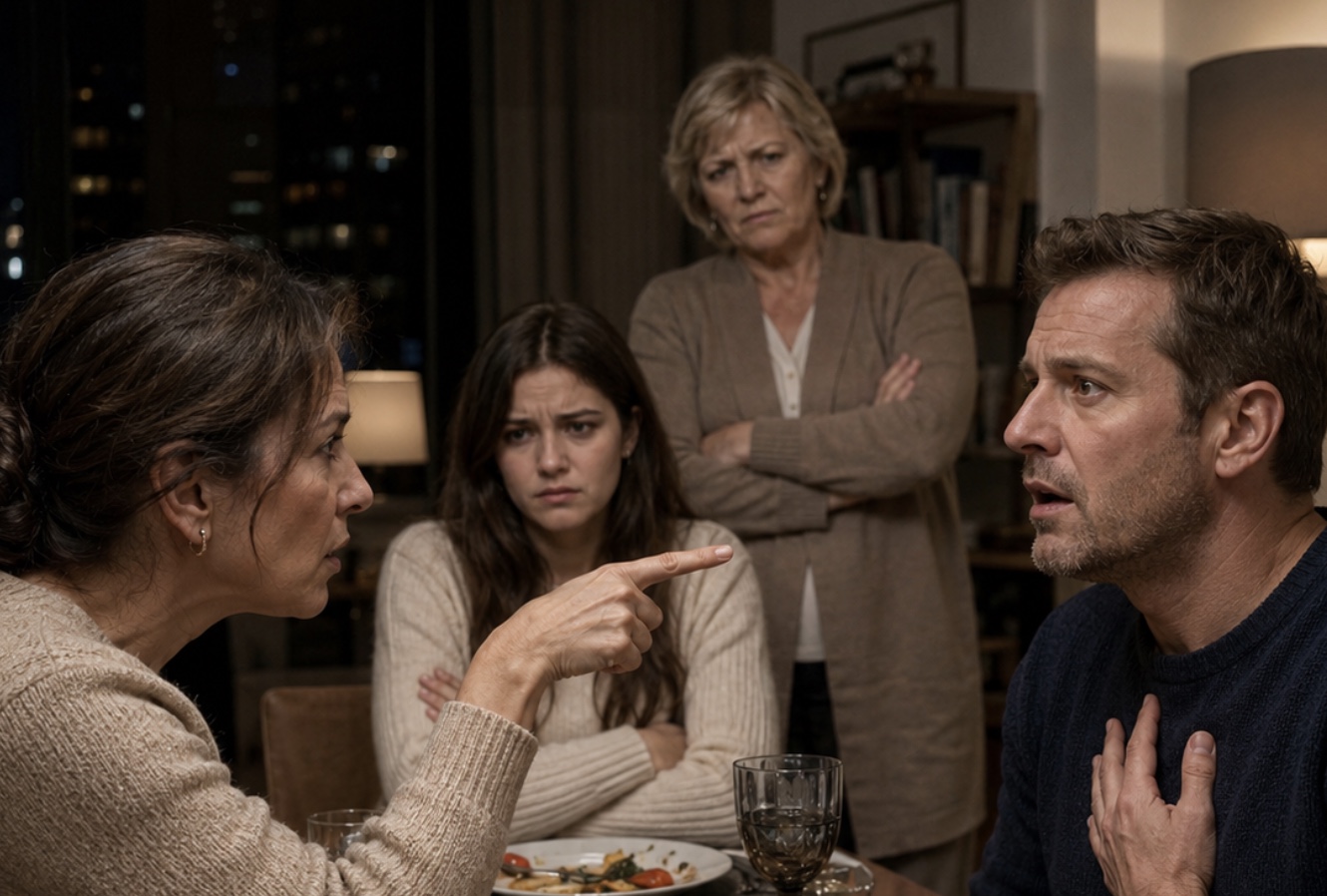
Artyom continued chewing his meat patty as though he had heard a reminder to buy salt rather than an ultimatum. Through the open window came the buzzing of lawnmowers, the shrieks of children on the swings, and the low rumble of a street-washing truck crawling across the sun-scorched courtyard. The July evening was bright and stifling. A fan hummed in the kitchen, pushing warm air back and forth between the refrigerator and the window.
Lidia stood across from her husband with her arms folded over her chest. She was still wearing her work shirt, though the top button had been undone, and her hair was pinned up with a pencil. She had arrived home forty minutes earlier but had not changed her clothes or even sat down to eat.
In front of Artyom sat two meat patties, buckwheat with vegetables, and a salad. In front of Lidia was a thick stack of printed documents held together with a binder clip.
“Did something happen again?” he asked after swallowing.
“It happened six months ago. Today, I finally put everything into one table.”
She removed the clip and placed the first page in front of him.
Artyom gave it a quick glance. Dates were listed across the top, followed by amounts, recipients, and payment descriptions. His mother’s name appeared six times. His sister’s appeared eight times. His brother’s appeared four.
He picked up his fork and tried to reach for the buckwheat, but Lidia placed her hand over his plate.
“Look at it first.”
“I can see it.”
“No, Artyom. You recognize the names. That is not the same as seeing the whole picture.”
Reluctantly, he put down his fork.
Lidia sat opposite him and spread out the remaining pages. She worked as a dispatcher for a transportation company and was accustomed to turning dozens of scattered details into one clear system. When a driver arrived three hours late, she did not listen to stories about a difficult day. She checked the route, the stops, the traffic, and the unloading time.
She had treated their finances in exactly the same way.
During the previous six months, Artyom had regularly transferred money to his mother, his sister Inga, and his older brother Pavel. Sometimes he used his own card. Sometimes he took money from the joint account where he and Lidia saved for major expenses. On several occasions, he had paid for his relatives’ purchases directly, which meant the statements showed electronics stores, a repair shop, and a private clinic instead of their names.
Lidia had found those payments too.
“I was helping Mom pay for medicine,” Artyom said. “You know she has high blood pressure.”
“I know. That is why I did not include her doctor visits or prescribed medication in the amount I consider unnecessary.”
He looked more closely.
Short notes had been written in red ink beside several transactions: “medical examination,” “prescribed medicine,” and “refrigerator repair.” Lidia had placed those expenses in a separate category.
The main table contained entirely different payments.
“What is this?” she asked, touching one of the lines. “A new phone for Inga.”
“Her old one broke.”
“It was less than a year old. She dropped it in a parking lot and cracked the screen. Repairing it would have cost several times less than buying a new phone.”
“She needed a decent phone for work.”
“Inga does not work from her phone. She posts photographs of her manicures and orders clothes.”
Artyom dragged his palm irritably across the table.
“Have you been spying on her?”
“No. She told me herself on Sunday. She also bragged that you bought her a better model because the cheaper phone’s camera was not good enough for her ‘content.’”
“Fine. One phone.”
Lidia turned the page.
“A new television for your mother. A holiday at a countryside resort for Pavel and his wife. Driving lessons for Inga, which she abandoned after the third session. Repairs to Pavel’s car. Furniture for his summer house. Two transfers for your nephew’s birthday because he spent the first one before the celebration. Weekly grocery deliveries for your mother, even though you were also sending her separate money for food.”
Artyom frowned.
“Mom does not know how to order through an app.”
“But she does know how to receive payment twice for the same groceries.”
“Are you accusing my mother of deceiving us?”
“I am showing you where the money went. You can draw your own conclusions.”
Lidia reached into the folder and took out a small calculator. It was not a phone, where an app could be accidentally closed or a call could interrupt the calculation, but an ordinary desktop calculator with large buttons.
She began entering the amounts, reading each one aloud.
At first, Artyom leaned back in his chair and watched her with amused patience. Gradually, his expression hardened. Halfway through the calculation, he pulled one of the pages closer and began following each transaction himself.
When Lidia announced the final amount, the rotating fan clicked and sent a warm stream of air across the table. The corner of one page lifted.
“That is one-third of everything we contributed to the household budget over the past six months,” she said. “Not what was left of your personal money after our shared expenses. Not money you kept separately. One-third of our entire joint budget.”
Artyom reached for his fork again.
“You are deliberately presenting it as if I stole money from our home.”
“That is exactly what you did.”
“I was helping my family.”
“With my money.”
“With our money.”
“A joint account does not mean one person gets to spend the money in secret.”
“I was not hiding anything.”
Lidia raised an eyebrow.
“Then why was the payment for the television labeled ‘tools’?”
Artyom fell silent.
“Why was the money for Pavel’s holiday listed as ‘car repairs’?” she continued. “And why did you split the payment for Inga’s phone into two transfers on different days?”
“That was just how it happened.”
“No. You did it that way so the amount would not attract attention.”
He picked up his glass and drank several mouthfuls of water. Moisture glistened at his temple, but the heat had nothing to do with it.
Lidia watched him without sympathy. It was not because she had stopped loving him or because she enjoyed cornering him with numbers. She had already had this conversation with him three times.
The first time had been in winter, when she discovered a transfer to Inga. The second was in spring, after Artyom paid for his brother’s car repairs. The third was before the May holidays, when money they had set aside for train tickets disappeared from the joint account.
Every time, he promised the support was temporary.
Every time, another reason appeared.
Artyom worked as an elevator maintenance supervisor. He was not helpless, weak-willed, or foolish. At work, he was valued for his precision. He remembered the diagrams of old mechanisms, could quickly locate a malfunction, and had no patience for employees who blamed carelessness on circumstances.
Yet whenever his relatives were involved, his common sense seemed to take a vacation.
His mother was accustomed to calling him about every minor problem. Inga treated her brother like an emergency wallet. Pavel asked less frequently, but when he did, he always needed a large amount and always insisted that there was absolutely no other solution.
Artyom liked being the person everyone came to for help. Around his family, he became the man who solved problems, rescued people, and filled every financial hole.
The trouble was that Lidia was helping pay for that role.
“In February, we chose a hotel in Kislovodsk,” she reminded him. “You found the room with the balcony yourself. We planned to stay for ten days.”
“I remember.”
“In March, you said we should postpone the trip until June because Pavel urgently needed his car. In June, we discovered that there was not even enough money left in the joint account for the tickets. Then last week, your brother sent photographs from the same holiday resort we paid for without knowing it.”
“I did not know he would spend the money on a vacation.”
“You did not ask.”
“He said he needed the car for work.”
“The insurance company paid for the repairs. He kept the money you gave him. You found out four days ago and never told me.”
Artyom raised his head.
“How do you know?”
“Your sister-in-law called me and asked me to thank you for paying for the trip. She assumed I already knew.”
He swore under his breath and pushed his plate away.
“Pavel set me up.”
“Pavel behaved exactly the way you allowed him to behave.”
“So I am still the guilty one?”
“For spending our joint money without my consent, yes.”
Artyom stood and walked over to the window. Two teenagers were spraying each other with water from plastic bottles in the courtyard. Across the way, a woman was removing dry laundry from her balcony.
The ordinary summer evening continued as peacefully as ever, even though an eight-year marriage was beginning to crack at the kitchen table.
“You have always been stingy,” Artyom said without turning around. “You hate spending money on anyone. Even when you buy presents, you use a calculator.”
Lidia carefully arranged the printed pages in order.
“I choose gifts in advance and according to what we can afford. That is called planning.”
“No. It is called counting every last coin.”
“Yes. I count the money I earn.”
He turned sharply.
“You think I do not earn money?”
“You do. But for some reason, you believe your contribution gives you the right to control mine as well.”
“There you go again, dividing everything into yours and mine.”
“You divided it first. When you secretly gave money to your relatives, you never asked how much of that generosity I was expected to finance.”
Artyom returned to the table and placed both hands against the countertop.
“Fine. What do you want? Should I call my mother and demand that she return the grocery money? Should I take away her television? Or send Inga an invoice for the phone?”
“I want to stop what is happening now.”
Lidia opened the top drawer of the kitchen cabinet and removed Artyom’s bank card. He had left it there that morning while rushing to work. They used that card to pay for groceries and household purchases.
Lidia could access his banking app only through an old tablet they kept at home for paying bills. Artyom had connected it several years earlier when he frequently went out on emergency calls and asked his wife to handle the payments.
She placed the card beside his plate.
“Tomorrow, you will cancel every automatic transfer to your relatives and delete the saved payment templates from the joint account.”
“I will decide for myself what I cancel on my card.”
“Do whatever you want with your personal card. But not another ruble will leave the joint account for your relatives without both of us agreeing.”
“You cannot forbid me from helping my mother.”
“I cannot, and I am not trying to. Help her with whatever remains of your personal money after mandatory expenses and our shared goal. But first, we are separating our accounts.”
Artyom straightened.
“What accounts?”
“One account for utilities, groceries, and household expenses. Each of us will deposit an agreed amount. A second account for savings, which cannot be accessed without approval from both of us. Everything else remains on our personal cards.”
“You want us to live like roommates?”
“I want to stop financing your generosity.”
“Nicely phrased.”
“I spent two days finding the exact wording.”
He stared at her in disbelief.
“You prepared this conversation?”
“Of course.”
Lidia took out another sheet. It contained a new household budget: mandatory payments, groceries, car maintenance, an emergency reserve, and vacation savings. There were no income comparisons and no attempt to humiliate her husband.
There were only clear proportions and clear rules.
“From today onward, no money leaves our shared funds without discussion,” she said. “A genuine emergency—an operation, a fire, or serious damage to someone’s only home—will be discussed separately. A new phone, a holiday, furniture, someone else’s debts, or a desire for greater comfort are not emergencies.”
Artyom picked up the page.
“You have already decided everything.”
“I have decided what I will do with my money. You decide what you will do with yours.”
“Then I can refuse to contribute anything to the savings account.”
“You can.”
He had expected an argument, so her answer caught him off guard.
“And what happens then?”
“Then we cancel our shared plans. I go on vacation alone with my own money. You pay for the maintenance of the car you use most of the time. You repair your mother’s summer house without my contribution. Then, after a few months, we see whether our marriage still has common goals or merely a shared kitchen.”
Artyom sat down.
“Are you threatening me with divorce?”
“No. I am explaining the consequences.”
“You make everything sound so simple.”
“I make it consistent.”
He ran his finger along the line for savings.
“And what if Mom needs help again?”
“If she genuinely needs it, we discuss it. I have never refused to pay for her medicine or medical examinations. But I will not pay for grocery delivery and then send her the same amount again. I will not buy her another appliance while she already has a working one at home.”
“The old television had a bad picture.”
“It worked perfectly well. Galina Petrovna wanted a larger screen for the summer television series. She told Inga, and Inga told me.”
Artyom gave a dark laugh.
“So you have already analyzed my whole family.”
“No. I analyzed the bank statement.”
Lidia stood, picked up her untouched plate, and placed it in the refrigerator. She took the calculator with her but left the printed documents in front of her husband.
“Finish your dinner. I am not discussing anything else tonight.”
“Convenient. You issue an order and walk away.”
She stopped at the doorway.
“I asked you three times to stop. Three times you agreed and then carried on. This is no longer a request.”
“And if I refuse your conditions?”
“Then each of us will live on our own money in practice, not just in theory. I expect your decision by noon tomorrow.”
“You are serious?”
“Completely.”
Lidia left the kitchen and closed the bedroom door behind her.
She did not throw herself onto the bed or begin calling her friends. She changed out of her work clothes, took a shower, put on a cotton lounge set, and opened her laptop.
The hotel page for Kislovodsk was still saved on the screen. It was the same room with the balcony that they had selected during the winter.
Their vacation was three weeks away.
Lidia checked the available dates and reserved a single room with free cancellation. Then she bought a refundable train ticket. She had no intention of using the holiday as a threat.
Artyom would either go with her after honoring their financial agreement, or she would go alone.
Half an hour later, he entered the bedroom.
“What are you doing?”
“Booking my vacation.”
“We canceled it.”
“We did not cancel anything. You spent the savings.”
“And what money are you using?”
“My own.”
Artyom came closer and saw the booking confirmation.
“Are you going alone?”
“For now.”
“And you did not even discuss it with me?”
Lidia turned the laptop toward him.
“I have been discussing this vacation with you since February. You chose to help your relatives. I chose not to spend August at home.”
“So everything has already been decided.”
“My decision has. We are waiting for yours until tomorrow.”
He walked out and slammed the door. A minute later, water began running in the kitchen. Then Artyom called someone.
Lidia did not listen.
She gathered the documents into a folder, placed the bank statements in the bottom drawer of the desk, and set a reminder on her phone for the morning: open a separate household-expense account.
She was not going to wake up during the night to check whether her husband finally understood the scale of the problem. His realization would not return the money they had lost.
Changing the system that allowed him to spend their shared funds without consequences was far more important.
Even so, Lidia remained awake for a long time.
It was not because she feared the argument. She was remembering November, when Artyom had first suggested going to Kislovodsk. They had sat in the kitchen looking at photographs of the mountains and debating whether to book a room with breakfast.
That evening, he had promised that they would finally spend time together in the summer, without work, relatives, or emergency calls.
Then his mother asked him to pay for a delivery of firewood to her summer house. Inga needed a phone. Pavel needed repairs.
Each request had seemed small and almost reasonable when considered separately.
Together, they had consumed the vacation, the emergency reserve, and Lidia’s trust.
Around midnight, she got up and went into the bathroom. She switched on the light, washed her face with cold water, and stood in front of the mirror for a long time.
What angered her was not that Artyom helped the people close to him. What angered her was that he had made her an unwilling participant in his private charity.
She took down a box where they kept receipts for major purchases and found the receipt for his mother’s new refrigerator, which they had paid for the previous year. Galina Petrovna had promised to repay part of the cost after selling her old appliance.
She never did.
Artyom told Lidia not to remind her.
Lidia gave a short laugh, though nothing was funny. One receipt after another formed a simple conclusion: everyone saw her as the woman who might complain but would ultimately pay.
A floorboard creaked in the hallway. Artyom stopped outside the bathroom but did not enter.
“Are you awake?” he asked.
“Obviously.”
“Have you been crying?”
Lidia opened the door. Her face was wet from washing, but her eyes were clear.
“No. I am looking for the documents for your mother’s refrigerator.”
“Why?”
“To finally understand how many times I agreed to temporary help that quietly became permanent.”
Artyom looked at the box in her hands.
“I will pay you back.”
“I do not need my husband to send me money as compensation for his relatives. I need rules that you do not break.”
“You turn everything into control.”
“Control became necessary when trust stopped working.”
He opened his mouth to answer but said nothing.
Lidia walked past him into the bedroom. Artyom remained in the hallway. A few minutes later, she heard him sit down in the kitchen again.
The papers rustled quietly until almost two in the morning.
Lidia woke at half past six. Artyom was not beside her. The smell of coffee drifted in from the kitchen.
He was sitting at the table in his work clothes. The same stack of documents lay in front of him. Beside it was a notebook covered in his handwriting.
“I calculated everything again,” he said instead of greeting her.
“And?”
“Your total is correct.”
Lidia poured herself a glass of water.
“Good.”
“That is all?”
“What are you expecting? Applause because the calculator confirmed what I told you?”
He rubbed his tired face.
“I called Pavel last night. He admitted that the insurance company paid for the car.”
“I know.”
“He said he was planning to return the money.”
“He was not.”
“Probably not.”
Artyom pushed the notebook toward her. He had separated the transfers according to each relative.
“I helped Inga far more often than I realized.”
“Because she asked for small amounts.”
“Mom did too.”
“Because one large sum attracts attention. Several smaller payments look like ordinary household expenses.”
He nodded without arguing.
“I canceled the automatic transfers.”
“From the joint account?”
“From every account. I also deleted the saved templates.”
Lidia sat opposite him.
“That is a beginning.”
“I opened a separate account for household expenses too. We can configure everything together after work.”
“All right.”
Artyom picked up his phone. Inga’s number was already on the screen.
“I am going to call her now.”
“Go ahead.”
He pressed the call button and turned on the speaker, not to put on a performance but to ensure that he could not later retell the conversation in a more convenient way.
Inga answered quickly.
“Artyom, hello. You are calling early. Is everything all right?”
“Everything is fine. I am calling for a reason. Starting this month, there will be no more regular transfers.”
There was silence at the other end.
“What do you mean?”
“Exactly what I said. If your son genuinely needs something, I may help separately. If there is a serious emergency, we will discuss it. But you will pay for your phone, deliveries, clothes, and other personal expenses yourself.”
“Did Lidia put you up to this?”
Artyom looked at his wife. She calmly drank her water without interfering.
“No. Lidia showed me the bank statement. I made the decision myself.”
“Oh, please! She has always treated us like parasites.”
“This is not about her.”
“How convenient. First you promise to help, and now you hide behind your wife.”
“I am not hiding. For six months, I spent money from our household budget on all of you without discussing it with her. That will not happen again.”
Inga’s voice grew louder.
“What am I supposed to do now? I have payments for the phone, preschool, and groceries!”
“You chose the expensive phone yourself. Discuss your child’s expenses with his father. Every adult has to pay for groceries.”
“You know perfectly well what my ex is like!”
“I do. That is why I will help you find a lawyer if he refuses to fulfill his responsibilities. But I will not pay for your entire life every month.”
Inga ended the call.
For several seconds, Artyom stared at the dark screen.
“Now Mom,” he said.
“Do not present it to her as a punishment. First, find out what help she actually needs.”
“Do you think she will ask for the same expense twice again?”
“I think you need to stop automatically saying yes.”
He called his mother. The conversation with Galina Petrovna lasted longer. First she became offended, then reminded him how much of her life she had sacrificed for her sons, and finally attempted to change the subject to her health.
Artyom calmly asked which medication she needed and when her next medical examination was scheduled.
Faced with specific questions, his mother became confused.
It turned out she already had enough medicine for two months, her examination was not scheduled until autumn, and she actually wanted money to replace the garden path.
“I will come and inspect the path myself,” Artyom said. “If it is dangerous, we will buy the materials. I am not transferring money without knowing what it is for.”
“You used to trust me.”
“I trusted you without checking. Those are not the same thing.”
Galina Petrovna abruptly ended the call.
Pavel was last.
He did not pretend to be surprised. He listened to his brother and said, “I understand. I would be angry too if I were you.”
Artyom frowned.
“Then why did you not return the money after the insurance payment?”
“Because you did not ask, and I saw a chance to take my family away for a holiday. I behaved badly. I will repay it in installments.”
“You will return it to the joint account.”
“All right.”
“And no more stories about me being your last hope.”
Pavel gave a short laugh.
“Fair enough.”
After the calls, Artyom put down the phone.
“Do I look like an idiot?”
“No,” Lidia replied. “You look like a man who enjoyed feeling needed and failed to notice the cost.”
“You could have said that earlier.”
“I did. You could not hear me without a spreadsheet.”
He looked at the clock. He had ten minutes before he needed to leave for work.
“Can the Kislovodsk reservation still be changed?”
“I can add a second guest.”
“What do I need to do?”
“Put the vacation money back into savings and do not remove it the next time one of your relatives asks for something.”
“I will deposit my share today.”
“Then I will add you to the reservation tonight.”
Artyom stood, but paused at the door.
“Lida, I cannot promise that refusing my mother will be easy.”
“It is not supposed to be easy. But you need to understand where helping ends and supporting another adult’s entire lifestyle begins.”
He nodded.
Lidia remained alone in the kitchen. The printed statements, calculator, and cold buckwheat that Artyom had never finished were still on the table.
She gathered the pages into the folder but did not throw them away. She did not intend to remind her husband of his mistake for years. She simply never wanted to argue with someone’s selective memory again.
Artyom came home later than usual that evening. He brought the agreement for the new account and a printed list of automatic payments. Every transfer to his relatives had been canceled.
Pavel had already returned the first installment of the money. Inga was not responding to messages. Galina Petrovna had sent a photograph of her garden path. Two paving stones were cracked, but there was no immediate danger.
Artyom silently placed the documents in front of Lidia.
“Check them.”
She reviewed the pages.
“Everything is correct.”
“I transferred the money for the vacation.”
Lidia opened the banking app and saw the payment.
“Then we will go together.”
“After everything that happened today, you still want to travel with me?”
“I never wanted to give up my husband. I wanted to stop paying for his role as everyone’s rescuer.”
“Harsh.”
“But clear.”
He sat across from her, remained silent for a moment, and then pushed the new budget toward her.
“I added a category for helping relatives from personal funds, with a monthly limit.”
“You can set your own limit. But once your personal money is gone, you do not touch the joint account.”
“Agreed.”
‘
“And no loans taken out in both our names.”
“Agreed.”
“If Pavel or Inga claims there is an emergency, we confirm what actually happened before sending anything.”
“Agreed.”
Lidia picked up a pen and wrote the date beside the rules.
It was not a signature, a formal contract, or a theatrical oath. It was simply the date on which their household stopped confusing love with the uncontrolled financing of other people’s desires.
One month later, they left for Kislovodsk.
During the train journey, Inga called Artyom. Lidia did not deliberately listen, though she caught a few phrases.
“I cannot.”
“Discuss it with your son’s father.”
“That is not an emergency.”
After ending the call, Artyom put away his phone and looked out the window.
“She wanted me to buy our nephew a new tablet.”
“For school?”
“His old one works. He wants a new one because his classmate has a better model.”
“What did you tell her?”
“That jealousy is not an emergency.”
For the first time in weeks, Lidia laughed without bitterness.
Artyom smiled too.
Green fields stretched beyond the window. At small stations, people sold berries and cold bottles of water. In the distance, the hot air trembled above the land.
They had finally reached their vacation.
It was not because they had suddenly begun earning more money. It was because their savings were no longer quietly disappearing into other people’s requests.
Lidia did not consider that summer conversation a victory over her husband. Defeating someone you love rarely leads to anything good.
She had achieved something different: she had reclaimed the right to decide where her money and emotional energy went.
Artyom did not become a completely different person overnight either. Sometimes, when his mother complained about another household problem, he still instinctively reached for his phone. Sometimes, he became annoyed when Lidia asked questions.
But now he asked for details, verified the situation, and calculated the cost before agreeing.
His relatives quickly discovered that they were capable of handling far more than they had previously claimed. Inga found part-time work for several evenings a week. Pavel repaid the debt and stopped asking for money for holidays. Galina Petrovna arranged with her neighbors to replace the cracked paving stones together, spending several times less than the amount she had originally wanted from her son.
Once the permanent source of money disappeared, the so-called emergencies suddenly became ordinary problems that capable adults could solve themselves.
There were no more secret transfers in Lidia’s home, no disguised payment descriptions, and no accusations that she was greedy.
Whenever Artyom showed signs of falling back into his old habits, she simply opened the spreadsheet and asked one question:
“Is this help, or are we supporting them?”
Usually, that question was enough.