The long dining table was crowded with expensive dishes and self-satisfaction. Vika placed a porcelain soup tureen in front of her mother-in-law and stepped back, smoothing a loose strand of hair that had slipped from her hairstyle. Andrei’s guests — his mother, Elvira Karlovna, his sister Alisa, and a couple of their friends — did not even look at her. The conversation flowed past her as if she did not exist.
“Darling, just look at this table setting,” Elvira Karlovna sang out to the woman beside her, nodding toward the plates. “Cooking is the only talent I ever managed to notice in our Victoria. Though, of course, she lacks imagination. Everything is done in that village style.”
Alisa laughed and took a sip of wine.
“Mom, what do you expect from someone with a technical school education? At least she makes excellent borscht.”
Andrei, sitting at the head of the table, smirked and raised his glass.
“To my hardworking little wife! Vika, why are you just standing there? Bring another carafe of liqueur.”
Vika silently went into the kitchen. Her fingers trembled slightly, but her face remained calm. She took the misted carafe from the refrigerator and paused for a moment by the window. The phone in her apron pocket vibrated briefly. One message. Vika read it, and the corners of her mouth lifted in a barely noticeable smile — the kind none of the guests had ever seen. She slipped the phone away and returned to the dining room.
The dinner slowly came to an end. The guests said their goodbyes, while Andrei escorted his mother and sister out, showering them with gratitude. When the door closed, he turned toward Vika, who was already clearing the table.
“Well, village girl, is your little performance over?” he threw at her, pulling off his jacket. “Next time, try not to get underfoot. You embarrassed me again with that silence of yours. Couldn’t you at least smile at someone, you peasant?”
Vika straightened and rested her hands on the back of a chair.
“I did smile, Andrei. You simply didn’t notice.”
He only waved his hand dismissively and went into the bedroom.
Three days later, it was the birthday of his university friend and business partner, Kirill. Andrei took his wife with him — he needed to show everyone that he had a strong family. Vika wore a dark blue dress, gathered her hair into a low bun, and used almost no makeup, just the way her husband liked. The restaurant was filled with people from his circle: owners of small companies, lawyers, accountants. Andrei shone, joked, and handed out compliments with practiced ease. Vika stayed beside him, calmly drank water, and barely spoke.
The evening continued smoothly until one of the guests suggested playing an old student game: “explain the term.” The host called out a complicated word, and the players had to give a clever definition. Andrei was called up. He easily handled a couple of rounds, but then the host, giggling, handed him a card with the word “pleonasm.” Andrei froze. An awkward silence settled over the room. Then Vika, sitting beside him, said quietly but clearly:
“It is a figure of speech involving unnecessary repetition of meaning. For example, ‘work colleague’ or ‘first debut.’ It comes from the Greek word meaning ‘excess.’”
Silence fell. Several guests exchanged glances; someone smiled, impressed by the answer. Andrei turned crimson. He sharply spun toward his wife, and his eyes burned with wounded anger.
“You little…” he began, but stopped when he noticed everyone staring.
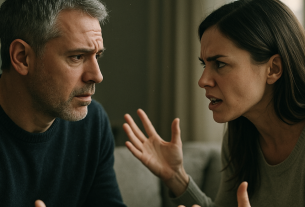
The host tried to smooth over the awkwardness, but Andrei was already losing control. He clenched a napkin in his fist and hissed through his teeth loudly enough for everyone to hear:
“Keep your mouth shut, you uneducated village woman! Who asked you to speak? Sit there and smile like you’re supposed to.”
The room froze. Vika slowly lifted her head and looked at her husband. There were no tears in her eyes, no fear. She smiled — softly, almost with pity. And there was something in that smile that made something inside Andrei drop. Kirill, the host of the evening, coughed, trying to ease the tension, but Vika had already risen and, without saying goodbye, headed for the exit. Andrei did not follow her. He did not want to lose face.
At home, she locked herself in the small room she had once turned into a sewing workshop. Andrei returned long after midnight and pounded on the door for a long time.
“Open this door immediately! What kind of circus was that? You think you’re smarter than everyone? Answer me!”
The door opened slightly. Vika stood on the threshold, and behind her, papers were spread out across the table.
“Andrei,” she said quietly, without anger, “I am filing for divorce.”
At first, he was stunned. Then he laughed.
“You? Filing? What are you going to live on, you silly woman? The apartment is mine, the car is mine, everything is mine. What will you be left with? Pots and pans?”
“With the Civil Code,” Vika replied calmly. “And with our children’s birth certificates. That is enough. Now, please let me rest. Tomorrow will be a difficult day.”
She closed the door in his face, and the click of the lock sounded like a gunshot.
The next morning, Andrei woke up in an empty living room. The children had already gone to school — Vika had gotten them ready early and taken them herself. He drank coffee, endlessly replaying her words in his head, and decided to act in the only way he knew. By noon, his “support team” had gathered in the apartment — his mother and sister. Elvira Karlovna swept into the living room like a general before inspection.
“Where is that upstart?” she thundered. “Andryusha, you allowed some cook to give you conditions?”
Alisa dramatically rolled her eyes.
“I always said she had something hidden inside her. And here it is. She waited for the right moment and showed her claws. Don’t worry, we’ll put her back in her place quickly. If she wants money, she won’t get it. If she wants the children, we’ll take them. You know Dad has connections with child services.”
Vika came out of the kitchen with a cup of tea and calmly leaned against the doorframe. In the pocket of her house cardigan was her phone, with the voice recorder already switched on.
“Good afternoon, Elvira Karlovna. Hello, Alisa. Did you want to say something to me?”
Her mother-in-law stepped forward, pronouncing every word like a sentence.
“I want you to come to your senses, girl. You are nothing without my son. We took you into this family. We gave you a roof over your head. Your children will live with their father and with me if you don’t end this nonsense immediately. And you will return to the kitchen and do what you know how to do — cook well and stay silent. Otherwise, we will leave you with nothing. Do you understand me?”
“I understand everything,” Vika answered quietly. “Now please tell me, are you threatening to take away my parental rights and property? I just want to know exactly what to say in court.”
Elvira Karlovna turned red, but Alisa tugged her mother by the sleeve.
“Mom, she’s provoking you. Let’s go. We won’t get anything from her anyway. Let her play at being independent until she gets hungry.”
They left, slamming the door loudly. Vika stopped the recording, saved the file, and forwarded it to her lawyer — the same lawyer whose name she had received in that message a few days earlier. Then she dialed another number.
“Liza, hi. Yes, I’m fine. Everything is going according to plan. Is your father still willing to meet with my husband? Excellent. Ask him to schedule the meeting for tomorrow.”
Monday morning began for Andrei with a deafening phone call. He had barely opened his eyes when the voice of the company accountant shrieked through the receiver:
“Andrei Nikolaevich, we have an emergency! The bailiffs have frozen all your personal accounts! And your share in the company’s authorized capital too. A court order has arrived for interim measures in your wife’s lawsuit over division of property and child support. You can’t carry out any transactions!”
Andrei jumped out of bed. His fingers shook as he tried to call Vika. Her phone remained silent. He got dressed in two minutes and rushed to the office. In the reception area, Kirill was already waiting for him — the same friend and partner whose birthday celebration had started everything. His face was stone-cold.
“Andrei, come in. We need to talk.”
The office smelled of expensive tobacco and trouble. Kirill sat across from him and clasped his fingers together.
“I found out the details of that scene. And you know, I thought about it for a long time. We are friends, but I cannot do business with a man who publicly humiliates the mother of his children. You lost control over nothing in front of witnesses. Tomorrow you could lose control during a deal. We are terminating the equipment supply contract. I’m sorry.”
Andrei opened his mouth, but no words came out. At that moment, the office door opened, and Vika walked in. She was wearing a strict trouser suit, her hair neatly gathered, and she carried a folder of documents in her hands. Without a word, she placed a sheet of paper in front of Andrei.
“This is the divorce agreement and the schedule for contact with the children. Sign here and here. Otherwise, we will meet in court, where the recording of your mother’s threats and the school’s report will be added to the case. The children have already spoken with a psychologist, and he confirmed that their grandmother frightens them. So, Andrei, choose for yourself.”
He stared at her as if he no longer recognized her. Before him stood not a quiet housewife, but a confident stranger who played by her own rules.
“The apartment is marital property,” Vika continued. “Your share will go toward child support and repayment of the loan you took out for business development. As for the business registered in Elvira Karlovna’s name, the examination has shown that you were the one actually managing it and hiding income. The court has already frozen your share. So in the near future, you will be free from both your job and me.”
Andrei sank into the chair. He tried to object, but his voice broke into a hoarse whisper.
The court hearing took place two weeks later. Elvira Karlovna tried to pressure the judge, and Alisa had a hysterical outburst in the hallway, but it was useless. The audio recording, witness statements, and school reports all formed the basis of the decision. The children stayed with their mother. The apartment was sold, and the money was divided. Andrei received his share, but it was barely enough to cover legal expenses and debts. Vika’s lawyer was flawless.
A month later, Andrei was drinking bitter alcohol in a rented room on the outskirts of the city. His mother and sister, who had recently shouted so loudly about being right, suddenly remembered that he had destroyed his family himself and stopped answering his calls. His mistress, whom he had been seeing for the past six months, learned about his financial collapse and threw him out without even letting him collect his things. His reputation was ruined. No serious partner wanted to work with him anymore — everyone remembered how he had publicly humiliated his wife and lost the contract.
Six months passed. In a quiet part of the city, a small café with homemade pastries opened. The owner’s business was doing surprisingly well: a cozy hall, friendly staff, and always-fresh buns. Vika stood behind the counter in a simple light apron and smiled at the customers. She had let the waitress take a break and was pouring cappuccino herself when the bell above the entrance door rang.
Andrei stood on the threshold. He looked gaunt, with a gray face and empty eyes. For a long time, he could not bring himself to approach, but eventually he stepped up to the counter.
“Vika… I wanted to say… I understand everything now. I was wrong. Let’s try to start over. For the children. I’ve changed.”
She set the cezve aside, slowly wiped her hands on a towel, and raised her calm gaze to him.
“Be quiet, you uncultured fool,” she said evenly, without malice, almost with relief. “You already said everything six months ago.”
She nodded to the café administrator, and the entrance door closed silently in front of Andrei. Vika watched his hunched figure disappear, then turned to the next customer.
“Good afternoon! What would you like to order?”
There was such light, confident joy in her voice that none of the guests could have guessed what kind of storm had just passed by this fragile woman.