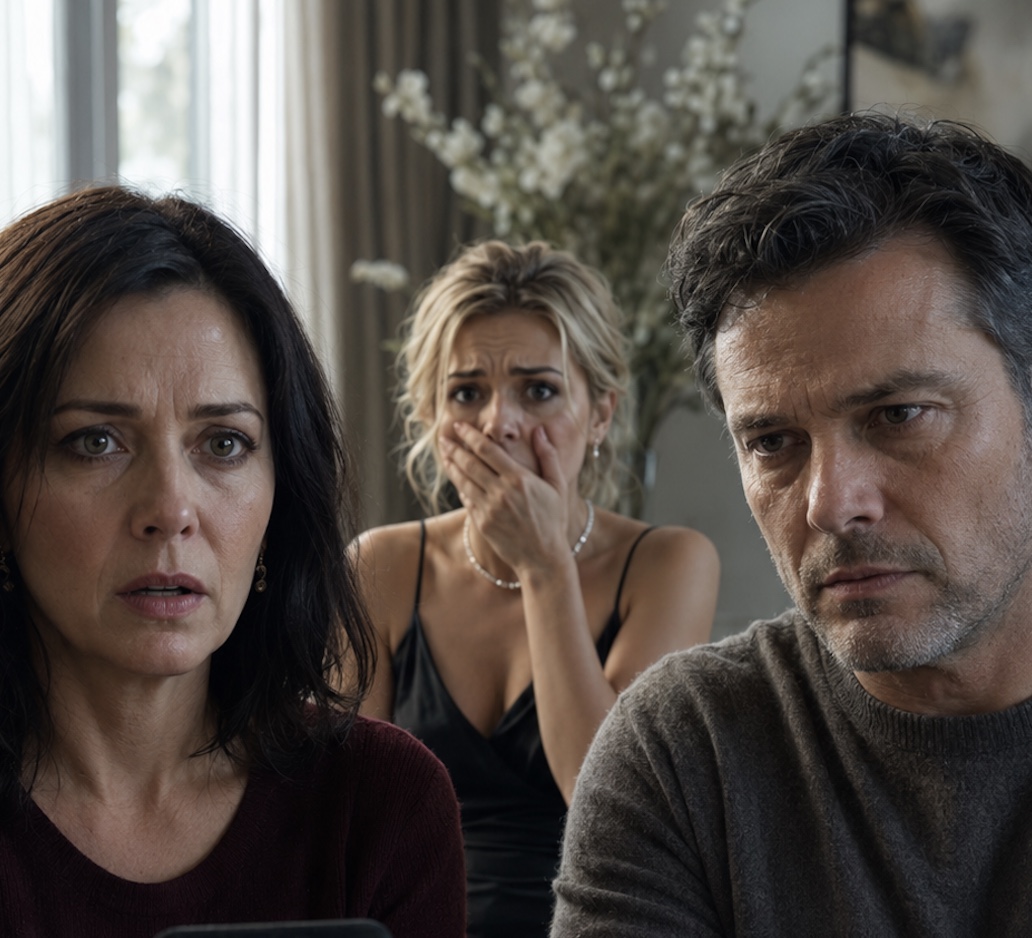
“Don’t look for the necklace. It was pulled out of the bag on the subway,” Sergey said, placing the empty velvet box on the kitchen table. “I told you not to wear such expensive things around the city.”
I picked up the box. Inside, there was only a white cushion with a mark where the clasp had rested.
“Why did you open my wardrobe?” I asked.
Sergey immediately grimaced, as if I had chosen to focus on something trivial.
“Olya, this is not about the wardrobe right now. It was stolen, do you understand? There was a crowd at the transfer, someone pushed me, the bag was unzipped. I only noticed later.”
“Later where?”
“In the car.”
“What car, if you were talking about the subway?”
He turned away toward the sink and reached for the kettle, even though it was empty.
“The company car. I got in later. What difference does it make?”
It did make a difference. That morning, I had put the necklace into a black pouch, and the pouch into the inner pocket of my bag. Sergey was supposed to drive me to the jeweler because one of the links near the clasp had become loose. Just before we left, he got a phone call. He said he urgently needed to go to the office, asked for my bag “for a minute,” supposedly to move some of his documents from the hallway, and returned it already zipped.
Back then, I did not check the pocket. I simply took the bag and went to work.
The necklace was not just a piece of jewelry. My grandmother, Zoya Pavlovna, had bought it in the late nineties after selling her small country plot near Tver. White gold, seven small sapphires, old-fashioned craftsmanship that you would not find in an ordinary store today. My grandmother wore it on family holidays, then it stayed with my mother, and later it came to me through her will. Along with the receipt, an old photograph, and an appraisal report that I had made in February.
Sergey knew all of this. He had laughed when he saw the amount in the report: 185,000 rubles.
“For those little stones?” he said back then. “I’d rather buy a proper engine with that money.”
I did not argue. I put the documents into a folder and placed it in the top drawer of the dresser.
And now he was standing in front of me, telling a story about a pickpocket. Too quickly. Too loudly. Too angrily for someone who had accidentally lost someone else’s family heirloom.
“Did you go to the police?” I asked.
“Why would I?” Sergey immediately became animated. “Can you imagine how much paperwork there would be? The subway, the crowd, a million cameras. No one will find anything. Don’t ruin your nerves.”
“We need to file a report.”
“Olya, don’t start. I’m already guilty for taking your bag. I wanted to help. And now you’re interrogating me as if I stole it myself.”
He said the word himself. I looked at him and realized he was already ready to defend himself, even though I had not accused him of anything yet.
“Where exactly was it stolen?”
“At Kievskaya. Or at the transfer to the Circle Line. I already told you.”
“You were on the subway, then somehow ended up in a company car, and decided not to file a report?”
Sergey set the cup down so sharply that it knocked against the countertop.
“I don’t have to account for every minute.”
“You do when my property disappears.”
“Your property?” he smirked. “We’ve been married for twenty years. Everything is shared.”
I closed the box. The click sounded short and dry.
“Inheritance is not shared property, Sergey. And you know that perfectly well.”
He waved his hand dismissively.
“Who even needs your old junk? You kept it in the wardrobe for years. The one time you took it out, you lost it. That’s the whole lesson.”
After that sentence, I stopped asking questions. Not because I believed him. Arguing with him was simply useless. He had already chosen the version in which I was supposed to be the guilty one: I had worn it, I had lost it, and now I was “winding myself up.”
Still, I went to the police station. I reached the door, but I did not file the report at that moment. The empty box was in my bag, and his words about the subway, the car, and “why all the paperwork” kept spinning in my head. For a proper report, I needed more than suspicions. I needed documents.
At home, I took the folder from the dresser. The will. The receipt with the jewelry store’s stamp. The appraisal report dated February 17, 2026. A photograph of my grandmother wearing the necklace. A picture of me from a family evening where the jewelry was clearly visible. Then I opened my banking app and found the payment for the appraisal. I put everything into a transparent file and made copies.
Sergey came home closer to ten. He smelled of expensive tobacco and a sweet unfamiliar perfume that did not appear in our apartment by itself.
“So, did you file a complaint against the entire subway system?” he asked, taking off his watch.
“I’ll do it tomorrow.”
He smirked.
“Smart woman. Tomorrow you’ll cool down and realize there’s no reason to embarrass yourself.”
He loved the word “embarrass.” It could shut down any attempt I made to protect myself. Don’t go to a lawyer, you’ll embarrass yourself. Don’t call his boss, you’ll embarrass yourself. Don’t ask in front of friends where the bonus went, you’ll embarrass yourself.
I barely slept that night. I lay there replaying the morning minute by minute. His hand on my bag. His request for me to go get the keys. His irritation when I asked why he needed the inner pocket of my bag. At the time, he had laughed it off: “Just checking whether you’re carrying a secret million in there.”
In the morning, Sergey left early. He left a note on the table: “Don’t wind yourself up.” He did not even sign it.
At work, I opened social media to answer a client in our clinic’s group. I worked as an administrator at a small dental clinic: appointments, calls, contracts, endless rescheduling. In the feed, photos from a city creative evening flashed by. Sergey sometimes went there “for work.” He said he was sponsoring a musician he knew and looking for a cultured image for the company.
In the third photo stood a girl in a milk-colored dress. Long hair, neat styling, her face slightly turned to the side, as if she were deliberately showing her neck. The caption was simple: “My new chapter. Thank you to the person who believes in my music.”
On her neck was my necklace.
I zoomed in on the photo. Seven sapphires. The uneven old clasp on the side, the one I had planned to fix. A small scratch on the outer link. The very one the appraiser had complained about, saying the necklace needed to be worn more carefully.
The girl’s name was Alina Lebedeva. Twenty-seven years old. A singer, event host, vocal teacher for children, and someone who called herself “the muse of the old city.” Sergey did not appear in her feed by face, but in details: a man’s hand with a watch behind the wheel, a bouquet on the passenger seat, a box with a bracelet, dinner for two without faces. In one short video, his laugh could be heard off camera.
He did not laugh like that at home. At home, he grumbled, asked me not to bother him, and called my expenses “women’s whims.” There, he was generous, light, and attentive. Though his generosity, as it turned out, came at my expense.
I took screenshots. Saved the link. Sent everything to my email. Printed the photo at work on the color printer while the doctor was seeing a patient. Then I asked my colleague for a thick envelope and said I needed to step out for an hour.
“Is everything okay?” she asked.
“I’ll handle it,” I replied.
At the police station, the officer on duty listened at first without much interest. Jewelry was often lost. Spouses often fought. But when I laid out the receipt, the appraisal report, the will, the old photographs, and the fresh printout from Alina’s page, he stopped twirling the pen in his fingers.
“Your husband claims the necklace was stolen on the subway?” he clarified.
“Yes.”
“He did not file a report himself?”
“No. He tried to talk me out of it.”
“Do you believe he may have passed the jewelry to this woman?”
“I believe the necklace belongs to me. I did not give it to anyone, sell it, or allow anyone to wear it.”
I deliberately did not use the word “mistress.” In a police report, that proved nothing. The documents proved the necklace was mine, and the photo showed who currently had it around her neck.
They asked me to describe the jewelry in detail. I mentioned the clasp, the scratch, the sapphires, and the old box with the worn corner. I wrote where the necklace had been kept, when I had last seen it in my bag, and who had access to it. Separately, I stated that the jewelry had come to me by inheritance and was not marital property.
I returned home before Sergey. I put the document copies back into the folder and hid the originals separately. That evening, he came home with a bag from an expensive store and in a good mood.
“I bought fish. Make something decent,” he said.
“Make it yourself.”
He stopped in the kitchen doorway.
“What now?”
“I filed a report.”
Sergey slowly lowered the bag onto a chair.
“What report?”
“About the stolen necklace.”
For several seconds, he was silent. Then he gave a short laugh.
“Are you serious? You reported a pickpocket you never even saw?”
“I attached the photo where my necklace is on Alina Lebedeva.”
His face hardened. He came closer, but I did not step back.
“You’ve been digging through my life?”
“I saw my jewelry on another woman’s neck.”
“It’s none of your business who wears what.”
“It is when it is my property.”
“Do you understand what you’re doing?” His voice dropped. “You’re destroying my reputation because of jealousy.”
That was where he was going. Not theft. Not lies. My “jealousy.” He was trying to put me back in the old place where I was supposed to justify myself for noticing the obvious.
“You destroyed your own reputation when you decided to give away someone else’s necklace.”
“She didn’t know!” he blurted out.
I looked at him. Sergey understood he had said too much. He grabbed the bag, threw the fish into the sink, and paced around the kitchen.
“I was going to return it later,” he began. “Alina was performing. She needed an image. It was an important evening, people, photos. I took it temporarily.”
“And told me it had been stolen on the subway.”
“Because you wouldn’t have let me take it.”
“Of course I wouldn’t have.”
“Well, exactly!” He slapped his palm on the table. “It’s impossible with you. You keep every object like a museum exhibit. Someone needed help.”
“You can help people with your own money.”
“Don’t start counting my money.”
“I’m counting my property.”
He exhaled and changed his tone.
“Olya, let’s do this without the police. I’ll talk to Alina. She’ll give it back. We’ll say it was found. Why take it so far? We’re adults.”
“The report has already been accepted.”
“You’re my wife.”
“That’s exactly why you thought I would swallow it.”
He sat down on a chair and ran a hand over his face.
“If you don’t withdraw the report, I don’t know what will happen.”
“There will be an investigation.”
“You want to put me in prison?”
“I want my necklace back and an official answer about who took it.”
That night, Sergey slept in another room. In the morning, he left without breakfast. During the day, he started sending messages: “You’ll destroy the family,” “Think about all our years together,” “Alina has nothing to do with this,” “I’ll fix everything.” Then an unknown woman called me.
“Olga Sergeevna? This is Alina. We need to talk.”
Her voice was young and confident, though without the polished charm I had heard in the video.
“Go ahead.”
“Sergey told me you filed a report because of me. You understand, he gave me the necklace. In front of witnesses. I didn’t know it was yours.”
“Then give it to the investigator.”
“Maybe I can bring it to you personally? Quietly? I don’t need a scandal. I teach children, my parents read social media.”
“I don’t need a scandal either. That’s why I went to the police, not to you.”
“You’re taking revenge.”
“I’m returning stolen property.”
She was silent for a moment.
“He said you hadn’t worn that necklace in years. That you were going to sell it anyway.”
“He lied.”
“I see,” Alina said, and hung up.
Two days later, I was called in for questioning. The investigator asked the same questions in different ways: had I seen the moment of theft, had I handed over the necklace voluntarily, had I allowed my husband to take the jewelry, was there any dispute over division of property? I answered briefly. No, I had not seen it. No, I had not handed it over. No, I had not allowed it. No, there was no dispute: the necklace was mine according to the documents.
Sergey also went in to give his explanation. After that, he came home furious and began speaking not like a husband, but like a man backed against a wall by facts.
“Do you even understand that they’re dragging me around like a thief?”
“The item disappeared from my bag and appeared with your acquaintance.”
“I’ll handle it myself.”
“Not anymore.”
He began calling someone in the hallway. I heard fragments: “we need to return it,” “she’s being stubborn,” “don’t say too much,” “just say you found it in the box.” Then he slammed the door and left.
The search at Alina’s place took place at the end of January. I was told about it later, already in the investigator’s office, when the necklace was returned to me for safekeeping after inspection and examination. I did not ask for details. There were enough of them in the report.
The investigator arrived with an order and a court decision. In the presence of witnesses, Alina was offered the chance to surrender the item voluntarily. At first, she said the jewelry was at a friend’s place. Then she took the box out of a drawer with sheet music. On the box was the gold sticker from my wardrobe. The report included the description: white gold, seven sapphires, defective clasp, scratch on the outer link.
That evening, Sergey came home without his former arrogance. His coat was open, his face angry and exhausted.
“Are you happy now?” he asked.
I was sitting at the table, checking a copy of the report.
“The necklace was found.”
“She dumped me.”
“Who?”
“Don’t pretend. Alina. She said I was a cheap thief in an expensive jacket. She deleted all the photos. Returned the bracelet by courier straight to my office. In front of my secretary.”
He waited for me to react. For me to feel pity, pleasure, or pain. But his hurt no longer had anything to do with me.
“You wanted to look generous using my inheritance,” I said. “It turned out exactly the opposite.”
Sergey slammed his fist into the wall near the light switch. Not at me. It was enough to show his usual force, but not enough to scare me.
“You’ll regret this, Olya.”
“I can report threats too.”
He fell silent.
The following months passed through paperwork. Sergey tried to present everything as a family misunderstanding. First, he said he had planned to return the necklace. Then he insisted that I had once allowed him to take my jewelry, although that had never happened. Then, through his lawyer, he explained that he had only wanted to “support a talented young woman” and had failed to consider the consequences.
Each time, the investigator returned the conversation to the same points: who owned the necklace, where it had been kept, whether I had given consent, and why Sergey had told me a false story about the subway.
During the confrontation, he spoke for the first time without his usual confidence at home.
“Olya, tell them you don’t want to punish me,” he asked.
“I want the truth to be in the report.”
“We lived together for twenty years.”
“And in twenty years, you still never learned where my property ends and yours begins.”
Alina also gave testimony. She said Sergey had presented the necklace as a family heirloom that his wife “didn’t appreciate anyway.” He said that he and his wife had long been separate in everything, and that he was not rushing into divorce only because of habit and convenience. When asked why she had not clarified the origin of the gift, Alina answered, “I thought adults don’t ask such things.”
In court, Sergey behaved properly. A new suit, a lawyer, a folder with references. His lawyer spoke about his job, his age, his clean record, and the family conflict. I sat across the aisle. I was not wearing the necklace. After the examination, I had put it into a safe deposit box and decided that I would wear it only when I wanted to, not to prove anything to anyone.
The judge asked questions calmly. Sergey admitted that he had taken the jewelry without my consent. He admitted that he had given it to Alina. He admitted that he had told me a made-up story about the subway. The only thing he did not admit was that he had intended to keep the necklace from me permanently.
“I was going to return it,” he said. “The situation simply got out of control.”
To him, that was how our whole life looked: he did whatever he wanted and then called it a situation.
The verdict was announced on May 22, 2026. Sergey received a suspended sentence with a probation period and an obligation to reimburse procedural costs. The court took into account that the property had been returned and that he had no prior convictions. For him, it was almost a rescue. For me, it was an official ending.
After the hearing, he caught up with me near the exit.
“Olya, let’s talk without lawyers.”
“We’ll talk about the divorce through a representative.”
“You’re destroying a marriage over one necklace?”
I stopped.
“No. I’m ending it because of a man who stole a family heirloom from his wife, gave it to his mistress, lied about the subway, and then called it a family misunderstanding.”
He wanted to answer, but Alina walked past us. No bright dress, no stage, no jewelry. She did not even look at him. She only said to me quietly:
“I’m sorry. I really didn’t know.”
I nodded. Not as a friend. Simply because at least she had called things by their proper names.
Sergey remained standing with the folder in his hands. At that moment, he no longer looked like a generous patron or an offended husband. He was simply a man who had confused someone else’s trust with permission to take for far too long.
That evening, he sent a message: “You are still my wife.”
I answered: “While the divorce procedure is ongoing.”
He did not write again that day.
A week later, I received a notice from my lawyer: the divorce petition had been accepted. A month later, Sergey packed his things and moved out of the apartment where we had lived. He took his suits, laptop, toolbox, and old fishing rod. He left the keys on the kitchen table. No note.
I did not check Alina’s social media. I did not try to find out who was discussing Sergey at the office. I did not wear the necklace out of spite toward him or her. Something else mattered more: my property came back to me not through persuasion or family conversations, but through a report, documents, and an official record.
Now I know the exact price of his generosity. 185,000 rubles according to the appraisal report. Twenty years of marriage by the human measure. And one verdict after which beautiful words about family are worth nothing at all.