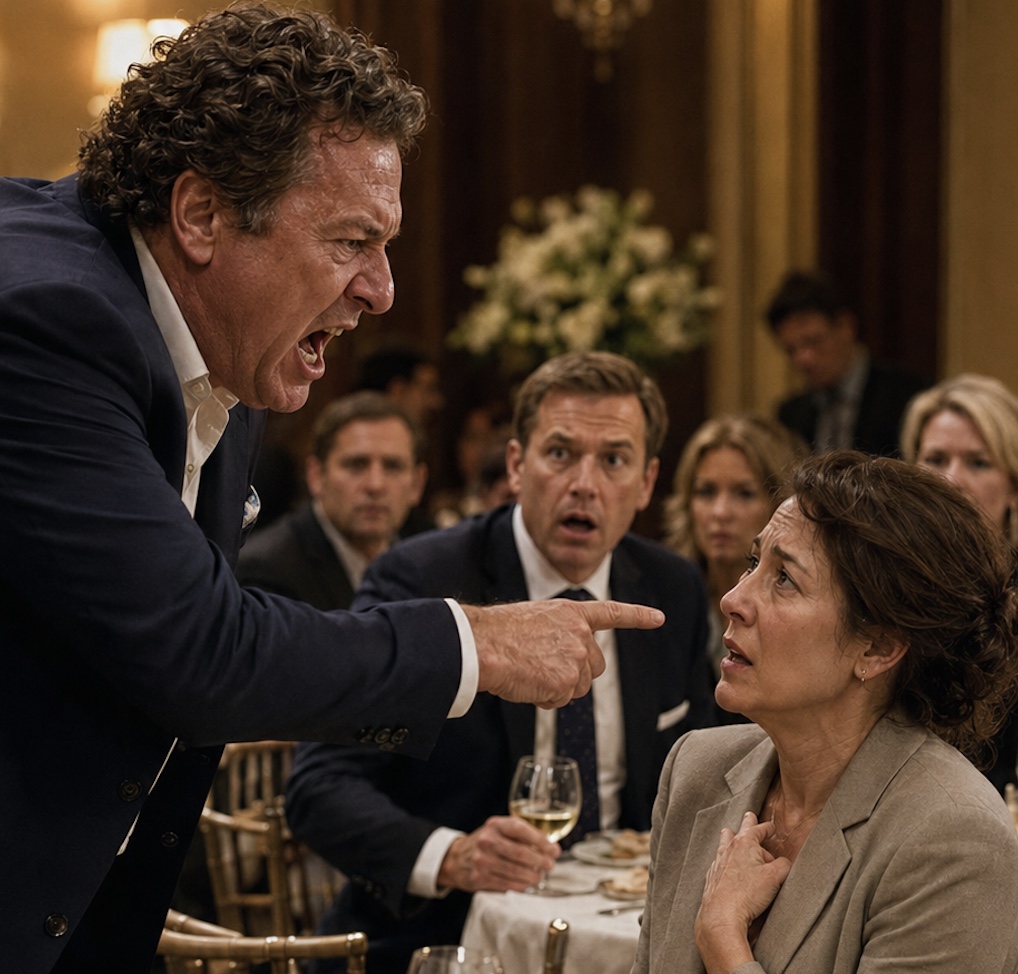
“Ira, pass me the knife. Why are you just sitting there?” Kirill said loudly, tapping his fork against his plate.
His colleagues from the construction company were seated around us. Kostin, the chief engineer, froze with a glass in his hand. Across the table, Lidochka, his secretary, smiled faintly.
“Right away, Kirill,” I said, reaching for the utensil.
“You always need to be pushed,” he snapped, grabbing the knife before I could hand it to him and deliberately brushing against my fingers. “Half-asleep as usual. People are watching.”
I adjusted the silver bracelet on my wrist. One of its links had been cracked for a long time. It kept catching on the sleeves of my coat, but I had grown used to holding it down with my middle finger.
“Kirill Petrovich, why say it like that?” Lidochka said, taking a sip of wine. “Irina Vasilyevna was just distracted. It’s a celebration, after all.”
“She’s always distracted longer than necessary,” Kirill said, taking a sip of cognac and looking around the table. “Just look at her. She put on that gray blazer like she was going to a funeral. Did I give you fifty thousand for a dress before this banquet or not?”
“You did,” I answered quietly, staring down at my plate. “I bought something I felt comfortable in.”
“Comfortable,” Kirill repeated sharply, turning toward me as red patches spread across his face. “You’re sitting at the anniversary banquet of my company. Management is here. Investors from the region are here. And you look like a cellar mouse. Disgraceful.”
Kostin cleared his throat and turned toward the window, pretending to study the lights of the evening city. Lidochka immediately lowered her eyes to her phone.
“Kirill, please stop. We’ll talk at home,” I said, trying to touch his sleeve.
“Don’t touch me,” he raised his voice, drawing attention from the next table. “You are a walking embarrassment, not a wife! You don’t know how to present yourself, and you don’t know when to keep quiet. Why did I even drag you here?”
The words dropped into the silence of the banquet hall. The music coming from the speakers suddenly seemed too loud, pounding against my ears.
“I’ll leave,” I said.
“Then go,” Kirill replied without even turning his head. “Call your own taxi. I don’t have cash for your little tantrums.”
I stood up. My bracelet caught on the edge of the tablecloth again and gave a small metallic clink. I carefully freed my hand. Behind me, his laughter followed me, picked up by one of the young managers.
“Come on, Kirill Petrovich, you got a little carried away,” Kostin’s muffled voice reached me.
“I’m sick of her, honestly, guys,” Kirill answered. “No polish, no charm. Just grayness.”
I stepped into the cool corridor of the restaurant. My phone vibrated in my pocket. It was my mother.
“Irochka, how is everything going? Is Kirill happy with the celebration?” she asked.
“Yes, Mom. Everything is fine,” I said, swallowing the dryness in my throat.
“Thank God. Hold on to him, Ira. He’s a handsome man, he earns well. It’s hard to be alone at forty-two.”
“I know, Mom. I’ll call you later.”
I ended the call.
The taxi arrived in five minutes. It was warm inside and smelled of cheap air freshener. The driver, a young man who looked about twenty, glanced at me in the mirror.
“Should I turn the music down?”
“If possible, could you turn it off completely?”
“No problem. Bad celebration?”
“It was fine. Everything is fine.”
“That happens. I’ll turn the heater up. You’re shaking.”
I looked out the window.
The apartment was dark when I got home. Our two-room flat on the outskirts greeted me with the smell of stale tea. I didn’t turn on the light. I sat down on the sofa without taking off my coat.
Three years earlier, I had given him all my savings — eight hundred thousand rubles from my Sberbank card — to cover his foolish debt from his first company. Back then, he had cried in this very kitchen. He said he would be ruined if his father found out. Pyotr Valentinovich, his father, a former career officer, did not forgive mistakes.
And I had stayed silent.
I saved my husband. And by doing so, I taught him one thing: that he could treat me this way.
The next morning, the key turned in the lock only at eleven. Kirill came in, rustling plastic bags. He smelled of alcohol fumes and someone else’s tobacco.
“Ira! Are you home?” he shouted from the hallway.
“I’m home. In the kitchen.”
I was standing by the stove, making coffee.
He entered and tossed a bottle of mineral water onto the table. His eyes were red, and his crumpled tie was stuffed into his pocket.
“So why did you put on that circus yesterday?” he began right away. “Everyone kept asking where my dear wife had disappeared to.”
“You called me an embarrassment in front of your colleagues, Kirill.”
“Oh, here we go,” he waved me off. “I was joking. I had a little too much to drink. Happens to everyone. You know how much pressure there was. The investors are difficult, the contract is at stake. I needed to let off steam. And you puffed up your cheeks and ran away. A real wife supports her husband. She doesn’t ruin his evenings.”
“You humiliated me.”
“I stated a fact, Ira,” his voice hardened. “Look at yourself. You’re stuck in your tiny-budget world, counting your little pennies at that factory office. I give you money for clothes, and you buy something miserable. I’m doing all of this for us. If I have a respectable woman by my side, they’ll see me differently at the ministry. This is business. Image matters.”
“I don’t want to be shouted at.”
“Who shouted at you?” he opened the bottle of mineral water. “I just told the truth. Fine, forget it. Make me some eggs. My head is splitting. And iron my white shirt. I need to go to the office after lunch. Father said he might stop by.”
At the mention of Pyotr Valentinovich, something inside me tightened.
“Why is he coming?”
“I don’t know. He called this morning. His voice was gloomy. Said we needed to talk about the new land plot.”
I turned toward the window.
“I’m not frying eggs, Kirill. I’m going to work.”
“On a Sunday?” he asked, surprised. “What work?”
“A report. My manager asked me to come in and check the payroll statements.”
“You’re an idiot,” he muttered. “Working yourself to death for thirty thousand. Dinner should be ready by evening. Father likes mashed potatoes.”
The factory office was quiet. I sat at my desk, sorting through payment documents. My colleague Marina came into the room with a kettle.
“Irish, why are you so pale?” she asked. “Your husband’s banquet was yesterday, wasn’t it? Come on, tell me how it went.”
“It was fine,” I said, burying myself in the papers. “Just a regular banquet.”
“Oh, come on. I bet your husband was throwing money around again. Mine won’t give me an extra kopeck.”
“Marina, let’s just work, please. I need to balance the accounts.”
“Oh, fine, I’ll keep quiet,” Marina sighed and left.
I stared at the debit and credit columns. In paperwork, everything eventually balanced if you made enough effort. The mistake could always be found.
So why had I failed to notice, for three years, how I had turned into convenient furniture?
I had endured it because I was afraid of being alone. And I had Kirill. Handsome, loud, successful.
The price of that success turned out to be simple: my self-respect.
I returned home at five. Kirill was asleep on the living room sofa. An empty beer bottle stood on the table. The bracelet on my wrist caught again, this time on the pocket of my house robe. I yanked my hand sharply, and the cracked link opened even wider.
“Ira, you’re back?” Kirill appeared in the kitchen doorway. “Did Father call?”
“No. Write to him yourself.”
“No, he sounded strange. Gloomy. Peel more potatoes.”
“Peel them yourself, Kirill. My hands are tired.”
He looked at me with sincere astonishment.
“What’s wrong with you, Ira? Overworked at that office? I’ve been carrying this company on my back for five years, while you just count papers. I have the right to lose my temper. And now you’re making a scene over potatoes? Don’t be ridiculous.”
At that moment, the intercom rang sharply and insistently in the hallway. Kirill flinched.
“Father,” he whispered, pulling up his sweatpants. “Go open the door quickly.”
Pyotr Valentinovich entered the apartment without taking off his strict black coat. His face was gray. He ignored his son’s outstretched hand.
“Hello, Pyotr Valentinovich,” I said, stepping into the corridor.
“Hello, Irochka,” my father-in-law replied, surprisingly gently. “Forgive me for coming without warning. Kirill, go into the room.”
We went into the living room. Kirill fussed around, trying to remove the beer bottle from the table.
“Dad, do you want tea? Or coffee? Ira will make—”
“Sit down,” Pyotr Valentinovich cut him off.
Kirill obediently lowered himself onto the edge of the sofa. His father took a phone from his pocket, tapped the screen, and placed it on the table in front of his son.
Loud restaurant noise came from the speaker, followed by music and Kirill’s drunken voice:
“You are a walking embarrassment, not a wife! You don’t know how to present yourself, and you don’t know when to keep quiet…”
The recording lasted about fifteen seconds. In the video, my pale face was clearly visible, along with the way Kirill pushed my hand away in disgust.
A suffocating silence settled in the living room. Kirill’s face broke out in red patches.
“Dad… this… this was taken out of context,” he stammered. “We were just joking. Who sent this to you? Kostin? I’ll fire him tomorrow!”
“It was sent to the general chat of our construction association veterans, Kirill,” Pyotr Valentinovich said quietly. “The same chat where the people who gave you this business are members. People who respected me. And now they are watching my son behave like a complete lowlife.”
“Dad, I’m sorry, I lost my temper!” Kirill jumped up. “Ira, tell him! Tell him everything is fine!”
He stared at me with wild, pleading eyes.
“Ira, look at me,” Pyotr Valentinovich said, turning toward me. “Has he been treating you like this for a long time?”
I remained silent. The bracelet on my wrist suddenly felt unbearably heavy.
“Ira, don’t just stand there!” Kirill rushed toward me and grabbed my shoulders. “Tell Father that everything is fine between us! We have to sign the agreement for the new project tomorrow. He’ll withdraw his bank guarantees if you don’t say something! Ira!”
“I spent my whole life trying to make a decent man out of you, Kirill,” Pyotr Valentinovich said, standing and buttoning his coat. “But now I see I raised a doorman with the manners of a spoiled master. A man who does not respect his wife cannot run a business I built for twenty years.”
“Dad, wait!” Kirill shouted. “Ira, answer him!”
I looked at my father-in-law. His hands were visibly trembling. He was genuinely suffering from this shame.
And I understood that my job — to endure and cover for my husband — was over.
Pyotr Valentinovich left, slamming the door behind him. Kirill stood in the middle of the living room, breathing heavily.
“So why did you keep silent?” he suddenly asked calmly, turning toward me. “Was it so hard to open your mouth? You could have said I was joking, and that would have been it. Now the old man’s blood pressure will shoot up, and I’ll lose the contract. Because of your stupidity.”
I went into the kitchen. He followed me.
“Ira, am I talking to myself?” his voice became condescending. “Fine, stop sulking. This is serious. Right now, you take your phone, call Father, and tell him you provoked me. Say you spent the money, and that’s why I lost my temper. He’s an old-school man. He’ll understand. Come on, dial.”
He held my phone out to me.
“I’m not calling,” I said.
“What do you mean, you’re not calling?” Kirill smirked. “Ira, you don’t understand. My company is our money. Your fur coat, this apartment. If Father cancels the guarantee, we’ll be kicked out of here in a month because of debt. Is that what you want? Come on. Call him.”
“No,” I repeated.
The smile slid off his face.
“Listen carefully, my dear,” he took a step toward me. “You’ve been sitting on my neck for three years…”
“I work as a chief accountant, Kirill,” I interrupted him. “And three years ago, I gave you all my savings so you wouldn’t end up in prison for embezzlement. Did you forget?”
“That was our money!” he barked. “And anyway, I made one mistake back then. Now I’m running a real business. You owe me help. We’re family!”
“No, Kirill. We are not a family. To you, I’m a walking embarrassment. You said it yourself yesterday. In front of everyone.”
“Who cares what I said at a banquet?” his face twisted with anger. “I drank too much! I worked like a dog all month! And you really did look shabby there!”
I looked down at my wrist. The silver bracelet had caught on the edge of the kitchen potholder. I pulled my hand, and the damaged link finally snapped. The bracelet slipped onto the linoleum with a quiet sound.
I did not pick it up.
“Call Father, Ira,” he hissed. “Or I won’t be responsible for myself. I’ll throw you out of here without a kopeck. You’ll crawl back to your mother and her old Khrushchev-era apartment. Do you understand?”
“Throw me out,” I said, taking a step toward the hallway. “The apartment is registered in your father’s name, Kirill. You are nobody here. And your company is his too. He has already made his decision. Exactly one day after your banquet, you were left with nothing.”
He froze, his fists clenched, his eyes widening. At that moment, he realized that the convenient, quiet Ira who had always cried into her pillow no longer existed.
“You… you bitch, Ira,” he whispered, losing his voice. “You ruined my life.”
“You ruined it yourself yesterday, Kirill. When you decided you could devour a person alive and face no consequences for it. I’m leaving.”
“Where will you go?” he shouted, but there was no strength left in his voice. “Who needs you at forty-two?”
“Myself,” I answered.
I went into the bedroom and took the bag where I had placed my passport that morning.
Kirill stood in the hallway, watching me put on my shoes. He did not try to stop me. His world, built on appearances, had collapsed in a single evening.
On my mother’s nightstand lay a clean folder. Inside were the extract from the property register for her apartment, my divorce application, and my income certificate from the factory. The public services center opened tomorrow at eight in the morning. I needed to get in line to submit the documents.
I looked at my left wrist. The skin there was pale, without the familiar silver band around it. The bracelet was gone.
The feeling was strange, as if I had removed heavy shackles I had worn for years.
The phone on the mattress gave a short chime. A message from Pyotr Valentinovich appeared:
“Ira, the lawyer is ready. He will contact you tomorrow.”
I did not reply.
I simply closed the folder.
There would be many court hearings ahead, and many of Kirill’s screams. But for the first time in three years, I felt completely calm inside.
What do you think — can public humiliation be forgiven if the person sincerely believes they were only “joking” under stress?