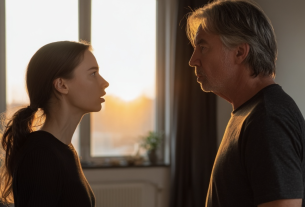
Kira gave the faintest smile and set her cup aside.
Outside, it was a clear Saturday afternoon. The new apartment still smelled of fresh wood from the cabinets that had been assembled the day before. Boxes of dishes were stacked in the corner of the hallway, and on the kitchen counter lay the documents her mother-in-law had asked to see immediately after walking through every room.
Lyudmila Anatolyevna had come “for the housewarming,” as she put it. But from the moment she stepped inside, she began inspecting the apartment as if she were accepting a property before moving in.
“The bedroom is nice. Bright,” she had said in the hallway without even taking off her coat. “Your father and I will stay here when we visit.”
Kira had said nothing then. Her husband, Yegor, had coughed awkwardly and quickly carried a bag of fruit into the kitchen.
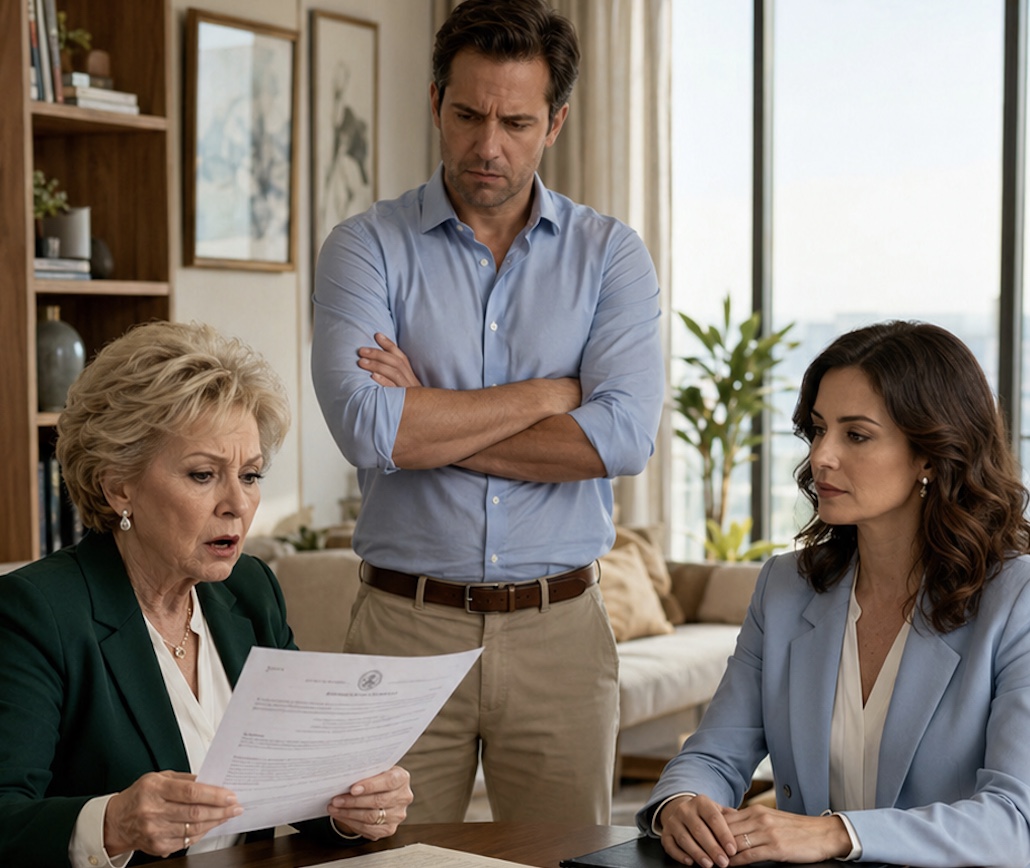
Now the three of them were sitting at the table. Lyudmila Anatolyevna was holding the property registry extract and frowning more and more with every passing second. Her carefully styled hair had already become slightly disheveled because she kept touching it, as though the paper in front of her was not a document, but someone’s insulting joke.
“Only your name is listed here,” she finally said. “Where is Yegor?”
Yegor lowered his eyes to his interlaced fingers. Kira glanced at her husband. He had been tense since morning. First, he spent too long choosing a shirt. Then he asked twice whether they really had to invite his mother today. Then he said it would be “better without the documents.”
That was when Kira understood: Lyudmila Anatolyevna was not coming simply to congratulate them.
“Yegor is exactly where he should be,” Kira replied calmly. “At the table. Beside you.”
“Don’t joke,” her mother-in-law snapped. “I’m asking seriously. Why is the apartment registered only in your name?”
Kira tilted her head slightly and studied the woman across from her. This was not her usual irritation over small things. In her voice there was genuine confusion, even offense, as if something promised to her had suddenly been taken away.
“Because I bought it,” Kira said.
Lyudmila Anatolyevna blinked.
“What do you mean, you bought it? You are husband and wife.”
“We are husband and wife,” Kira confirmed. “But this apartment was purchased with my personal funds. I saved the down payment before marriage. I covered the main part with my savings and with the money from selling a room that belonged to me before the wedding. Yegor knows that.”
Yegor lifted his head, then immediately looked away again.
“Yegor?” his mother turned to him. “Are you hearing this?”
“Mom, let’s not…”
“No, we will!” Lyudmila Anatolyevna slapped her palm on the papers. “For six months everyone said you were buying a family home. I told people my son had finally become the owner of a proper apartment. And now it turns out he is nobody here?”
Kira placed her hand on the edge of the table.
“There is no ‘nobody’ in this apartment. Yegor and I live here together. But the owner is me.”
Lyudmila Anatolyevna leaned back in her chair and looked at her daughter-in-law as if she were seeing her true face for the first time.
For Kira, this moment was not unexpected. She had heard enough over the past few months.
First, her mother-in-law had said on the phone that “the children need a spacious apartment so the parents have somewhere to come.” Then, in the family chat, she wrote that the smaller room should not be filled with things because “guests are people too.” Later, at her father-in-law’s birthday, she announced to Yegor’s aunt that she would come stay with the young couple for a month in the summer: “Kira works shifts, Yegor is at work, and I’ll take care of the household.”
Kira had been sitting nearby, peeling a mandarin. The peel tore into tiny pieces, and juice splashed onto her fingers. She wiped her hand with a napkin and stayed silent because the purchase had not yet been finalized.
But when Lyudmila Anatolyevna called after the apartment was bought and asked where she would store her winter clothes, Kira realized something clearly: her silence was being mistaken for consent.
“So you planned all this in advance,” her mother-in-law said slowly. “You smiled, nodded along, and then quietly registered everything in your own name.”
“I never once agreed to give anyone a room or store other people’s belongings,” Kira replied. “You decided on your own that you had the right to manage this apartment.”
“Other people’s belongings?” Lyudmila Anatolyevna almost rose from her chair. “I am your husband’s mother!”
“I remember.”
“Then why are you speaking to me as if I’m a stranger?”
Kira looked down at the papers. On the table lay the registry extract, the purchase agreement, the documents from the sale of her room, and the payment records. Everything was clean, transparent, and calm. Exactly how she liked things. Unlike the conversations in this family.
Finally, Yegor spoke.
“Mom, Kira really did everything herself. I didn’t invest in the purchase. I helped with the move, assembled the furniture…”
“Furniture!” Lyudmila Anatolyevna snapped, turning sharply toward her son. “Do you hear yourself? They turned you into a mover in your own family!”
Yegor’s ears turned red. He ran his hand over his face and said quietly:
“Mom, stop.”
“No, I won’t stop! If you keep quiet, tomorrow she’ll throw you out of this apartment, and you’ll leave with nothing but a bag of socks.”
Kira exhaled slowly. She wanted to answer sharply, but she could see that this was exactly what her mother-in-law was waiting for. She needed a scene so she could later tell the relatives how her daughter-in-law lost control, was rude, and showed her real face.
“If Yegor behaves like a husband and not like a messenger between me and your plans, no one is going to throw him out,” Kira said evenly. “But if you continue deciding things for us, this conversation will be short.”
Her mother-in-law narrowed her eyes.
“So that’s how it is. Threats already.”
“It’s not a threat. It’s a boundary.”
Lyudmila Anatolyevna smirked and picked up the documents again. This time she flipped through them not with surprise, but with irritation. The papers rustled loudly and unpleasantly, as though she were trying to force reality to change through sound alone.
“And the mortgage?” she asked. “There is one, isn’t there?”
“There is. In my name.”
“And you’ll pay it together?”
“No. The payments come from my account.”
“But Yegor lives here. He buys groceries, repairs things, helps around the apartment. That means he has rights.”
Kira looked at her husband.
“Yegor, do you think buying groceries makes you an owner of the apartment?”
He looked up.
“No.”
“And you don’t even argue,” Lyudmila Anatolyevna went pale with anger. “You just sit there and nod. I didn’t raise you like this.”
“Mom, you raised me to understand what is mine and what belongs to someone else,” Yegor suddenly said.
For the first time that morning, Kira looked at her husband carefully. His voice trembled with hurt, but he did not back down.
Lyudmila Anatolyevna fell silent. For a second, the room became so quiet they could hear a neighbor’s door lock click in the hallway.
“Someone else’s?” she repeated. “Your wife’s apartment is someone else’s to you?”
“Kira’s apartment is Kira’s apartment. It is our home because she allows me to live here and because we are married, not because I can bring whoever I want into it.”
Kira had not expected those words. For the past six months, Yegor had avoided conversations too often. When his mother talked about the future guest room, he pretended not to hear. When she hinted that “young people have plenty of space,” he changed the subject. Kira had already begun to think that when the decisive moment came, he would hide behind silence again.
Lyudmila Anatolyevna stood up. The chair scraped sharply against the floor.
“So she turned you against me.”
“No one turned me against you,” Yegor replied. “I’m just tired of your conversations as if Kira is obligated to share everything.”
“Everything?” his mother raised her eyebrows. “Am I ‘everything’ to you now?”
Kira placed the documents back into the folder.
“Lyudmila Anatolyevna, let’s speak honestly. You didn’t come here to congratulate us. You came to check whether Yegor was listed as an owner. You checked. You got your answer.”
Her mother-in-law turned sharply toward her.
“And you seem very pleased.”
“Yes,” Kira said calmly. “I am pleased. I worked for several years, saved money, denied myself unnecessary things, sold my room, went through the transaction, the document checks, and the move. Now I live in an apartment I bought honestly. I have every reason to be pleased.”
Lyudmila Anatolyevna grabbed her handbag from the back of the chair, but she did not leave. Her gaze moved toward the hallway, then to the room whose door stood slightly open.
“The small room should still be kept free,” she said in a different tone. “You never know. Your father and I aren’t strangers. At our age, it’s not easy to run around staying in hotels.”
Kira stood up.
“The small room will be my office.”
“An office?” her mother-in-law smiled crookedly. “You need a whole room for papers, but there’s no space for your husband’s parents?”
“Yes. Because this is my apartment and my work.”
“You are selfish, Kira.”
Kira nodded as if she had heard a weather forecast rather than an insult.
“So be it.”
Yegor stood too.
“Mom, enough.”
But Lyudmila Anatolyevna had already entered that state where a person no longer argues, but pulls out everything they have been storing inside for years.
“I saw right away that you had your own agenda. Too quiet, too proper. Always smiling, while calculating every step. I thought maybe I was imagining it. Now I see I wasn’t.”
Kira took a kitchen towel from the hook near the wall and calmly wiped a drop of water near the sink. Her hands moved steadily, though the skin on her fingers felt hot.
“I do calculate every step,” she said. “That is exactly why I have an apartment, documents, and an understanding of whom to let into my life.”
“Yegor, did you hear that?” his mother turned to him. “She is cutting me out of your life.”
“No, Mom. She doesn’t want you managing her home.”
“Her, her, her!” Lyudmila Anatolyevna waved her hand. “Is nothing here yours?”
Yegor looked at Kira. His expression carried shame and heaviness.
“My things are here. My wife is here. And my choice is here, if I don’t ruin everything completely,” he said.
Kira turned toward the window. Reflected in the glass were the kitchen, the table, the folder of documents, and three figures frozen on different shores of the same conversation.
Unexpectedly, her mother-in-law sat down again. The anger on her face gave way to a businesslike expression.
“All right. Suppose you are the owner. But Yegor is your husband. That means you should at least give him a share. To be fair.”
Kira gave a small laugh.
“Fair is when someone invests in the purchase and then receives a share. Or when the owner wants to gift one. I don’t.”
“Why?”
“Because I already see how quickly a board of directors forms around property that belongs to someone else.”
Yegor coughed quietly, but he did not smile. Lyudmila Anatolyevna’s face flushed in blotches.
“You just humiliated me.”
“No. I described the situation.”
Her mother-in-law stood up for good.
“Then listen to me. I will not allow my son to live here like a tenant with no rights. I’ll take him home today. Let him think whether he needs a wife who treats him like a lodger.”
Kira looked at Yegor.
“Yegor will decide for himself where he lives.”
“I am his mother. I have the right to interfere.”
“In your own apartment, you do. In mine, you don’t.”
Lyudmila Anatolyevna grabbed her phone.
“I’ll call his father now. Let him come. We need a man-to-man conversation, since everyone here has become so clever.”
“Don’t call Dad,” Yegor said more firmly than before.
“I will call him!”
“Then call him from the stairwell,” Kira said.
Her mother-in-law froze.
“What?”
Kira walked to the hallway, picked up Lyudmila Anatolyevna’s handbag from the console table, and handed it to her. She did not throw it, did not toss it, but calmly offered it.
“This conversation is over. You may visit us when you are ready to respect the rules of the hostess. But not today.”
“You’re throwing me out?”
“Yes.”
Yegor looked at his wife, then at his mother. Confusion flashed across his face, but he did not step between them.
“Yegor!” Lyudmila Anatolyevna cried. “You’ll allow this?”
He slowly nodded.
“Yes, Mom. Today it’s better if you leave.”
His mother opened her mouth, but for once she could not immediately find words. She took her bag, yanked at the zipper as if it were to blame for everything, and marched into the hallway.
At the door, she turned back.
“You’ll regret this. Especially you, Kira. When you end up alone in this apartment of yours.”
Kira opened the front door.
“Don’t forget your shoes.”
Lyudmila Anatolyevna put on her shoes, stepped out onto the landing, and spent another couple of seconds staring at her son. Yegor stood in the hallway, pale but unmoving.
“Mom,” he said quietly. “I’ll call you tonight.”
“Don’t bother,” she snapped, then walked toward the elevator.
Kira closed the door. Then she turned to her husband.
The apartment became too quiet. Not cozy, not peaceful, but silent in the way air still rings after a loud noise.
“Thank you for not staying silent,” Kira said.
Yegor ran a hand over the back of his head.
“I stayed silent for too long.”
“Yes.”
He nodded. He did not try to justify himself, and that was better than any long explanation.
“I thought if I didn’t argue with my mother, she would calm down on her own,” he said. “But she decided that meant I agreed.”
Kira put the folder with the documents into a drawer.
“She decided not only for you. She decided for me, for the room, for the guests, for our future. You saw that.”
“I saw it.”
“And now what?”
Yegor sat on the edge of a chair, then immediately stood up again, as if he could not find a place for himself. He walked to the window and looked down into the courtyard. On the playground, a boy was riding a scooter while his father walked beside him carrying a bag.
“Now I’ll talk to her myself. Without you. I’ll explain that she won’t come over without an invitation, won’t discuss your apartment with relatives, and won’t ask for documents.”
Kira looked at him closely.
“Won’t ask? Today she didn’t ask. She inspected.”
Yegor grimaced as if the word had hit exactly where it hurt.
“Yes. She inspected.”
Kira walked to the table and picked up her cup. The tea had long gone cold, but she had no intention of drinking it. She simply carried it to the sink and poured it out.
“I don’t want to spend my whole life proving to your mother that I have the right to what is mine,” she said.
“You won’t.”
“That doesn’t depend on her. It depends on you.”
Yegor turned around.
“I understand.”
But his understanding was only the beginning. Lyudmila Anatolyevna was not going to surrender after one conversation.
That evening, she did not answer Yegor’s calls. Instead, she wrote in the family group chat that “some women lose all respect for their elders after buying an apartment.” Kira’s name was not mentioned, but everyone understood who she meant.
Half an hour later, Yegor received a call from his aunt, Nina Pavlovna. Kira could not hear the whole conversation, only separate phrases from her husband.
“No, Aunt Nina, no one insulted Mom… No, the apartment isn’t shared… No, I’m not out on the street… Why did you decide I was thrown out?”
He paced around the kitchen, gripping the phone tighter and tighter. Kira sat with her laptop in the future office and pretended to be busy. In truth, she had already read the same line ten times.
Then her father-in-law, Viktor Stepanovich, called.
Yegor spoke with him longer.
“Dad, I’m an adult… Yes, I know Mom is upset… No, there is no need to register a share… Because the apartment isn’t mine… Dad, would you give part of your apartment to someone just because they were your relative?”
After that sentence, there was a long silence on the other end.
Kira smiled involuntarily. Not with joy, exactly, but with respect. Yegor had finally started saying simple things in simple words.
The next day, Lyudmila Anatolyevna came again.
Kira was arranging books in her office. Yegor was home too. After the previous day, he had decided not to leave his wife alone in case the family performance continued. The doorbell rang insistently, in short, sharp bursts.
Kira looked through the peephole and saw her mother-in-law. Beside her stood Nina Pavlovna, the same aunt who had called Yegor the night before. Both women were carrying bags.
“We’ll only be a minute,” Lyudmila Anatolyevna said through the door. “We brought something for the housewarming.”
Kira opened the door but remained standing in the doorway.
“Hello. What exactly?”
Her mother-in-law lifted the bag.
“Bed linen. For the small room. For guests.”
Kira looked at the bag, then at Nina Pavlovna.
The aunt quickly smiled.
“Kirochka, don’t hold a grudge. Lyuda is emotional. A mother worries about her son.”
“I’m not holding a grudge,” Kira replied. “But the small room is not a guest room.”
Lyudmila Anatolyevna tried to step inside, but Kira did not move.
“May we at least come in?” her mother-in-law asked with pressure in her voice.
“No.”
Nina Pavlovna adjusted her collar in confusion.
“What do you mean, no?”
“We are not receiving guests today.”
Yegor appeared behind Kira.
“Mom, I told you yesterday. Visits need to be agreed on in advance.”
“I came to see my son!” Lyudmila Anatolyevna lifted her chin.
“And your son lives in Kira’s apartment,” he replied. “And right now he is telling you: not today.”
His mother narrowed her eyes.
“Has she already taught you to repeat memorized phrases?”
Yegor stepped closer to the door.
“No. These are my words.”
Kira noticed how Nina Pavlovna’s expression changed. She had clearly expected to see a humiliated daughter-in-law and a lost nephew. Instead, she saw a door behind which two adults were not going to explain themselves.
“All right,” the aunt said quietly. “Lyuda, let’s go. Don’t do this.”
“I’m not leaving,” Lyudmila Anatolyevna cut in. “I want to come in and talk normally.”
“Normally does not mean arriving with bed linen for a room no one promised you,” Kira said.
Lyudmila Anatolyevna sharply thrust the bag toward her son.
“Take it.”
Yegor did not take it.
The bag hung in the air. For several seconds, his mother held it out with an outstretched arm, then her face twitched. She lowered the bag, turned around, and headed toward the elevator.
Nina Pavlovna lingered.
“Kira, understand this. Lyuda has already told everyone that you have plenty of space now. She feels embarrassed in front of people.”
“She feels embarrassed because of her own words,” Kira replied. “Not because of mine.”
The aunt said nothing and hurried after her.
Kira closed the door. Yegor stood beside her, looking at the floor.
“Are you ashamed?” she asked.
“Yes.”
“Of me?”
“Of us. Of the fact that it came to this.”
Kira took his hand. Not as a reconciliation gesture, not for beauty, but so he would understand: she saw his effort.
“Then don’t let the situation slide back.”
He squeezed her fingers.
“I won’t.”
A week passed. The apartment finally began to feel like a home. Kira finished unpacking, set up her office, hung a note board on the wall, and sorted documents into folders. Yegor bought a shelf for his books and offered on his own to pay part of the household expenses that had nothing to do with the apartment itself.
For the first time, they calmly discussed rules: who could visit, how they should warn each other, and what to do if relatives started applying pressure.
Kira was not asking for the impossible. She did not need Yegor to quarrel with his mother forever. She needed him to stop pretending that other people’s fantasies did not harm their marriage.
But Lyudmila Anatolyevna decided to approach from another direction.
On Friday evening, Kira received a message from an unfamiliar woman. The woman introduced herself as a friend of her mother-in-law and wrote:
“Good evening, Kira. Lyudmila said you might be able to rent us the small room for two weeks while we’re in town for medical tests. We’re quiet and tidy.”
Kira reread the message twice. Then she showed it to Yegor.
His face hardened.
“I’ll handle it,” he said.
He called his mother in front of Kira and put the phone on speaker.
“Mom, who did you give Kira’s number to?”
“Oh, that’s Zoya Sergeyevna, an acquaintance of mine. A good woman. They only need two weeks. Your room is empty anyway.”
Kira did not even smile. She sat down and crossed her arms over her chest.
“The room is not empty,” Yegor said.
“Well, it’s an office. So what? You can move the laptop to the kitchen.”
“No.”
“Yegor, don’t be ridiculous. People are in a difficult situation.”
“Mom, you promised them a room in an apartment that doesn’t belong to you.”
“I didn’t promise. I said I’d ask.”
“You gave them Kira’s number as if it was almost settled.”
On the other end came an irritated breath.
“Son, you’ve started speaking very unpleasantly.”
“I’ve started speaking honestly.”
“This is all because of her.”
Yegor closed his eyes. Kira saw his jaw tighten.
“Mom, I’ll say this once more. Do not give anyone the address, Kira’s phone number, or invite people to this apartment. If it happens again, we will stop receiving you altogether.”
Lyudmila Anatolyevna laughed sharply.
“So this is what I’ve waited for. My own son is cutting his mother out of his life over a few square meters.”
“No, Mom. Over disrespect.”
He ended the call.
Kira said nothing. Yegor placed the phone face down on the table.
“I’ll write to Zoya Sergeyevna myself,” he said. “Politely. I’ll tell her there was a mistake.”
“All right.”
“And I won’t let Mom twist her way out of this anymore.”
Kira nodded. Inside, she felt no triumph, only exhaustion. She did not want a war over her own apartment. She wanted an ordinary life: to come home, close the door, and know that behind that door no one was assigning rooms without her consent.
A month later, Lyudmila Anatolyevna appeared again, but this time not with an aunt and not with bags. She called Yegor in advance and said she wanted to talk. Kira agreed, but warned him that the conversation would be short if demands began again.
Her mother-in-law arrived without her former self-assurance. In the hallway, she removed her shoes, placed her handbag neatly by the wall, and entered the kitchen only after being invited. Kira noticed it but made no comment.
Lyudmila Anatolyevna sat down, placed her hands on her knees, and stared at the table for several seconds.
“I behaved badly,” she finally said.
Yegor raised his eyebrows in surprise. Kira stayed silent.
“I felt hurt,” her mother-in-law continued. “Not because the apartment is yours. But because I had already said too much to everyone. I imagined how we would visit, how well everything had turned out for Yegor, how my son had his own place. Then I saw the documents and realized I had invented it all myself.”
Kira listened carefully. For the first time, there was no attack in Lyudmila Anatolyevna’s voice.
“But instead of admitting that I had rushed ahead, I started pressuring you,” she said. “It was ugly.”
Yegor looked at his mother cautiously.
“Mom, and Zoya Sergeyevna?”
Lyudmila Anatolyevna winced.
“I apologized to her too. I told her I had misunderstood the situation.”
Kira leaned back in her chair.
“Lyudmila Anatolyevna, I am not against communication. But I am against you discussing my apartment as if it were a family resource.”
“I understand.”
“And one more thing. If you visit, it must be by agreement. Not with bags for a week. Not with other people’s requests. Not with plans for the room.”
Her mother-in-law nodded.
“All right.”
Kira could see that these words were not easy for her. Lyudmila Anatolyevna was used to seeing care as a right to interfere, and motherhood as a lifelong pass through every door in her son’s life. But at least now she was trying to stop herself.
“I don’t want to quarrel,” Kira said. “But I will protect my home. Calmly or firmly — that does not depend only on me.”
Her mother-in-law raised her eyes.
“You are very strong.”
“I had to be.”
Lyudmila Anatolyevna nodded as if, for the first time, she heard not a challenge in those words, but a life story.
That evening, they did drink tea after all. Without discussing rooms, ownership shares, or future visits. The conversation was awkward, dry in places, but it was no longer destructive. Her mother-in-law asked about the neighborhood, praised the view from the window, then mentioned that her husband had planted new blackcurrant bushes at the dacha.
Kira listened calmly. For the first time in a long while, Yegor did not look like a man trapped between two fires.
When Lyudmila Anatolyevna was about to leave, she paused by the door.
“Kira,” she said, not looking directly at her. “I won’t ask for the documents again.”
“That’s the right decision,” Kira replied.
Her mother-in-law smiled faintly.
“You’re tough.”
“But honest.”
Lyudmila Anatolyevna left. Yegor walked her to the elevator and returned a minute later. Kira stood in the hallway, listening to the fading sound of the elevator car.
“Well?” he asked.
“We’ll see,” she replied. “One conversation isn’t enough, but this beginning is better than another scandal.”
Yegor came closer and wrapped an arm around her shoulders.
“I thought you wouldn’t let her in at all today.”
“So did I.”
“Why did you?”
Kira looked at the closed door.
“Because she didn’t come with a bag for the guest room. And she didn’t come with a demand. That already makes a difference.”
Yegor laughed softly.
“You notice everything.”
“That’s why we have an apartment,” Kira said.
He smiled, then became serious.
“Kira, I want you to know something. I don’t need a share. I don’t need a room for my mother. I don’t need to prove to anyone that I’m the owner here. What matters to me is that we live normally in this home.”
Kira turned to him.
“Then remember this: normal means the home is peaceful not only for guests, but also for the woman who owns it.”
“I’ll remember.”
A few days later, Yegor himself suggested making a spare set of keys only for the two of them and not giving it to any relatives. Kira agreed. The old keys that Lyudmila Anatolyevna had once asked for “just in case” were never given to her. There was no need to change the locks: no one else had a key, and Kira considered that her small victory of foresight.
Gradually, the relatives stopped talking. One day, Nina Pavlovna sent Kira a short message: “You were right. Lyuda went too far.” Kira did not continue the topic. She simply replied, “The main thing is that everything has been cleared up.”
Lyudmila Anatolyevna slipped back into old habits a couple more times: once she wanted to come over “on the way,” and another time she hinted that it would be useful for Yegor to have “something of his own.” But each time, Yegor stopped her himself. Without shouting, without fighting, but firmly.
And that became the most important outcome of the whole story for Kira.
Not the documents on the table. Not the name in the registry. Not even the fact that her mother-in-law finally understood the apartment did not belong to her son.
The most important thing was that Yegor stopped hiding behind Kira’s back and behind his mother’s difficult character.
One evening, Kira was sitting in her office, sorting through work notes. Yegor looked in through the doorway.
“May I?”
“Into my terrifying private room?” she asked with a smile.
He raised his hands.
“Only with the hostess’s permission.”
Kira laughed. Easily, for the first time in a long while without tension.
“Come in.”
Yegor entered and looked around the room: the desk, books, neatly arranged folders, a warm desk lamp, an armchair by the window. No guest bed. No strangers’ suitcases. No “we’ll only stay for a little while.”
“Nice office,” he said.
“I know.”
He sat on the edge of the chair and looked at her.
“Mom’s friend called her today while I was there. She asked when she could visit us. Mom answered, ‘When Kira invites you.’”
Kira froze for a second, then slowly smiled.
“Progress.”
“Huge progress.”
She closed the folder.
“You see? Sometimes it’s useful to show documents.”
Yegor shook his head.
“I thought that day would just be an ordinary family conversation.”
“It turned into a test of boundaries.”
“And who won?”
Kira looked out the window, where the lights of neighboring homes were glowing.
“No one won. Everyone simply found their proper place at last.”
Yegor understood without needing an explanation.
Lyudmila Anatolyevna remained a mother. Yegor remained a husband. Kira remained the owner of her apartment.
And the small room did not become storage for other people’s expectations, a place for uninvited guests, or proof of someone else’s power.
It became the office of a woman who knew the price of her peace too well to give it away to people who had not even asked permission to enter.