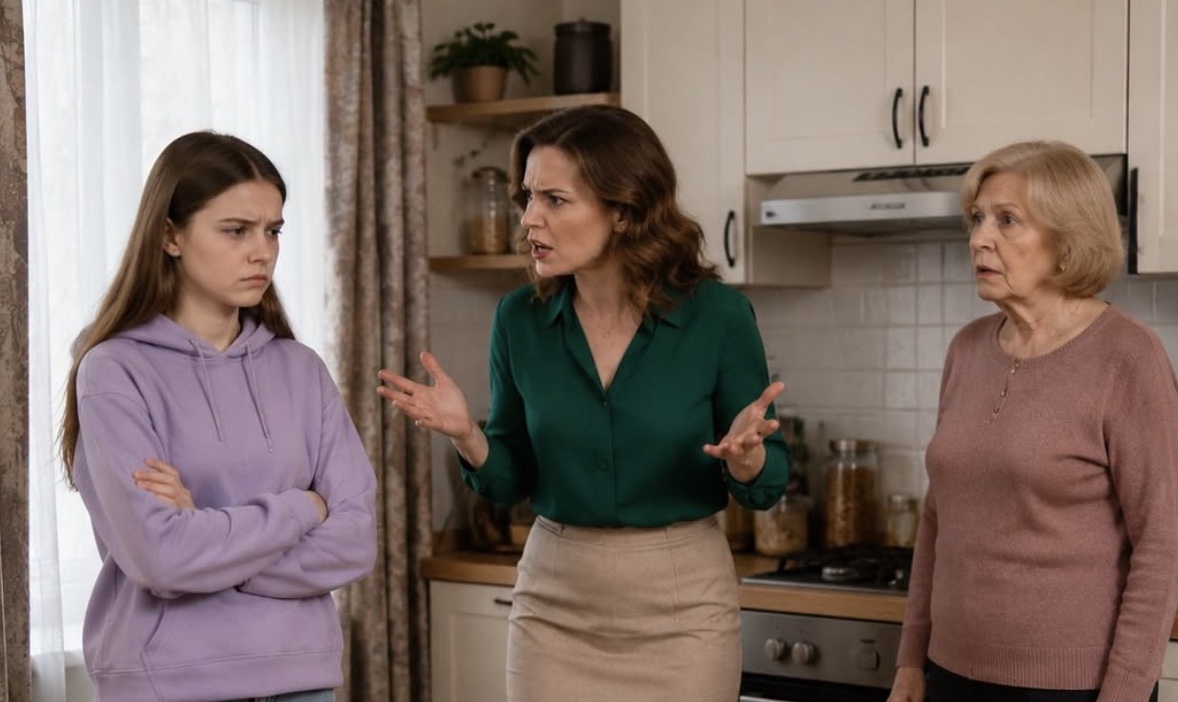
Her voice broke. Not from tears, but from fury — from that quiet rage that had been building for months, the kind that, at some point, stops being quiet.
“If you want meat, then buy it!”
The words hung in the air of the small kitchen. Her mother-in-law, Larisa Nikolaevna, froze with her teacup halfway to her mouth. Katya, her sister-in-law, widened her eyes and parted her lips — exactly the way she always did when she wanted to look offended. Then came silence. Thick, ringing silence, broken only by the hum of the elevator somewhere outside the window.
Tanya stood by the refrigerator and felt her heart beating too fast. Her hands trembled slightly. She clenched them into fists, unclenched them, pressed her palms against the cold refrigerator door, and stared into the space between her mother-in-law and sister-in-law — into the place where the air seemed especially heavy.
How had she ended up in this kitchen? How had all of them ended up at this day?
It had all started with the apartment. Or rather, with the dream of an apartment — a dream that she and Ilya had finally made real after two years of renting and endless moving. The mortgage was far from small. But it was their apartment. They could paint the walls any color they wanted and no longer fear that the landlady would call and ask them to move out by the next month.
When Ilya first showed her the listing, Tanya immediately asked:
“Isn’t this in the same building where your mother lives?”
“So what?” he shrugged. “It’s convenient. They can help us if anything happens. She’s my mother, after all.”
Tanya said nothing then. She was good at staying silent at the right moments — she had always considered it one of her strengths. Now, however, she suspected that very habit was what had brought her here, to the open refrigerator where the cheese should have been.
The first few months were fine. Pleasant, even, if she was honest. Larisa Nikolaevna helped with the move — she told them where to buy cheaper shelves, brought homemade cutlets during the first week when the dishes were still packed away. Katya helped hang the curtains. Back then, Tanya thought: well, neighbors. Close neighbors. That was a good thing.
She missed the first warning sign because she decided it was just a coincidence. Larisa Nikolaevna rang the doorbell on a Sunday morning while Tanya was standing at the stove in her pajamas, making pancakes. She had not called ahead, simply rang the bell — “I thought you’d be awake by now.” Her mother-in-law lived two floors below.
Tanya treated her to pancakes. Put the kettle on. They sat together for an hour and a half. Larisa Nikolaevna talked about the neighbor from the fourth floor, about the rude concierge, about how she had once been offered a job as a concierge in the very same entrance but had refused — as if, at her age, she needed to sit in a booth for pennies. Tanya listened, smiled, and thought that there were plenty of pancakes anyway, so it was fine.
Then the visits became regular. Not every day — not at first. But often enough that Tanya began to notice she was planning groceries “for three.” That every time the doorbell rang, she automatically looked at the clock and calculated what was on the stove and whether there would be enough for everyone. That whenever Katya came over with her mother, she never asked, “May I?” She simply opened the refrigerator and looked inside.
“Tanya, is this cottage cheese old?” she would say, inspecting the shelves like an experienced auditor. “The date is coming up soon.”
“I’m using it today,” Tanya would answer.
“Oh, fine then.”
One day, Tanya asked Ilya directly whether he thought his mother was coming over too often. He thought for a moment and said his mother was alone, that she got bored, and that, after all, she was his family. Tanya said she understood, but still. He said he would talk to her. Tanya never heard that conversation, and the visits did not become less frequent.
The cheese was gone.
The morning had started well. Tanya woke up earlier than Ilya, as usual, and lay quietly for a while, looking at the ceiling where the sun was already drawing long pale stripes through the loosely closed curtains. Friday. Ilya would come home early. The day before, she had decided to arrange a small dinner for them — candles, a glass of wine, and that cheese she had found in a specialty shop and bought with a sudden joyful impulse, completely unlike an ordinary weekday purchase. Expensive, covered in white mold, wrapped in waxed paper. The shop assistant had said it went beautifully with pear and honey. Tanya bought both the pear and the honey.
She got up, made coffee, and opened the refrigerator — just out of morning habit, to decide what to have for breakfast. And immediately she saw that the top shelf, where she had left the cheese in its beautiful wrapping, was empty. She looked at the middle shelf. The lower shelf. She even checked the vegetable drawer — why, she had no idea, but her hand moved there on its own.
The cheese was nowhere.
Her first thought was perfectly practical: maybe Ilya had moved it? She took a sip of coffee, went into the bedroom, and shook her husband by the shoulder.
“Ilya. Did you take the cheese?”
He opened one eye.
“What cheese?”
“The one in the white paper. On the top shelf.”
“I didn’t take it.” He had already closed his eye again.
Tanya returned to the kitchen and stood for a long time in front of the open refrigerator. Then she remembered that the previous evening, while she was in the shower, Larisa Nikolaevna and Katya had stopped by. Ilya had later said something about them just dropping in briefly. Tanya had already been in her pajamas and had not come out to greet them, only asked Ilya to say hello for her.
She put her mug on the table. Looked out the window at the building across the yard. Then she picked up her phone and wrote a short message to her mother-in-law: “Larisa Nikolaevna, did you happen to see the cheese in waxed paper in our refrigerator yesterday?”
The reply came quickly — that much could be said for her mother-in-law, she responded to messages instantly.
“Yes, Katya and I took it. I didn’t think you’d notice. We made sandwiches. To be honest, it wasn’t very good for sandwiches, the taste was strange. Where do you even buy that kind of thing?”
Tanya read the message. Then she read it again.
“I didn’t think you’d notice.”
She put the phone away and finished her coffee standing by the window. The sky above the rooftops was clear, high, and completely indifferent to everything happening below.
They appeared around noon — rang the doorbell, as always without warning, and Tanya opened it because… because she always opened it. That reflex had formed on its own over the months of living in this building: doorbell — open the door — put the kettle on.
Larisa Nikolaevna entered first, heading straight to the kitchen with the air of someone returning to a familiar place. That was what always bothered Tanya a little — that confidence, that ease with which she moved around the apartment, pausing by the bookshelf, the refrigerator, the mirror in the hallway. Like a hostess checking whether everything was in order.
Katya followed behind. Katya was in her final year of university, and in her own firm opinion, student life existed mainly to be enjoyed — freely, lightly, without unnecessary burdens. She often said things like, “Well, I’m still a student, I’m allowed,” and that “I’m allowed” seemed to cover a very wide range of things, including other people’s refrigerators.
Katya had a couple of part-time jobs — she mentioned them in passing, reluctantly, as if they were something entirely insignificant. Tanya once asked how much free time she had between classes. Katya laughed and said, “It depends.” Tanya did not ask again.
Larisa Nikolaevna, meanwhile, was retired and considered her pension a well-earned rest. She refused to hear anything about part-time work — “I worked my whole life, that’s enough.” A concierge position had opened up in their building, and one of the neighbors had even suggested that Larisa Nikolaevna try it — close to home, part-time, decent pay. She refused with such an expression that one might think she had been offered something insulting. Tanya learned about it from the neighbor on the third floor and thought then: fine, that’s her business. But later she remembered that just the previous week, her mother-in-law had spent half an hour complaining that money was catastrophically tight and had asked to borrow some until the next month.
“We won’t stay long.” Her mother-in-law was already opening the upper cabinet where the cups were kept. “We’ll just have some tea. You don’t mind, do you?”
It was not a question. Or rather, it was the kind of question that already knew the answer.
“Sit down,” Tanya said.
Katya dropped into a chair, crossed one leg over the other, and stretched.
“Oh, Tanya, do you have anything to snack on? Mom and I were at the market, the lines were awful, we have no strength left.”
“Was there nothing to buy at the market?” Tanya asked. Her voice sounded flat, without emotion — even she was surprised by it.
“Everything there is so expensive,” Katya waved her hand. “And we only went for greens. So, do you have anything?”
Tanya opened the refrigerator. Silently. She took out bread, a piece of ordinary cheese left from the previous week, and placed them on the table. She poured tea for her mother-in-law. Then for Katya. She did it all slowly, every movement deliberate, while something inside her gathered and swelled, like water building pressure in a blocked pipe.
Larisa Nikolaevna took a sip of tea and looked at the bread and cheese without much enthusiasm.
“Tanya, by the way,” she began in the voice people use when speaking about something long since decided, “could you fry us some meat? We’ve just come from the market, we’re tired. Katya needs a proper meal, she’s studying, she needs strength.”
“I want meat,” Katya confirmed, looking at her phone. “You had something in the fridge yesterday, I saw it.”
Tanya stood with her back to them. She looked at the stove. At the clean burners. At the pot she had washed that morning and left to dry.
“Speaking of yesterday’s cheese,” she said without turning around. “The one in the white paper.”
“Oh, yes,” Larisa Nikolaevna replied lightly. “There was barely any of it! We used it for sandwiches. You were busy, we didn’t want to disturb you. Honestly, it doesn’t really work for sandwiches, it’s too soft and the taste is too specific. Where do you buy it?”
“At a specialty shop,” Tanya said. “It cost…” She named the amount.
Silence.
“Well,” Larisa Nikolaevna began.
“I bought it for a special occasion,” Tanya continued in the same calm voice. “For dinner. It wasn’t just lying there.”
“Oh, Tanya, don’t get upset,” Katya cut in with the tone she considered soothing. “You’ll buy another one. You earn decent money, it’s nothing for you.”
Tanya turned around.
Her mother-in-law was looking at her with mild confusion — she genuinely did not understand what the problem was, and that sincere lack of understanding was the worst part of all. Katya was already staring at her phone again. Two cups of tea stood on the table beside the untouched bread.
“So, will you fry the meat?” Katya repeated without looking up. “You definitely had some.”
And that was it — that exact moment, when Katya said it again in her usual tone, the tone of a person who had never once doubted the answer — something inside Tanya snapped.
She opened the refrigerator. Slowly. Then closed the door.
She turned to her mother-in-law and sister-in-law.
And said:
“If you want meat, then buy it!”
The silence lasted a long time.
Larisa Nikolaevna set her cup down on the table. Straightened. Her face took on that expression people get when they hear something they cannot quite believe is real.
Katya finally looked up from her phone. She stared at Tanya with absolute astonishment — as if the earth had suddenly behaved in an unexpected way.
Tanya stood by the refrigerator and did not look away. Something inside her was still trembling — but differently now. Not from fury, not from fear. From a strange sense of release, the kind that comes when you finally say what has been building for too long.
“Tanya,” her mother-in-law said. Her voice had changed — drier, colder. “I think you’re forgetting yourself.”
“Maybe,” Tanya replied. “But you took the cheese I bought for myself and Ilya without asking. And now you’re asking me to fry meat. I’m simply suggesting you buy it yourselves.”
Katya snorted.
“What a personality.”
“Katya,” Tanya said evenly. “You’re a student, I understand that. But you’re not a little girl. And you and Larisa Nikolaevna have your own kitchen.”
Her mother-in-law stood up. Slowly, with the dignity she knew how to perform very convincingly.
“Ilya will hear about the way you speak to us,” she said.
“Good,” Tanya replied. “I’ll tell him myself.”
They left.
The door closed — it did not slam, no, that would have been too simple. It simply shut with a quiet click, and Tanya was left alone in the kitchen. She stood there for a long time without moving, then lowered herself onto the chair where Katya had just been sitting and placed her hands on the table.
Outside the window was an ordinary daytime sky. Somewhere below, the entrance door to the building slammed.
Tanya thought she should call Ilya now. Or maybe not — he would come home in the evening, and they would talk. She did not know exactly what he would say. He loved his mother; that was true. He was used to the idea that “Mom just drops by,” that it was normal, that it had always been this way. He did not see what Tanya saw: how, month after month, what had seemed like friendly closeness had turned into something else.
She stood up and opened the refrigerator again. She took out the pear — it lay on the lower shelf, alone, completely unaware of the dramatic events of that morning. The honey was in the cupboard. The cheese was gone.
Tanya picked up her phone and wrote to the same shop to ask if they had any more of that cheese. There was one last piece left. She ordered delivery.
The evening with Ilya was quiet. At first, it was heavy, because the conversation she had been waiting for turned out exactly as it had to be: not easy, not simple. Ilya was silent longer than she had expected. Then he said a few words — she did not remember all of them, only the important ones. Then they both fell silent, and there was something different in that silence now — no longer heavy, but tired and honest.
Tanya lit the candles anyway. The cheese turned out to be exactly as it should have been — soft, with that white rind, slightly sharp, and wonderful with honey and pear. They ate slowly while darkness gathered outside the window.
Larisa Nikolaevna did not call that evening, or the next day. Katya was silent too. It was a demonstrative silence, offended and carefully designed to be noticed and interpreted correctly.
Tanya interpreted it correctly.
And did nothing.
A week passed. Then another. The doorbell, which used to ring almost every day at the most unexpected times, no longer rang. The refrigerator stayed exactly the way Tanya filled it: nothing disappeared, nothing was used up without her knowing. In the mornings, she made coffee and did not hurry — she simply drank it while looking out the window at the rooftops of the neighboring buildings.
One evening, Ilya asked how she was feeling. She thought for a moment and answered honestly: good. He nodded. They did not return to that conversation — not because it was finished, but because it seemed to have given both of them the answer they needed.
Deep down, she knew this was not the end of the story. Larisa Nikolaevna was not the kind of person who could stay silent for long. Family is always a long, tangled story in which there is never only one correct answer.
But that day, standing beside the open refrigerator with trembling hands, Tanya said what she should have said long ago. Not rudely, not cruelly — simply honestly. Four words that held everything inside them: the missing cheese, the uninvited visits, and that exhausted feeling that builds up when a person stays silent for too long out of politeness.