Anton met Alina in the hallway before she had even managed to take off her coat. He looked disheveled, his eyes darting nervously. She had only just bent down to unzip her boots when he blurted out, speaking so fast it seemed he was afraid he would lose his nerve.
“I already promised that money to Mom! She’s waiting.”
Alina froze. Her hand stopped on the zipper. Slowly, she straightened up and looked at her husband. Something dropped painfully inside her chest. Today, of all days, she had planned to talk to him about the very same thing — money. The seven hundred thousand rubles they had been saving for four years, denying themselves nearly everything, dreaming of a down payment on a two-room apartment.
But that very morning her mother had called, and her voice had sounded so confused and small that Alina immediately knew something terrible had happened.
“What do you mean you promised it?” she asked quietly, walking into the room. “Promised it to whom? Your mother?”
“Yes!” Anton spread his hands helplessly. “You have no idea what happened to her. A pipe burst in the apartment above hers, everything flooded, part of the kitchen ceiling collapsed. The renovation is ruined. She urgently needs two hundred thousand, she’s short on money. And since repairs are already starting, she decided to replace the windows and radiators too. That makes about four hundred thousand. She doesn’t want to take a loan. She’s afraid of credit. We’re family. We have to help.”
Alina felt nausea rise in her throat. She sank down onto the stool in the hallway.
“Anton, did you promise her all our money? All seven hundred thousand?” Her voice trembled.
“Well, we’re not buying an apartment right now anyway. Prices have jumped so much…” he began, but stopped under her stare.
“And did it occur to you to ask what my mother needs?” Alina almost shouted. Her own voice sounded strange to her. “She needs surgery.”
Anton froze. His face showed confusion mixed with irritation.
“What surgery? You didn’t tell me anything.”
“I was going to tell you today. I only found out this morning. My mother has cataracts in both eyes, and her vision is getting worse very quickly. The doctor said we can’t wait. In six months she may stop seeing altogether. The surgery costs one hundred and eighty thousand, plus rehabilitation and lenses. I thought we would use part of the savings.”
“And you already decided all that without me?” Anton raised his voice. “So my mother is supposed to live with a hole in her ceiling and freeze?”
“Your mother is an adult, able-bodied woman! She works, she has savings, she simply doesn’t want to spend them!” Alina jumped to her feet. “My mother is a third-degree disabled pensioner, and every day she sees less and less. Do you even understand what eyesight means to her?”
“Oh, here we go,” Anton crossed his arms. “Who are you accusing now? My mother? She fed us while you were on maternity leave!”
“That is not true, and you know it,” Alina cut him off. “My mother saved us when we drowned in debt three years ago. Your mother said then, ‘I have no spare money. You got yourselves into this, so get yourselves out.’ And we did get out. Those seven hundred thousand are our only chance to finally leave this rented one-room apartment. But right now I’m not thinking about an apartment. I’m thinking about my mother’s eyes.”
A heavy silence fell between them. Anton stared at the floor, his jaw clenched. Alina could see shame and stubbornness fighting inside him. Finally, he raised his eyes.
“I already promised. She’s waiting. It’s too late to back out.”
“Then go and tell her you were wrong. Tell her we have our own circumstances. Tell her we’ll help later, in installments, but not the whole amount at once,” Alina said calmly, though everything inside her was shaking.
“You don’t understand.” Anton shook his head. “She said if we don’t help now, she’ll sell the apartment and move to the village. There are no proper conditions there, no doctors. And that apartment, by the way, is something we were expecting to inherit one day.”
“How can you be so…” Alina stopped herself. She turned and walked into the kitchen before she said something she could never take back.
She turned on the tap and stared out the window. Raindrops trembled on the glass — it had begun to rain. Behind the wall, the upstairs neighbors were ironically banging something heavy, as if they really were doing renovations.
Her phone vibrated in her pocket. A message from her mother appeared on the screen.
“Sweetheart, don’t worry. I’m waiting in line at the clinic. Maybe they’ll give me a state quota. Don’t you dare fight with Anton because of me. I’ll think of something.”
Alina bit her lip until it hurt. Her eyes blurred. Of course, nothing would work out. State quotas took a year to wait for, and her mother’s vision was disappearing now. If they gave the money to her mother-in-law, her own mother would go blind. If they refused, there would be a huge scandal with Anton and his mother, who would bury him alive under guilt.
Alina took a deep breath, called her mother, and said as confidently as she could:
“Mom, don’t go anywhere. The money will be there. I promise.”
Then she ended the call before her mother could object.
The next day, Anton brought up the conversation himself. He looked exhausted, with dark circles under his eyes. Clearly, he hadn’t slept either. He suggested they go to his mother’s place to “discuss everything together and find a compromise.”
Alina agreed reluctantly. She understood that this battle could not be avoided. She had to face the enemy directly.
They were silent in the car. Only halfway there did Anton speak, keeping his eyes on the road.
“You have to understand, she has no one else. My father left, we live separately, and she’s alone in a three-room apartment. Her ceiling is falling over her head. She’s scared.”
“I’m scared too, Anton. I’m scared that my mother won’t be able to see my children one day, if we ever have them,” Alina answered quietly.
He said nothing. She noticed how tightly his hands gripped the steering wheel.
Her mother-in-law, Svetlana Vasilyevna, met them at the door wearing an old but clean house robe, her face arranged into a tragic expression. The apartment did smell damp, and there was a yellow stain on the kitchen ceiling, but Alina saw nothing catastrophic.
“Oh, my dear children, come in!” Svetlana Vasilyevna exclaimed. “Antosha, I baked your favorite pies. Alina, tea?”
“Mom, let’s talk about the matter right away,” Anton said, carefully putting an arm around her shoulders. “That’s why we came.”
“What is there to talk about?” his mother pursed her lips. “You said you would help. Or have you changed your mind? Maybe Alina doesn’t agree?”
Alina sat on the edge of a chair without taking off her jacket, making it clear the conversation would be short.
“Svetlana Vasilyevna, I respect your situation. But my mother has been diagnosed with cataracts. She urgently needs surgery, otherwise she may go blind. This money is all we have.”
Her mother-in-law’s face changed. First came surprise, then a cold smirk.
“Oh, come on, Alina. Cataracts aren’t a stroke. People live with them for years without surgery. But I can’t live here — mold, fungus, no air to breathe. Antosha, you promised me!”
“I remember, Mom.”
“Then remember it properly,” she raised her voice. “I worked myself to the bone for you my whole life, raised you alone, suffered for this apartment. And now, when I need help, some cataract is suddenly more important than your own mother?”
“Don’t you dare speak like that!” Alina snapped. “You have lived your life. You have your pension, your apartment, and you still work. My mother barely makes ends meet and may lose her eyesight forever!”
“Oh, so I work!” Svetlana Vasilyevna almost rose from her chair. “Do you know how much health I ruined at that job? And anyway, Antosha, this is how your wife values me. Who are you going to help — some outsider woman? Blood is blood.”
Anton stood between two fires, helplessly looking from his wife to his mother. Alina understood: he was about to break. Her heart sank. She stood up.
“Fine. Then everyone keeps their own position. But I won’t allow the money to be withdrawn from the account. It’s a joint account, and both signatures are required.”
“What do you mean, you won’t allow it?” Svetlana Vasilyevna gasped. “You want my son to go against my will?”
“I want you to stop pressuring him. It’s his money just as much as mine. But we will only decide what to do with it together,” Alina said firmly and headed toward the door.
“Antosha, did you hear that? She doesn’t respect you at all!” Svetlana Vasilyevna wailed behind him as Anton followed his wife.
In the car, he sat in silence for a long time. Then he asked hoarsely:
“What now?”
“Now I’m not backing down,” Alina said without looking at him. “And you know I’m right.”
She felt a wall growing between them. But there was no other choice.
When they returned home, Alina went straight into the bedroom and locked the door. Her mother-in-law’s words kept echoing in her head. She understood that the woman would not give up. She would keep dripping poison into Anton’s ears every single day.
Alina had to act first.
She sat at the computer and checked the bank account through the app. All seven hundred thousand were still there — for now. Anton had access too, but a large transfer required confirmation from both of them. At least that was what they had been told when they opened the savings account. But did her husband have another card account she didn’t know about? Or could he give his mother authorization? Her heart beat faster.
Then she remembered the time, three years ago, when after the debt crisis they had promised each other never to hide anything again. Back then, her mother, Elena Nikolaevna, had helped them. She had come over and simply placed four hundred thousand rubles on the table — all her funeral savings, plus money she had borrowed from a coworker.
“You’ll pay me back when you can. Just don’t go near those microloan companies again.”
They had both cried then and written a note acknowledging the debt. Alina vaguely remembered hiding the paper in a folder with documents. Had they repaid it? No. Her mother had always said, “Not yet. Live calmly.”
But that note was proof of a debt. Maybe those seven hundred thousand, in truth, partly belonged to her mother.
Alina rushed to the storage closet, pulled out a box of folders with trembling hands, and began sorting through contracts, receipts, and old certificates. Finally, she found a folded sheet inside a transparent file.
The debt note.
Written by hand: “We, Anton Igorevich Savelyev and Alina Viktorovna Savelyeva, borrowed 400,000 rubles from Elena Nikolaevna Titova interest-free and undertake to return the money upon demand.”
The date was June, three years earlier. Both signatures were there.
Upon demand.
Legally, that meant her mother could demand the money back at any moment. They had owed her for three years. No interest, but the debt was real. The savings were, in a way, the delayed repayment.
Alina reread the note several times, then carefully photographed it with her phone. Now she had an argument strong enough to change the course of the battle.
At that moment, the front door slammed — Anton had come home from work early. Alina quickly put the file back, then went into the hallway, trying to look calm.
“Anton, I want us to go see a lawyer,” she said evenly.
Her husband gave a short laugh.
“Have you lost your mind? What lawyer? We just talked, got heated, said too much. Mom understands now. She agreed to wait.”
“Really?” Alina narrowed her eyes. “And what exactly did she say?”
“She said she’ll borrow from neighbors for the repairs, and we’ll help later in parts,” Anton said, avoiding her gaze.
Alina understood: he was lying. Or he had made it up himself to calm the conflict.
She decided not to push. But suddenly she heard a sound from the half-open bedroom door. Anton’s phone was lying on the bed, and a sharp female voice was coming from it. Apparently, he had been speaking on speakerphone and forgotten to end the call.
Alina froze.
The voice was familiar enough to make her shiver.
“…and you’re a fool, Antosha, if you let her take that money! Her dear mother has been riding on your back all her life. Remember how she used to criticize you for not earning enough? And now she wants surgery? Let her daughter earn the money herself! You owe your own blood to Mom, not to some old stranger. And if Alina doesn’t calm down, file for divorce and divide the property. We’ll show her how to kick back. Transfer the money to my account for now. I’ll hide it.”
Alina’s heart stopped.
It was Olga — Anton’s older sister, who lived in another city and always interfered in their affairs.
So that was how it was. They were already discussing divorce, division of property, and transferring the money.
Anton was in the bathroom at that moment and apparently had no idea the call had not ended. Olga continued speaking. Alina tiptoed into the other room to keep listening.
“Mom called yesterday in tears. She says that shameless wife of yours threatened to secretly withdraw the money and send it to her mother. Watch the account, do you hear me? Go to the bank tomorrow and try to withdraw the whole amount in one day. If that doesn’t work, transfer at least three hundred thousand to my card, and I’ll bring it to Mom. Tell Alina you needed it urgently for work.”
Anton’s reply could not be heard, but Alina no longer doubted it: he was part of this plan.
She went cold.
Tomorrow he would go to the bank. There was no time to waste. Silently, she got dressed, took her passport and documents, and left the apartment. She had a plan: first to her mother, then to a lawyer together.
She sent her mother a short message: “I’m coming. Wait for me.”
Alina arrived at Elena Nikolaevna’s place late in the evening. Her mother looked at her anxiously through thick glasses, squinting as she tried to make out her daughter’s expression. Alina hugged her, sat her down on the sofa, and told her everything: the scandal, the mother-in-law, the overheard conversation with Olga, and the debt note.
Elena Nikolaevna shook her head and stroked her daughter’s hand.
“I never expected that from Anton,” she whispered. “He always seemed decent.”
“Mom, I won’t let them steal your sight,” Alina said. “That money is owed to you. Do you remember the note?”
“I remember. But I never intended to demand it back. You were family.”
“Now you will demand it,” Alina squeezed her hands. “By law, you have the right to ask for the debt at any time. We’ll go to a lawyer, formalize the repayment procedure, and then I’ll show Anton and his family. Let them try to take it.”
The next morning, without delay, they went to a legal consultation.
An elderly attorney with tired eyes, who introduced himself as Vadim Sergeyevich, listened carefully to Alina’s uneven story. He studied the debt note, asked a few questions, and summarized:
“According to Article 807 of the Civil Code, under a loan agreement, the borrower must return the borrowed amount within the time and manner established by the agreement. Yours says ‘upon demand.’ That means your mother can demand the money at any time, giving you a reasonable period to pay. Also, if your husband attempts to move funds from the account without your consent, that will be a violation. But right now, the most important thing is to formalize the debt. We’ll prepare an agreement acknowledging the debt and repayment schedule, and have it notarized. Then, if there is a dispute in court, you will have strong evidence.”
He paused, then added:
“And one more thing. The obligation of able-bodied children to support their parents applies when the parent is unable to work and genuinely in need. Olga and Anton are not legally obligated to support their mother if she works and has income. But your mother, if she loses her sight and becomes unable to work, may become a dependent you are obligated to support. The Family Code has relevant provisions. Think carefully.”
Alina felt something inside her straighten, like a spring released.
She thanked the lawyer while already planning the next steps in her mind.
By evening, she and her mother had gone to a notary. Since Elena Nikolaevna needed surgery, they agreed the money would be returned in parts: one hundred and eighty thousand immediately for the clinic, the rest later according to a schedule. The notary certified the agreement and referenced the original debt note.
Now the document had full legal force. A simple piece of paper had become a powerful shield.
Meanwhile, Anton really had gone to the bank.
He came home gloomy.
“I submitted a request to transfer three hundred thousand to Olga’s account,” he muttered when he saw Alina. “They said they need your confirmation. If you don’t approve it, they’ll block the operation. What are you doing?”
“I’m doing what is fair,” Alina said, putting the kettle on and trying not to show her nerves. “Anton, we need to talk seriously.”
“What is there to talk about? You went against my family. Against my sister. Against my mother. I’m the one who wants to put an end to this now.”
“So do I.”
She placed a copy of the notarized agreement to repay Elena Nikolaevna’s debt on the table.
Anton stared at the papers, then read the lines and frowned.
“What is this? So you decided to go to court after all? And you dragged your mother into it too?” His voice rang with anger.
“This is the loan note from your mother-in-law, the one we both signed three years ago. We never repaid her. Now she has officially demanded the money back. We must transfer one hundred and eighty thousand immediately because she needs surgery. The rest will be returned according to schedule. Your mother won’t get a single ruble, because our savings are, in fact, a debt to my mother. Any lawyer will confirm it.”
Anton turned pale. Apparently, he remembered both the conversation and the note. He was silent for a while, then breathed hoarsely:
“You wouldn’t dare.”
“I already did. And do you know the most interesting part? Paying my mother back is my legal and moral responsibility if she is in need. But no one is required to pay for repairs in your able-bodied mother’s apartment, no matter how loudly she demands it.”
At that moment, the doorbell rang. Sharp, long, demanding.
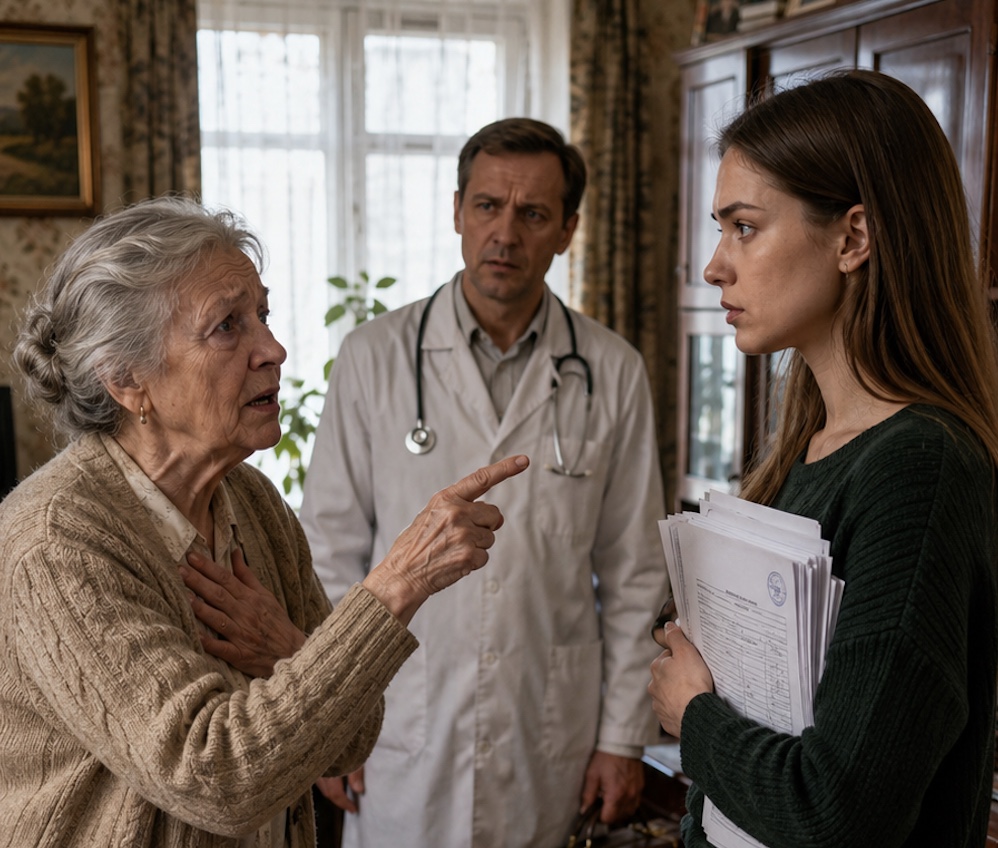
Alina looked through the peephole. Svetlana Vasilyevna was standing on the landing, and behind her was another figure with a small case — possibly a local doctor or someone from the clinic.
Alina’s heart jumped.
Her mother-in-law had come in person, and she had brought a doctor. The final battle was beginning.
Alina opened the door.
Svetlana Vasilyevna swept into the hallway without taking off her shoes and began wailing from the threshold:
“Look at this! My daughter-in-law has left her own mother-in-law without help! I have a pre-heart-attack condition, the doctor will confirm it, and she’s hiding the money!”
The doctor awkwardly asked for water, clearly realizing he had stepped into the center of a family war. Svetlana Vasilyevna, without waiting for an invitation, walked into the room and collapsed onto the sofa, clutching her heart.
“Antosha, tell her to give the money! Or I’ll call the police right now and file a report for theft! You owe me that money! You are my son! You are obligated!”
Anton darted helplessly between his mother and his wife.
The doctor measured Svetlana Vasilyevna’s blood pressure, shook his head, and said the emotional tension was high and she needed to calm down. But the mother-in-law would not stop.
“You thought I wouldn’t find out? I have a nose for these things! You and your dear mother plotted together and are moving the money! Fine. Tomorrow I’ll go to court and sue my son for support!”
“Go ahead, Svetlana Vasilyevna,” Alina said calmly. “The court will explain that support is not collected from able-bodied children for able-bodied parents. Read the Family Code. Besides, our money is a debt owed to my mother. Tomorrow I will transfer the amount needed for the surgery. The rest is our personal savings, and there will be enough left for a lawyer if you decide to sue.”
Silence filled the room.
Anton looked from one woman to the other, and a shadow of understanding crossed his face.
Svetlana Vasilyevna turned red, then suddenly jumped up and rushed toward the door.
“You’ll regret this, you witch! You have no idea who you’re dealing with!”
The doctor retreated after her, apologizing.
Anton remained standing with his head lowered.
“Did she really want to sue me for support?” he asked quietly.
“I don’t know. Maybe she was bluffing. But the court would have refused her,” Alina said, sitting on the armrest of the chair. “Anton, I’m tired. Either you are with me and with the truth, or you can go to your mother.”
He was silent for a long time. Then he raised his reddened eyes.
“I didn’t know about the note… Well, I forgot. Forgive me. I got confused. Mom and Olga pressured me so much. I thought you were just being stubborn, but you had all this… What do we do now?”
“Now we live honestly,” Alina said. “Mom’s surgery is the day after tomorrow. I’m going with her. If you want, come with us. But I will not communicate with your mother or Olga anymore. The choice is yours.”
She stood and went to pack things for the hospital. At the doorway, she turned back.
“And remember, I am not your enemy. I am your wife. But I will not allow anyone to take health away from the people I love. That is final.”
Two days passed.
The surgery was successful. Elena Nikolaevna lay in the hospital room with a bandage over her eye, smiling with eyes that could not fully see yet, but had already been saved.
Alina sat beside her, holding her hand.
Her phone vibrated. It was a message from Anton.
“I talked to Mom. I told her that if she doesn’t stop interfering, I’ll stop visiting her. I apologized to your mother. I’m waiting for you at home. I understand everything now.”
The next day, Anton came to the hospital with flowers and a guilty expression. After his conversation with his mother, Svetlana Vasilyevna had gone quiet. Olga tried calling, but Anton blocked her.
He asked Elena Nikolaevna for forgiveness. Naturally, she softened immediately and told them to live in peace.
Alina was not ready to forgive him completely. Something inside still hurt. But she could see that her husband was sincerely sorry. More importantly, for the first time in his life, he had put their family first instead of his mother’s demands.
When they returned home, Alina suggested they see a family psychologist together “to learn how to protect boundaries.” Anton agreed.
The savings, from which a part had already gone toward the surgery, remained in the account as an emergency reserve for Elena Nikolaevna’s future treatment. The rest they would continue saving for their own home — but now without looking over their shoulders at anyone else’s opinion.
That evening, as they drank tea in the kitchen, Anton suddenly said:
“You know, it feels like I finally opened my eyes. I spent so many years being afraid of Mom’s hurt feelings that I almost betrayed both you and your mother. Thank you for not giving up.”
“I almost did give up,” Alina admitted. “When you promised her the money without asking me, I thought everything was over. But love isn’t about pleasing people at any cost. Love is when you fight your way through trouble together, even when the whole world is against you.”
Anton embraced her, and for the first time in a long while, Alina felt the wall between them collapse.
Their family story was only beginning to heal, but they had already understood the most important thing: toxic relatives lose their power when a husband and wife stand as one team, and the law becomes a shield for justice.