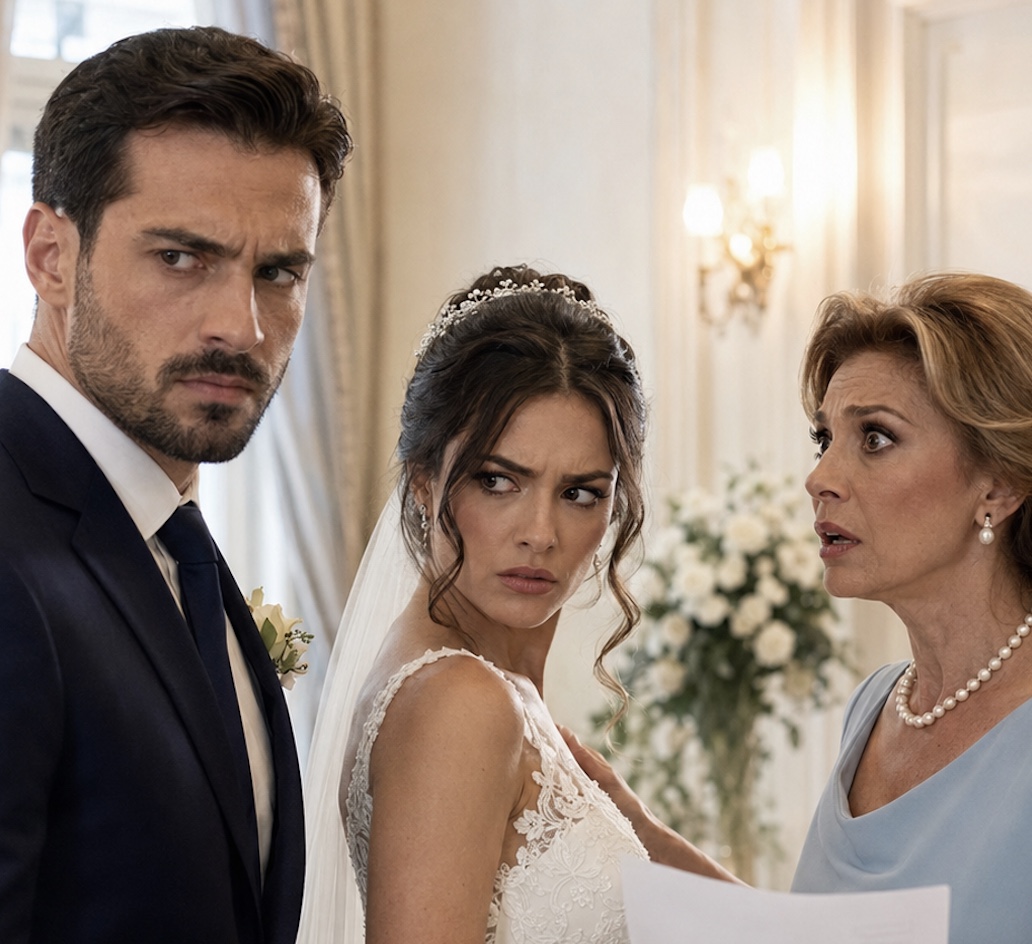
“Nadya, sign it now. The ceremony starts in twenty minutes.”
I was standing in front of the mirror in the small bridal room, where the air smelled of hairspray, someone else’s perfume, and fresh roses. Outside the window, July rain was beating softly against the glass, thin streams running down the pane. On the windowsill lay two pins I still hadn’t managed to fasten into my veil.
Raisa Lvovna was holding a sheet of paper in front of me. White, thick, with one corner neatly folded. In her other hand was a pen with a golden cap.
“What is this?” I asked.
She smiled the way saleswomen smile when they know the item is defective, but the customer is already almost ready to buy it.
“Just a normal family agreement. Stanislav explained it to you.”
Stas was standing by the door in a dark blue suit. Handsome, clean-shaven, with a boutonniere on his lapel. I had pinned it on him myself that morning, laughing that he was more afraid of pricking himself than of getting married.
Now he wasn’t laughing.
“Nadya, don’t start,” he said. “We already discussed this.”
“We discussed that after the wedding you would move in with me,” I said. “And that no one would offend your mother. Everything else, you discussed without me.”
Raisa Lvovna raised her eyebrows slightly.
“How sharp. Stanislav, I told you, you should have made this clear earlier.”
She placed the paper on the little table beside the ring box. It wasn’t even proper legal paper. It was more like a leash they were trying to slip around my neck right before the registration.
The whole meaning fit into a few lines: after the wedding, I would sell my apartment, and the money would go toward buying a larger home for our “new family.” The new place was supposed to be registered in Stas’s name. Why? No one bothered to explain. Apparently, I was simply expected to be pleased.
I looked at my reflection. The white dress fit perfectly. Of course it did. I had sewn it myself at night, when the sewing machines at the atelier finally went quiet and I could work on something for myself. I spent three weeks choosing the lace for the sleeves. I redid the waistline twice. There was nothing accidental about that dress.
Except the groom, as it turned out.
“The apartment was bought by me before I even met Stas,” I said. “I am not selling it.”
Stas pushed himself away from the door and stepped closer.
“Nadya, stop clinging to your walls. It’s a one-room apartment. Are we supposed to squeeze into it for the rest of our lives?”
“I’m not against a bigger apartment. I’m against selling mine under your name and under your mother’s orders.”
“Mom wants what’s best.”
“For whom?”
Raisa Lvovna sighed.
“For everyone. My legs hurt. It’s hard for me to live alone. Stas is my only son. You are his wife, which means you should think more broadly, not only about your threads, rags, and that little stool by the window.”
That little stool by the window was what she called my workspace. There stood my old sewing machine, heavy and cast-iron, which I had received along with my first real order from the owner of a closing atelier. On that machine, I had hemmed strangers’ coats, sewn school dresses, altered dresses after bad purchases, and eventually saved enough for the down payment on that very apartment.
Small. Stubborn. Mine.
Stas knew all of that. He had even once said,
“I love that you do everything yourself. With you, I’m not afraid.”
As it turned out, he hadn’t meant he wasn’t afraid with me. He meant he wasn’t afraid at my expense.
“I’m not signing anything,” I said.
Raisa Lvovna stopped smiling immediately.
“Then what was the point of this whole performance?”
“What performance?”
“The white dress, the guests, the restaurant. You want to enter a family, but you don’t want to give anything to that family?”
I looked at Stas. I waited for him to say at least, “Mom, enough.” Or simply take the paper away from her.
He said nothing.
Behind the door, someone passed by laughing. Glasses clinked. They were probably already pouring champagne for the guests. My friend Lyuba sent me a message: “Where are you? The registrar is getting nervous.”
I didn’t answer. My phone lay beside the bouquet of white peonies, which had suddenly started looking like heads of cabbage.
“Stas,” I said quietly. “Did you know about this paper?”
He adjusted his cuff.
“Why are you picking at words? It’s just a paper so everyone can feel calm. Later you’ll change your mind, start dragging things out. And we already have an agreement with people.”
“What people?”
Raisa Lvovna quickly glanced at her son. That was the first moment I truly felt afraid. Not because of the paper. Not because of the conversation. But because the answer already existed, and it was going to be worse than I thought.
Stas grimaced.
“I showed the apartment to an acquaintance. He’s willing to wait. It’s a good price. Don’t act like it’s a crime.”
“You showed my apartment to a buyer?”
“Don’t dramatize it. I’ve been there. I have keys.”
Something inside my chest turned empty and cold. The keys. The very same keys I had given him in the spring when I got sick and asked him to bring me medicine. He had kept the set afterward.
“You took a stranger into my apartment?”
“Into our future apartment,” he snapped. “And stop speaking to me in that tone.”
Raisa Lvovna pushed the pen toward me.
“Nadezhda, a smart woman does not cling to a box with a balcony when she is being offered a normal life.”
At that moment, I remembered how Aglaya Semyonovna, my first mentor at the atelier, had taught me to unpick a crooked seam.
“Don’t feel sorry for the thread, Nadya. If it went wrong from the first stitch, the whole piece will pull crooked. Better to rip it out at once than cry later over ruined fabric.”
Back then, I thought she had been talking about skirts.
Stas picked up the ring box, opened it, took out my ring, and turned it between his fingers.
“Let’s end this conversation. Now you’ll go out there, smile, we’ll sign the papers, and at home we’ll discuss everything calmly.”
“At home?” I repeated. “Which home?”
“Yours. For now.”
That “for now” was the final thread.
I took the ring from his hand. Small, smooth, golden. We had chosen it together. Or rather, Stas had chosen it, and I had agreed because I was tired of arguing. Back then, he had said,
“Simplicity suits you.”
And I had only wanted him, just once, to ask what I liked.
I walked to the window. It was slightly open because the room had become stuffy. Down below, under the awning, the guests’ cars stood wet from the rain. A drop of water trembled on the windowsill.
Raisa Lvovna stepped toward me.
“What are you doing?”
I turned to both of them. To the woman who had already mentally arranged her furniture in my apartment. To the man who had decided that after a stamp in my passport, I would become more convenient, softer, quieter.
“Congratulations! You have just lost the bride, the apartment, and the last scraps of my respect!”
I threw the wedding ring out the window.
It struck the metal sill with a sharp clink and disappeared somewhere into the wet greenery below.
Raisa Lvovna screamed as if I had thrown out not a ring, but her plans for a peaceful old age.
Stas turned pale.
“Have you lost your mind?”
“No. I’ve finally come to my senses.”
I lifted the hem of my dress so I wouldn’t step on the lace and walked toward the door.
“Nadya!” Stas grabbed my arm. “There are guests out there. My colleagues. Your mother came. You’re going to disgrace everyone.”
I looked at his fingers wrapped around my wrist.
“Let go.”
“We’ll talk.”
“You’ve already said everything.”
He didn’t let go right away. First, he squeezed harder, as if testing how much of the old obedient Nadya was still left in me. Then he loosened his grip. Red marks remained on my skin.
In the hallway, Lyuba caught me. She was wearing a lilac dress, and her mascara had smudged slightly from the humidity.
“Where did you disappear to? Everyone is waiting. Oh… What happened?”
“There won’t be a wedding.”
She looked over my shoulder, saw Stas, Raisa Lvovna with the paper in her hand, and understood everything without needing words.
“Come on,” she said.
“Wait. Tell Mom not to worry.”
“You’ll tell her yourself. She’s by the coatroom. She already feels something is wrong.”
Mom really was standing by the coatroom. Small, in a dark blue suit, holding her handbag with both hands in front of her. When she saw me, she didn’t ask, “How could you?” She didn’t ask, “What will people say?” She simply came over and fixed the loose strand of hair near my face.
“Did he hurt you?”
I nodded.
“Go change. I’ll speak to the guests.”
“Mom, it’s complicated.”
“Complicated is when the pattern doesn’t match and the order is due tomorrow. This is simple. He is not your person.”
I took off the dress in the restaurant’s storage room, where Lyuba brought me my usual linen sundress and sandals. The zipper got stuck, the lace caught in my hair. I jerked, and a thin thread on the sleeve snapped.
“Careful,” Lyuba said.
“Let it tear.”
“But it’s such a pity. You worked so hard on it.”
I looked at the white fabric, at the neat seams, at the row of tiny buttons sewn on by hand.
“It isn’t a pity. The dress did nothing wrong.”
Lyuba hung it on a hanger. It swayed as if it had sighed.
At the restaurant entrance, the guests were making noise. Someone was outraged, someone was whispering, someone was trying to call a taxi. Raisa Lvovna was speaking loudly.
“The girl is nervous. We’ll sort everything out.”
My mother answered her so calmly that I heard her even through the door.
“The girl has an apartment. And a head on her shoulders. Your son, however, seems to have a problem with respect.”
I left through the service exit. The rain had almost stopped. The air smelled of wet asphalt and linden trees. Lyuba wanted to come with me, but I said,
“No. I want to be alone.”
“Are you sure you’ll be okay?”
“I already am.”
I caught a taxi near the next courtyard. The driver glanced at me in the mirror: linen sundress, bridal hairstyle, bouquet of white peonies on my lap.
“Celebration didn’t go well?” he asked carefully.
“On the contrary. It ended just in time.”
He asked nothing more.
At home, the first thing I did was collect the spare key from the concierge, the one I kept there in case of emergencies, and went upstairs. The door opened quietly. The apartment was exactly the way I loved it: a measuring tape lay on the table by the window, an unfinished jacket hung over the back of a chair, and a pot of basil stood on the windowsill.
My life.
Small, sometimes cramped, but not someone else’s.
I removed the old lock cylinder and placed it in my palm. A neighbor from the third floor had once shown me how to replace it when my key got stuck. Back then, I had laughed.
“I should be sewing dresses, not messing with locks.”
He had replied,
“A woman in her own apartment should know how to do both.”
The new lock was lying in a drawer. I had bought it after Stas once came over in the morning without warning, opened the door with his keys, and said,
“Surprise.”
Back then, I stayed silent. I simply hid the box under my laundry. Apparently, my mind had already understood everything; only my heart was lagging behind.
It took me a long time to change the lock. In that amount of time, I could have fitted a dress to a figure, but with metal I worked like a beginner. The screwdriver slipped, the screw fell, my fingers ached. But when the new key finally turned inside the new cylinder, I smiled for the first time that day.
My phone kept exploding. Stas. Raisa Lvovna. Unknown numbers. Then messages.
“Don’t embarrass yourself. Come back.”
“The guests are asking what to say.”
“I’m coming over. Open the door.”
“You owe me an explanation.”
I turned off the sound.
There was no one left to explain anything to.
Stas arrived when the wet courtyard outside the window was beginning to darken. First he rang the intercom. Then he knocked. Then he spoke through the door.
“Nadya, open up. We’re adults. We need to solve this.”
I was sitting on the floor by the sewing machine, unpicking the edge of the wedding dress. Not because I couldn’t hear him. Because for the first time that day, my hands were doing something understandable.
“I know you’re home,” he said. “Don’t turn this into a circus.”
I kept cutting the seam with small scissors, carefully, so I wouldn’t damage the fabric.
“My keys don’t work,” his voice changed. “You changed the lock?”
I said nothing.
“Nadezhda, this isn’t funny anymore.”
The scissors clicked. The thread gave way.
“Open the door, at least talk to me!”
I walked to the door, but I didn’t remove the chain.
“Talk.”
“Do you understand what you’ve done? People came, my mother almost fainted. You made me look like a fool.”
“You handled that yourself.”
“Because of a piece of paper? Because of some apartment?”
“Not because of the apartment, Stas. Because you had already decided how much my life was worth.”
He inhaled sharply behind the door.
“I wanted a family.”
“No. You wanted a convenient exchange: my apartment for your comfort.”
“You’re twisting everything.”
“Leave.”
“I’m not leaving until we reach an agreement.”
“Then I’ll call the local officer.”
He fell silent. Then he struck the door with his palm. Not very hard, but enough for the mirror in the hallway to tremble.
“You’ll regret this.”
“Not anymore.”
His footsteps did not fade right away. He stood there a little longer, hoping I would get frightened by my own determination. Then the elevator doors clanged, and the apartment became quiet.
I returned to the dress. I cut off the long train. Then I removed the lace from the sleeves and folded it separately. The white fabric lay on the table, obedient and clean. It could become anything now: an elegant dress for a little girl, the lining of a jacket, a cover for a mannequin. Not every piece of material is guilty just because someone tried to use it for the wrong purpose.
When the first light came on at the atelier, I was already standing by the cutting table with a bag in my hands. Aglaya Semyonovna sat by the window, drinking tea from a glass in a metal holder.
“Well?” she asked without even looking up.
“There was no wedding.”
“I can see that. Brides who actually had a wedding walk differently. You walk like someone who carried a sewing machine out of a burning barn.”
I placed the bag on the table.
“Can I take it apart here?”
“You must.”
She came over and touched the fabric.
“Good work.”
“It was.”
“The work is still good. The seam didn’t make the mistake, Nadya. The mistake was made by the person who decided that the dress already made you his property.”
We sat down side by side. She unpicked the side seam, and I removed the buttons. No loud conversations. Only the soft tearing of threads and the sound of rain tapping against the metal awning.
Mom called while I was winding the lace into a neat roll.
“How are you?”
“Alive. Angry. But fine.”
“Did he come?”
“He came. He didn’t get in.”
“Good.”
“Mom, are you ashamed of me?”
She actually got angry.
“I’m ashamed I didn’t ask earlier whether you were happy. Nothing else is shameful.”
I came home in a fine drizzle. Raisa Lvovna was standing near the entrance without an umbrella. Her hair had come loose from its style, and her face looked gray.
“Nadezhda,” she said. “We need to talk.”
“We don’t.”
“You’re young and hot-headed. You don’t understand what you’re doing. Stas is suffering.”
“Let him get used to it.”
She pressed her lips together.
“An apartment won’t make you happy.”
“Maybe not. But it won’t ask me to sell myself for someone else’s convenience.”
“You’re cruel.”
“No. You heard the word no for the first time and decided it was cruelty.”
She stepped closer.
“Stas is a good man.”
“Then let him become good without my apartment.”
Raisa Lvovna turned away. It seemed she wanted to say something sharp, something familiar and cutting. But the courtyard was empty, there was no audience, and the words lost half their strength.
“He loved you,” she said at last.
“Love doesn’t arrive with a paper to sign before the ceremony.”
I walked around her and entered the building.
They never came again. They called a few more times, then stopped. They dealt with the restaurant and the guests without me. Stas collected his boxes from the balcony through a neighbor without even coming upstairs. He returned the keys, though they no longer opened anything.
I thought it would hurt more. But the pain turned out to be like the prick of a pin: sharp, insulting, but at least you immediately know where to pull it out.
The apartment slowly stopped remembering Stas. His mug with the words “the boss of the house” disappeared. I threw out the slippers he had bought for himself and left by the door like a sign of his future move-in. I took down the calendar where he had circled the wedding date in red marker. In its place, I hung a wooden spool from old thread that I had found at the atelier. Large, darkened with age, with a chip on one side. For some reason, it suited my wall better than any calendar.
I didn’t throw the dress away. From the thick satin, I sewed a cover for the sewing machine. From the lace, I made a curtain for the small window in my work corner. I placed the buttons in a glass jar. The train lay separately for a long time until I finally thought of what to do with it.
On a day free from orders, I brought a narrow wooden chair to the window. The same chair where Stas had once sat scrolling through his phone and said,
“Nadya, who even needs all these alterations? You should find a normal job.”
The chair was sturdy, only the seat had worn thin. I covered it with fabric from the wedding train. The white satin stretched evenly, without a single wrinkle. I ran a fine stitch along the edge. No roses, no lace, no bows. Just a clean, bright surface.
When the chair was ready, I placed it beside the sewing machine. I sat down, pressed the pedal, and heard the steady movement of the mechanism. The machine began stitching confidently, as if it, too, had been waiting for the unnecessary noise to leave the apartment.
On the table lay a new order: a simple blue dress for a woman who had said during the fitting,
“I want something I can be myself in.”
I smiled. Now that was a task I understood.
Outside the window, the roofs were growing lighter after the rain. Somewhere in the grass near the restaurant, my ring was probably still lying there. Maybe a groundskeeper had found it. Maybe it had rolled beneath a bush. I didn’t care.
The ring belonged to a promise that had never existed.
But the chair by the window belonged to the place I had saved for myself.
I lowered the presser foot onto the fabric and guided the first seam forward.
I no longer altered myself to fit someone else’s pattern.