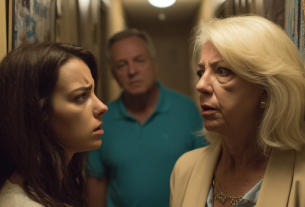
From the force of the blow, the old porcelain saltcellar gave a delicate ring — a family heirloom Irina had inherited from her grandmother. Irina herself did not even flinch. She kept methodically cutting boiled beetroot into neat little cubes for the vinaigrette, moving with almost mechanical precision. The kitchen smelled pleasantly of sunflower oil and roasted vegetables. On the radio, Mark Bernes was quietly singing, and the cozy Saturday atmosphere seemed completely out of place against the storm clouds that had been gathering over their marriage for the past three months.
“Go ahead and file,” Irina replied calmly, without lifting her eyes from the cutting board. “The court fee has gone up, keep that in mind when you plan your budget. And you’ll need to pay a lawyer too. Do you have any spare money, Vadim?”
Vadim rolled his eyes and dramatically clutched his chest, exactly like a character from an old Soviet comedy.
“You… you are just a cold, calculating robot, Ira!” he declared with genuine theatrical despair, pacing around their small but lovingly renovated kitchen. “We’ve been married for twelve years! My brother Igor is in a terribly difficult situation. He needs this miserable permanent registration so he can get a job at a respectable company and take out a proper loan. And you’re digging in your heels! It’s just a stamp in a passport, just a piece of paper! But for you, square meters matter more than human relationships!”
Irina finally put the knife down, wiped her hands on a towel embroidered with roosters, and looked carefully at her husband. Vadim was forty-four, but he looked like a slightly worn-out overgrown student: curly hair already touched with noble gray, his favorite stretched-out sweatshirt, and the permanently offended expression of a man whom the cruel world had failed to appreciate.
“Vadim, your ‘poor’ thirty-year-old brother Igor has changed four jobs in the last three years, and everywhere he was asked to leave because of, to put it mildly, financial dishonesty,” Irina said quietly but firmly. “If I register him in this apartment, removing him without his consent will only be possible through court. And knowing Igor, he’ll immediately bring his things here. Then, for all we know, he’ll get married and register his child here too. And our life will turn into communal hell. I am against it.”
“Oh, so that’s how it is?” Vadim narrowed his eyes. Something unpleasant, something unusually determined for him, flashed in them. “Then we’ll divide everything. Our apartment was bought during the marriage. By law, exactly half of it belongs to me. I’ll take my share in money, and you can do whatever you want here. I’ll register at my mother’s place, and I’ll help Igor with the money from the sale. You are destroying our family with your primitive greed!”
He turned around and proudly left the kitchen, loudly shuffling in his house slippers. Irina remained standing by the table. Her hands were trembling slightly, but inside she felt a strange, cold numbness.
She was forty-one. She worked as deputy chief accountant for a large retail chain. Her days consisted of numbers, reconciliations, reports, and brutal deadlines. She was used to solving problems — not only her own, but also the problems of Vadim’s entire large family. Over twelve years of marriage, Irina had somehow quietly turned into a workhorse, carrying their household, finances, and long-term planning on her shoulders.
When they got married, they had nothing except Vadim’s old car and enormous ambitions. For the first few years, they lived in rented apartments and counted every coin. Irina took on extra jobs, keeping accounts for small businesses at night while Vadim was “searching for himself” in the creative business world. He opened a party-planning agency, then a web design studio, then a comic book store. All of those ventures had one thing in common: they required start-up money, which Irina provided, and closed six months later with losses, which Irina also covered.
They had bought the two-room apartment on Prospekt Mira six years earlier. More precisely, Irina had bought it. Her beloved grandmother had passed away, leaving Irina a small but solid studio apartment on the outskirts of the city. Irina sold it, and that money — almost eighty percent of the price of the new apartment — became the down payment. The rest was covered by a mortgage. Since Vadim was not officially employed at the time, being in yet another “creative crisis,” the bank approved the loan based solely on Irina’s salary.
For six years, Irina had faithfully transferred forty-five thousand rubles to the bank on the fifteenth of every month. By then Vadim had become an “independent real estate consultant” at an agency owned by a friend of his. His income was as vague as March fog: one month he might bring home thirty thousand rubles, and for the next three months nothing at all, blaming “a slow market” and “the difficult economic situation.” He contributed almost nothing to the household but sincerely believed he fully provided for the family, because once a week he bought farm milk and expensive gluten-free bread.
On Monday evening, Irina’s mother-in-law, Elena Valeryevna, appeared in the kitchen. She arrived without warning but with heavy artillery: a three-liter jar of her signature pickled tomatoes and a cabbage pie. Elena Valeryevna, a former teacher of Russian language and literature, had a way of speaking that made every remark sound like a quotation from a critic and every accusation like concern for one’s neighbor.
“Irochka, my dear,” Elena Valeryevna began, carefully slicing the pie with an old knife she herself criticized for being dull. “I came to speak to you as a mother. Vadim has not been himself. He’s lost weight, he looks worn out. Is it really worth turning your home into a Shakespearean tragedy over some household formality?”
Irina tiredly poured her mother-in-law some tea. Work had been insane that day: the tax office had sent a demand related to an old audit, and her head was splitting.
“Elena Valeryevna, this is not a formality,” Irina sighed, sitting opposite her. “Igor is an adult man. He is thirty years old. Why can’t he solve his registration problems himself? For example, he could rent a place officially and get temporary registration.”
“Oh, Irochka, you know Igor. He is sensitive, delicate,” her mother-in-law said, throwing up her hands so that her silver bracelets jingled sadly. “He needs guidance, support. Vadim, as the older brother, feels responsible for him. Remember that old film about people helping one another? They weren’t even brothers there. But here we are talking about blood. Vadim was so proud when you bought this apartment. He always told me, ‘Mama, now we have our own hearth.’ And now you are telling your husband that his brother is nobody here. That is a blow to a man’s pride, Ira! A man must feel like the master of his home, otherwise he withers.”
“The master of what, Elena Valeryevna?” Irina asked quietly, and dangerous notes appeared in her voice. “Of the apartment for which he has not paid a single mortgage payment in six years? Of the apartment where everything — from the Czech laminate flooring to the kitchen cabinets — was bought with my bonuses?”
Elena Valeryevna pressed her lips together, and her literary face instantly turned into a mask of offended dignity.
“You know, Irochka,” she said in an icy tone, pushing her teacup aside, “one should not be so… materialistic. Money comes and goes. Today it exists, tomorrow it doesn’t. But family is sacred. Vadim has a full legal right to this space. He showed me the documents. You acquired it during the marriage. And if you decide to take this to divorce because of your egoism, the law will be on his side. Think about that. Is your pride worth a ruined marriage?”
After her mother-in-law left, Irina sat in the dark for a long time. She felt unbearably hurt. All those years, she had stayed silent when Vadim bought himself expensive fishing rods for fishing trips he went on once a year. She had stayed silent when he “lent” Igor large sums from their shared envelope for the repair of some nonexistent business. She endured it because she believed marriage meant compromise. She wanted peace at home. She wanted to avoid the awful, exhausting kitchen scandals she had witnessed as a child between her parents. For the sake of that fragile illusion of peace, she swallowed insults, paid the bills, and smiled tiredly whenever her husband spoke about his “higher mission.”
The turning point came on Wednesday. That day overturned her whole life, the way a strong gust of wind flips the page of an open book.
Irina came home earlier than usual, around four in the afternoon. The servers at work had been shut down because of an accident at a power substation, and the employees were sent home. The hallway was unusually quiet. Vadim, who usually “worked with documents” on his laptop on weekdays, was apparently home. His muffled voice came from the living room.
Irina was about to call out that she had arrived, but the words she heard made her freeze mid-breath, with one half-removed boot in her hand.
Vadim was talking on the phone, using speaker mode. His tablet lay on the sofa, and from it came the hoarse, satisfied voice of his brother Igor.
“Come on, Igor, don’t panic,” Vadim said confidently. “Mama went to see her yesterday, softened her up. Irka will throw a little fit and then sign. Where is she going to go? She’s terrified of scandals and divorce. Being a married woman is some kind of obsession for her. I threatened her with dividing the property, and she turned pale. She thinks the apartment is hers just because inheritance money went into it. But legally, it was purchased during the marriage. My lawyer, Sanek, said we can easily bite off half. The court won’t dig into whose money it was if it passed through a shared account.”
“Listen, Vados, what if she really files for divorce?” Igor asked doubtfully. “The main thing is for me to get registered in time and take out a big loan using that registration. If she rebels before that, the whole thing is over.”
“She won’t rebel,” Vadim snorted, and Irina could almost feel his smug, satisfied smile on her skin. “She’s obedient. She’ll cry for a night, make her famous borscht, and go with me to the public services office like a good girl. I’ll tell her it’s for the sake of our future child, the one we’ll ‘definitely have next year.’ She always falls for that bait. By the way, did you transfer the money from that deal to my hidden account?”
“Yes, all one hundred and twenty thousand is on your card,” Igor replied. “Your Irka still thinks you’re sitting around broke again?”
“Of course,” Vadim laughed. “Let her think I’m a poor artist. She even likes feeling like a savior. Let her pay the utilities and the mortgage. Her salary is like a minister’s. And you and I will take that money and go to the bathhouse this weekend, celebrate the future deal.”
Irina stood in the dark hallway. The boot slipped from her hand and rolled across the mat with a dull thud.
It was as if the light inside her had gone out. Then another light switched on — bright, merciless, surgical. All her fears disappeared. So did her years-long habit of smoothing over conflicts and the stupid guilt drilled into her by upbringing. She was not merely unloved. She had been used with cold, cynical precision. The husband for whom she had denied herself even simple pleasures, the man she had defended in front of her friends, turned out to be nothing more than a domestic parasite sucking her blood and money together with his foolish brother.
Carefully, trying not to make a sound, Irina put her boot back on, left the apartment, and quietly closed the door behind her.
She went downstairs to the courtyard, got into her car, and sat for several minutes simply staring at the steering wheel. Her eyes were dry. She did not want to cry. She wanted to act. She opened the glove compartment and took out a business card that her friend Svetlana had given her three years earlier. It read: “Oleg Nikolaevich Kotov. Family Law and Property Division Attorney.”
She dialed the number.
“Oleg Nikolaevich? Hello. My name is Irina. I need your help. Urgently. The situation is standard: my husband is threatening to divide an apartment bought during our marriage, but it was purchased with my personal premarital money from the sale of inherited property. Yes, I have all the statements and contracts. And also… I suspect my husband has hidden accounts where he is keeping income from me.”
“Come to my office in an hour, Irina,” came the calm, confident voice on the other end. “We’ll look at your papers. If the inheritance money went by direct bank transfer into the purchase of the new apartment, your husband is in for very bad news. We will make sure his ‘half’ turns into a pumpkin.”
For the next two days, Irina lived a double life. At home, she behaved as usual: quietly moving around the apartment, making dinner, listening to Vadim complain about how difficult it was to find honest business partners, and even nodding when he brought up the need to help Igor. Vadim took her silence for surrender and walked around the apartment like a rooster, savoring his coming victory.
In reality, Irina was conducting a special operation. At work, she pulled up all her personal bank archives from the past six years. She found the sale contract for her grandmother’s studio apartment and the bank statement clearly showing that the money from the buyer had arrived on May thirtieth, and on June second that exact amount, down to the last kopek, had been transferred to the developer as the down payment for the apartment on Prospekt Mira. There had been no “mixing of funds,” as Vadim’s incompetent friend-lawyer had claimed. The money had a clear, perfectly traceable premarital origin.
Moreover, through his channels, attorney Oleg Nikolaevich made an official request, and by Friday Irina had an official statement for Vadim’s hidden account at a commercial bank. It turned out that over the past two years, the “poor artist” had saved almost eight hundred thousand rubles there — payments for various unofficial deals and consultations he had carefully hidden from his wife while she carried the mortgage alone.
The climax was scheduled for Saturday — exactly one week after that first conversation.
The weather was miserable. Wet snow was falling. Vadim had been in high spirits since morning. He even deigned to make coffee and bring Irina a cup in bed — a rare gesture from him, which in his language meant the highest level of manipulation.
“Irus, so shall we go to the public services office today?” he asked sweetly, sitting on the edge of the bed and trying to stroke her shoulder. “Igor is already there waiting for us with the documents. Let’s close this issue, and a new stage of life will begin for us. I feel our relationship moving to a new level.”
Irina moved the cup aside, sat up, and looked at him. There was no anger in her eyes, no resentment. Only cold, investigative curiosity, like an entomologist studying a rare beetle.
“We are not going to the public services office, Vadim,” she said calmly, getting out of bed. “But a new stage of your life really will begin. Right now. Get dressed and come to the kitchen. It’s time we talked.”
Ten minutes later, they were sitting at the same table. Irina placed a thick blue folder with plastic binders in front of her husband. Vadim, sensing something was wrong, tried to turn on his usual irony.
“Oh, accounting reports again? Ira, you can’t turn your whole life into debit and credit statements. As they say, you are not a dried-up ledger, you are a woman!”
“Shut up, Vadim,” Irina said quietly, but with such weight that Vadim instantly fell silent and even opened his mouth in surprise. He had never heard that tone from his soft, accommodating wife before.
Irina opened the folder and pushed the first sheet toward him.
“This is the sale contract for my premarital studio apartment. And this is the payment order showing that the entire amount went to the developer of our apartment. My attorney has already prepared the claim. Since the apartment was purchased with my personal funds received through inheritance, it is not marital property. According to court practice in cases like this, your share here, Vadim, is zero point zero percent.”
Vadim turned white. He grabbed the sheet, and his fingers began to tremble.
“This… this is nonsense!” he shouted, stammering. “We’re married! The apartment is common property! You have no right! My lawyer said—”
“Your lawyer Sanek is the same kind of idiot as your brother Igor,” Irina replied evenly. “Now open the second page.”
With a shaking hand, Vadim turned the page. He found himself looking at a printout of his hidden bank account, with a detailed history of deposits and a final balance of 784,000 rubles.
“And this, Vadim, is exactly marital property,” Irina said with a smile, and that smile made Vadim shrink into his shoulders. “Money earned by you during the marriage but hidden from the family. Half of this amount belongs to me by law. And my attorney has already filed a motion to freeze this account as part of the divorce proceedings.”
“Ira… Irochka…” Vadim’s voice broke into a pathetic squeak. He realized his house of cards had collapsed, burying all his grand plans beneath it. “You misunderstood everything. This was money for our joint business! I wanted to surprise you! For our anniversary!”
“You gave me a surprise last Wednesday, when you and your brother discussed on speakerphone what an obedient fool I am and how you would bite off half my apartment so you could take out a loan and go to the bathhouse,” Irina cut him off. “I came home early and heard your entire conversation from the first word to the last.”
Vadim froze. His face shifted through several shades, from deathly pale to crimson. He understood that denying it was pointless. At that moment, the name “Igor” lit up on his phone screen. Vadim nervously declined the call.
“Ira, forgive me…” He suddenly dropped to his knees in front of her and tried to grab her hands. Real tears appeared in his eyes — tears of fear and pity for himself. “The devil got into my head! Igor pressured me. He has debts. People are after him! I didn’t know what to do! I love you, Irishka! We’ve been together for twelve years! We’ve been through so much! Remember how we drove to Crimea in our old car, and the tire burst in the middle of the steppe? We were happy! You can’t destroy everything over one mistake!”
Irina gently but firmly freed her hands, stood up, and walked to the window. Outside, wet snowflakes swirled behind the glass, hiding Prospekt Mira in a gray haze.
“You know, Vadim,” she said quietly without turning around, “let the court decide which of us owes what to whom. You have exactly two hours to pack your personal belongings and move to your mother’s place. To the same mother who cared so much about your masculine pride. I put the suitcases in the hallway. In two hours, a locksmith is coming to change the locks on the front door. If you stay, I’ll call the police and show them the documents proving you are not registered here and are not an owner.”
“You… you’re a monster!” Vadim shouted, jumping up from his knees. The rage of a loser who had just been deprived of his free feeding trough woke inside him. “You’ll come crawling back to me! Who needs you at forty, you dried-up accountant? Count your pennies alone!”
“Leave, Vadim,” Irina replied without raising her voice.
The next two hours turned into a chaotic domestic nightmare. Vadim noisily threw shirts, jeans, fishing rods, and countless bottles of expensive cologne — all bought with Irina’s money — into his suitcases. From the hallway came his curses and sobs. During that time, Elena Valeryevna called three times, but Irina simply blocked her number.
At exactly two in the afternoon, the door closed behind Vadim and his two enormous suitcases. At two fifteen, a silent locksmith in a blue uniform arrived and replaced the old locks with new ones in twenty minutes.
When the locksmith left, Irina locked the door with all three turns of the key. An incredible, clean, ringing silence settled over the apartment. She went to the kitchen, poured herself some tea, and suddenly realized that for the first time in many years, her head did not hurt.
Four months passed. Warm spring arrived.
Irina’s life changed so much that sometimes, when she woke up in the morning, she barely recognized herself. The divorce process went surprisingly quickly and smoothly. When Oleg Nikolaevich’s attorney presented irrefutable proof in court of where the apartment money had come from, Vadim and his “lawyer” Sanek instantly lost all fighting spirit. The apartment remained Irina’s sole property. Moreover, the court ordered Vadim to pay Irina half of the money hidden in his account — almost 400,000 rubles.
Without the need to support a grown, spoiled man and his endless “business projects,” Irina’s financial situation improved sharply. It turned out that her high salary was more than enough for a comfortable, peaceful life. With the money she received from dividing the hidden account, Irina paid off a significant part of her mortgage early, reducing the monthly payment to a manageable twenty thousand.
She refreshed her wardrobe, replacing strict accounting suits with flowing, feminine dresses. She joined a swimming pool and began learning Spanish, something she had dreamed of since her student years. During the May holidays, she flew on vacation alone for the first time in her life — to a small, quiet coastal town, where she simply walked by the sea, breathed the salty air, and read books in cozy street cafés. Her self-esteem, trampled down by years of marriage, spread its wings. Men at the office began looking at her with open interest, noticing how light and confident her walk had become.
Things were far less rosy for Vadim and Igor. Their loan plan failed: without official guarantees and stable income, the bank refused Igor, despite his registration at their mother’s place. The brothers now lived together in Elena Valeryevna’s old two-room apartment.
Recently, Irina accidentally ran into her former mother-in-law near a shopping center. Elena Valeryevna looked older and tired. She was wearing the same old coat, and there was no longer any of that literary grandeur in her eyes.
“Irochka…” she called hesitantly. “How you have changed. You have blossomed… And we have trouble at home. The boys argue all the time. Vadim lost his job and sits at the computer all day. Igor is carrying things out of the apartment… Vadim regrets everything so much, Irochka. He remembers you every day. He says he was a fool, that he didn’t value his happiness. Maybe… you could meet? Talk? Old love doesn’t rust. People should forgive one another…”
Irina looked at her. She honestly, humanly felt sorry for this elderly woman who had raised two spoiled parasites with her own hands. But inside Irina, nothing trembled. There was no guilt, no old softness, no former willingness to give in.
“I’m sorry, Elena Valeryevna, I’m in a hurry,” Irina said gently, but with a smile. “Everyone has their own life and their own lessons. I learned mine perfectly. Tell Vadim it’s time for him to finally grow up. He is almost forty-five.”
She turned and walked toward her car — clean, shining in the spring sun. Behind her, she heard her former mother-in-law sigh heavily, but Irina was no longer listening. She got behind the wheel, turned on her favorite radio station, and drove home — to her own warm, free apartment on Prospekt Mira, where the curtains hung exactly the way she liked them, and where no one had the right to impose their rules on her anymore.