The elevator, as if out of spite, crawled upward slowly, almost reluctantly digesting each floor. Alisa shifted the heavy paper bag from her right hand to her left. Inside was a perfect ribeye steak—aged, beautifully marbled, bought from a farm shop for an indecent amount of money—along with a bottle of dry Malbec. Tonight, all she wanted was silence. She wanted to put on some jazz, change into something comfortable, pour herself a glass, and simply sit there, watching the sunset burn out beyond the gray boxes of the new apartment blocks.
Her meeting with partners had been canceled at the last minute, and the sudden empty space in her evening felt almost like an undeserved gift. The key slipped easily into the lock, but she did not have to turn it.
The door was already open.
Only by a centimeter.
Alisa froze and listened. Her heart gave one heavy thud, then immediately steadied, falling into a cold, precise rhythm. Years of working in financial analytics had taught her not to meet unexpected situations with panic, but with mobilization.
Voices came from inside. A woman’s voice, high and commanding. A man’s voice, smooth and businesslike.
She pushed the door open and stepped inside.
In the hallway, on the snow-white Italian porcelain tiles she and Oleg had spent two months choosing, stood someone else’s dirty shoes. Brown, worn-out men’s shoes, and her mother-in-law’s elegant pumps. Small puddles had dripped from them onto the floor—the kind left behind by the miserable April rain outside.
Alisa set the bag down in the corner and walked into the living room.
What she saw made her first go completely still. Then a hot, almost scalding wave of fury rose into her cheeks. She buried it at once, deep inside.
Emotions were poor advisers.
First, reconnaissance.
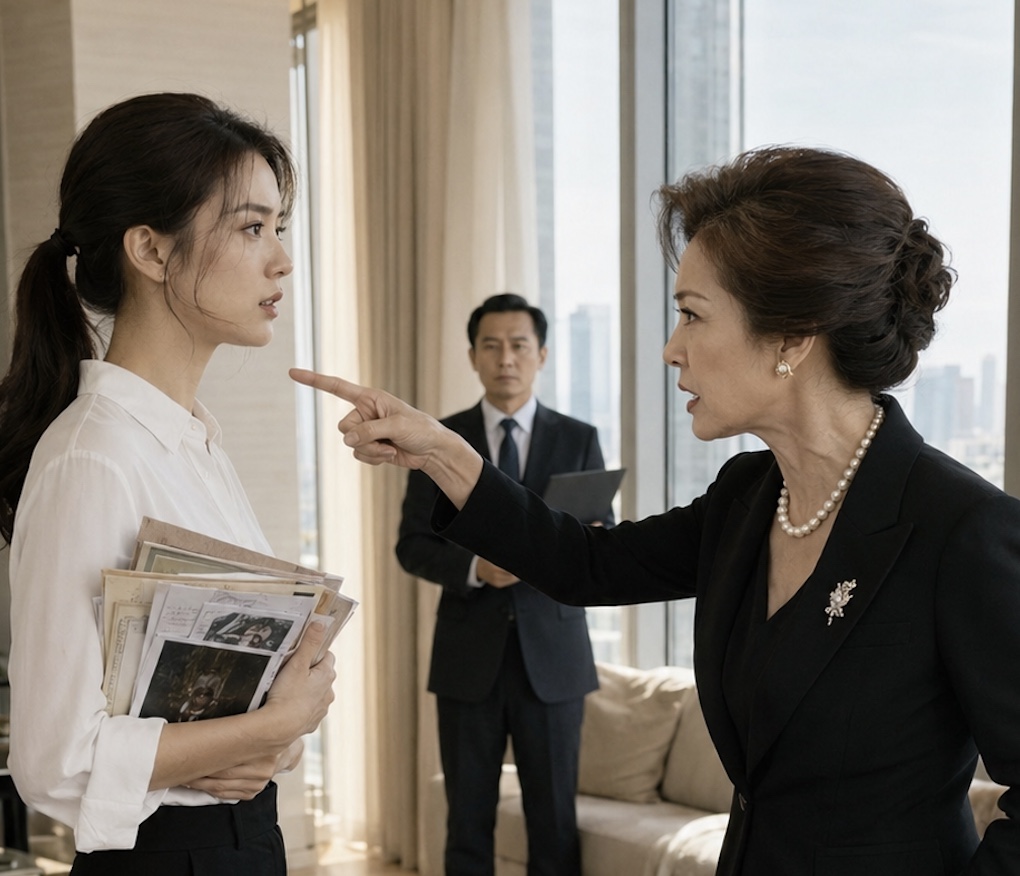
Svetlana Nikolaevna, her mother-in-law, stood in the middle of the room, grand and immovable, like a battleship at anchor. She wore a beige trench coat, her hair arranged in a flawless shell, and around her neck hung a strand of heavy, slightly yellowed pearls. She was gesturing animatedly as she spoke to a thin man holding a tablet. The man had a pen clamped between his teeth and was trying to take measurements with a laser tape, sending a red dot skimming across the walls.
On the coffee table—one Alisa always kept perfectly clear except for a vase with an orchid and an art book—there was now a cardboard box. Thrown into it without the slightest care were framed family photographs, a small figurine from Barcelona, and drawings made by their daughter, Anyuta. Five-year-old Anyuta, whose crooked little pictures Alisa treasured as if they were priceless masterpieces.
And on the kitchen island, right on the marble countertop, several documents had been spread out. Stamps. Forms. Official-looking papers.
“Arthur, make sure you mention the view from the window,” Svetlana Nikolaevna was ordering. “Panoramic glazing is very valuable now. And write that the kitchen set stays. It is built-in. We will not be removing it.”
“Excuse me,” Alisa said.
Her voice sliced through the sudden silence like a whip. Clear. Ringing. Without the slightest tremor.
The thin man, Arthur, flinched and dropped the pen from his mouth. It rolled across the floor.
Svetlana Nikolaevna turned around. Her face did not change. Only one thin, plucked eyebrow lifted slightly.
“Alisa? Why are you home? I thought you had an important meeting today, if I remember correctly.”
The question was asked as if Alisa were the one who had entered someone else’s space without permission. As if she were the one who owed an explanation.
“You seem to have forgotten to confirm the viewing time,” Alisa said, without moving from where she stood. “Good afternoon. I am the owner of this apartment.”
Arthur turned pale and began nervously retracting the tape measure cord.
“I thought… I was told the residents knew…” he stammered.
“Arthur, please wait in the hallway,” Svetlana Nikolaevna ordered in a tone that seemed to blow the realtor right out of the room.
They were left alone.
Her mother-in-law sighed, adjusting her pearls, as if preparing herself for an unpleasant but necessary conversation with an unreasonable child.
“Alisa, don’t be dramatic. You appear to have forgotten, but the apartment is registered in my name. Why would I need your permission to sell it?”
Alisa slowly, very slowly, walked to the kitchen island. She picked up the top sheet. It was not a purchase agreement, as she had expected. It was a preliminary lease agreement with an option to buy. And the buyout amount was far below market value.
It was some strange, murky arrangement.
“We are not selling it,” Alisa said, looking directly into her mother-in-law’s eyes. “We are leasing it to some company with vague prospects and giving them an option to purchase at a reduced price. That is not even a sale. That is an asset dump.”
Svetlana Nikolaevna narrowed her eyes slightly. She clearly had not expected her daughter-in-law to grasp the legal nature of the scheme so quickly.
“There is no need for you to dig into details you do not understand. This is competent optimization. You do not need to burden your head with it.”
“Should I burden my head with why my personal belongings have been dumped into a box like trash?” Alisa nodded toward the coffee table.
“Things are just things. Pack the rest. You and Oleg are moving in with us,” Svetlana Nikolaevna announced. Her voice became almost gentle. “The house is large. There is plenty of room for everyone. Anyuta needs fresh air, apples straight from the tree, not this concrete cage. Especially while her mother disappears at work day and night. I have already chosen a nursery for her on the second floor, with a little balcony. The wallpaper would look wonderful there, little roses.”
There it was.
The kill shot.
The child.
Always the child.
The most vulnerable place.
For one second Alisa imagined that house. The smell of pies. Whispered conversations behind her back. Svetlana Nikolaevna deciding what her daughter could eat, what she could wear, when she could speak.
“Does Oleg know?” was all Alisa asked.
“Of course he knows. We had a lovely dinner yesterday and discussed everything. He is not against it. A man must think about his family, not someone’s career ambitions. You are too tired, Alisa. You have become… jumpy. Everyone can see it. You will rest. Sleep. You simply lack nature, you know.”
Alisa looked at Svetlana Nikolaevna. The woman stood there radiating certainty in her own right to decide other people’s lives. And the most frightening part was that Oleg really might not be against it. He might have sat at the table yesterday, eaten chicken broth, and nodded along while his mother mapped out his future.
“Leave,” Alisa said quietly.
“What did you say?”
“Leave now. Take your realtor, your papers, and leave. I need to think.”
Her mother-in-law smiled with the corners of her mouth.
“Think, my girl. Think. Just not for too long. Arthur said the buyers are very eager. We cannot keep them waiting forever. Time is money.”
She turned and walked out, her heels clicking across the porcelain tiles. The front door slammed.
Alisa remained standing in the middle of the living room. The heavy, sugary scent of her mother-in-law’s perfume still hung in the air. The bag with the ribeye stood abandoned in the hallway.
She was no longer hungry.
She wanted to smash something.
She walked to the box and pulled out one of Anyuta’s drawings. On the yellow sheet, clumsy little fingers had drawn three figures.
“Mom, Dad, and me.”
Under the number three were two crooked triangular houses. Their houses. The old one in the countryside and this new one.
Alisa pressed the drawing to her chest and closed her eyes.
The silence in the apartment rang in her ears. But it seemed to her that she could hear the fabric of her life tearing at the seams, carefully unpicked by the hands of a woman who believed everything in the world—including people—had a price and an owner.
Oleg came home around ten that evening.
Alisa was sitting in the dim living room. The only light came from a floor lamp that threw strange shadows across the wall. She had not turned on music. She had not lit candles. She simply sat curled into her favorite wide armchair and waited. She had put the ribeye in the refrigerator, but she had opened the wine. The glass stood almost untouched on the floor beside her.
Oleg came in whistling something careless. He flipped on the overhead light, and Alisa squeezed her eyes shut against the sudden brightness.
“Why are you sitting in the dark? Saving electricity?” he chuckled, not noticing her condition. “Can you imagine, the client from Green Park finally approved the facades. They dragged it out for half a year, and then—boom! Though I had to redraw the bay windows three times, but it was worth it.”
Oleg was a talented architect. But, like many talented people, he had no idea how to sell himself. He could talk for hours about constructivism, but froze whenever tenders and budgets came up. It was as if he were always waiting for someone bigger and stronger to come and solve everything. In childhood, that person had been his mother. Later, he seemed to think it would be his wife.
But Alisa did not solve his problems. She made him solve them himself.
And apparently, that had begun to exhaust him.
“Oleg, we need to talk seriously,” she said.
He took off his coat and hung it up. Then he went to the kitchen, opened the refrigerator, and pulled out a carton of juice.
“I know what you want to talk about,” he said, standing with his back to her. “Mom called. She said you were rude. Why did you attack her in front of a stranger? Arthur apparently almost developed a stutter. Mom only wanted to help.”
“To help?” Alisa rose from the armchair. “Oleg, your mother barged into our apartment with some strange man, threw my personal belongings into a cardboard box, and tried to lease our home to unclear people at a price twice below market value. And you are telling me I was rude?”
Oleg took a sip of juice and grimaced. Not because of the juice. Because of the conversation. He hated it when Alisa “went after” his mother.
“Listen, you are exaggerating. She would not have done anything without us knowing. It was just… preparation. We have discussed a hundred times that we are stuck in this mortgage like prisoners. You work like a horse. I do not have any major projects. Everyone’s nerves are on edge. Anyuta only sees you on weekends, and even then you are with your laptop.”
“And what is the solution?” Alisa folded her arms.
“Mom is offering for us to live with them,” Oleg finally turned around. His eyes were honest, almost childlike. “The house is huge. Three floors. We would have an entire wing. Our own space. Anyuta would have fresh air, a garden, even a dog again. We could rent out this apartment, pay off the mortgage, and you would still have money left for… well, for your wants. Rest, clothes. You would not have to get up at six in the morning.”
“So, Oleg, are you seriously suggesting that I sell my life?” Alisa felt her eyelid twitch. It always happened in moments of extreme tension. “I spent ten years climbing out of the hole where ‘fresh air’ meant the smell of manure and my father’s alcohol breath. Ten years, Oleg. A dorm room, three jobs, studying at night. I clawed my way to a place under the sun so I could sit not in your mother’s vegetable garden with a hoe, but in my own office overlooking the city. And you want to drag me back? Into dependence? Drag our daughter into the very place I swore never to return to? For your mother’s convenience?”
“What does Mom have to do with it?” Oleg raised his voice. “What does your past have to do with it? I am offering you a normal life without stress. You come home and snap at me. You stopped smiling. You became hard as a board. Businesswoman…” He spat the word with unexpected bitterness. “At home, you also need to be a woman, Alisa. Soft. Understanding. But from you there are only problems and calculations. Mom is right—you are ruining yourself with this race.”
At that moment, something inside Alisa tightened into a block of ice.
He had not even argued with his mother.
He had not even tried to stand on her side.
He had simply sat in their kitchen and repeated his mother’s arguments, without even bothering to translate them into his own language.
“Do you know what she told me today?” Alisa asked quietly. “She said the apartment is registered in her name. And that she can do whatever she wants with it. Do you understand what that means? It means you lied to me all these years. You told me the apartment was ours.”
Oleg suddenly looked embarrassed. He put the glass in the sink and began carefully washing his hands, though they were already clean.
“Well… technically, that is true for now. But it is just a formality. Mom gave us the down payment when we first got married. You were not working then, we were students. She simply protected herself. Once we pay off the rest, I will transfer everything to us. I swear. It is only a matter of time.”
“I paid it,” Alisa said sharply. “Not we. Not you. I did. With my bonuses over the last five years. I paid off sixty percent of the principal. And I put three times more into the renovation than that down payment was worth. So technically, this apartment stopped being your mother’s ‘formality’ a long time ago.”
Oleg fell silent. He dried his hands with a towel and avoided looking at his wife.
“I thought you would be happy,” he said. “I thought you were tired of carrying everything on your shoulders.”
“I am tired of carrying everything on my shoulders, Oleg. Including you. Tomorrow, you will go to your mother and tell her there will be no sale. The apartment stays with us.”
He did not answer. He simply walked out of the kitchen, and soon Alisa heard the sound of water running in the bathroom.
The conversation was over.
But she had never received an answer.
And that silence was worse than any shouting.
Two days later, Alisa received a message from her mother-in-law. Not a call—no, calls could be ignored—but a message in a messenger app, written in flawless, almost official language:
“Alisa, I expect you and Anyuta for a family dinner on Saturday at 5:00 p.m. I have informed Oleg. Svetlana N.”
The word “family” cut her eye.
Family was the three of them. She, Oleg, and Anyuta.
But in Svetlana Nikolaevna’s world, “family” meant Svetlana Nikolaevna herself and everyone orbiting around her like satellites.
Alisa decided to go. She wanted to see the balance of power. She wanted to understand how deeply this worm of doubt had burrowed into her marriage. She left Anyuta with the nanny, saying the girl felt a little unwell. The last thing she needed was for the child to witness a possible fight.
Svetlana Nikolaevna’s house stood in an old country settlement that, over the years, had grown guard booths and high fences, turning into an enclave for those who “had always lived here.” It was a red-brick mansion covered in ivy, with an attic level and a huge terrace. The air smelled of wet soil and decaying leaves.
Alisa parked her car beside Oleg’s imposing SUV and an old sedan she did not immediately recognize.
In the living room, furnished with heavy oak furniture, there was already a lively atmosphere. Svetlana Nikolaevna, wearing a flowing burgundy dress, poured tea from an antique porcelain teapot. Beside her sat a woman of about the same age, but dressed far more simply, in a chintz blouse with ruffles. She seemed vaguely familiar to Alisa.
“And here is our businesswoman,” Svetlana sang without rising. “Meet Polina, Oleg’s third cousin. She has come to visit from Tambov. Remember, I told you about her?”
Polina smiled a sugary, sticky smile. One of her fingers was stained with ink, and her whole appearance radiated an extreme degree of servility. It was her old sedan standing by the gate.
“Oh, I have been dreaming of meeting you!” Polina exclaimed, throwing up her hands. “I have heard so much about you! They say you are simply brilliant with money. That is so… womanly wise.”
The compliment had a double bottom, cheap with sarcasm.
Oleg sat on the sofa, leaning back into the cushions, and looked relaxed. He drank tea and looked at his wife without a trace of the tension from the previous night. Apparently, on his own territory, he felt safe again.
“Come in, sit down,” Svetlana nodded. “Polina baked a wonderful cake. Our family recipe. Do you remember, Olezhek, how much you loved it as a child? With raisins and walnuts?”
Oleg nodded, sending another piece into his mouth. He seemed to have slipped back into childhood. His shoulders were relaxed, his eyes soft and complacent.
Alisa sat on the very edge of a chair and refused tea.
“Well, tell us, how are things at work? They say a crisis is coming,” her mother-in-law asked in a tone that suggested she was discussing frost expected in the vegetable garden.
“We are managing,” Alisa replied shortly.
“She is doing well,” Oleg inserted unexpectedly, though weakly, without warmth. “They have some kind of merger coming up. Mom, pass the jam, please.”
“I will,” Svetlana smiled. “But actually, I invited you for a reason. We wanted to discuss our plan while everyone is here. The move. The property. Everything needs to be put in order. I have made inquiries. The value of your apartment is at its peak right now. In six months the market will freeze, and we will not get that kind of money.”
“The plan is for me to abandon my life?” Alisa asked evenly.
Polina suddenly joined the conversation. She picked up a silver sauceboat—apparently a family heirloom—and began pouring some sweet syrup over her piece of cake.
“Oh, Alisa, why say it like that?” she cooed, though her eyes were sharp and ratlike. “You are clinging to that apartment as if treasure were buried there. Or are you afraid that without your own corner, you will not be able to keep Oleg? Who knows, maybe he will find someone younger and more agreeable while you sit in your glass-and-concrete tower. We are only concerned about your well-being. Your health. Anyuta’s future.”
A spoon clinked against porcelain.
Alisa moved her gaze from Polina to her mother-in-law, and in that instant she caught the glance they exchanged. Quick as an electric shock.
A conspiracy.
Svetlana Nikolaevna, this hereditary aristocrat of local importance, had simply taken some provincial fool as an ally so that she could voice the dirtiest thoughts while Svetlana herself remained in a white coat.
“You know, Polina,” Alisa took the unfortunate sauceboat from her hands and set it on the table, “silver spoons are lovely when they are your own. But when someone tries to reach into another person’s plate with someone else’s spoon, there is always a risk of choking.”
Her mother-in-law’s face changed. The mask of hospitality cracked, barely but visibly.
“This is family silver,” she said sharply. “Such things do not have to be bought, Alisa. They are passed down. They teach respect for lineage, land, tradition. Things that you, unfortunately, will never understand. You are used to buying. We are used to owning.”
“Owning what? Jars of jam?” Alisa stood. “I can see that this moving plan is not about helping. It is an attempt to solve some internal financial problem of yours. I do not know why Polina is nodding along—perhaps she has been promised a share in the ‘family estate.’ But I have already said my piece: we are not selling the apartment, and we are not leasing it. There will be no transactions involving this property. Period.”
Oleg jumped up from the sofa.
“Alisa, sit down! You are behaving like… like some market woman!”
“No, darling,” she looked at her husband, but saw a complete stranger in front of her. “I am behaving like the only adult in this room. I am leaving. Dinner is over.”
She turned and walked out, followed by heavy silence. Just as she reached the door, she heard Svetlana Nikolaevna say to Polina, without lowering her voice:
“You see? That is what plebeian blood means. No upbringing. We shall see who defeats whom.”
Alisa got into her car and gripped the steering wheel, trying to stop her fingers from shaking.
The main thing she took from that dinner was this: Polina was not merely a guest.
She was part of the scheme.
And Svetlana Nikolaevna had not started all of this from a good place.
She urgently needed money, and she intended to get it by effectively throwing her daughter-in-law out of her own home.
A week passed after the dinner at her mother-in-law’s house.
A week of icy distance.
The apartment that had once been their fortress turned into a communal flat for two strangers who had accidentally ended up under the same roof. Oleg spoke to her through clenched teeth, and only about practical matters. A stubborn, childish resentment had settled in his eyes.
Alisa tried to reach him through logic.
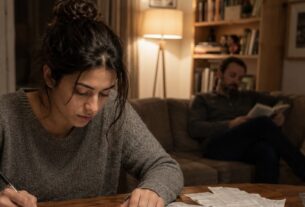
One evening, after Anyuta was already asleep, she laid bank statements, the mortgage agreement, and a calculator across the dining table. Oleg sat demonstratively in headphones, pretending to work on a project.
“Oleg, take off the headphones,” she asked.
He reluctantly pulled them from his head.
“What now? If you are going to apologize for Mom, let’s not do this now.”
“I am not going to apologize. I want to show you numbers. Just look.”
She slid a sheet toward him. In her neat handwriting, she had listed all the financial flows from the past eight years.
“Look. Your mother’s down payment in 2009 was twenty percent of the value of the unfinished apartment. This amount here. Then came the mortgage. We paid it together for the first three years—you from your early fees, me from my salary. But for the last five years, after your firm went bankrupt and you had only occasional projects, I paid. Alone. Here, look. Transfers. Monthly payments. I paid off sixty percent of the principal.”
Oleg glanced at the paper and pushed it away.
“And what do you want to say with that? That you supported me? That I am worthless?”
“I want to say that this is our apartment. Yours and mine. Not your mother’s. We invested everything in it. And now, considering the market growth, your mother’s share in it is ridiculous. She wants to sell it not for us, but to pull out the money. Do you understand? Someone urgently needs cash.”
“You understand nothing!” Oleg slammed his fist on the table so hard the calculator jumped. “This is for you! Mom wants to get you out of this debt pit, and you are looking for a conspiracy! For you, everything comes down to money. You measure everything in cash! But for Mom, relationships matter. Family matters. She cannot bear to watch us breaking our backs here. Her heart hurts!”
“Her heart hurts when she loses control,” Alisa cut in. “I am not against moving in if there were a real need. But selling the apartment now is idiotic. Let us live there for a while if you want, but we will lease the apartment officially, without any option to buy, and cover the mortgage with rent. That would be our safety cushion.”
“No,” Oleg stood. His eyes were red from lack of sleep and anger. “Mom said no rental. The house must be one whole. Family property must be concentrated in one pair of hands. So there is no temptation to run away at the first difficulty. And you know what? I agree with her. As long as you have this apartment, you will blackmail me with divorce. I do not want to live under the sword of Damocles.”
“So this is not care,” Alisa whispered. “It is a way to tie my hands.”
“I cannot go against my mother!” he suddenly shouted, with a desperate, almost hysterical note in his voice. “Do you not understand? She will not survive it! Her blood pressure keeps jumping. Do you want my death on your conscience? Do you want to give my mother a heart attack because of your stupid pride?”
Alisa looked at him and did not recognize him.
Somewhere deep inside, a terrible and final reevaluation was taking place.
This was not a husband. Not a partner. Not a lover.
This was a frightened little boy hiding behind his mother’s skirt, ready to destroy his own family as long as the old woman did not stamp her foot.
On Saturday morning, when Alisa came out of the shower, she heard the front door slam.
The apartment was suspiciously quiet.
She looked into the bedroom—empty.
The child’s room—empty.
On the kitchen table lay a note written in Oleg’s sprawling handwriting:
“Anyuta and I will stay at Mom’s for a while. You need to cool down and think about your behavior. A nervous mother harms a child. We will come back when you are ready to speak normally and not like a business terminator.”
Below, in childish crooked letters, was written:
“Mommy I love you.”
Alisa sank to the floor. Right onto the cold porcelain tiles.
The apartment she had loved so much suddenly became empty, echoing, and foreign. The silence pressed against her eardrums.
She sat like that for perhaps an hour.
Then she jumped up, wiped away her tears, and picked up her phone.
Enough.
Enough being a victim.
She needed to understand what game Svetlana Nikolaevna had started.
She went to the shelf where she had thrown the stack of documents left behind by the realtor on the day of the visit. She decided to study them with a lawyer’s eye.
Alisa locked herself inside the apartment and plunged into work. She armed herself with a marker, sticky notes, and her experience in reading complex financial documents. The preliminary agreement with the real estate agency, so arrogantly spread across her table, was cleverly written—but amateurishly. It had clearly been thrown together in a hurry, designed to rush the deal through.
The strangest clause concerned not the price, but the timing. The buyer insisted that the apartment be vacated within a week after signing. It did not look like a commercial lease. It looked more like a hostile takeover.
Attached to the contract with a paperclip were copies of ownership documents. A certificate of ownership in Svetlana Nikolaevna’s name. An extract from the property register. And one old, yellowed document caught Alisa’s attention.
It was the sale agreement for Svetlana Nikolaevna’s parents’ old house, the very “family estate” in Tambov Province that had supposedly been sold for a fortune before they moved.
Alisa read the numbers carefully.
The amount was laughable.
The house had been sold for almost nothing because it was burdened with the debts of a certain brother of Svetlana Nikolaevna’s, who had lost his share in cards and mortgaged the estate again. Her mother-in-law had always told the legend that they sold the house “to invest in the grandchildren’s future.” But in reality, they had been running from creditors.
It was a lie Svetlana Nikolaevna had been polishing for decades.
But the real bomb was another sheet hidden inside a folded envelope. It fell out by accident when Alisa shook the folder.
It was a photocopy of a notarized gift statement from Tambov. It was addressed to Oleg.
It turned out that Oleg’s grandmother, Svetlana Nikolaevna’s mother, had set aside part of her personal savings for her grandson before she died, with a clear statement:
“For the purchase of his own housing, so that he may have a fortress and a roof over his head, independent of any circumstances.”
The sum was exactly the amount used for the apartment’s down payment.
Svetlana Nikolaevna, as the administrator of the inheritance, had formally fulfilled her mother’s will—but registered the apartment in her own name, claiming all the glory of the benefactor and hiding the fact that the money had actually belonged to Oleg.
It was not her generosity.
It had been the will of a deceased grandmother who had wanted to protect her grandson from his domineering mother.
Alisa sat for a long time, staring at the yellowed paper.
The puzzle assembled itself in her mind.
Svetlana Nikolaevna did not simply want to sell the apartment behind her daughter-in-law’s back. She wanted to cover her tracks. If she sold the apartment now and poured the money into the reconstruction of the “family house” in the settlement, proving the existence of the grandmother’s gift would become almost impossible. The money would dissolve into concrete and plaster.
Oleg would receive nothing.
Alisa would receive nothing.
All power and all finances would remain in the hands of an aging woman whose greatest fear in the world was losing control.
Her mother-in-law’s motive was not merely greed.
It was a pathological hunger for control.
Alisa had been needed by this family as a thoroughbred, hardworking horse. Give birth. Raise the child. Earn money. Renovate the apartment. And once she was no longer useful, discard her—preferably while transferring all joint property to the “clan.”
Alisa carefully arranged the papers and made a call.
She dialed Arthur, the realtor who had been so frightened during their first meeting. He was the only weak link. A hired professional, not a family member. He could be offered a deal more interesting than Svetlana’s shady scheme.
“Arthur? This is Alisa. The same woman whose belongings you kicked into a box. We need to meet. I have a business proposal for you—one you will not be able to refuse. And unlike the adventure proposed by my respected mother-in-law, it will not land you in court as an accomplice to fraud.”
There was a pause on the line, followed by a doomed sigh.
“Give me the address.”
Alisa arranged the meeting in that same apartment.
She decided the battle had to take place on the field the enemy already considered captured.
She invited Svetlana Nikolaevna, Polina, and, of course, Oleg. She called Oleg personally and said only one sentence:
“If you ever wanted to be an adult man even once in your life, come on Saturday. We will settle everything. Either we will do it together, or I will do it without you—and then you will be left with nothing.”
They gathered exactly at noon.
Svetlana Nikolaevna arrived first, like a general before an inspection of troops. She wore a strict black suit, almost as if she were in mourning. Polina followed, clutching a small handbag to her chest. Oleg came last, holding Anyuta in his arms.
When Alisa saw her daughter, she almost broke—but she held herself together. Anyuta waved happily.
“Mommy, look, Grandma bought me a lollipop!”
Not a word about the fact that she had been taken from home without permission. The child thought it was a vacation.
“So,” Svetlana began, settling into an armchair, “I hope you have come to your senses and are ready to sign consent for the deal. Arthur, by the way, should be here soon. We have settled all the formalities.”
“Arthur is already here,” Alisa said, nodding toward the guest bedroom.
The door opened, and Arthur entered the room.
But he looked different now. No nervous fussing. He held a laptop in his hands, and on his face was the gloomy determination of a man backed into a corner.
“What is going on?” Svetlana Nikolaevna frowned.
“Svetlana Nikolaevna, I have studied the documents,” Alisa began calmly, with that cold metal in her voice that never promised anything good. “You were right. The apartment does need to be sold. And I have found a buyer.”
A triumphant spark flashed in her mother-in-law’s eyes. She already tasted victory.
Too early.
“The buyer is me,” Alisa continued. “Arthur, announce the market value of comparable apartments in this area.”
The realtor pressed something on the keyboard. Figures appeared on the television screen mounted to the wall.
Oleg whistled softly.
Polina gasped.
Svetlana Nikolaevna pursed her lips.
“But there is one legal nuance,” Alisa said, picking up the photocopy of the gift statement. “Your mother, Svetlana Nikolaevna, left this money to Oleg. It was not your property. This apartment was purchased with funds received by my husband as inheritance. Moreover, Ivan Semyonovich from Notar-Pravo confirmed that if the heir is your son, then you, as administrator, were obligated to transfer the property to him in full—not register it in your own name. Your ‘formality’ could qualify as concealment. But we will not create a scandal.”
She looked around the room.
Oleg stood as pale as death. For the first time, he was looking at his mother not with worship, but with horror. It was as if the rose-colored glasses had finally fallen from his eyes.
“The money from the sale,” Alisa continued, each word precise, “if it had taken place, would have had to be divided according to the marriage contract. What?” She smiled faintly. “Did you think I had not included clauses about property division in case of early mortgage repayment? Oleg receives the down payment amount, indexed as his inherited share. According to the bank documents, everything invested above that belongs to me. And that is how much, Arthur?”
“Sixty percent of the apartment’s market value,” the realtor replied dryly, as if in court. “Alisa Vladimirovna is the primary credit-history holder and payer. In practical terms, this is her asset.”
Svetlana Nikolaevna sprang to her feet.
“This is absurd! This is my apartment! I paid! Oleg, tell her! She has lost all shame! I will sue!”
“Go ahead,” Alisa shrugged. “Then we will bring up the grandmother’s gift statement. Oleg will have to testify against you. And Polina, as a witness to your schemes, may also be exposed. If I am not mistaken, she has certain legal troubles in Tambov connected to financial fraud. I checked.”
Polina turned white and shrank into the corner of the sofa.
The air in the room became thick and suffocating.
“I do not want courts,” Alisa stood. The metal left her voice, and now she simply sounded tired. “I do not want to divide anything, Svetlana Nikolaevna. I am returning your money to you. Every last coin, with inflation interest. Oleg will receive his maternal inheritance. And I am buying the apartment for myself and Anyuta. My daughter and I will have a home. No encumbrances. No mother-in-law’s right to burst in here with a realtor.”
She placed a check on the table.
“This is exactly the amount once used for the down payment. Multiplied by three. That is the price of your peace. Take it and leave.”
A ringing silence filled the room.
Svetlana Nikolaevna stared at the check. Her face reflected a complicated mixture of feelings: rage, humiliation, and, somewhere deep down, relief. She desperately needed money. The debts on the country house were growing, and Polina, as it turned out, had become not a helper but a parasite.
She snatched the check with dry, well-kept fingers and hid it in her bag without another word. Then she turned and walked away.
Polina rushed after her, tripping over the edge of the rug.
Oleg stayed.
He simply stood there and watched his mother leave the apartment with the money, without even saying goodbye to her son.
“Alisa…” he began.
“Be quiet,” she raised her hand. “You handed me my daughter without a fight. You called me a terminator. You chose a side. And you know what, Oleg? While you were hiding behind your mother, I stopped respecting you. And without respect, there is no family.”
A month passed.
A month of painful paperwork and even more painful conversations.
Alisa moved.
She furnished the new apartment from scratch. She took almost nothing from her previous life. Only her favorite orchid and the folder with Anyuta’s drawings.
Oleg signed the divorce papers without hysterics. It was as if he had switched off.
Alisa sat in her new living room. Outside the window, May rustled through the leaves. The apartment was smaller than the old one, but here it smelled only of her perfume and vanilla from children’s cookies.
She could finally breathe.
The money from the sale of the old apartment, after paying off the shares owed to her mother-in-law and husband, allowed her to buy this home without a single loan.
The doorbell rang.
Svetlana Nikolaevna stood on the threshold.
But what a different woman she was.
Not a trace remained of her former grandeur. No pearls. Her coat was wrinkled. In her hands, she held a box with a cake. And behind her, strangely, there was no one.
“Alisa, may I come in?” her mother-in-law asked. Her voice trembled for the first time in her life.
“Why?” Alisa asked, without moving.
“Polina… she robbed us. She went back to Tambov, withdrew all the money from the accounts I transferred to her, believing in her foolish investments. Oleg… he does not speak to me. He says I destroyed his life. He sits alone in the old apartment and drinks. I am alone in that enormous barn, Alisa.”
Her mother-in-law shifted from one foot to the other. The cake box tilted slightly.
“Let us talk. You are… you are smart. Strong. Maybe forget these apartments? We are family, after all. Forgive me, old fool that I am.”
Alisa looked carefully at the woman before her.
It was the dirtiest manipulation possible. Abandoning a failed ally. Pressing on pity. Trying to enter again under the banner of “family values.”
But now, looking into Svetlana Nikolaevna’s extinguished eyes, Alisa felt neither triumph nor anger.
Only emptiness.
And a faint disgust.
She took the cake from her mother-in-law’s hands.
“Thank you for visiting, Svetlana Nikolaevna. I will think about your words. But the keys to my apartment…” She smiled slightly. “I will never give them to you again. The door opens only from the inside. That is the rule of my life.”
She closed the door in front of the stunned woman.
Alisa leaned her back against the cool metal of the door, clutching the useless cake to her chest, and slowly slid down until she was crouching on the floor.
Silence.
Only the soft hum of the refrigerator came from the kitchen.
She thought of that village girl who had feared her drunken father and dreamed of having a corner of her own.
She had done it.
She had built her fortress.
The foundation had cracked. The walls had shaken. But she had strengthened them not with cement, but with her own will.
She had not become bitter.
She had simply stopped being afraid of ending up alone.
Because she now knew: it is better to be alone in peace than trapped with the wrong people in hell.
Anyuta would come home from the nanny tomorrow.
And together, they would bake their own cake.
Without family silver.
Without false toasts.
And without giving the powerful the right to burst into their lives.