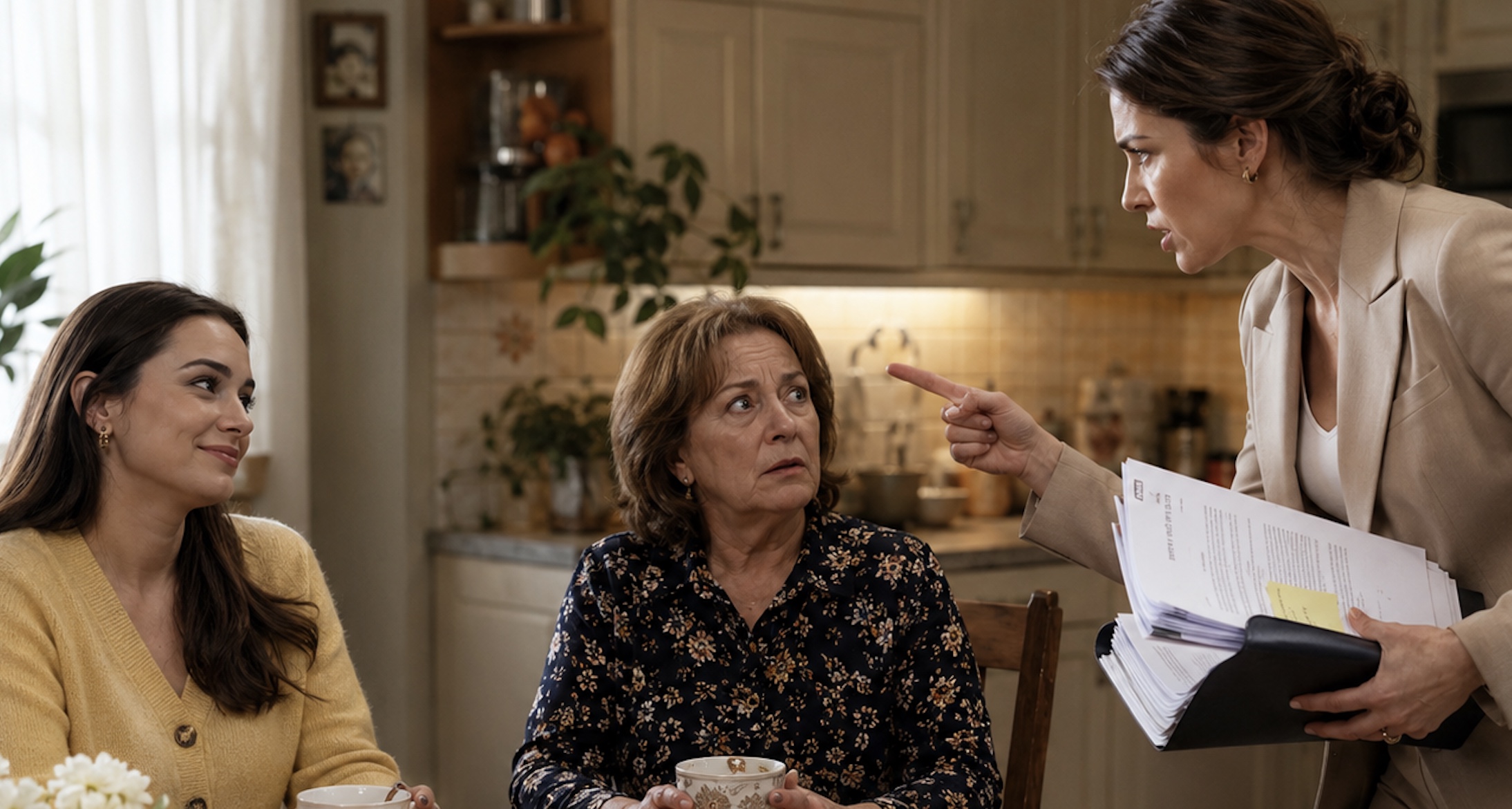
“We’ve decided to put the apartment in Sveta’s name. It’s the right thing to do,” her father said calmly.
Marina froze with the cup still in her hands. The tea was hot, but she no longer felt its warmth.
“The same apartment you live in?”
“Yes. You already have a place of your own.”
“And what about the fact that Sveta already got an apartment once and sold it?”
Her mother nervously adjusted the tablecloth, even though it was lying perfectly straight. Her father turned his eyes toward the window, where an ordinary gray November sky hung beyond the glass.
“She was young then. Things are different now,” he finally said.
Marina looked toward the hallway. The door to her sister’s room was closed. Forty-year-old Svetlana had not even come out for the conversation — not to support their parents, not to pretend she felt uncomfortable, not even to say a single word.
And in that moment, Marina finally understood: after twenty years, her parents still had not understood anything.
Marina Kovalyova was the younger daughter in the family. It should have meant privilege. But in their home, everything worked the other way around.
The eldest, Svetlana, had always been considered special by their parents — not because she was talented, but because she was fragile. Unfortunate. Helpless. Someone who needed protection. Marina, on the other hand, had been raised differently — without leniency and without extra tenderness.
A B in her school diary made her mother ask why it was not an A. Coming home late was discussed minute by minute. Any complaint about being tired was met with the same calm phrase: learn to manage, life won’t wait for you.
Svetlana was forgiven for everything.
She dropped out of college after her first year, and their parents only sighed: apparently, it just wasn’t the right field for her. She quit her first job, and they decided her boss must have been impossible. She fought with her friends, and naturally, the friends were to blame.
Marina clearly remembered one autumn evening when she was thirteen. She came home with a certificate — first place in a district mathematics competition. The paper was thick, with a golden seal, and she had carried it all the way home with both hands so it would not bend.
At home, her parents were sitting in the kitchen, speaking in low voices. Svetlana had quarreled with another employer and was jobless again.
“Mom, look,” Marina said, placing the certificate on the edge of the table.
“Well done,” her mother replied without even turning her head. “Put it on the shelf. So, Dad, what is our poor Sveta going to do now?”
Marina picked up the certificate and went to her room.
The following summer, she got a part-time job at a bookstore. She stocked shelves and helped at the register. She spent her first paycheck on a laptop — old, but working. She came home pleased and placed the box on the table.
“You bought it yourself?” her father asked in surprise.
“Yes. Myself.”
He nodded, not with pride, but simply as if acknowledging a fact. That same evening, Marina accidentally overheard him calling the bank to withdraw money from a savings account. Svetlana needed help paying off her credit card debt — again.
At dinner, her mother divided the potatoes between their plates and said the familiar words:
“Our Marina is strong. She can handle things on her own.”
No one objected. That phrase had long become something like a family rule — unspoken, but firm.
When Svetlana turned twenty, their parents gave her their grandmother’s one-room apartment. They made a whole ceremony out of it: changed the lock, bought a new stove, and wallpapered the place with their own hands. They believed that having her own home would finally make her grow up.
Three years later, Svetlana sold the apartment.
“I’ll buy a bigger place and take out a mortgage,” she explained.
But the money went elsewhere: new phones, trips, restaurants, gifts for yet another boyfriend, online shopping orders she forgot about before even opening the packages. Within a year, Svetlana returned to her parents — almost broke and with the expression of a person unfairly wounded by life once again.
Marina was finishing university at the time. By then, she already knew she could count only on herself.
Years passed. Marina worked at a large company and eventually became a department head. It cost her a lot — not in dramatic sacrifices, but in steady, daily effort without the right to relax.
She bought her apartment with a mortgage. In the evenings, she sat over expense spreadsheets, moving numbers around, cutting everything that could be cut. For several years, she did not take a vacation — every spare ruble went toward the down payment. She did the renovation herself: plastering, painting, watching video tutorials on how to assemble furniture, and then assembling it — slowly, swearing under her breath, but doing it. On Saturdays, she traveled to hardware stores and carried heavy bags of tile and grout home on the metro.
Meanwhile, Svetlana lived with their parents. A couple of times she got jobs — first in a store, then in an office — but each time she quit after a few months. Her managers were always unbearable. Her relationships always reached a dead end. Her money always ran out before it had even properly arrived.
Marina had long stopped being angry at her sister. Svetlana was who she was, and she probably would never change. The irritation now lived somewhere else.
With her parents. They were the ones who truly drove her mad.
Every time Svetlana fell into another hole, they rushed to save her — with money, with excuses, with comforting words. Every time, they found a reason why none of it was her fault.
At her mother’s anniversary dinner, relatives gathered — aunts, uncles, cousins. The table was set, wine was poured. Valentina Sergeyevna, flushed and emotional, raised a toast.
“Life has not been easy for Sveta and me,” she said with soft sadness. “Thank goodness Marina is so independent.”
The guests nodded and looked at Svetlana with sympathy — as if she were the one in the family who had achieved something, rather than simply grown tired of her own life.
Marina sat there with a glass in her hand and said nothing.
In the past, hurt would have risen inside her — hot, choking, with a lump in her throat. But now there was no hurt and no anger. Only exhaustion. Flat and heavy, like a wet coat hanging on her shoulders.
Suddenly, she understood clearly: all this time, she had been trying to earn recognition from people who had made their choice long ago. And that choice had never been in her favor.
Her mother called on Wednesday evening and said they needed to talk. Her voice was quiet, somehow cautious.
Marina immediately thought of something bad. Heart problems. Blood pressure. Test results. On Friday, she came over with a heavy bag — buckwheat, canned meat, sea buckthorn tea, and a box of medicines she had bought just in case.
Her father opened the door looking perfectly healthy. Her mother was setting the table calmly, without any panic. Marina exhaled and went into the kitchen.
They drank tea. Behind the wall, in her room, Svetlana quietly existed.
“We’ve decided to transfer the apartment to Sveta as a gift,” her father said. “It’s the right thing to do.”
Marina set her cup down.
“Wait. This apartment? The one you both worked your whole lives for?”
“You already have a home,” her mother said gently. “You earn well. You’ll manage. But Sveta will be lost without us.”
“She already had an apartment. Grandma’s apartment. She sold it in three years.”
“She was young then.”
“She is forty now, Mom.”
Her parents exchanged glances. Her father looked away again. Her mother began saying something about a difficult personality, bad luck, and how life simply had not worked out for Sveta.
Marina listened and stared at the closed door in the hallway. Svetlana had been sitting there the entire time. She did not come out. She did not say a word — not in defense of their parents, not against them. She did not thank anyone. She simply waited for the adults to decide her fate for her.
That was what truly frightened Marina.
Marina remained silent for a while. Then she spoke — evenly, calmly.
“I’m not talking about the apartment right now. I’m talking about something else.”
She spoke slowly, as if she had finally given herself permission to say aloud what she had carried for years.
“You gave her an apartment, and she sold it. You paid off her debts, and she got into new ones. You paid her bills, found her jobs, cleaned up after her scandals. Every single time, you removed the consequences for her as if she were a child.”
“We were just helping,” her mother said quietly.
“No. You weren’t helping her live. You were helping her avoid changing,” Marina said, looking directly at her mother. “Sveta is not helpless. She simply learned a long time ago that someone would always come and fix everything. You taught her that yourselves.”
Her father sat motionless. For the first time during the conversation, he had no answer. He looked down at the table, his face confused and almost unfamiliar.
Her mother could not hold back.
“You speak as if we were terrible parents! We did everything for both of you!”
“For her — everything. For me — nothing, except the phrase, ‘She’ll manage on her own.’”
The conversation grew heated. Her mother raised her voice, then cried, then started speaking again. Marina did not back down and did not become rude. She simply refused to step away from the truth. She understood that she would not change their minds. They heard only what they wanted to hear.
Marina stood up when it was already dark outside. She put on her coat and picked up the empty grocery bag.
“This is your apartment,” she said calmly. “You have the right to do whatever you want with it. I won’t stop you.”
Her mother watched her warily.
“But I want you to know this: if Svetlana loses everything again, I will not be part of it. Not with money, not with housing, not by helping clean up the mess again.”
“So you’re just abandoning your family,” her mother said, her voice ringing with offense.
Her father remained silent.
The door to Svetlana’s room stayed closed.
Marina walked into the hallway and put on her shoes without rushing. At the threshold, she turned back.
“I love you. That won’t change.”
She went down the stairs and stepped outside. It was cold. The air smelled of wet asphalt and the first snow.
And somewhere between the third floor and the pavement, she suddenly felt something heavy slipping off her shoulders. Not anger. Not resentment. Just a burden she had carried for so long that she had stopped noticing it.
The gift deed was finalized in February. Marina found out from her mother, who called on her own and spoke briefly, without details. Marina said, “I understand,” and the conversation ended.
Their relationship remained strained, but slowly, cautiously, it began to thaw. Her mother called once a week. They spoke about simple things — the weather, health, neighbors.
Marina lived her own life. She made her monthly mortgage payments. She renovated her bedroom, plastering the ceiling herself and spending a long time choosing the paint color. In March, she bought a vacation package for the first time in several years — nothing expensive, but still a vacation. She made plans for the next quarter.
One spring day, her mother called and stayed on the phone a little longer than usual.
“Sveta quit her job again,” she said in her familiar tired voice. “She says the team was unbearable.”
“I see,” Marina replied.
She did not give advice. She did not ask for details. She did not offer help and did not judge.
She simply listened. And when her mother fell silent, Marina quietly asked:
“How are you feeling yourself?”
Later, after the call, Marina sat by the window with a cup of tea and thought about how love and responsibility were still two very different things. You could love people without carrying the consequences of their choices on your back.
The pity her parents had mistaken for love for twenty years had never made Svetlana happy. It had only taught her to wait.
To always wait for someone else to come and fix everything.