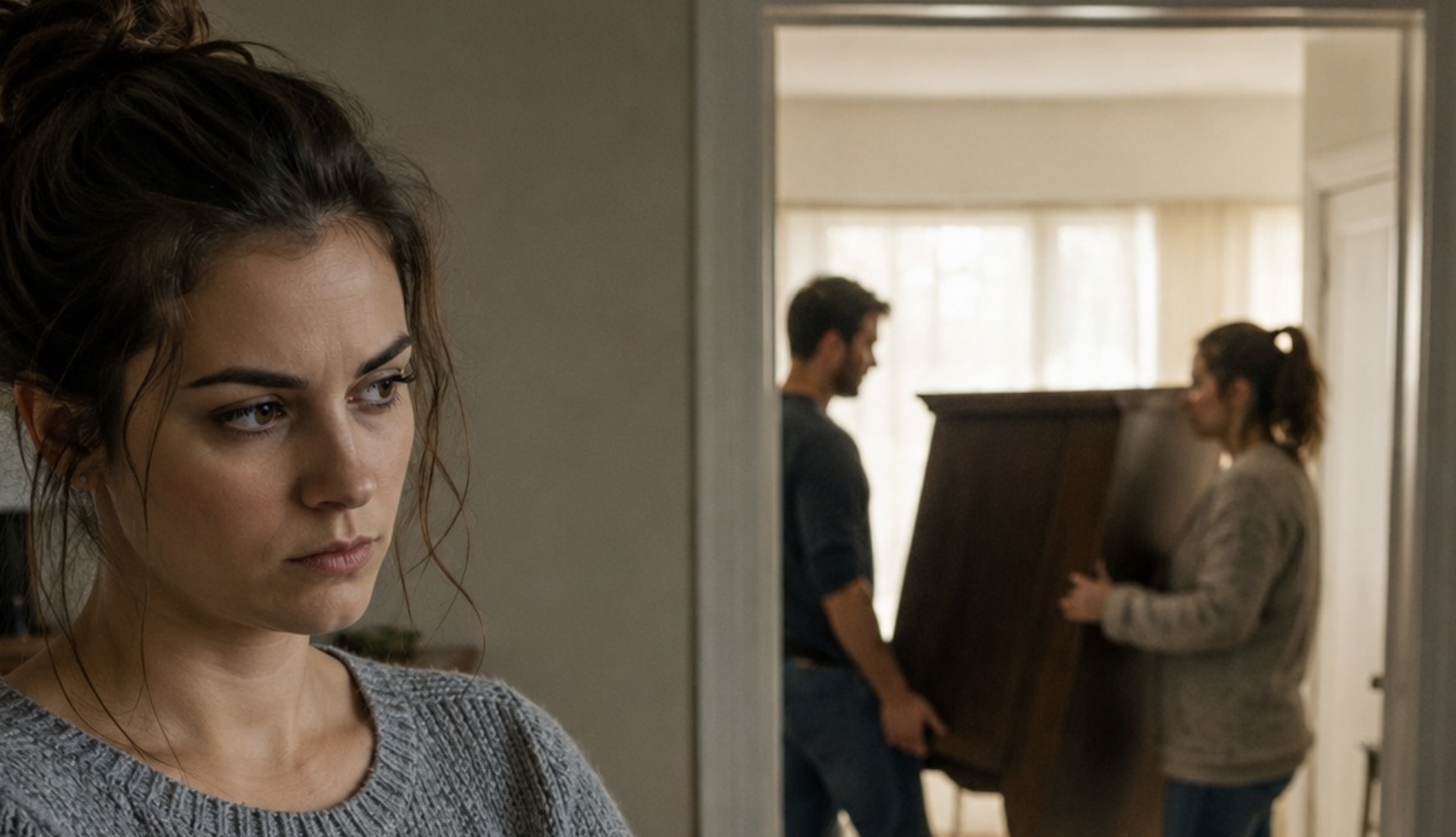
“Lera, I’ll be gone five minutes. Zhanna needs help carrying a washing machine up to her apartment. The movers only brought it to the entrance and left. I’ll be quick.”
Savely was standing in the hallway in his brand-new little shoes, with a backpack on his shoulders. Inside it were his spare clothes and wet wipes. It was his first day at kindergarten. I had been ironing the collar of his shirt since six in the morning because I had forgotten to do it the night before, and he had already walked up to the mirror three times asking, “Mom, am I handsome?”
Kirill was already pulling on his jacket. One hand was in the sleeve, the other held his phone to his ear.
Zhanna.
His ex-wife.
They had divorced a year before our wedding. They had no children together. Their property had been divided long ago. But Zhanna still called. Three or four times a month. A leaking tap, a socket, a curtain rod, a shelf, a lock, assembling something, carrying something out, giving her a ride.
Four years. Like clockwork.
“Wait,” I said. “You promised to take him with me. He was waiting for you. We agreed yesterday.”
Kirill rubbed the bridge of his nose. He always did that when he knew he was wrong but was still planning to do things his way.
“Come on, Lera, it’s a washing machine. Forty kilos. She can’t drag it up by herself. I’ll be back by nine. You can tell me how it went.”
Tell him.
For him, it was easier to say, “You can tell me,” than, “I’ll come and see it myself.”
And this was not the first time. In February, Zhanna asked him to help move boxes from her old apartment, and Kirill spent the whole Saturday there. In January, he assembled a bookcase for her. Four hours. In November, he replaced her faucet. Every time it was “five minutes.” Every time I wasn’t even trying to count — dinner simply got cold, and my eyes kept catching the clock on the microwave.
He left.
The door clicked shut.
Savely looked down at his new shoes and asked quietly:
“Is Dad not coming?”
“Dad will come later,” I lied.
I took our son by myself. His teacher, a woman of about fifty with warm hands, greeted him and asked, “And where is Dad?”
“At work,” I answered.
Savely said nothing. On the way home, he pulled his hand out of mine and walked half a step ahead of me.
He was four.
And he already knew how to be hurt in silence. Not screaming. Not stomping. Just walking a little faster so I wouldn’t see his face.
That evening, Kirill came home at nine.
Not by nine.
At nine.
Three hours for a washing machine.
I didn’t count out loud. I put dinner in the refrigerator without reheating it. He came into the kitchen and opened the fridge.
“Why is everything cold?”
“Why weren’t you back by nine? Savely is asleep. Ask him tomorrow how his first day went.”
He sat at the table. Took out the container. Ate in silence, glancing at me. Waiting for me to start talking.
But I didn’t.
I went to the bedroom and closed the door. Not because I couldn’t speak, but because I knew that if I started, he would spend the next week walking around with the face of a man who had been unfairly accused.
And then it would start again:
“Well, what was I supposed to do? She’s alone. It’s hard for her.”
Hard for her.
And what about me?
I work twelve-hour shifts at the warehouse. I have a child who has to be picked up by five. I have cooking, laundry, cleaning, and dark circles under my eyes that I cover with foundation because my coworkers start asking questions.
But Zhanna has it hard.
Zhanna, with her one-room apartment, her job from ten to six, and no children.
There was a magnet on the refrigerator with the phone number of a moving crew. It had been left there after our own move. My eyes slid over it, and I thought, “That might come in handy.”
I don’t know why I thought that.
But I did.
Three months later, I caught him lying.
Kirill said he would be late after work because the site hadn’t passed inspection and he needed to stay another two hours. That was normal. He worked as a foreman, and delays happened.
That evening, Savely asked to watch cartoons on the tablet. I opened the messenger to send him a link. The family account was open on the screen.
And so was Kirill’s location.
The blue dot was on Vatutin Street.
A nine-story panel building.
Zhanna’s building.
I had memorized the address back in the first year, when Kirill had entered it into the navigator right in front of me.
He came home at eight. His jacket smelled of fried onions. Zhanna loved cooking with onions, and that smell soaked into fabric like it had claws. I could smell it from the hallway as soon as he hung his jacket on the hook.
“How was the site?” I asked from the kitchen.
“Finished. We were exhausted. Barely made it. The boss changed the estimate three times.”
He was giving details.
That was a bad sign. When a person adds details no one asked for, he is filling the emptiness of a lie with specifics.
I placed the phone on the table, screen up.
The map was open, and the blue dot was standing directly on Zhanna’s building.
Kirill looked at it.
Then he rubbed the bridge of his nose.
“Lera, I can explain.”
“You can,” I said. “But first answer one question. Why did you lie?”
“Her faucet burst. Badly. There was water ankle-deep in the bathroom. I didn’t want you getting upset again, so I said it was work. I was stupid. I admit it.”
“Kirill, in four years you have gone to her place — I counted — forty-three times.”
He froze.
He had not expected a number.
People never expect to be counted. They think individual trips are just individual trips. But when “individual” becomes forty-three, it is no longer occasional.
It is a schedule.
“Forty-three times,” I repeated. “More than once a month. Faucet, socket, curtain rod, shelf, lock, cabinet door, tiles, washing machine. Every time it was ‘five minutes.’ Every time it was between an hour and a half and four hours. I kept track.”
“You were writing it down?”
“No. Dinner got cold, and I looked at the clock. It’s not my fault the numbers stuck in my head. It’s your fault there are so many of them.”
Kirill sat down heavily, as if someone had placed a sack of cement on his shoulders. He sat there for a while, then said:
“I’ll talk to her. I’ll set boundaries. Next time, I’ll say no.”
I nodded.
And I didn’t believe him.
Because I had heard “next time” after the fifteenth time, after the twenty-eighth, and after the thirty-sixth. And every next time turned out exactly like the last one.
The magnet with the movers’ phone number was still on the refrigerator.
I looked at it again.
And this time, I didn’t look away.
Savely’s birthday.
Five years old.
I had been preparing since Thursday. A dinosaur cake cost three thousand eight hundred. Balloons — five hundred. A “Happy Birthday!” banner — four hundred. Disposable plates with triceratops — two hundred thirty. Our gift — a scooter for four thousand.
Altogether, about nine thousand, not counting the food on the table.
With the food, around fifteen thousand.
I invited my mother-in-law, my mother, and two friends with their children. Twelve people. I set the table for two o’clock.
Kirill promised to be home by one.
At twelve-thirty, his phone rang. He answered in the bathroom, but the walls in our old Khrushchev apartment were made of cardboard, and I heard every word.
“Zhanna, it’s my son’s birthday today. Today. Can we do it tomorrow? I can’t right now. Fine. Okay, fine.”
He came out and said Zhanna felt unwell. Her blood pressure had jumped. He needed to drive her to the pharmacy and back.
“It’ll take twenty minutes, Lera. The guests are coming at two. I’ll definitely be back.”
“Kirill, tell her to call a taxi. It costs three hundred rubles.”
“She feels bad, Lera. What taxi, if it’s blood pressure? I’ll keep an eye on her.”
“And who will keep an eye on your son?”
He pulled on his shoes.
At twelve-forty, the door closed.
The guests arrived at two. My mother-in-law came in wearing a nice blouse and carrying a gift bag. She looked around.
“Where is Kirill?”
“He left. Zhanna felt unwell.”
My mother pressed her lips together, turned to the cutting board, and began slicing cucumbers so forcefully that the knife knocked against the board throughout the entire apartment.
Savely blew out his candles without his father.
Five candles. One for each year.
My friend filmed it on her phone, and in the video I saw how, after the last candle went out, the boy turned his head over his shoulder.
Toward the door.
Checking whether Dad had come.
Kirill returned at four.
Two hours.
Not twenty minutes.
Two hours.
On his own son’s birthday.
He handed him a gift — a Lego set. Savely took the box silently. He didn’t smile. He said “thank you” because I had taught him to say thank you. But his eyes were dry and calm, like an adult’s.
The guests left by six. I cleared the dishes. Washed frosting off the plates, gathered the balloons into a bag, wiped the table.
Then I opened social media.
Zhanna had posted a photo three hours earlier.
Café Lavender in the city center.
Tiramisu on a small plate. A latte in a tall glass. A smile.
Caption: “Best day off in a month!”
Blood pressure.
Pharmacy.
Twenty minutes.
I took a screenshot.
The next day, my mother-in-law stopped by to pick up containers. Kirill was in the shower. I took out my phone.
“Here,” I said. “Zhanna. Yesterday. Three in the afternoon. Café Lavender. And your son, at that exact time, was supposedly driving her to the pharmacy.”
My mother-in-law took the phone. Zoomed in on the photo. Looked at the tiramisu, the latte, the smile.
“I’ll talk to him,” she said.
“Don’t,” I replied. “I’m not showing you this to start a fight. I’m showing you so you know. So the next time he says ‘Zhanna feels bad,’ you remember this photograph.”
She left.
That evening, Kirill came home from the store with another Lego set.
As if a second box could replace two hours of his son’s birthday.
As if a toy worth eighteen hundred rubles could glue back together what he had broken.
A week later, Savely started learning a poem for the kindergarten spring performance.
Twelve lines about spring.
Every evening, he stood in front of the hallway mirror, rose onto his toes, and recited it. He mixed up “murmur” and “ring,” and I corrected him four times a night. Then he would start again.
From the first line.
One evening, after the third attempt, he turned to me and asked:
“Mom, will Dad come to the performance?”
“He will,” I said.
And I looked at Kirill.
Kirill was sitting on the sofa, scrolling through his phone. He raised his eyes.
“I’ll come, of course,” he said. “I’ll even take time off.”
Savely nodded.
And started again from the first line.
The kindergarten performance.
Friday.
Ten in the morning.
Kirill had even bought our son a suit — a white shirt and trousers with suspenders. Savely tried it on the night before and spent half an hour walking around the apartment with his thumbs hooked under the straps, like a tiny professor.
The poem was attached to the refrigerator with a magnet.
Right next to the magnet with the movers’ phone number.
Two pieces of paper on the white refrigerator door, and I saw both of them every morning.
On Thursday evening, the phone rang.
Kirill glanced at the screen.
Then stepped out onto the balcony.
I stood in the kitchen and heard fragments.
“Zhanna, not on Friday. I have the kindergarten performance. Well, when do you need it? What about movers? Fifteen? That’s a normal price. Fine. Okay.”
He came back in and sat down beside me.
“Lera, I need to help Zhanna move a wardrobe tomorrow morning. The new one was delivered, and the old one has to be carried out. Movers want fifteen thousand. She says that’s expensive.”
Fifteen thousand.
For moving a wardrobe.
That was the cost of Savely’s entire birthday.
And for that amount, my husband was being invited to miss his son’s kindergarten performance.
“Kirill,” I said, placing my hands on my knees. “The performance is tomorrow. At ten. You took time off. Savely has been learning that poem for a month. A month.”
“I’ll be back by ten. I’ll go at eight, and I’ll be at the kindergarten by half past nine.”
“You always come back ‘by nine,’ ‘by two,’ ‘by ten.’ And every time you are late. His first day at kindergarten — you came home at nine at night. His birthday — you returned after two hours. Forty-three trips in four years, Kirill. Not one of them lasted five minutes.”
He rubbed the bridge of his nose.
“Lera, it’s a wardrobe. It’s heavy. She can’t handle it alone.”
“And can you handle it alone? With two people waiting for you?”
He said nothing.
“If you don’t come to the performance tomorrow,” I said evenly, without raising my voice, “I will make sure you remember that wardrobe for a very long time. Not Zhanna. You.”
“What are you going to do? Seriously, what?”
I didn’t answer.
I got up and went to the bedroom.
In the morning, he left at seven-thirty. He kissed sleeping Savely on the forehead and whispered, “I’ll be there by half past nine.”
At nine-thirty, I called him.
Ringing.
I called again.
Ringing.
At nine-forty-five, a message came:
“The wardrobe is stuck in the doorway. We’re sawing it. Another 20 minutes.”
Sawing.
The wardrobe.
Sawing.
The performance started in fifteen minutes.
Savely stood by the door in his suit, his hair combed neatly to one side, and asked:
“Mom, where’s Dad?”
“Dad is delayed. Let’s go, sweetheart.”
We walked through the March slush, and Savely held my hand so tightly that his fingers turned white.
His fingers.
Small, warm, clinging to my palm.
He recited the poem onstage alone.
Twelve lines about spring, streams, and dripping icicles.
He didn’t make a single mistake.
He stood straight, his suspenders shining under the lights. I filmed him on my phone, but the screen kept blurring because my eyes were stinging.
When he bowed, the plastic seat beside me was empty.
Kirill’s jacket should have been lying on it.
But it wasn’t.
Kirill arrived at the kindergarten at twelve. With a guilty face and a box of chocolates.
“Lera, the wardrobe really got stuck. I couldn’t just leave halfway through.”
“You could,” I said. “You could have hired the movers for that fifteen thousand. You could have said no yesterday evening. You could have called Zhanna this morning and said, ‘My son has a performance. Find someone else.’ You could, Kirill.”
I didn’t take the chocolates.
I turned around and went home with Savely.
At home, I waited until Kirill left for work after lunch. Savely was playing at my friend’s place — I had taken him there myself.
I took the magnet off the refrigerator.
I called the movers.
Two guys with a Gazelle truck. Four thousand rubles for two hours.
Forty minutes later, they were standing outside our building.
In an hour and a half, we moved all of Kirill’s things out of the bedroom.
His wardrobe — a two-door IKEA one, the very same one we had assembled together on the third day after moving in.
His nightstand.
A stack of clothes.
A toolbox.
His winter jacket.
His sneakers.
The belt that had been hanging from the wardrobe handle.
The movers arranged everything in the hallway. The wardrobe stood sideways against the wall because it didn’t fit properly in the corridor. The nightstand stood beside it, with a bag of socks on top. His jacket hung on the hook by the front door, next to Savely’s little backpack.
Then I called a locksmith.
Another two thousand.
He changed the bedroom lock in twenty minutes.
I wrote a note on an A4 sheet of paper. With Savely’s marker, in large letters:
“The wardrobe has been moved. Yours too.”
I taped it to the door of Kirill’s wardrobe in the hallway.
Six thousand rubles.
Four for the movers.
Two for the lock.
It cost me less than half of what Zhanna had been too cheap to pay her movers.
But for him, it was much more expensive.
I sat down in the kitchen. The bedroom was half-empty now — my bed, my wardrobe, silence.
My hands were no longer shaking.
I poured myself tea and drank it slowly, without looking at the clock.
For the first time in four years, I didn’t have to count when he would come home.
At six in the evening, the lock clicked.
Steps in the hallway.
Then a dull thud: Kirill had hit his knee against the nightstand.
Silence.
Thirty seconds.
“Lera!” His voice came from the hallway. “Lera, what is this?”
I walked out of the kitchen.
He was standing between his wardrobe and the wall, holding the note in his hand. I had never seen that look on his face in all four years.
Not anger.
Not offense.
Confusion.
The look of a man who came home and discovered that home was no longer entirely his.
“It’s exactly what the note says,” I said. “The wardrobe has been moved. The movers managed in an hour and a half. Without you. And I only needed five minutes too. Five minutes to decide.”
“Are you serious?”
“Kirill, you missed your son’s first day at kindergarten because of a washing machine. You lied to me about work while you were fixing Zhanna’s faucet. You left Savely’s birthday for two hours while she was drinking latte and eating tiramisu in a café. And today, you chose a wardrobe worth fifteen thousand over his performance. Over the poem he had been learning for a month.”
Kirill placed the note on the nightstand.
“So what, am I supposed to sleep in the hallway now?”
“On the sofa. It’s in the living room. You love moving furniture so much — settle in.”
He was silent.
He rubbed the bridge of his nose for the third time that day.
Then he turned and went into the living room. He didn’t slam the door. He just closed it quietly.
I returned to the kitchen.
The tea had gone cold, but I finished it anyway.
Savely came back from my friend’s place at seven. He saw the wardrobe in the hallway and looked at me.
“Mom, is Dad moving too?”
“No,” I said. “Dad is learning how to choose.”
He nodded and went to wash his hands.
As if that answer was enough for him.
Two weeks have passed.
Kirill sleeps on the sofa. I have not removed the lock from the bedroom door. He has not asked me to.
In the morning, he makes his own breakfast, and when he puts his mug in the sink, he does it quietly, as if apologizing to the dishes.
Zhanna hasn’t called once in these two weeks. Kirill wrote to her himself — I caught a glimpse of the message on his phone:
“Don’t call me for now.”
She replied with three dots.
My mother-in-law called once.
She said, “I’m on your side. But still, take the lock off.”
I answered, “I’ll think about it.”
And I didn’t take it off.
Every evening, Kirill reads to Savely before bed on the sofa in the living room. The boy falls asleep beside him, and Kirill carries him to his room in his arms. Carefully. As if only now he has remembered that he has a son.
But we do not talk.
About our son — yes.
About food — yes.
About us — silence.
He told a friend on the phone that I had “made a circus out of a wardrobe.” That he had “just helped a person, and his wife lost her mind.”
A fifteen-thousand-ruble wardrobe.
A twelve-line poem.
Four years.
And forty-three trips to his ex-wife.
Did I go too far?
Or did I do the right thing — making him feel what it is like to be moved aside for someone else’s furniture?