Anya pushed open the chief doctor’s office door with her shoulder, almost knocking into a nurse. She muttered, “Sorry,” and hurried toward the stairs. Waiting for the elevator felt like an eternity.
Head of the department. At twenty-eight.
“Anna Sergeyevna, we all support your candidacy,” Viktor Pavlovich’s words echoed in her mind. “You’ve earned it.”
Outside, a thin October drizzle was falling, but to Anya it felt as if the sun were shining. She pulled down her hood, lifted her face to the wind, and laughed. A passerby turned to look at her.
She was thinking about Dima. She imagined him lifting her off the floor — he always did that when she came home with good news. He would spin her around the kitchen, open the bottle of champagne they had been saving “for a special occasion,” and call her mother first, as he always did.
“Congratulate your daughter,” he would say to Nina Petrovna. “She’s outdone herself again.”
And her mother would cry into the phone.
Then Lera would come over. Her best friend. Her sister in everything but blood. She would rush in with a Napoleon cake from the bakery on the corner — Anya loved only that one, and Lera knew it. There would be a toast. And the three of them would sit together until late at night, just like back in their student days.
Anya stopped at a flower kiosk and bought herself yellow chrysanthemums. It was funny — buying flowers for herself. But today, everything was allowed.
The taxi got her home in twenty minutes. She ran up to the fifth floor on foot — the elevator was broken again. At the door, she stopped to catch her breath.
And froze.
There were unfamiliar shoes in the hallway.
Women’s shoes.
Red. Thin heels.
Lera’s.
The pain did not hit her heart immediately. At first, she even felt glad — Lera was here, and she could tell them both the news at once. But the shoes were placed strangely. Carelessly. One had fallen sideways, as if they had been kicked off in a hurry.
“Dima?” Anya called softly. “Ler, are you here?”
Silence.
Only somewhere deep inside the apartment, there were muffled voices.
Anya took one step forward. The chrysanthemums suddenly felt heavy in her hand. She placed them on the small cabinet beside the mirror. Then she slowly took off her raincoat, as if afraid that even the smallest sound might disturb something important.
Her reflection stared back at her from the mirror — pale face, huge eyes.
A stranger.
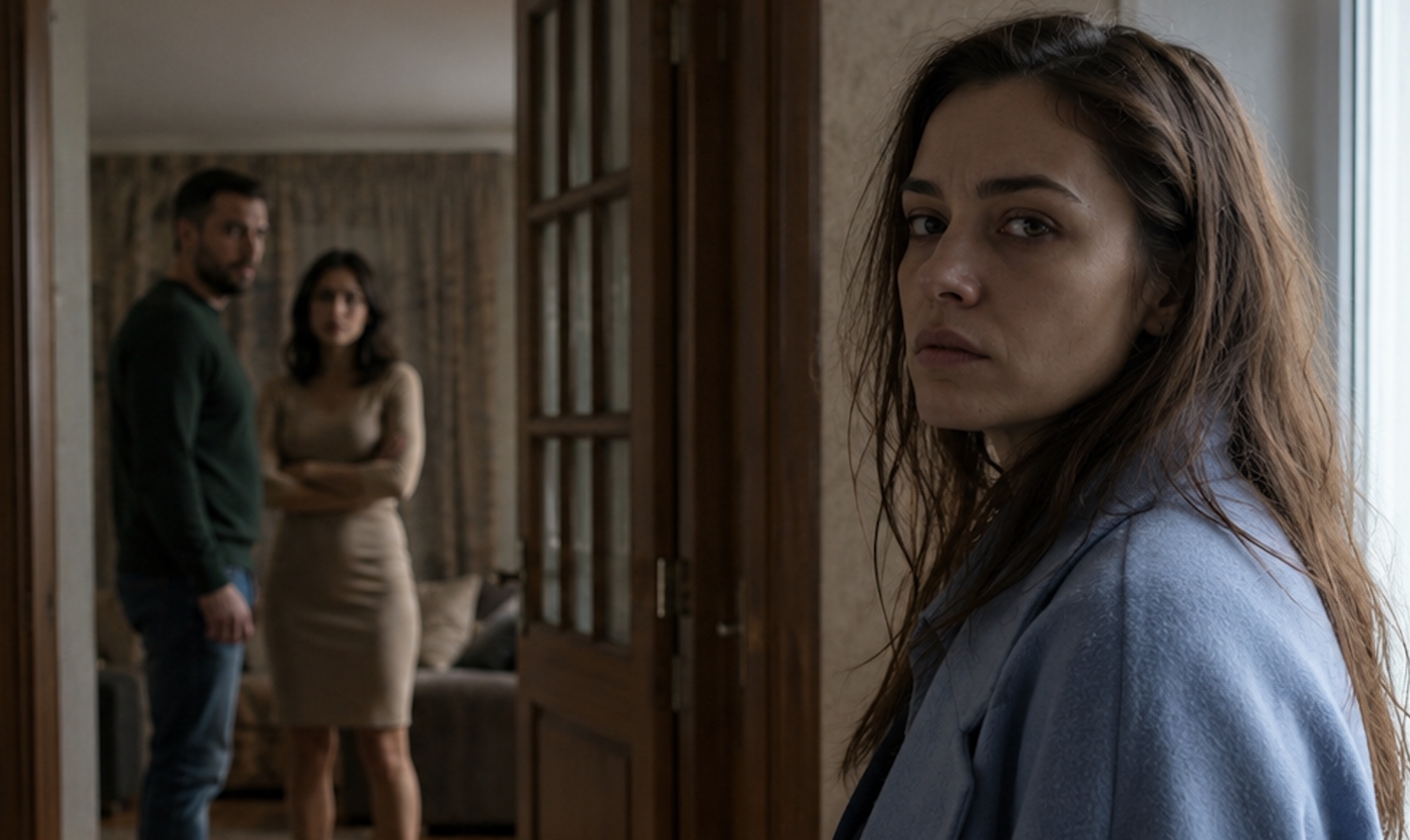
She walked down the corridor. She was not sneaking. But she was not walking normally either. Somewhere inside, she already understood everything. But her mind resisted, desperately offering other explanations: Lera was unwell, Dima was helping her, they were just talking…
The bedroom door was slightly open.
Anya approached it.
Looked inside.
And saw.
She did not scream. She did not collapse.
She simply stood there and looked — one second, two, three.
Then she quietly closed the door.
‘
From the outside.
She returned to the hallway and sat down on the small upholstered bench. Her eyes fell on the yellow chrysanthemums. They were hanging over the edge of the cabinet, their heads bowed.
So ridiculous.
So unnecessary.
Inside her, there was emptiness. No tears. No shouting. Only a ringing silence, as if someone had turned off the sound.
“Head of the department,” she thought for some reason.
And gave a faint, bitter smile.
About ten minutes passed.
From the bedroom came rustling, then quiet laughter.
Lera’s laughter.
The same laughter Anya had known since their first year at university, since the dormitory, since Lera’s wedding — the one that had fallen apart after six months, when Anya had taken Lera into her own home, poured tea for her, comforted her, and drove her to therapy appointments.
That same laughter had sounded at Anya’s own wedding, where Lera had been her witness, crying and saying, “Anechka, you two are such a perfect couple…”
Anya stood up.
She took off her wedding ring and held it in her palm.
Dima had bought it three years ago in a small jewelry shop on Pokrovka Street — simple white gold, nothing flashy. She had loved that ring.
She placed it on the cabinet beside the chrysanthemums.
Then she took out her phone and opened her banking app.
They had a shared account. She had insisted on it herself back then — it had seemed right, honest, mature. The account contained exactly as much money as she had put into it. In three years, Dima had not added a single ruble.
“Once the project takes off, Anyut, you understand,” he always said.
She had understood.
She had transferred money.
She had supported him.
Now Anya transferred everything. Every last ruble. Into her personal account, the one Dima knew nothing about — the account her mother had opened in her name before she got married.
“Never close it, Anechka,” her mother used to say. “A woman’s emergency savings are sacred.”
Then Anya opened Dima’s work email.
He had given her the password once — “in case something urgent comes up.”
He trusted her.
She wrote one email to his boss.
Attached screenshots of correspondence she had found six months earlier, the correspondence she had forced herself to believe was “just work-related.”
It was not just work-related.
There were kickbacks.
Small ones, but regular.
Back then, Anya had kept silent. She loved him. She believed in him. She hoped.
Now she hoped for nothing.
She pressed “send.”
Then there was Lera.
Lera owned a beauty salon. Small. Struggling. Last year, Anya had lent her four hundred thousand rubles for renovations — with a notarized promissory note.
“So everything is official and grown-up,” Lera had said at the time, laughing.
The document was in Anya’s mother’s safe.
Anya called her mother.
“Mom,” she said evenly. “Hi. I need Lera’s promissory note. The one you’re keeping. Do you remember?”
“Anyuta, what’s wrong?” her mother immediately asked, alarmed. “What happened?”
“Nothing. It’s just time to present it. The deadline has passed.”
“Anya…”
“Mom. Later. I’ll explain later. Right now, please do this for me.”
Her mother fell silent. Then she said quietly:
“I’m coming to you.”
“No. Don’t. I’m leaving. Right now.”
“Where?”
“To Aunt Galya’s. To Svetlogorsk. For a week.”
“Anya…”
“Mom, I love you. Everything is fine. Truly.”
She ended the call.
From the bedroom, laughter came again.
Anya went into the study and gathered her documents — passport, diploma, employment records. She threw a few clothes into a small suitcase, then added her laptop and charger.
The last thing she did was take the wedding ring from the cabinet.
She looked at it.
Then she went into the kitchen, opened the trash bin, and dropped it inside.
The ring clinked against a tin can.
Anya closed the lid.
She placed the bottle of champagne on the table.
The very same bottle.
Beside it, she put two glasses and a note:
“Congratulate me. I became head of the department. And I’m leaving both of you. Leave the keys in the mailbox. The apartment is mine — a gift deed, Dima, remember?”
She quietly shut the door behind her and went downstairs.
Outside, the drizzle was still falling, but now it felt real — cold and sharp.
Anya caught a taxi.
“Where to?” the driver asked.
“To the station. Baltiysky.”
Svetlogorsk greeted her with salty wind and a low gray sky.
Aunt Galya, her mother’s younger sister, had lived there for about fifteen years. After her divorce, she had moved “to the sea, away from everyone,” bought a small house two steps from the promenade, and opened a café. Anya had spent every summer there as a child.
“Anyuta!” her aunt said at the station, pulling her into a tight hug.
She asked no questions. She only looked into Anya’s eyes and said:
“Come on.”
They drove in silence in Aunt Galya’s old Niva. Then suddenly her aunt said:
“My café is closing. I’m selling the place.”
“What? Why?”
“New neighbors opened nearby. A chain café. They’re undercutting everyone. I can’t keep up.”
Anya looked at her.
“What if I buy it?”
“You?”
“Me, Aunt Galya. I’m staying here. For good.”
Her aunt nearly drove into a ditch.
For the first week, Anya simply walked along the shore. Across the wet sand, beside the cold water.
Sometimes she cried. Sometimes she suddenly laughed for no reason.
Her mother called, and Anya answered briefly, calmly. Her mother cried.
Anya did not.
Dima wrote to her.
At first, furiously: “What have you done?! I got fired! Was it you?”
Then humbly: “Anyuta, forgive me. I lost my mind. I can’t live without you.”
Then with threats.
Then with pleading again.
Anya did not read his messages. She blocked one number, and he wrote from another.
Lera called once from an unknown number. For some reason, Anya answered.
“Anka,” Lera’s voice was drunk and angry. “Are you serious? You filed the note? Four hundred thousand? I can’t…”
“You can,” Anya said. “Sell the salon. I don’t care.”
“But we were… I was like a sister to you…”
“Sister,” Anya repeated.
And ended the call.
A month later, she bought the premises.
Two weeks after that, it reopened.
She called it Chrysanthemum.
Aunt Galya was surprised by the name, but Anya did not explain.
There was more than enough work. She ran around meeting suppliers, made coffee herself, and learned to bake. Her aunt had an old German recipe for apple pie that everyone there loved.
By November, regular customers began to appear.
Locals. Fishermen. A couple of writers with summer houses.
And an artist — tall, gray-haired, with unexpectedly young eyes.
His name was Andrey.
He came every morning. Ordered a double espresso and a slice of pie. Sat by the window and drew in his sketchbook.
They started talking by chance. One day, he forgot his wallet, and Anya treated him. Later, he brought her a drawing — a portrait of her.
He had not flattered her. Had not made her prettier.
It was simply her.
Tired. Quiet. With something unfinished living in her eyes.
“Where are you from?” he asked.
“St. Petersburg.”
“I’m from Kaliningrad. But I was born…” He smiled faintly. “I was born in St. Petersburg. On Petrogradskaya.”
“I grew up on Petrogradskaya too.”
They looked at each other.
“What street?” he asked.
“Kronverkskaya.”
He froze.
Put down his cup.
“What building?”
“Seventeen.”
Andrey turned pale. He reached into the inside pocket of his jacket and pulled out an old photograph.
He handed it to her.
In the picture was a courtyard.
Her courtyard.
The swings she had sat on as a child. The sandbox. And two children — a little girl of about five in a red coat, and a boy a little older than her.
The boy was holding the girl’s hand.
“That’s me,” Anya said slowly. “That’s… me?”
“That’s you,” Andrey said. “And me.”
They sat in the empty café until late evening.
Aunt Galya closed the hall and tactfully went upstairs.
It turned out their parents had been friends. Very close, almost like family. Andrey had been eight, Anya five. They had lived in the same entrance. Then Andrey’s family moved away — his father had been offered work in Kaliningrad.
Before they left, Andrey’s mother had given little Anya a ring.
A simple child’s ring. Silver, with a tiny blue stone.
“Mom said, ‘This is for your bride, Andryusha. When you grow up.’ And I argued — why should she have it? And Mom said, ‘Then let it be hers. Let her wear it.’”
“The ring,” Anya whispered. “With the blue stone…”
She remembered it.
Vaguely, as if through water.
As a child, she had worn it on a chain. Later, as a teenager, she had lost it. She had searched for it and cried.
Her mother had said, “It will turn up, Anyut. Things like that always do.”
“Why are you here?” Anya asked.
“I came for an exhibition. For one week. I’ve already stayed three months.”
He was silent for a moment.
“I was looking for you,” he said suddenly. “Not on purpose. But all my life, I think I was looking. I knew somewhere out there was the little girl with the ring.”
Anya laughed.
Then she cried.
Then she laughed again.
The next day, she went to St. Petersburg for one day to see her mother.
“Mom. That ring. The child’s ring with the blue stone. Do you remember it?”
Her mother looked at her strangely.
Then she stood up, walked to the chest of drawers, opened the bottom drawer, and took out a small jewelry box.
“It was never lost, Anyut. I hid it. You were a careless teenager, and I was afraid you would truly lose it. Then I forgot about it. I only remembered now, when you called.”
Inside the box lay the ring.
Tarnished. Small.
But the blue stone still shone.
Anya brought it back to Svetlogorsk and showed it to Andrey.
He was silent for a long time.
Then he said:
“Do you know what my mother used to say? ‘When they meet again, they’ll recognize each other at once. Even if half a lifetime has passed.’”
They got married six months later at the Svetlogorsk registry office.
No crowd. No big celebration.
Only Aunt Galya and Anya’s mother. Nina Petrovna had come from St. Petersburg and cried quietly, but these were different tears now.
Another six months passed.
Dima found her.
Through acquaintances of Aunt Galya, somehow, he tracked her down. He came to Svetlogorsk in May. Anya saw him through the café window — standing across the street, soaked by the rain, wrinkled, older-looking.
She went outside.
“Anyut,” he said. “I understand everything now. I’m out of work. Lera left me when she realized I was nothing. I live with my mother. I’m ready to do anything. Forgive me.”
Anya looked at him calmly.
Without hatred.
With a kind of mild surprise, the way one looks at a stranger who has mistaken you for someone else.
“Dima,” she said softly. “Thank you.”
“What?”
“Thank you. Truly. If it hadn’t been for you and Lera, I would have kept living the same life. I never would have discovered that things could be different.”
Andrey appeared in the doorway. He came over and stood beside her. He placed his hand on Anya’s shoulder — not possessively, simply calmly.
He looked at Dima without anger, the way one looks at last year’s snow.
Dima opened his mouth.
Then closed it.
Turned around.
And walked down the wet promenade, hunched and small.
Anya watched him go.
The wind tangled her hair.
On her left hand, hanging from a thin chain, was the little silver ring with the blue stone. She wore it close to her heart.
And on her ring finger was another one, also with a sapphire, only larger. Andrey had found it in an old jeweler’s shop in Kaliningrad.
“Come on,” he said. “It’s cold.”
They went back into the café.
Aunt Galya looked up from the cash register. She asked nothing. She only smiled — that same wrinkled smile she had given Anya when she was a child.
Outside the window, the rain stopped.
Above the sea, the clouds parted, and late May light broke through.
Anya poured herself a cup of coffee.
Then she sat by the window.
Beyond the glass, seagulls cried.