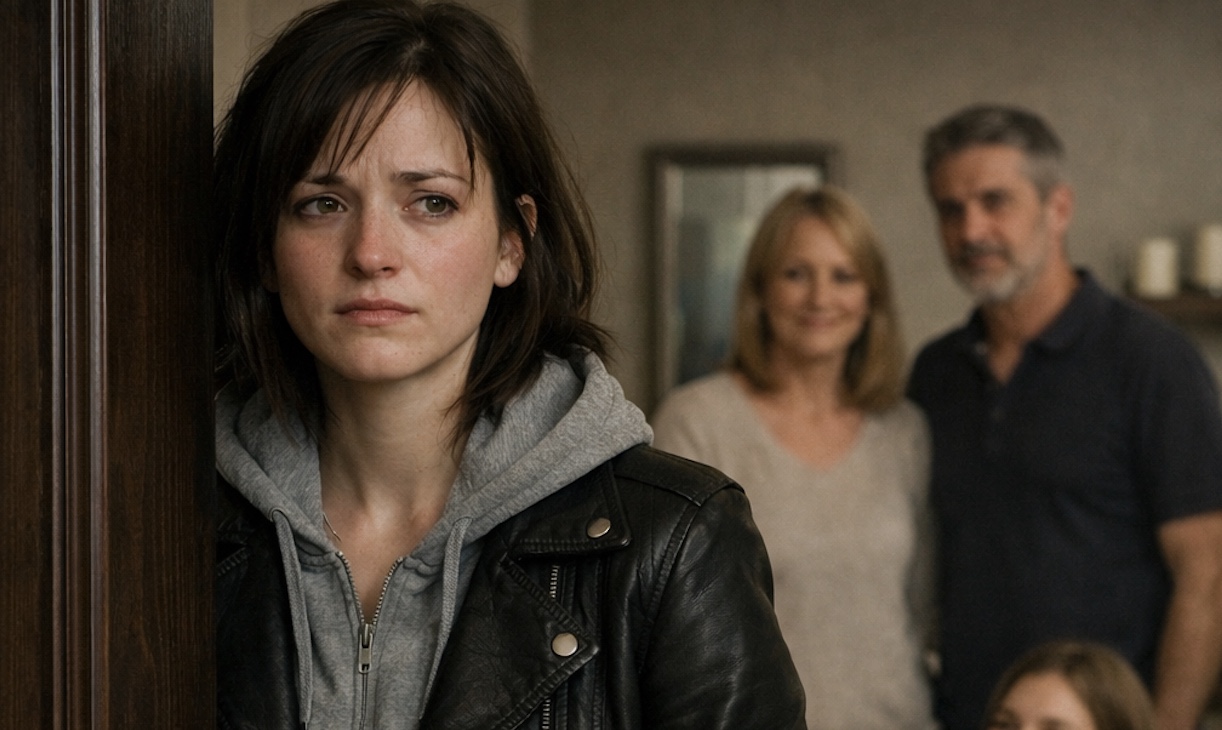
Anna Larionova stood in the entryway of her parents’ old Stalin-era apartment, clutching a cardboard folder of documents to her chest. Four years of payments, hundreds of sleepless nights at the computer, thousands of cups of cheap instant coffee — all of it fit into that folder no thicker than a finger.
“Lerochka is pregnant,” her mother said, nervously twisting the edge of her apron. “And Stanislav has proposed. They need a place to live.”
Her father did not lift his eyes from the newspaper. Behind the wall, the neighbor’s Spitz barked itself hoarse. From the kitchen came the smell of something frying.
“We signed the deed of gift,” Nadezhda Pavlovna said, setting an envelope on the hall table. “Yesterday. The apartment belongs to Lera now.”
Anna stared at the envelope. An ordinary white envelope from the stationery shop around the corner.
“But I paid for it. For four years.”
“This is a decision for the family, darling. It’s the right thing,” Oleg Dmitrievich said, nudging the envelope closer to her.
Something inside her chest snapped loose and dropped, like an elevator with a severed cable.
Back in the summer of 2018, the three of them had stood on the empty plot where the future residential complex “Zapovedny Mys” would rise. Around them were concrete mixers, exposed rebar, and the sharp smell of fresh mortar. A sales manager in a hard hat walked them between wooden stakes marking out the site.
“There will be a playground here, parking over there. Your apartment windows will face southwest, so you’ll get the sun after lunch.”
Her parents had put in all their savings. Her father’s savings, her mother’s bonuses from thirty years working in the library, even the money from selling their dacha outside Kaluga.
“For a peaceful old age,” Oleg Dmitrievich kept repeating as he signed the contract.
A year later, the first letter came from the bank. Missed payment. Her father had been laid off from the research institute — “optimization,” they called it. Nadezhda Pavlovna had been reduced to half-time. In their old apartment, a pipe had burst and they had to pay for repairs in the downstairs neighbors’ place.
At the time, Anna had only just defended her diploma. Junior visualizer at a firm called ArtProject. Salary: thirty-five thousand rubles.
“I’ll make the payments,” she said then, spreading printed calculations across the kitchen table. “I’ll take on extra work. I’ll manage.”
Her mother cried. Her father said nothing. Lera painted her nails in her room — she was eighteen, newly enrolled in the paid journalism program.
“When the mortgage is paid off, the apartment is mine,” Anna said, looking at both parents in turn. “Agreed?”
They both nodded.
The first year was hell. Office work until six, then home to the laptop. Private rendering jobs, revisions until dawn. She slept on the floor beside the system unit — it overheated while rendering and warmed the room better than the old radiator ever had.
She lived on twenty-ruble pasta. Apples only when they were discounted. Coffee — the cheapest instant kind. At work she stuffed her pockets with cookies from office tea breaks.
She kept an Excel sheet. Every kopek accounted for. The “mortgage” column swallowed eighty percent of her income.
Every weekend she hauled the heavy computer tower home because the office machines were too weak for complex projects. Twelve kilos of metal in a sports bag. The neighbors thought she went to the gym.
Her mother called one morning just as Anna was sending off the final render to a client.
“Come over. We need to talk.”
Lera was sitting in the kitchen, stroking her stomach. A ring with a tiny diamond glittered on her finger.
“Stanislav is opening a restaurant,” Lera chirped. “A gastropub with author’s cuisine. We need registration in a good neighborhood for investors.”
The folder slipped from Anna’s hands and hit the floor. Receipts scattered like a fan — four years of payment slips, now weighing nothing at all.
Anna picked up her backpack. Passport, laptop charger, flash drive with projects — she always kept the important things with her. Habit.
“Where are you going?” Nadezhda Pavlovna asked, stepping into the doorway.
“If all my effort means nothing to you, then I have no place here.”
The door closed quietly behind her. Only the Spitz behind the wall let out a mournful howl, as if seeing her off.
She found a room on Vasilyevsky Island through Avito. “Attic room, fifteen square meters, all conveniences, ten thousand.”
Semyon Markovich, the landlord, greeted her in sweatpants and an old tank top with the Olympic bear on it.
“No smoking. No guests after ten. Shared fridge, the middle shelf is yours.”
The room had a dormer window and a slanted ceiling with beams — in one corner you couldn’t even stand up straight. The window stuck and only opened a third of the way. An ancient electric kettle from Soviet times took eight minutes to boil and whistled like a steam train. A mattress on the floor, a particleboard wardrobe, a desk from the same era.
“I’ll take it.”
Anna bought a secondhand foldout chair from a used furniture shop. She hung a calendar on the wall — not with payment due dates, just ordinary days of the week. On the windowsill she lined up three cacti in yogurt cups.
That first evening in the new room, she sat on the floor eating instant noodles straight from the container. An old Audrey Hepburn movie played on her laptop — one she had never had time to finish before. Her stomach burned from the spicy broth, and her chest burned from a strange mix of fear and relief.
Her phone stayed silent. Her parents did not call.
In the second month of attic life, Anna woke to a call from an unknown number.
“Good afternoon, this is Solar Development. You applied for the BIM specialist position?”
The interview was scheduled for the next day. Anna pressed her only white shirt with Semyon Markovich’s iron — an ancient Tefal with electrical tape wrapped around the cord.
In the office, by a glass-walled meeting room, stood a man in jeans and a black turtleneck — Ilya Kramskoy, head of department. He spoke quietly, sketching diagrams on the whiteboard with a marker.
A week later, during her first planning session, they were discussing a shopping center project near Pulkovo. Anna turned a printout over in her hands. Something did not add up.
“Excuse me, but why are the ventilation shafts running through a load-bearing beam on the third floor?”
Ilya looked up from his laptop. The structural engineer flushed red and fumbled through the drawings. It was a mistake. A three-million-ruble penalty if it had made it to construction.
“Stay after the meeting,” Ilya said with a nod.
By the end of that day, she had a new badge: Project Coordinator.
In the department she was welcomed by Karina — red curls, vintage glasses, a unicorn travel mug in hand.
“You’re the new one? Come on, I’ll show you where they hide the decent coffee. We’ve got a club for late-night workers here. Join us.”
Valentin Sergeyevich, a draftsman with forty years of experience, handed her a flash drive.
“Here. Backup copy of the block library. One of these saved me from being fired once. Now it’s our tradition — we give one to every newcomer.”
That evening Ilya sent her a link.
“Try taking this visualization job. Reliable studio. They pay on time.”
The first freelance payment was forty thousand. Anna bought an ergonomic chair and a proper winter coat.
Three months into Solar, Anna was promoted to senior coordinator. Salary: eighty thousand plus project bonuses. Freelance work brought in another fifty.
Semyon Markovich knocked on the attic door.
“Anya, the two-room apartment on the third floor is becoming available. The landlady’s a friend of mine — she’ll give you a discount.”
It was forty square meters, with a separate bedroom and a kitchen window looking out onto a quiet courtyard. Thirty thousand a month. But now Anna could afford it.
She moved in with two suitcases and the computer tower. Ilya drove over in his Skoda with an IKEA desk as a housewarming gift.
“A proper workspace is the foundation of productivity,” he said while screwing on the legs.
Karina brought over a coffee machine she had found on Avito.
“We’ll fix it together. I saw a tutorial on YouTube.”
They did. Anna drank the first coffee in her own kitchen sitting on the floor — there were no chairs yet. But it was hers.
By the end of the year, there were three hundred thousand rubles in her account. Her first real financial safety cushion. She stared at the numbers in the banking app and could hardly believe it — she had earned all of it herself.
One day over lunch Valentin Sergeyevich casually said,
“You know, Kramskoy and I have been talking. If we ever opened our own visualization studio, would you come with us?”
Anna looked up from her salad.
“So there are actual plans?”
“For now, just talk. But think about it.”
In the new apartment, she set up a proper office — shelves to the ceiling, two monitors, a professional drawing tablet. In the evenings she worked on projects of her own — not for money, but because she loved them. She drew houses she wished she could build.
Sometimes Ilya stopped by after work — to talk through projects, drink tea, and look at her sketches.
“You’ve got talent,” he said once, studying a rendering of an art space. “Not just technical talent. You feel space.”
Her life was taking shape brick by brick. Her own home, a stable income, the respect of her colleagues, plans for the future. Everything she had not had a year earlier, when she stood in her parents’ entryway with a folder of documents in her arms.
A year and a half passed with no contact between Anna and her family. She was checking a housing complex model when her phone exploded with messages. Seventeen missed calls from her mother.
Anna stepped into the corridor and called back.
“Anya, it’s a disaster. Lera… Stanislav has lost everything. The restaurant actually closed in the spring, but he hid it. He’s been taking microloans at two hundred percent interest.”
A baby was crying somewhere on the other end of the line — her nephew Misha was a year and a half old.
Stanislav’s gastropub had lasted eight months. Duck in cherry sauce for three thousand rubles, tiny plates, black walls. By spring, the only customers left were friends who came to eat on credit.
“He mortgaged the apartment to some shady company,” her mother sobbed. “The apartment was in Lera’s name. We signed it over ourselves. She knew, but kept quiet. She didn’t want to upset us.”
From what her mother said, bailiffs had sealed the door of the apartment in Zapovedny Mys. A red notice stretched across the lock, with official papers posted on the door.
Stanislav had received a court summons. Lera had been ordered to vacate within ten days.
“Anya,” her mother cried, “help us. We need money, two million to pay off the debt. Or at least let Lera and little Misha stay with you. You have a spare room.”
Anna looked at her laptop screen. The Excel sheet with all the savings she had built while working at Solar. The first real safety net she had ever had.
“I’ll help, but not at the cost of my home and not at the cost of my savings.”
“But we’re family!”
“Exactly. That’s why I’ll help — but not by destroying myself.”
They arranged to meet in a café on Nevsky Prospekt. Her parents looked five years older. Lera did not come — too ashamed to face her.
Anna pulled out her tablet and opened a document she had prepared in advance.
“Write this down. Maria Sergeyevna Kotova — lawyer for personal bankruptcy cases, works with government support programs, first consultation is free. Subsidized housing program for families with children — here’s the State Services link, Lera qualifies on every point. Free retraining courses for SMM managers through the employment center — with her degree, Lera could finish in a couple of months.”
Her father wrote everything down in a notebook. Her mother looked at her daughter as though she were a stranger.
“And money? At least a loan?”
“I won’t give money. Those are my boundaries.”
For the first time in her life, her father looked at her with respect.
“You’ve grown up, Anya.”
A month later, Lera sent her a photo — keys to a studio apartment in Kupchino. Social housing, twelve thousand a month. In the background were cardboard boxes, a folding IKEA table, and Misha’s crib.
Stanislav got a job as a car dealership sales manager. No big ambitions, but steady.
Oleg Dmitrievich found part-time work at the polytechnic college — three days a week as a drafting consultant. He sent Anna a smiling emoji: “The students call me Grandpa, but they listen.”
Nadezhda Pavlovna signed up for a support group run by a district psychologist. Free through public insurance — Anna had found the contact details for her.
“There are women there with stories just like mine,” her mother called every Thursday. “One gave her apartment to her daughter, and the daughter sold it. Another helped her son start a business, and it collapsed. After the sessions we have tea together and bring pies for each other.”
At Solar Development, Anna was called into the general director’s office.
“Kramskoy wants to spin visualization off into a separate division. Will you head it? Ilya will be technical director. You’ll be creative director.”
Ilya was waiting for her by the coffee machine.
“Do you agree to a partnership? Fifty-fifty.”
They shook hands. Firmly, professionally. Then Ilya smiled.
“Should we celebrate? I know a good place.”
They found a space two weeks later. The attic floor of a former candy factory on Obvodny Canal. Three hundred square meters, brick walls, metal beams, skylights overhead.
Anna knelt on the floor, sketching the layout in chalk.
“Glass meeting room here. Lounge area with sofas there. Coffee point by the window. Shelving for material samples along that wall.”
Ilya took pictures of her as she worked. A slim figure in jeans and an oversized shirt, hair twisted into a messy knot, face intent with concentration.
“This is going to be the best studio in the city,” he said.
“Our studio,” Anna corrected.
The glass door with the logo “AK Visualization” swung open every five minutes. After one year of work, they had twelve employees.
Karina waved a color palette in front of two interns.
“Terracotta, not ochre! The client said warm shades for the kindergarten.”
Valentin Sergeyevich lounged in a beanbag chair, telling the younger staff stories.
“And then the director says, where are the drawings? And I tell him — on the server, where else? Three backup copies, just like Anna Sergeyevna taught us.”
On the wall hung a rendering of the Baltic Pearl residential complex. Their first major studio contract: fifteen million rubles.
Then the bell rang.
Nadezhda Pavlovna stood there holding a tray, Oleg Dmitrievich carrying a thermos.
“Apple charlotte,” her mother said. “With Antonovka apples. Remember how much you loved it?”
Anna showed them around the studio. Her mother touched the glass partitions. Her father studied the drawings glowing on the monitors.
“All this is yours?” her mother asked, gesturing around the space.
“Ours,” Anna replied. “Mine, Ilya’s, and the team’s.”
Her parents looked at one another. In their eyes was the respect that had never been there before.
After they left, Anna stood beneath the skylight. Below her stretched the rooftops of Obvodny, the tram lines, the endless movement of people. On her tablet was a sketch for a cultural center in Kronstadt.
I built my own space with my own hands, she thought, adding another line to the drawing. Now I can build anything I want.
The studio smelled of coffee and watercolor paint. Behind the glass partition, Ilya was explaining the finer points of BIM to the interns. Karina and Valentin Sergeyevich were arguing about color.
An ordinary working evening in a place she had created for herself.