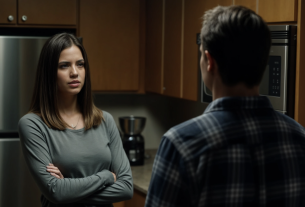
“You’re moving out of my apartment today,” Olga said calmly.
She said it so evenly, as if she were not throwing her husband out, but merely reminding someone that he had forgotten to turn off the bathroom light.
Andrei did not even understand her words at first. He was standing beside the open wardrobe, holding a folded shirt in one hand while the other rested on the wardrobe door. On the floor near the bed were two suitcases, his belts, a folder of documents, a box of tools, winter boots, and neatly stacked T-shirts. It all looked as though he was not packing to leave the home, but settling into it again — only now according to his own rules.
Olga closed the front door, took off her coat, hung it on the hook, and only then looked more carefully into the room. Her first thought came almost automatically: perhaps her husband had been urgently sent on a work trip. In recent months, he had already had several sudden trips around the region. He would throw things into a suitcase, rush through the apartment looking for a charger, then irritably ask her to find his documents, even though he was always the one who had put them somewhere.
But this time, something was different.
This time, next to the suitcases stood his old cardboard boxes — the kind people use when they are moving. On one box, written in black marker, was: “Kitchen.” On another: “Office.” On the third: “Mom’s.”
That word stopped Olga more sharply than anything else.
She placed her bag on the dresser, calmly took off her shoes, and walked into the room. On the table lay printed advertisements for beds, sofas, and wardrobes, marked with notes in pen. Beside them were a medical statement, a list of medications, a photocopy of Galina Petrovna’s passport, and a sheet of graph paper with a rough sketch of the apartment.
On that sketch, a cross had been drawn over the small room Olga had arranged for herself many years earlier. It held her writing desk, sewing machine, a narrow cabinet full of fabrics, an ironing board, boxes of work materials, and a fold-out sofa where she sometimes fell asleep after working late into the night.
Andrei followed her gaze and cleared his throat.
“You’re home already? Good. I was just about to talk to you calmly.”
Olga raised her eyes.
“I can see that.”
“Just don’t start immediately, okay? It’s not what it looks like.”
She looked at the box marked “Mom’s.”
“Oh? And what does it look like, then?”
Andrei put the shirt down on the bed and began speaking in the tone of a man announcing something that had already been decided, while still trying to present it as a discussion.
“Mom is having a hard time living alone right now. The house in the village is damp, the stove keeps acting up, the neighbors are hardly ever around. She’s been complaining about her blood pressure again, her knees, and how frightened she gets at night. I thought we should bring her here for a while. Until she gets stronger. Until something is sorted out with the house.”
Olga said nothing. She walked to the table, picked up one of the printed pages, glanced over an advertisement for a narrow bathroom cabinet, then placed it back down.
“For a while?” she asked.
“Yes.”
“And where exactly is your mother supposed to live?”
“In the small room.”
“In my room,” Olga corrected.
“Olya, don’t start picking at words. It’s not your room. It’s a room in the apartment.”
She slowly turned her head.
“In my apartment.”
Andrei grimaced, as if she had once again dragged out an old topic that would have been better left untouched.
Olga had inherited the apartment after her aunt passed away. Not through connections, not through someone’s help, but legally, as the only heir. It had taken six months to complete the paperwork, then came the renovation, and only after that the move. Andrei had entered her life when the apartment already had new windows, light laminate flooring, and a renovated bathroom.
After the wedding, he simply moved into a finished space and quickly began calling it theirs, even though legally he had no claim to it at all.
At first, Olga did not argue. In everyday life, it had simply been easier to say “our home,” “our kitchen,” “our bedroom.” She had felt it would be petty to correct the man she lived with every single time.
But recently, Andrei had started saying the word “ours” with too much confidence. Not out of habit anymore — but with ownership.
“We’ve already discussed everything,” he continued. “Mom agrees. Tomorrow I’ll order a moving truck and pick up her things. On Sunday, a handyman will come and see how to rearrange the room properly.”
“We?” Olga repeated.
“Mom and I.”
“So, without me.”
“I was going to tell you.”
“When? After her bags were already standing by the door?”
Andrei let out a sharp breath.
“Olya, why are you being dramatic? We’re talking about my mother. Not some stranger.”
“I asked a simple question. When were you going to tell me?”
“Today.”
“After you had already removed my things from the room?”
He shrugged.
“I haven’t removed anything yet.”
Olga stepped toward the small room, opened the door, and froze.
Inside, her desk had already been shifted. The boxes of fabric had been taken down from the top shelf and lined up in a row. Her blankets, pillows, and rolls of patterns were neatly stacked on the sofa. Half of the things had been removed from the cabinet. Empty flowerpots stood on the windowsill — only yesterday she had been planning to plant herbs in them.
The picture was clearer than any explanation.
The decision had not merely been made behind her back.
It had already started being carried out.
She slowly ran her hand along the back of the chair, looked at the moved desk, and suddenly remembered with painful clarity how she had chosen the lamp for this room, how she had assembled that cabinet by herself using the instruction manual, how she had refused to throw away her aunt’s old bookcase because it was sturdy and practical.
Andrei almost never came into this room. He called it “your corner,” where threads and papers were always sticking out everywhere.
And now he was calmly treating it as if it were a storage closet.
“You’ve already decided everything here,” Olga said without turning around.
“I’m telling you, the situation is unavoidable.”
“No. You’re not telling me. You’re presenting me with a fact.”
“Because it’s impossible to discuss anything calmly with you! You react to every request as if someone is attacking you.”
Olga turned to face him.
“A request?”
“Yes. A normal human request. My mother will live with us until things get better.”
“How long is ‘until’?”
“How should I know? A month. Two. Maybe until spring.”
“And after that?”
“Then we’ll see.”
Those two words always meant the same thing: later, no one would leave, nothing would change, and the new situation would be declared the natural order of things.
That was how it had been with his garage shelves in the hallway closet. With his “temporary” boxes on the balcony. With Galina Petrovna’s dinner set, which had once been placed in their kitchen cabinet “just for now.” Everything Andrei brought into the apartment as temporary quickly grew roots.
Olga knew this. And that was exactly why she was silent now — not out of confusion, but because of the dangerous inner coldness that comes when everything falls into place without needing any more words.
“Here’s what we’ll do,” Andrei said, softer now, as though he sensed he needed to change his tone. “Mom is struggling. She’s not some stranger off the street. And besides, no one is asking anything terrible from you. We’ll move your desk into the bedroom. The sewing machine can go into the storage closet for now. The fabrics can go on the upper shelves. We’ll leave the sofa for Mom. She’ll be comfortable there. She’s elderly. She needs peace.”
Olga looked at him for a long moment, almost in disbelief. His face was focused, even noble. He truly saw himself as a caring son making the right decision.
It did not bother him that he had not bought the apartment. It did not bother him that he had been moving her things without asking. It did not bother him that another person’s life had already been rearranged on a sheet of graph paper.
“Do you hear yourself?” she asked.
“Perfectly.”
“You took control of my room. My belongings. My home. And now you’re explaining to me exactly where I’m supposed to live inside my own apartment.”
“There it is again. ‘Mine, mine, mine.’”
“Because it is mine.”
“We’re husband and wife.”
Olga gave a short, humorless laugh.
“And what does that change? Does it cancel the documents?”
Andrei was already losing patience.
“You know what? Sometimes you act as if I’m a stranger here.”
“Today, you worked very hard to make me think exactly that.”
He stepped toward the table, picked up the papers, and shook them in the air.
“I’m not stealing your apartment. I’m trying to help my mother. That’s normal.”
“What’s normal is asking first.”
“I knew you’d start resisting!”
“No. You knew I might say no. That’s why you decided to skip the conversation.”
The words hit their mark. Andrei looked away and placed the papers back on the table a little more sharply than necessary.
Olga did not continue arguing. She walked into the hallway, opened the closet, took out several large household bags, and returned to the room.
Andrei watched in silence as she began calmly placing his belongings into them: belts, a stack of T-shirts, his razor, a box of chargers, a folder of receipts, a tracksuit, a sweater, socks.
Then she picked up the box marked “Kitchen,” carried it into the hallway, and placed it closer to the door. Then the second box. Then the suitcase. Then the boots.
“What are you doing?” he finally asked.
She did not answer. She went back, picked up another box, and carried it out without rushing.
“Olga.”
She placed the box against the wall, returned, and looked at him.
That was when she said:
“You’re moving out of my apartment today.”
The room became so quiet that they could hear the refrigerator motor start in the kitchen.
Andrei blinked, then smirked in disbelief.
“Are you serious?”
“Yes.”
“Because of this?”
“Not because of this. Because you decided you could run things here without me.”
“Do you even understand what you’re saying? I’m your husband.”
“And I am the owner of this apartment. And the person you just excluded from a decision concerning her own home.”
“Oh, stop exaggerating! We’re talking about my mother, not some scam.”
“If it benefited you, you’d probably call a scam an unavoidable measure too.”
He stepped closer to her.
“You’re emotional right now.”
“No. Right now, I am completely calm.”
The calmness in her voice really was more frightening than any shouting. Andrei felt it and changed tactics.
“Fine. Let’s not get hysterical. We’ll sit down, talk, find a solution.”
“The time for solutions was before you went into my room with boxes.”
“I haven’t done anything irreversible.”
“You have. You showed me exactly how you plan to live from now on. Without asking. But with full confidence that I’ll swallow it.”
He ran a hand over his face, as if trying to wipe away the irritation clinging to it.
“And where, exactly, am I supposed to go?”
“That was something you should have asked yourself before you started making space for your mother.”
“I have things here too, you know! I live here.”
“Not anymore.”
She said it so matter-of-factly that, for a second, Andrei seemed genuinely thrown. Then he laughed loudly.
“You’re throwing me out? Really? Just like that?”
“Not just like that. After you tried to remove me from part of my own apartment, only with different words.”
“No one was removing you!”
Olga nodded toward the small room.
“Go in there and say that again.”
He did not go. He only glanced quickly in that direction and fell silent.
That silence was enough.
Olga took out her phone.
“What are you doing?” Andrei asked, suddenly alert.
“Calling Lida.”
“Why Lida?”
Lida was Olga’s cousin. She was a woman of few unnecessary words and no habit of smoothing over other people’s arrogance. Three years earlier, when a pipe burst in Olga’s kitchen, Lida had arrived before the emergency plumber and within ten minutes was commanding two repairmen as if she had done it all her life.
Andrei disliked her. He used to say that a woman like that was better not argued with.
“Because I need witnesses in case you decide to put on a show,” Olga replied.
“You’ve lost your mind.”
“Maybe. But at least I don’t move other people’s things without permission.”
Lida answered immediately. Olga explained briefly, without sobbing or complaining, what had happened. Her cousin was silent for a second, then said:
“I’m coming. Don’t let anyone leave and don’t move those boxes away from the door.”
Andrei listened, his face growing redder and redder.
“So you’ve decided to humiliate me in front of your relatives?”
“No. I’ve decided that the conversation about you leaving will not happen privately.”
“Leaving! Listen to the words you’re using.”
“Very accurate ones.”
He sat down on the edge of the bed, pressed his palms to his knees, and began speaking more quietly.
“Olya, don’t do this. Let’s be normal. Mom really isn’t in good shape. I can’t leave her alone.”
“Take her to your place.”
“What place?”
“Exactly.”
He raised his head.
“Are you mocking me?”
“No. I’m simply stating the reality you didn’t think about. You didn’t find housing for your mother. You didn’t prepare any separate option. You simply decided to occupy my home.”
Andrei stood up abruptly.
“That’s enough. I’m not going anywhere. You’ll cool down, and then we’ll talk.”
Olga nodded and dialed another number.
This time, she called the local police station responsible for their building. Not screaming. Not dramatic. She explained that there was a conflict in her apartment, that her spouse was refusing to leave after beginning to clear a room without her consent for the relocation of a third person, and that she needed officers to come to prevent an escalation and document the situation.
Andrei stepped closer.
“Have you completely lost it?”
She moved her hand away, not letting him look at the screen.
“Don’t touch me.”
“You called the police?”
“Yes.”
“Because of a family conversation?”
“No. Because of a person who decided he could force his way into my property and reshape it for himself.”
For several seconds, he stared at her, then turned away and slammed the wardrobe shut with such force that the mirror shook.
“Excellent. Just excellent. Look what you’ve brought this to.”
Olga did not even raise an eyebrow.
“I wasn’t the one moving furniture this morning and drawing up apartment plans behind someone’s back.”
Lida arrived about twenty minutes later. Andrei had spent that time pacing the bedroom, calling someone, then falling silent again. At one point, he did call his mother and began saying irritably into the phone that “nothing is clear yet.” From the fragments Olga heard, she understood enough: Galina Petrovna had already packed some of her things and was waiting for the weekend, fully convinced that she was moving to the city.
So this decision had been discussed for more than one day.
Lida entered without fuss. She simply looked around the hallway, glanced at the boxes by the door, then at Olga’s face.
“I see,” she said. “Hello, Andrei.”
“Very funny,” he muttered.
“Depends who you ask.”
Lida took off her shoes, walked into the room, looked inside the small room, came back, and let out a low whistle.
“Well, from what I see, you weren’t just talking here. You were already acting like the owner.”
“Don’t make me out to be a monster,” Andrei snapped. “I wanted to bring my mother to live with us.”
“With us?” Lida repeated. “When exactly did you buy half of this apartment?”
“We’re family.”
“Don’t say that phrase to me. I can’t stand it,” Lida cut him off. “Especially when people use it to justify putting their hands into someone else’s wardrobe.”
For the first time that evening, Olga let out a small breath. Not from relief — but because someone had finally named what was happening without wrapping it in polite excuses.
Ten minutes later, two police officers arrived. The younger sergeant wrote down the statements. The older one looked at the boxes, the room, the papers on the table, and asked Andrei:
“Are you registered at this address?”
Andrei gave another address — in the village.
“The apartment belongs to your wife?” the officer clarified.
“Yes, but I’m her husband.”
“We heard that already. The owner is asking you to leave the residential property. I advise you not to escalate the conflict.”
Andrei spread his hands.
“And where am I supposed to go at night?”
The older officer looked at him without sympathy.
“You should have thought about that before you began placing third parties in the apartment without the owner’s consent.”
The wording sounded especially dry and final. Not “mother.” Not “relative.” A third party.
Andrei went pale.
“I wasn’t placing anyone here.”
Olga opened the desk drawer, took out the apartment sketch, the medical statement, the passport copy, and silently placed everything in front of the officer.
He looked through the papers and handed them back.
“Pack your things,” he told Andrei. “Voluntarily. Without a scandal.”
There was no point arguing anymore. At first, Andrei twitched as if he might object, but then seemed to deflate. He silently zipped the suitcase, picked up one box, then another.
Lida stood in the hallway, leaning against the wall, watching so closely that there was no chance of him “forgetting” the keys.
When he carried out the first load, Olga walked to the small cabinet by the door and opened the ceramic bowl where they always kept the keys. The apartment key lay on top. Apparently, Andrei had intended to come back and take the rest without witnesses — or simply assumed the whole matter could still be replayed.
She took the keyring and put it in her pocket.
On the second trip, Andrei noticed.
“Give me the keys,” he said darkly.
“No.”
“That’s my key.”
“Not anymore.”
“Olga, don’t make a circus out of this.”
“You started the circus this morning when you began clearing out my room.”
He looked at the police officers, then at Lida, then at the boxes by the door, and understood that he would not be able to push through. So he tried another approach.
“Fine. At least let me come tomorrow for the rest.”
“Tomorrow, you’ll come at an agreed time. With me present. And alone.”
“And what do you suggest I do with my mother?”
For the first time, Olga stepped almost close to him.
“Put her wherever you were planning to live yourself. That is no longer my problem.”
He opened his mouth, but no words came out.
Half an hour later, the apartment felt strangely spacious. As if, along with the boxes and suitcases, some heavy, sticky pressure Olga had been trying not to notice for months had also been carried out.
It was not only today’s unauthorized attempt to move his mother in. The signs had been there for a long time: his irritation when she refused to let his brother stay with them for a month; his endless comments about how the small room could be “used more rationally”; his phrases about one person having too much space.
Today, it had simply reached the point beyond which there was no stepping back.
The police left. Lida helped her put everything back in the small room. The desk returned to the window. The boxes of fabric went back onto the shelves. The sofa took its place again. A mark from a dragged box remained on the floor, and Olga stared at that stripe for a long time before bringing a bucket, a cloth, and wiping it away herself.
“How are you?” Lida asked later in the kitchen.
Olga placed two mugs on the table, filled the kettle, and took out some cookies.
“I’m fine.”
“Are you lying?”
Olga sat down, clasped her hands together, and only then allowed herself a real reaction. Not tears. Not hysteria. She simply sat motionless, stared at the table, and slowly nodded several times, as if checking the fastenings inside herself.
“Do you know what hurt me most?” she finally said. “Not that he wanted to bring his mother here. It was how calmly he had already divided everything up. Where I would sit. Where I would put my things. How everything would look. They didn’t even see me as an obstacle. As if I was simply supposed to move aside.”
Lida placed her palm on the table.
“That’s exactly why you did the right thing.”
“He was sure I’d swallow it.”
“That’s why he moved the boxes during the day, instead of talking to you in the evening.”
Olga gave a half-smile.
“And he still would have called it a family decision.”
That night, Andrei sent fourteen messages. At first, they were angry. Then hurt. Then cautious. Then he began pressing on pity: he had to spend the night at an acquaintance’s place, his mother was upset, he had not expected Olga to “go this far.”
At the end came the classic line: “Let’s cool down and discuss everything like adults.”
Olga did not answer a single message.
In the morning, she called a locksmith and arranged to have the lock changed. Not because anyone had filed a report or staged a ceremony. Simply because it was calmer that way.
The locksmith came during the day, carefully removed the cylinder, installed a new one, turned the key a few times to check it, and left. Olga put the old set into her desk drawer together with the apartment documents.
Two days later, Andrei came for the rest of his things. Alone, as agreed. No shouting. No mother. His face was gray and stubborn.
Olga did not open the door immediately. She opened it only after checking through the peephole that there was truly no one else on the landing.
“Come in,” she said.
He entered, looked around the hallway, then the room. Everything was already back in its place. As if no relocation had ever been planned.
“You worked fast,” he said.
“Not really. I just returned the apartment to myself.”
He said nothing. He collected the remaining things from the balcony, took his books, tools, two jackets, and a box of papers. Near the door, he stopped.
“So you’re really destroying our marriage over this?”
Olga looked him straight in the face.
“You started destroying the marriage the moment you decided my consent wasn’t necessary.”
“I wanted to help my mother.”
“No. You wanted to solve her problem using my square meters.”
Andrei shook his head.
“You were always stingy with space for everyone.”
“That’s not true. I only feel sorry for myself when someone tries to use me.”
He had already taken hold of the suitcase handle, but still did not leave.
“So what now? Divorce right away?”
“And what did you want? To move your mother in first and then see what happens?”
His cheek twitched.
“I see.”
“Yes. Now it’s clear.”
He left without saying goodbye.
Olga closed the door, turned the new key in the lock, and suddenly noticed that for the first time in a long while, the apartment was quiet in exactly the way she liked.
Not empty.
Not hollow.
Just quiet.
Over the following weeks, Andrei disappeared, then started writing again. Sometimes he suggested meeting. Sometimes he accused her of ruining everything out of stubbornness. Sometimes he promised that his mother would not move in anymore and that they could “start over.”
But Olga remembered not his messages — she remembered the sheet of graph paper with the apartment plan and the cross over the door of her room.
That contained everything she needed to know about his “starting over.”
They divorced later through court. Not because Olga wanted to drag things out, but because Andrei refused to agree for a long time, hoping he could still reverse the situation. There was nothing to divide: the apartment did not belong to him, and they had no shared property worth fighting over. But the dispute over the divorce itself was enough to prevent it from being settled at the registry office.
Olga went through the process calmly, without loud declarations. She no longer needed to prove anything to him.
Galina Petrovna did call once. She began from afar, then moved into offense, then reproach. She said Olga had left her son without a roof over his head, that family should not be treated that way, and that old age does not forgive such cruelty.
Olga listened and answered only once:
“Your son lost access to this apartment not because I threw him out. He lost it because he decided he could manage it without me.”
After that, the calls stopped.
By spring, the small room had come fully back to life. Olga sorted through the fabrics, finished arranging the shelves, bought a comfortable chair, and placed a new desk lamp inside. Green herbs grew in pots on the windowsill. A corkboard appeared on the wall, covered with notes and sewing patterns.
It was not about creating a cozy life after divorce. It was not about showing anyone that she had moved on.
It was simply about putting things back where they belonged.
Sometimes Lida came over in the evening, looked around the room, and gave a satisfied hum.
“Good thing you didn’t talk yourself into tolerating it back then.”
At moments like that, Olga remembered that evening in every detail: the boxes by the bed, the word “Mom’s” written on cardboard, his confident voice, the apartment plan on the table.
And every time, she understood the same thing: the most important part of that story was not the argument, not the police, and not the door closing behind him.
The most important part was the moment when she stepped out of the small room into the hallway, saw his boxes, and suddenly understood with perfect clarity:
If she stayed silent now, tomorrow there would not be a single thing left in her home that she alone had the right to decide about.
That was why she had not argued until midnight. She had not tried to prove anything to anyone. She had not thrown around loud words or begged a man to remember his conscience.
She had simply moved his boxes closer to the door.