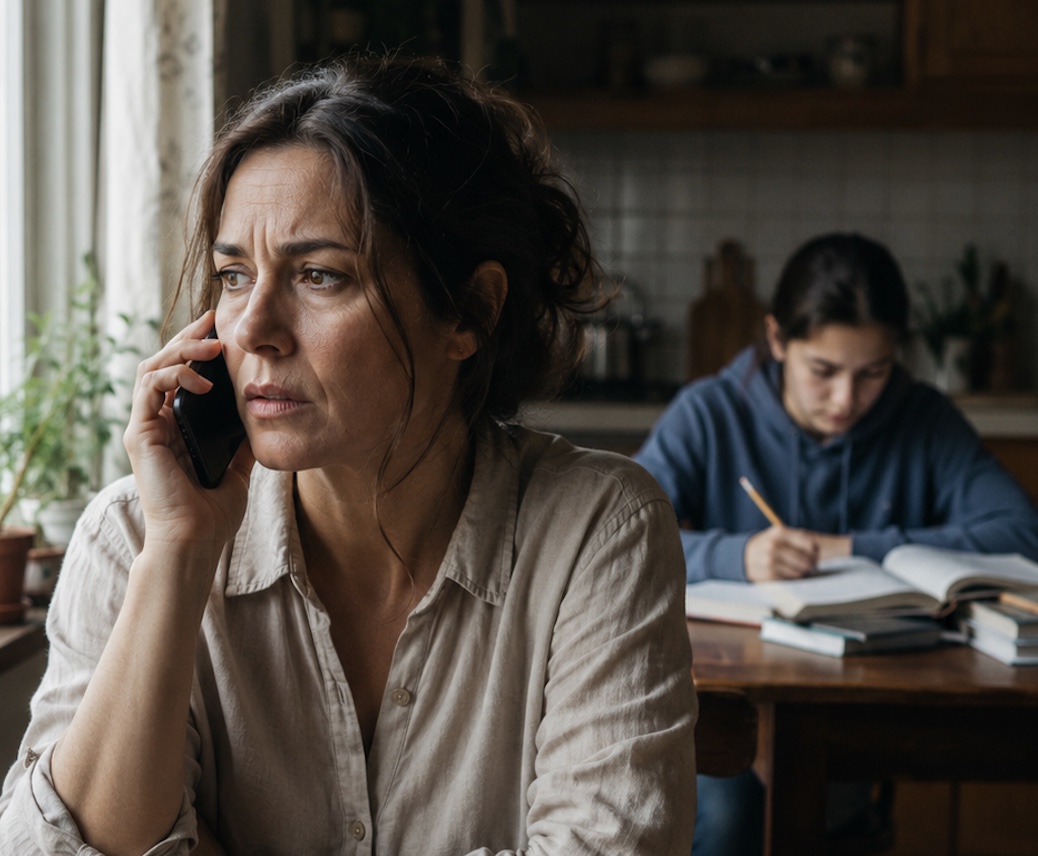
Exactly one year of silence was broken by a phone call. The name flashing on the screen made everything inside her tighten: Sergey. Tamara knew immediately. He was not calling to ask how she was.
A thin film had already formed over the tea in her mug. She sat in the kitchen, listening to the familiar sounds of the evening. The refrigerator hummed in a low tone. The wall clock—the same one they had bought during the first year of their marriage—counted the seconds with a quiet, irritating tick. From her daughter’s room came the muffled tapping of keys: Yulia was typing something, preparing for tomorrow’s seminar. The world was quiet, predictable, and balanced on three steady points: work, her daughter, and this evening tea by the darkening window.
Over the past year, Tamara had learned to value that predictability. Her mornings no longer began with the sharp smell of men’s cologne in the bathroom, but with silence and her own thoughts. She could eat breakfast while reading the news on her tablet instead of half-listening to his grumbling about politics.
At work, in the HR department of a small company, she was appreciated for her accuracy and composure. Her colleagues probably had no idea that her personal life had fallen apart a year ago. She had not mourned her marriage publicly. She had not complained.
She had simply become quieter, more collected, as if she had carefully packed away all unnecessary emotions and filed them in an archive along with his belongings. Sometimes, while filling out employment records, she caught herself calculating the length of her own loneliness. One year. It was no longer a catastrophe. It had become a fact of her biography.
She wrapped both hands around the cup, trying to catch the last traces of warmth. Her fingers found the familiar chip on the handle. A year. Eleven months and seventeen days, to be exact—and Tamara liked being exact about everything. During that time, she had stopped jumping at the sound of the doorbell. She no longer flinched when someone else’s door slammed in the stairwell. She had learned to sleep on her right side, though for twenty years she had slept on her left because Sergey tossed and turned and jabbed her with his elbow. The body forgot faster than the mind did.
On the dresser in the living room stood a glass vase. Inside it was a bouquet of roses, once bright red, now resembling clumps of dusty brown paper. Sergey had brought them on their last shared birthday, a month before he announced that he was leaving. She had never thrown them away. Not out of sentimentality.
That vase with the dead flowers was simply the most accurate image of what remained of their marriage: the shape was still there, but everything inside had dried up and would crumble at the slightest touch. It had become her private ritual—not to remember, but to acknowledge. Every evening, on her way to her room, she looked at them.
The phone vibrated again, stubbornly crawling across the table.
Tamara picked it up. Her finger hovered over the red button. But if she did not answer, he would call Yulia. Or he would come over. That was how things worked with Sergey: silence was a challenge, and a challenge meant a siege.
She remembered once, back when they still lived together, she had missed three of his calls while he was at work. That evening he burst into the apartment, sweeping everything out of his way, shouting that she was obligated to pick up the phone because he might have had something urgent to say. The urgent matter turned out to be a question about where she had put his passport.
It was in the same place as always. But she learned the lesson. Silence in response to his call was a provocation. And she could no longer afford provocations.
She slid her finger across the screen.
“Hello.”
“Tamara? It’s me.”
His voice. Low, with that same hoarseness that appeared in the evening or whenever he was nervous. The sound sent goosebumps down her back, familiar and unpleasant, like metal scraping against glass.
“I can hear that.”
“How are you?”
She did not answer. She waited. She knew it was not a question. It was reconnaissance.
“Listen, I need to meet with you. We should talk. Like normal people.”
“About what?” Her own voice sounded flat to her, almost lifeless.
“Different things. And Yulia too. How is she?”
“She’s studying. Everything is fine.”
“That’s good. I’m free tomorrow evening. Can I stop by? Around seven?”
“To your place.” Not “to your and Yulia’s place.” He erased boundaries on purpose. Always on purpose. Tamara looked at the shadow of the vase stretching across the kitchen floor, long and ugly.
“All right,” she said. “But not at seven. At eight.”
“Agreed. See you tomorrow.”
He hung up without saying goodbye. He had always done that—ended the conversation the moment he got what he wanted. Tamara placed the phone face down on the table. The palm that had held it was damp. She stood, went to the sink, and turned on the tap. She let cold water run over her wrists, the way her grandmother had once taught her to do when frightened. The water flowed, but the lump inside her remained. He had returned. Not into her life, no. He had returned into her silence. And now that silence was poisoned.
The entire next day passed in a strange, blurred state.
Tamara did everything automatically: checked reports at work, stopped by the store, bought the cookies Sergey used to like with tea.
Later, already at home, she stared at the package in her hands for a long time and then shoved it into the far corner of the cupboard. Why? She did not know. Maybe it was an attempt to appease the beast she herself had allowed into the house. Or maybe it was a test: had anything changed in her reactions over the year? It turned out something had.
Before, she would have bought those cookies thinking, Let him be pleased, with anxiety and hope. Now she had bought them with cold calculation, the way one buys bait for a trap. That realization was both bitter and sobering. Love—that sticky feeling that had kept her beside him for so many years—was gone. Only the instinct for self-preservation remained, along with a mother’s duty. And perhaps that was even stronger.
By eight o’clock, she was ready. She wore a simple blue turtleneck and jeans. Her hair was pulled into a tight bun. No makeup. It was important not to look provocative, but not pitiful either. Neutral. A fortress that had no intention of surrendering, yet did not display its weapons on the walls.
She walked through the apartment, straightening cushions on the sofa, wiping invisible dust from the table. That too was a ritual—the preparation of the battlefield. In her mind, she ran through possible scenarios. Would he come with a gift? With accusations? With nostalgia? She knew him inside out, and still she could not predict him. Unpredictability had always been his main weapon. But now she had her own. Silence and facts.
He arrived five minutes before eight. The doorbell rang like a gunshot. Tamara took a deep breath, felt a tremor run from her knees to her fingertips, and opened the door.
Sergey stood on the landing. Tall, wearing the same leather jacket he had worn a year ago. He smelled of expensive, unfamiliar cologne and the cold from outside.
“Come in,” Tamara said, stepping back into the hallway.
He crossed the threshold and looked around slowly, assessing everything.
“Nothing has changed,” he remarked, taking off his jacket.
Everything had changed. Every centimeter of that space had changed. He simply could not see it.
“Go to the kitchen. The tea is ready.”
He went in and took his old seat at the head of the table. Tamara sat across from him and placed her hands on her knees so he would not see them tremble.
“How’s life?” he asked, accepting the cup. His fingers, still wearing the familiar gold ring, wrapped around the porcelain.
“Fine. I’m working.”
“And Yulia? Does she come by often?”
“She lives here, Sergey. This is her home.”
He nodded, took a sip, then set the cup down on the saucer with a quiet but distinct clink.
“Listen, I’ll get straight to the point. I’m having some… financial difficulties at the moment. Temporary ones. I need to get through a rough patch. I thought maybe you could help.”
There it was. Tamara felt almost relieved. Money. He had come for money.
“I don’t have any extra money, Sergey. Salary, mortgage payments on this apartment—everything is already planned out.”
“I’m not talking about a handout. I’m talking about reasonable help. You do realize that legally half of this apartment is mine. We bought it during the marriage. I didn’t formalize my share because I trusted you. I thought we were one family.”
He looked at her, narrowing his eyes. That was his signature look—testing, slightly condescending.
“We are no longer one family,” Tamara said quietly.
“Paperwork can be corrected. I don’t have to insist on dividing the property right now. That’s a gesture of goodwill. But I expected you to show some understanding too. For example, the apartment could be used as collateral. Taking out a loan against it is a technical matter. And I have connections at the bank.”
The water in the kettle on the stove began to hiss. Tamara did not move.
“I will not take out a loan against the apartment.”
“Why not?” He leaned back in his chair, adopting the pose of a disappointed teacher. “We’re adults, Tamara. Everything can be settled peacefully, without courts and scandals. It benefits you too to maintain a decent relationship. For Yulia’s sake.”
He said her name like a trump card placed on the table.
“What does Yulia have to do with this?”
“She needs a father. And in order for a father to help his daughter, he needs resources. Simple.”
He reached for his cup again. Tamara watched his hand move and thought about how many times that hand had rested on this table just like that—confidently, like an owner’s hand. And how many times she, Tamara, had stayed silent.
She remembered how he had used the same tone when discussing the car she wanted but he considered unnecessary. Her trip to visit a friend in another city, which he called “running away from responsibilities.” Every time, her wishes had crashed against that stone-solid logic that somehow always benefited only him. Her voice would become quieter, her words fewer, until they disappeared altogether.
She had learned to negotiate with herself inside, without speaking aloud. And now that inner dialogue had to come out.
“The apartment cannot be used as collateral,” she said evenly, looking straight into his eyes. “Because it does not belong to me.”
His finger, which had been tapping on the table, froze.
“What do you mean?”
“It is registered in Yulia’s name. Since the divorce. A year ago.”
Silence fell. So thick that her ears began to ring. Sergey slowly lowered his cup. His face, which a moment earlier had been so self-assured, began to change. Beneath the mask of calm, something else appeared. Something dark and hot.
“Say that again.”
“The apartment is in our daughter’s name. In Yulia’s. I only have the right to live here. I cannot dispose of it.”
He stood up. The chair scraped back with a loud crash.
“Are you out of your mind?” His voice broke, turning sharp and loud. The vein in his temple began to pulse. “Without my knowledge? Without my consent? This is marital property!”
“She is an adult. As her parents, we could transfer property to her. I gave her my share. Your share… Yulia and I bought it from you. With the money you left us during the divorce. You said, ‘Take it, it’s for you to live on.’ So we did. We used it to live. In square meters.”
She said it calmly, almost monotonously, as if reciting a prepared statement. Everything inside her was trembling, but her voice did not fail. She had been preparing for this moment for a year. Every day, looking at those roses.
“Bought it…” he whispered. Then his voice exploded. “You bitches tricked me! You planned it all! And I, like an idiot, thought you were sitting here missing me! You were building a scheme!”
He stepped toward her. Tamara did not move back. She sat with her hands locked together under the table.
“She is my daughter! My apartment! You had no right!”
“We did,” she said. “Legally, we did. Everything is clean.”
“Nothing is clean! I’ll reopen this in court! I’ll find something to challenge! I’ll make your life hell—you’ll remember every one of my ‘bad habits’! You think you can hide behind your daughter? I’ll work on her so well that she’ll hand everything back to me herself! Manipulation! Pressure on a child!”
He shouted, waving his arms. Spit gathered at the corners of his mouth. He was frightening, disgusting, and… predictable. Like a storm whose path she had calculated from a weather map. Scary, yes, but not unexpected. At some point, she felt almost clinically curious.
She watched him like a dangerous but studied animal in a cage. Now he lunged forward: threat. Now he showed his teeth: insult. Now he tried to bend the bars: blackmail. But the cage was strong. It had been built out of a silent year, legal consultations, and the firm decision to stop being afraid.
“Leave, Sergey.”
“What?”
“Leave. And don’t call. Don’t come here. Any attempt to go through the court or contact Yulia will be treated as harassment. I have recordings of conversations from the past year. Your messages. Everything.”
He froze, staring at her with mute rage. Breathing like a cornered animal.
“You… you’ve become completely different.”
“Yes,” Tamara agreed. “I have.”
He stood there for another second, then sharply turned around, grabbed his jacket from the hallway, and stormed out. The door slammed so hard the walls seemed to tremble.
Tamara remained seated at the table. Her hands were still locked together so tightly that her fingers had gone numb. Silence hung in the apartment, but now it was the silence after an explosion—ringing, tense, full of fragments. She tried to do what she always did under stress: mentally count the tiles on the kitchen floor. One, two, three… But she lost count by the fifth row. Her thoughts tangled. He’ll go to Yulia. He’ll lie to her. She’ll believe him. He’ll break her.
Her body began to shake with a fine, uncontrollable tremor, as if someone inside her were shaking her by the shoulders. She stood, and her legs barely held her. She had to lean against the table. A lump rose in her throat, but there were no tears. Only a cold exhaustion that pierced down to the bone. And shame. Yes, shame. Shame that she had once loved this man. Shame that she had allowed him to define the rules of her life for so long. Shame that her daughter had seen and heard all of it.
She took a few steps toward the window and swallowed air. Outside was a black sky and yellow squares of light in the windows of the building across the way. Someone there was living their own life—perhaps also listening to shouting, or keeping silent. The world had not collapsed. It had simply become very, very heavy.
Fear, cold and sticky, crept up to her throat. She went to the bathroom and washed her face with icy water. She looked in the mirror at her pale, wet face. What have I done? Maybe I should have just given him money. Paid him off.
But she knew the answer. You could not pay Sergey off. He always came back for another tribute.
At ten-thirty, the key turned in the lock. Tamara, sitting in the dark living room, flinched. Yulia came in. The air filled with the smell of frost, citrus perfume, and youth.
“Mom, why aren’t you asleep? And why are the lights off?”
“Welcome the guest,” Tamara said dully from the darkness.
Yulia froze. Then the switch clicked. Light struck Tamara’s eyes.
“What guest?”
“Your father. He was here.”
Yulia slowly took off her jacket and hung it up. Then she came over and sat on the edge of the sofa beside her. Her face was serious, without a trace of fear or surprise.
“And?”
“He… wanted to take out a loan against the apartment. He found out it’s in your name. He went mad. Threatened court. Said you would… that you would demand everything back from me yourself.”
Tamara spoke while staring at the floor, feeling shame rise in her throat. Shame that she had let that man into their home. Shame that she had not been able to protect her daughter from that conversation.
“Mom,” Yulia said gently. “Breathe.”
Tamara lifted her eyes. Yulia was looking at her calmly, with an almost adult kind of weariness.
“I knew he’d crawl back sooner or later. I was waiting.”
“What?”
“I’m not a child. I was eighteen when you divorced, not eight. I saw how he talked to you all those years. I saw how afraid you were to argue with him. I was the one who told you back then: let’s put the apartment in my name, so there will be an ironclad argument. You thought it was your idea?”
Tamara was speechless. She stared at her daughter—at her clear, slightly amused eyes, at the confident arch of her brows.
“You… planted that thought in my head?”
“I said it at the right moment. And you picked it up because it was logical. And correct. Later I even consulted a lawyer friend of mine and checked everything. It’s all clean. He can’t do anything. If he goes to court, he’ll only waste money and time. And from what I understand, money is exactly what he’s short on right now. That’s why he showed up.”
Yulia spoke in a businesslike, detached tone, as if she were discussing a stranger. She adjusted the wide silver bracelet on her wrist—something she always did when thinking.
“You know what I realized this year?” she continued, looking somewhere over her mother’s shoulder. “He isn’t some movie villain. He’s just a very weak man. He constantly needs to break someone in order to feel strong. Before, it was you. Now he’s looking for someone new. He won’t find anyone. Because I won’t let him.”
“But he… he might try to pressure you. Manipulate you. Tell you I deceived you, that I’m bad…”
“Mom,” Yulia interrupted, and for the first time irritation slipped into her voice. “I remember him perfectly. I remember how he yelled at you over an unwashed cup. How he promised to buy me a bicycle and then ‘forgot’ for three years. How you made excuses for him afterward. I’m not going to share anything with him. Not the apartment, not memories. He made his choice a year ago. Let him live with it.”
She stood and stretched.
“And don’t be afraid. If he calls, I’ll send him away. Politely, but firmly. I already have a prepared line. Want to hear it?”
Tamara shook her head. She could not speak. There was a lump in her throat, but now it came from a strange, aching relief. She looked at her daughter—slender, red-haired, with a protective bracelet on her wrist—and could no longer recognize the silent teenager who used to hide in headphones from their fights. In front of her stood an adult. An ally.
“Thank you,” she breathed at last.
“No need,” Yulia said with a smile, and there was something almost maternal, protective, in that smile. “And throw away those damn roses already. They look creepy.”
She patted Tamara on the shoulder and went to her room.
Tamara sat alone for a long time after that. She listened to the night sounds of the apartment: a parquet board creaked near Yulia’s door, somewhere a drop of water fell from the faucet. Silence filled the space again, but now it was a different silence. Not emptiness after abandonment, but peace after battle. Heavy, hard-won, but hers.
She stood and went to the dresser. The vase with the roses stood there as always, a dusty reproach to the past. Tamara picked it up. The dry petals rustled and crumbled. She carried the vase to the kitchen and carefully emptied its contents into the trash bin. Then she washed the glass until it shone, dried it, and put it in the cupboard on the top shelf. Let it stay there. Perhaps someday it would be useful for living flowers.
She went to the window and pressed her forehead against the cold glass. Outside, sparse lights glowed, and the dark winter night drifted by. Her shoulders, which she had held tense for an entire year—no, for twenty whole years—finally lowered. Relaxed. Breathing became easier.
In the morning, pale winter sunlight looked into the window and woke her. Tamara did not wake from anxiety, but simply because she had slept enough. Her first thought was not about the phone call, but that it was Saturday and she could make coffee slowly.
She got up and went to the kitchen. Two cups still stood on the table—hers and his. She took his cup, washed it, dried it, and placed it in the cupboard beside the clean vase. Space opened up on the table.
Yulia came out of her room, squinting at the light.
“Will there be coffee?” she asked, her voice ordinary and everyday.
“There will,” Tamara answered.
And she smiled. Not broadly, not joyfully. But sincerely. It was the smile of a person who had survived a storm and discovered that her boat was still afloat. More than that, there was a reliable companion in the boat with her.
He would not call again. And even if he did, she now knew what to say. But in that quiet kitchen, filled with morning light, it no longer mattered. What mattered was here: the smell of coffee, her daughter pouring juice into a glass, and the clean, weightless silence of a new day.