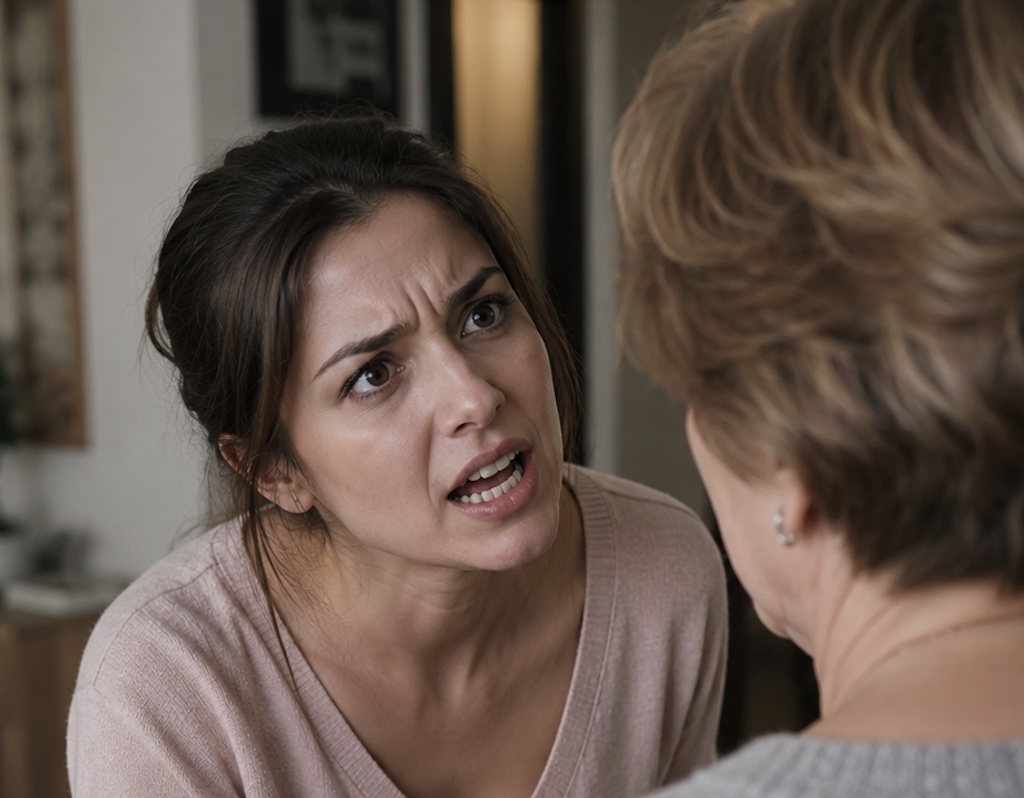
“I don’t understand. Are you really going to keep silent? What kind of person are you? Aren’t you going to say anything? Doesn’t this hurt you at all?” Larisa scolded her husband when they were finally alone in their room.
For the past few days, his wife had been darker than a storm cloud. She spoke to her visiting mother-in-law through clenched teeth and acted as if her husband barely existed. And she had a serious reason for it. No, it wasn’t the fact that her husband’s mother had come to visit that upset her. Antonina Mikhailovna had visited them before, usually for a couple of days, to see her son and daughter-in-law and spend time with her grandson Kolya.
She never stayed long.
“A good guest stays two days and leaves on the third,” she often said with a smile.
This time, too, she had come for only two days. She was leaving the next day. After that, Antonina Mikhailovna planned to visit her daughter’s family, who lived with her husband and three children in a neighboring town.
Larisa’s bad mood had nothing to do with the visit itself.
On the day she arrived, while sitting at the table prepared in her honor, Antonina Mikhailovna announced a strange decision to her son and daughter-in-law.
After that announcement, Larisa stopped talking altogether. She sat silently at the table until the end of dinner, unable to utter a single word. She could not even swallow her food. Her mother-in-law had upset her that much.
Boris also felt uncomfortable after hearing what his mother had said. He would have gladly stopped talking too, instead of forcing himself to carry on meaningless conversation just to keep things from becoming awkward. But if he had gone silent as well, a heavy, oppressive silence would have fallen over the table, and that would have looked terribly improper.
“Borya, Larisa, I want to share some news with you. I’ve finally decided to transfer Grandma’s house to one of my grandchildren. Of course, the house itself is hardly worth anything anymore. But everything must be done legally. Every house should have an owner, shouldn’t it? So I decided that the owner will be my eldest grandson, my daughter’s son, Ivan.”
“Ivan?” Boris asked, genuinely surprised. “Why him? Why does he get such a privilege? What’s wrong with our Kolya?”
“Well, I thought it over this way: he is the oldest, so he should own the house. Besides, his great-grandmother Klavdia, who lived in that house all her life, used to tell me the same thing — give this house to your first grandson.”
“And what about Kolya? Is he not your family? Is he not related to that same Grandma Klavdia?” Boris continued, clearly offended.
Larisa remained silent, but her husband could see perfectly well how much effort it took her to hold her tongue.
“Oh, Borya, are you really going to take offense over this? Your father’s and my house will go to the grandchildren after we’re gone!” Antonina Mikhailovna answered calmly, as if she did not notice how cold her son’s and daughter-in-law’s faces had become.
“You have four grandchildren, Mother, and only one house. And as far as I remember, you and Dad promised Grandma’s house to me,” Boris said, hurt.
And that was exactly how it had been. Many years earlier, when Boris’s older sister Vera got married, she had received a solid bit of help for her young family. Shortly before that, Boris and Vera’s grandfather on their father’s side had passed away. At that time, the bride’s parents decided to sell the small old apartment where Antonina Mikhailovna’s father-in-law had lived. They gave the money from the sale to the newlyweds, and Vera and her husband immediately bought their first one-room apartment in a new building.
“Borya is still just a boy. Who knows when he’ll even get married?” their father used to say. “And when he does get married, we’ll help him too. We’ll sell Klavdia’s house and give him the money. Then everything will be fair.”
“We’ll see,” Antonina would answer. “When the time comes, we’ll decide.”
Back then, Boris really had been young, still almost a teenager. He had not paid much attention to family conversations, and marriage seemed like something distant and unreal.
But when he grew up, got married, and then had a son, he immediately remembered his father’s words and that promise.
Larisa was an orphan, and after the wedding the couple moved into her apartment, which had been provided to her by the state. At first, they did not urgently need money or more living space.
Still, one day Boris proudly told his young wife that Grandma’s house in the village would one day be his, because his parents had decided that long ago.
“When we have a son or daughter, we’ll sell that house and buy a bigger apartment.”
“What about your older sister Vera?” Larisa asked him in surprise.
“Vera already got Grandfather’s apartment after her wedding,” Boris explained. “So she has no right to claim this house.”
Soon their son Kolya was born, but for some reason Boris’s parents never mentioned the house again.
“Well,” Boris thought, “I’ll wait a little longer. There’s no rush anyway. Our son is still a baby. We have other things to think about right now.”
Then Kolya started kindergarten, and Boris’s parents still did not bring up the house.
So Boris finally decided to raise the subject himself. He did not want to look like an empty talker in front of his wife. He had promised her so much: that they would sell the house, buy a bigger apartment, and their son would have his own room. But so far, nothing had moved forward.
To Boris’s surprise, his father somehow steered the conversation away and simply refused to discuss the subject. Then Boris went to his mother with the same question.
“Mom, when are you going to transfer Grandma’s house to me? You promised. I remember it, even though I was still a boy back then.”
“Borya, why are you so fixated on that house? Honestly, it’s almost funny. It’s falling apart already. It’s not worth anything. And you, your wife, and your son have a place to live. You don’t have a housing problem, so don’t bring up Grandma’s house anymore. It’s pointless. It isn’t worth a broken penny.”
Boris was very surprised and upset then, but he did not argue with his mother.
And now Antonina Mikhailovna had announced that she had transferred Grandma’s house to her eldest grandson. How was Boris supposed to react? Be happy for Ivan, his older sister’s son? For a boy who wasn’t even seventeen yet? Happy that he had received the house Boris’s parents had promised to him long ago? Absolutely not.
Boris understood perfectly well that it was not really about the house. Perhaps the place truly had almost no value anymore after standing empty for so many years. It was a matter of principle. Why had his father and mother made a promise and then failed to keep it? They had helped his older sister but refused to help him. How was he any worse than Vera?
“Borya, understand me, I really don’t want to interfere in your family matters,” Larisa told him that night. “But even to me, it seems your parents treated you unfairly. They simply ignored their promise. And you are their son, the one who carries on the family name. Why would they do this to you? Does this mean that you, I, and our son Kolya mean nothing to them? Why did Antonina Mikhailovna transfer Grandma’s house to Vera’s son? Vera already received help from them after her wedding. Don’t you understand why?”
Boris remained silent, wounded and deeply upset by his mother’s decision.
“And to me, everything is perfectly clear. To your mother, we are second-class people. She doesn’t care about our problems. She doesn’t even care about her younger grandson!”
With sadness in his heart, Boris had to admit that his wife was right. His mother should not have done that. It felt like a betrayal — everything for the older daughter, and nothing for him and Larisa. Boris should not stay silent. He had to say something. Remaining quiet would mean agreeing with the decision, accepting it. And he did not accept it. He did not agree. He was furious.
“Don’t be angry with me, Borya, but I personally won’t stay silent anymore. In the morning, I’ll tell your mother everything myself — and she can stop coming to our home after this!” Larisa said bitterly. “I can’t keep pretending nothing happened. You know my character. I can’t tolerate injustice. I’ve always believed in truth and honesty between relatives.”
“No, Larisa, don’t. I’ll do it myself. I’ll speak to my mother,” Boris replied, knowing his wife’s fiery temper. He understood that this was his personal matter.
The next morning, while seeing his mother off to the taxi, Boris avoided her eyes. He stayed mostly silent and barely answered her many questions and remarks. Then, finally, he made up his mind.
“I didn’t want to say this to you, Mom. But you forced me to. Don’t come to our place anymore. Larisa doesn’t want to welcome you after what you did. She believes you deceived us. And to be honest, I don’t accept your decision either. It’s unfair. It’s not even about the house, not about its price or condition. It’s about the fact that you once promised it to me. You promised it to me, and now you’re giving it to my sister’s family again.”
“So that’s how it is, son. Well, well. I didn’t expect this. You’re ready to reject your own mother because of an old village house? Fine then. God will judge you. I won’t come to you anymore, don’t worry. I still have a daughter. I’ll visit her family instead. They are kinder than you. Life will show who was right.”
His mother left, and a huge black emptiness opened inside Boris’s soul. It was filled with resentment, confusion, and bitterness. It felt as if he had never been a real son to his parents at all, but a stepson — a second-class person.
“So he really said that?” Vera asked in surprise as she listened to her mother’s story about what had happened at Boris’s house. “He rejected you? Borya is crazy. Imagine making such a scandal over nothing. That house isn’t worth a kind word, and he turned it into a whole tragedy. He was always abnormal, and he still is. His wife is the same — some crazy orphanage girl. She should be grateful the state gave her housing. She has no business reaching for other people’s property,” Vera said cynically.
“Yes, daughter, yes,” Antonina Mikhailovna replied sadly.
But for some reason, her heart tightened painfully when she thought of her son and his family.