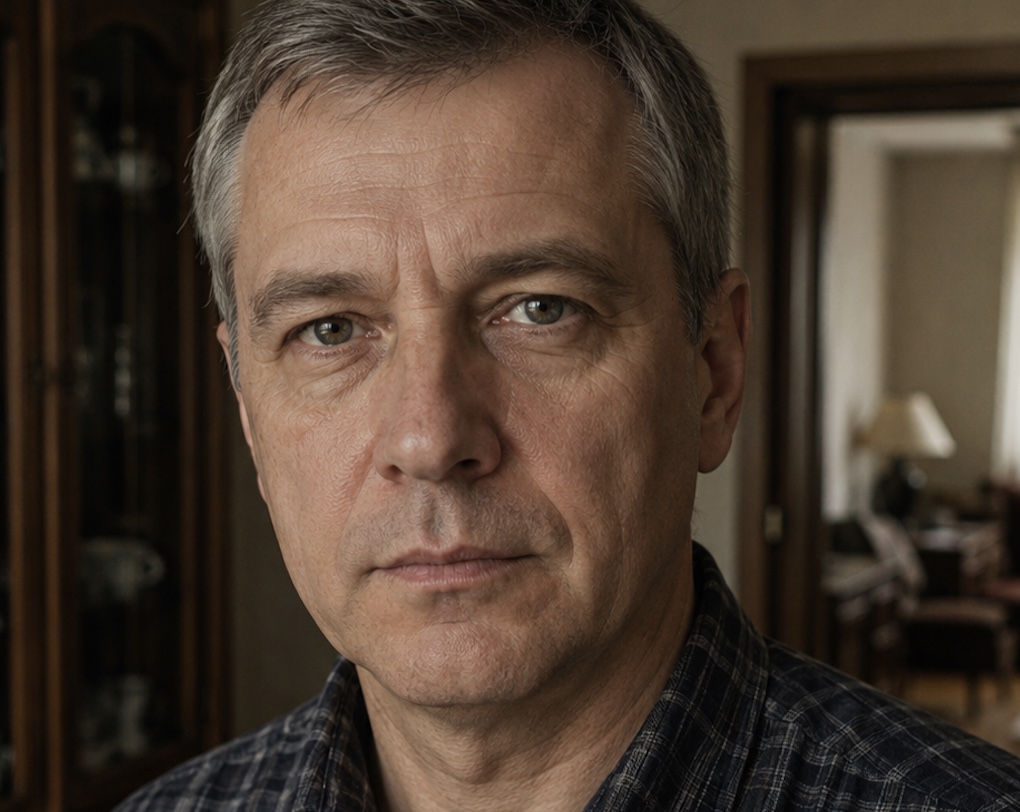
For Fifteen Years, My Father Beat My Mother and Me. When I Turned Thirty, He Broke His Hip and Demanded I Take Care of Him — So I Took Him to a Nursing Home
“Lena, have you completely lost your shame? Your own father is lying there with a broken hip, and you don’t care?”
Aunt Galya’s voice trembled on the phone with righteous outrage. I was standing in the kitchen, holding a cup of cold coffee, staring out the window. Seryozha was frying toast and pretending not to listen.
“Aunt Galya, I haven’t spoken to him in twelve years. Twelve. He was the one who said he didn’t have a daughter.”
“You know what he’s like. He lost his temper back then. But now he’s sick, alone in that apartment, with nothing to eat.”
“And what does that have to do with me? I haven’t seen him in twelve years. He didn’t know whether I’d had children, whether I’d gotten married, whether I was even alive.”
“Lena!”
She gasped, as if I had struck her. I imagined her round face, so much like my father’s. The same eyes. Only without the vodka and without the cruelty.
“Aunt Galya, I’ll think about it.”
I ended the call. My heart immediately tightened — not from grief, but from an old, forgotten terror. It always tightened like that when I heard footsteps in the hallway late at night.
“Who was that?” Seryozha asked, placing a plate of toast in front of me.
“My father’s sister. He broke his hip. He wants me to come and take care of him.”
Seryozha slowly put the spatula down. He said nothing.
“Why are you quiet?”
“What do you think?”
I looked at the toast. At the freshly fried golden crust. Seryozha always made perfect toast. And he always made breakfast for me when I was upset.
“I think he’s dying, and I should go. At least to bury him decently.”
“You should?” Seryozha sat across from me. “Lena, do you even remember what he did to you?”
I remembered. Of course I remembered.
And in that moment, standing in someone else’s kitchen in someone else’s city at thirty years old, I felt those fifteen years under the same roof with that man squeeze my chest all over again. I was that same twelve-year-old girl again.
Fifteen years.
From the age of three until eighteen.
Every morning — fear that Dad had woken up in a bad mood.
Every evening — fear that Dad had come home with his salary, and the salary had already been drunk away.
Every few days — my mother covered in bruises, me hiding under the bed, our neighbor Aunt Anya pounding on the door and shouting, “Vitya, open up! I’m calling the police!”
Four times, an ambulance took my mother away.
Once, I spent the whole night sleeping on the stairwell because my father locked the door and shouted that I no longer had a home there. I was eleven.
When I turned eighteen, I left for university in another city and never came back.
My mother died four years later, in 2018. A stroke.
I came to the funeral, stood by the coffin, then left.
My father arrived drunk and tried to hug me. I pulled away. In front of everyone, he said I was a “rotten daughter” and that he “had no child anymore.”
I nodded.
That suited me.
It suited me for twelve years.
“Lena,” Seryozha said, taking my hand. “Decide for yourself. I’m with you, whatever you choose.”
I stayed silent for five minutes. The coffee went completely cold. The toast went cold too. Seryozha didn’t rush me.
“I’ll go,” I said. “I’ll see him. Then I’ll decide.”
He nodded.
“Just promise me one thing.”
“What?”
“If he starts again, you won’t endure it. You’re not a little girl anymore. You’ll leave.”
“I promise.”
And I knew it myself. I was no longer that girl.
Seryozha had already understood — and still, I decided to go. Not out of love. Out of something else, something I still couldn’t put into words.
Two days later, I was standing outside my father’s apartment door on the fifth floor of a building with no elevator.
The smell hit me as soon as I opened the door with my old key.
Sour food. Tobacco. Something else — sickly, acidic.
It hadn’t smelled like that twelve years ago. Back then, it smelled of vodka and my mother.
“Who’s there?”
His voice came from the bedroom. Hoarse.
I recognized that voice instantly — all those nighttime calls of “Lenka, come here!”, all the “you did it wrong again,” all the “get out.”
I took off my shoes in the hallway, and my hands went cold.
“It’s me. Lena.”
Silence.
I walked into the kitchen. The sink was clogged. The table was sticky. On the windowsill stood about ten empty bottles. Apparently, before breaking his hip, he had still managed to drink.
I opened the fridge. Empty, except for an opened can of sprats and a piece of cheese already turning green.
“Len.”
I turned around.
He stood in the kitchen doorway, leaning on a cane.
Small. Shrunken. Nothing like the giant who, fifteen years earlier, could grab me by the collar with one hand and throw me onto the sofa.
The same eyes. Only cloudy now, streaked red, and somehow pitiful.
“You came,” he said.
Not a question. A statement. As if I had been obligated to.
“I came.”
“You look all right,” he said, looking me over. “Put on weight.”
I said nothing.
I no longer reacted to phrases like that. I had heard them twenty times a day as a child.
“Is there anything to eat? I haven’t eaten since morning.”
“I just got here. I’ll go to the store now.”
“You drove three hours. You could’ve brought something on the way.”
“I didn’t know your fridge was empty.”
“You couldn’t think?”
And that was when I understood.
Nothing had changed.
Absolutely nothing.
Twelve years of silence — and from the very first minute, the same tone, the same intonation: You, daughter, owe me.
You owe me food, care, respect, your very presence.
And I owe you nothing.
I gave you life, the rest is your problem.
I quickly went to the store. Bought bread, oatmeal, chicken, apples, potatoes. Spent two thousand rubles.
When I came back, I started cooking. He sat on a stool in the kitchen, his injured leg hanging awkwardly, watching the television I had turned on for him. Some talk show where people were screaming at each other.
“The oatmeal is ready. Want some?”
“Where’s the sugar?”
“Just a second.”
I put the sugar bowl in front of him. He scooped some in, tasted it, and grimaced.
“Too runny. You don’t know how to cook?”
“It’s oatmeal with milk. That’s how it’s supposed to be.”
“My mother always made it thick.”
“Dad, your mother died in the seventies.”
“Don’t talk back!”
The plate flew.
Not at me — onto the floor.
Oatmeal splattered across the linoleum. Shards scattered along the baseboard.
I stood there and looked.
Inside me, there was nothing.
Nothing at all, except a heaviness in my stomach.
As a child, my legs would have gone weak in moments like that. I would have squeezed myself behind a cabinet.
Now I simply stood.
“Clean it up,” he said. “Why are you standing there?”
I took a rag. Picked up the broken pieces. Wiped up the oatmeal. Washed my hands. Took out another bowl, poured fresh oatmeal into it, and placed it in front of him.
“This is the last serving I will ever bring you,” I said quietly. “Eat it yourself.”
“What?”
“You heard me. I didn’t come here to feed you. If you want it, eat. If you don’t, that’s your choice.”
“A daughter begrudges her own father a meal?”
“Dad, you stopped considering yourself my father twelve years ago. You said so yourself. I came only because of the broken hip. Not out of love. Out of conscience. And my conscience is almost empty now.”
He stared at me and blinked.
As if he were seeing me for the first time.
He didn’t remember this tone from his daughter. Back then, twelve years ago, I was still afraid to raise my voice.
Now I wasn’t.
And he understood that.
“Get out,” he said. “Get out of here, you bitch.”
“I’ll eat, then I’ll leave. And I’ll come tomorrow because there’s no one else. But I won’t feed you. Cook for yourself.”
He fell silent.
I ate my oatmeal standing by the stove. For a long time afterward, it tasted like nothing.
He didn’t touch his. Deliberately.
An hour later, I left and went back to the hotel where Seryozha was staying. I walked down the stairs, sat on a step in the entrance hall, and stayed there for a long time.
I didn’t cry. I didn’t smoke.
I just breathed.
The stairwell smelled of cats, but it was a good smell.
A free smell.
Seryozha opened the hotel room door, looked at me, and silently pulled me into his arms.
I stood against his chest and thought: What does it matter what a person smells like, if that person is yours?
That evening, we ordered dumplings. I ate twenty of them. I laughed for the first time that day.
But at night, when Seryozha had already fallen asleep, I lay there and understood: this wasn’t victory.
It was only a pause.
The next day, a social worker came — and I still didn’t know that everything would be decided in front of her.
“Tamara Mikhailovna. Nice to meet you. I’m here to see Viktor Stepanovich.”
A woman of about fifty stood in the doorway, wearing a jacket and holding a folder under her arm. Neat. Very tired.
You could tell right away that apartments like this were part of her everyday life.
“I’m Lena, his daughter. Come in.”
She stepped inside and looked around.
No reaction to the smell, the bottles on the windowsill, the sticky table.
A professional.
“I’m here as part of the social care program. Viktor Stepanovich filed an application through his sister — Galina Stepanovna, correct?”
“Correct.”
“I need to assess the living conditions and understand what kind of assistance he needs. Visiting caregiver, home support, or residential care. Where is he?”
“In the bedroom.”
We went in.
My father was lying in bed in an undershirt, staring at the wall. When he saw Tamara, he immediately pulled himself together and sat up higher. His face changed — pitiful, suffering.
I had known that trick since I was three: in front of strangers, he knew how to look normal.
“Hello, doctor,” he whined. “Here I am, lying here. My daughter came, God bless her, feeds me, gives me water. I have a good daughter.”
I almost laughed.
Tamara looked at the floor. A shard from the morning plate was still there; I hadn’t swept everything properly.
“What is that?” she asked calmly.
“He threw a plate at me this morning,” I said evenly. “Missed. I’ll sweep it up.”
“You’re lying!” my father shouted immediately. “She’s lying! You see what kind of daughter she is? I open my soul to her, and she humiliates me in front of strangers!”
“Viktor Stepanovich, calm down,” Tamara said, sitting on a chair beside the bed and opening her folder. “I need to ask you a few questions.”
She asked. He answered.
Half of it was lies, half of it wasn’t.
Pension: fifteen thousand.
Lives alone since his wife’s death.
A neighbor sometimes brings bread.
Can’t cook because of his hip — although, really, he could, he simply didn’t want to.
His daughter — here he glanced at me — “came and helps.”
“And who helped you before the fracture?”
“No one. I managed by myself.”
“And when did you last speak to your daughter?”
Silence.
“Viktor Stepanovich?”
“Twelve years ago,” I answered for him. “He threw me out himself. Said he had no daughter. At my mother’s funeral in 2018. In front of witnesses.”
“I never said that!” he snapped, rising in bed. “She’s lying, the bitch!”
“Dad.”
“What ‘Dad’? What ‘Dad’?! You came here to shame me?! Ungrateful creature! I raised you, I fed you, and you! You!”
Then he began saying things I will not repeat.
Swearing. Insults.
He dragged my mother’s memory through filth. He remembered me as a schoolgirl and used words no father should ever use.
Tamara sat with her back straight and wrote in her folder.
I stood by the door and counted silently to ten, then twenty, then fifty.
And then something inside me broke.
Not loudly.
Quietly.
“Tamara Mikhailovna,” I said when my father stopped for a second to draw breath. “I want to say one thing in front of you. Please write it down.”
“I’m listening.”
“From the age of three until eighteen, I lived with this man in one apartment. He beat my mother. The ambulance came four times; I remember all four. Once he threw me out onto the stairwell at night. I was eleven. He drank away his salary in three days, then borrowed money from neighbors, then beat my mother because there was no money. He beat me too. This scar” — I pointed to my eyebrow — “is from when he hit me with a belt when I was fourteen, because I stood between him and my mother. Twelve years ago, I left. For twelve years, he never called. He didn’t even know where I lived, whether I was married, whether I had children. Now he has broken his hip and demanded that I come. Apparently, he remembered my name after all. And I came. I feed him, wash the dishes, run to the pharmacy. I have been doing this for four days. And in front of you, he calls me a ‘creature.’ In front of the first stranger who walks in. That’s all.”
Tamara Mikhailovna looked at my father.
Then at me.
Then back at her folder.
Silence.
“Viktor Stepanovich, what can you say to that?”
He said nothing.
For a moment, I even thought he might be shocked that I had managed to say all that in front of someone else.
Before, I couldn’t.
Before, I looked at the floor.
“She’s lying.”
“All right,” Tamara said, closing her folder. “I understand the situation. Lena, may I speak with you in the hallway for a minute?”
We stepped out. She carefully closed the door behind her and lowered her voice.
“I don’t have the right to give personal judgments. But I’ve been doing this job for twenty years, and I’ll tell you unofficially: you owe him nothing. Not legally, not morally. You have options. Hire a caregiver at your own expense, leave things as they are, or arrange for him to enter a state nursing facility. There is a waiting list, but I can help. Or a private nursing home — faster, but more expensive.”
“How much is private?”
“From thirty-five thousand a month. Some are forty-five, fifty. With decent care.”
“And the state one?”
“A waiting list of about six months. Conditions are average.”
I nodded quickly.
“Thank you. I’ll think until tomorrow.”
“That is your right. He is your father only biologically. You have no other obligation.”
I watched her until she disappeared down the stairs.
Then I went back into the apartment, washed the floor, left two boiled eggs and a bottle of water on my father’s nightstand, and left.
He was silent.
He didn’t look my way.
At the hotel, I told Seryozha:
“I know what I’m going to do.”
He nodded and didn’t ask anything.
“You may agree with me or you may not, but I’ve already decided.”
“I’ll agree with you, whatever you decide.”
I cried.
Very quietly, for the first time that whole week.
Not because of my father — because of Seryozha.
Because I actually had a person in my life who could say that.
Two days later, I sat in the office of a private nursing home called Quiet Harbor and signed the contract.
Forty-five thousand a month.
A shared room for two.
Rehabilitation after a fracture.
Care, diet, caregivers, doctor.
Visits once a week — if relatives wished to come.
I did not wish to come.
“Lena Viktorovna, one last question,” the director said, looking at me over her glasses. “Who will be visiting him?”
“No one,” I said. “I live far away, in another city.”
“No one at all?”
“Possibly his sister. I’ll give her the address.”
“All right.”
I signed very calmly.
The money was quickly charged to my card. That week, I took it from the savings I had put aside for renovations. For the next month, I would have to work overtime.
Forty-five thousand a month was more than he had ever spent on me throughout my entire childhood.
I had already calculated that on the way from the nursing home to his apartment, where I went to collect his things.
When I arrived and told him, he didn’t understand at first.
“Where?”
“To a nursing home. A good one. Private. They’ll cook porridge for you there, wash you, treat your leg. In six months, you’ll be walking.”
“I’m not going.”
“You are. You filed an application with social services, which means you admitted you can’t manage alone. I found the best option. A vehicle is coming tomorrow.”
“I didn’t sign any papers for you!”
“You don’t need to. The contract is in my name. I’m paying. All you need to do is get in the vehicle.”
“I’m not going! I’m not crazy!”
“Dad. You can refuse. But then I leave tomorrow morning, and you will never see me again. Not you, not Aunt Galya, no one. I’ll change my number. I won’t even come to your funeral. Decide now.”
He was silent for a long time.
I looked at his hands on the blanket — old, spotted.
Those same hands.
I was no longer afraid of them.
They were just flesh.
“You’re rotten,” he said.
“I know. You told me that often. I’m used to it. Tomorrow at ten in the morning.”
I left.
On the stairs, my phone rang. Aunt Galya.
“Lena, your father called me! What are you doing? He’s your own father! God will punish you, do you hear me? Your mother is turning in her grave!”
“Aunt Galya, my mother is lying peacefully in her grave. He is the one who put her there. I’ll give you the nursing home address. You can visit him as much as you want. I won’t.”
“Shameless girl!”
“Maybe.”
I hung up.
Aunt Galya cursed me. I had heard the same tone in childhood, when she came to my mother and said, “Well, he’s a man, endure it.”
Back then, Aunt Galya had been on my father’s side.
Now she was on my father’s side again.
She had only one model of the world.
I could not break it.
In the morning, the nursing home minibus arrived.
Two orderlies carefully seated my father in a wheelchair. He was silent. He didn’t look at me.
I handed them his bag — pajamas, razor, two books, glasses. Everything I had packed the night before.
We left the apartment together.
I locked the door with my key — for the last time.
I put the key in my pocket and decided I would hand it over to the housing office that very day.
He got into the vehicle.
He didn’t even turn around.
I watched the van drive out of the courtyard and waited for something inside me to start hurting.
My heart. My soul. My conscience.
Something.
But there were no tears.
There was no pain.
There was emptiness and lightness, as if I had finally set down a heavy bag I had been carrying for thirty years.
Three months have passed.
My father is in the nursing home.
Aunt Galya calls there once a week — the director tells me. His hip is healing. He walks with a walker. They feed him three times a day.
Sometimes he causes scenes, but they know how to handle him.
And honestly, that is no longer my problem.
Aunt Galya no longer calls me. After that last conversation, she blocked me and wrote to the whole family on Odnoklassniki about what a “monster” I am.
At first, my cousins wrote to me angrily. Then, a month later, two of them apologized and said, “Lena, we remember how it really was.”
The rest are silent.
Let them be.
I paid forty-five thousand for May. Then for June. Then for July.
There is enough money.
I’m not selling my father’s apartment. Let it stand. When he is gone, by law it will pass to me, and I’ll decide then. Maybe I’ll sell it and donate part of the money to an orphanage. I don’t know yet.
At night, I sleep without dreams.
Seryozha says I’ve stopped flinching. Before, in my sleep, I used to jerk sharply and sometimes cry. He never told me because he didn’t want to frighten me.
Now I don’t flinch anymore.
I don’t feel guilty.
I want to write that honestly, without making myself look better: I truly don’t feel guilty at all.
Sometimes that frightens me.
Somewhere in my head, there is a voice — not mine, but Aunt Galya’s, and the old women from the stairwell, and all of them together — saying I am a bad daughter, that I went too far, that he is still my father.
That I shouldn’t have placed him in a nursing home. That I could have hired a caregiver. That I could have forgiven him. That I could at least visit him.
I hear that voice.
But it is not mine.
My own voice inside is calm and steady:
I did everything I could.
And more than I had to.
Tell me honestly — would you have forgiven him? Or would you have placed him there too and slept peacefully afterward?
And what is this, really — justice or sin?