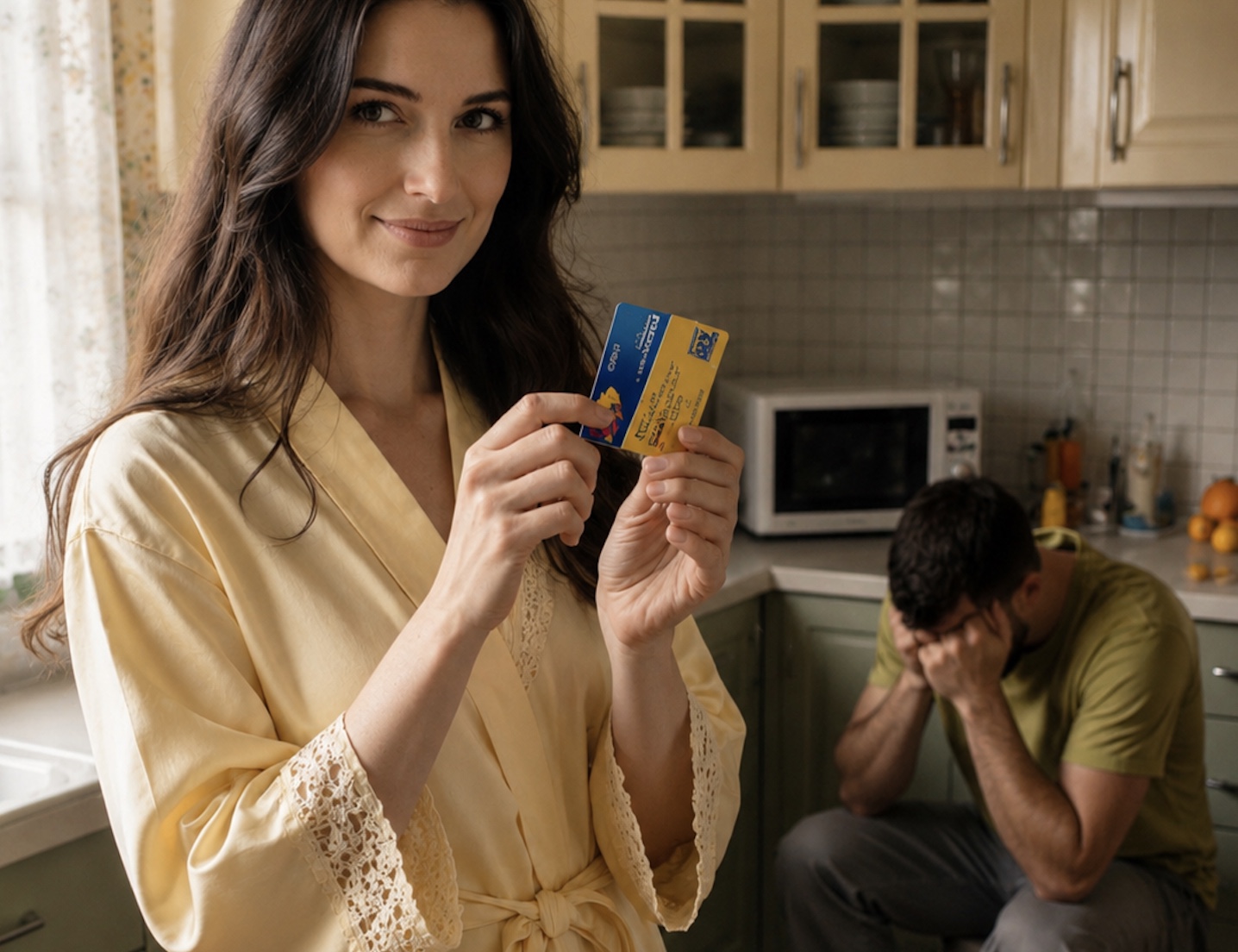
The notification arrived while Marina was standing at the checkout counter in the store. Her phone vibrated in her jacket pocket, and without really looking, she swiped across the screen.
“Transaction declined. Insufficient funds.”
Strange.
She knew for certain there was more than fifty thousand on that card. Her salary had come in just two days ago.
“Miss, are you paying?” the cashier asked, looking at her with barely hidden irritation.
“One moment, please…” Marina reached into her bag for her second card, the one she used less often. This one had to work.
She tapped it against the terminal.
The machine gave an offended beep.
“Transaction declined.”
Behind her, people began sighing impatiently. The line was growing. The sales assistant from the appliance department, who had spent half an hour explaining why this washing machine was better than the cheaper model, had already stepped away to help other customers.
Marina’s hands went cold.
She left the line and pressed the phone to her ear. The ringing sounded endless.
“Yes?” Viktor’s voice was calm, almost indifferent.
“Vitya, my cards aren’t working. Both of them. I’m at the store. I was just about to pay for the washing machine…”
“I know. I blocked your card. I’m the man of the house, so I decide what we buy.”
Silence followed.
Marina did not immediately understand what she had heard. The words seemed to break apart into separate sounds, refusing to form a real sentence in her mind.
“What did you just say?”
“We discussed this. I told you we don’t need such an expensive machine. But you went to buy it anyway. So I had to block your card.”
“Vitya, I explained to you why—”
“Marina, don’t start. I looked into it. The functions you need are available in a regular model. Everything else is just overpaying for a brand. When you get home, we’ll discuss which one to buy. I’m busy right now.”
He hung up.
Marina stood in the middle of the showroom, surrounded by families choosing refrigerators, smiling sales consultants, and soft background music. She wanted to scream, but her throat tightened so hard she could barely breathe.
She went outside.
The November wind struck her cheeks, and the sharp cold seemed to wake her up.
He had blocked her card.
As if she were not a grown woman, but a misbehaving teenager. As if the salary she earned at her own job had suddenly stopped being her money.
She should have agreed to open a salary card when they offered it at work. Back then, she had thought: why have several cards when she already had one? The one her husband had arranged for her. At the time, it had seemed convenient and reasonable.
When Marina got home, Viktor was sitting in his office in front of his laptop. He did not even lift his head when she came in.
“Hi,” Marina said, taking off her coat and trying to keep her voice steady. “Can we talk?”
“I’m listening,” he said, still looking at the screen.
“Please look at me.”
Viktor leaned back in his chair and crossed his arms. Marina knew that gesture well. Defensive. He was already preparing for a fight.
“Vitya, why did you block my card?”
“Because you ignore our agreements. We discussed this. The old washing machine broke, yes, we need a new one. I spent an evening researching the market and found the best option. But you decided to buy the more expensive one just because you felt like it.”
“I wasn’t ignoring you. I tried to explain why I need that exact model. It has a quick wash cycle, a dryer, a steam function to smooth clothes—”
“Why do you need steam? What is the iron for?”
“So I can spend less time ironing, Vitya. So I can free up time.”
“For what?” he smirked. “You already spend half the evening on your phone.”
It was unfair, and he knew it.
Marina felt anger rising inside her, but she kept speaking calmly.
“I do laundry every day. Your shirts, the ones you want perfectly ironed. Bed sheets. Towels. Artyom’s clothes — he’s seven and somehow manages to get so dirty that sometimes it’s easier to burn the clothes than wash them. I spend hours ironing all of it. If a washing machine with steam and drying saves me even one hour a day, it will pay for itself within six months.”
“That’s just emotion. The numbers say otherwise. The price difference is too big. Don’t you know how to count?”
“Do you know how to count my time?”
“Marina, don’t get hysterical. I made a reasonable decision. Tomorrow you’ll go and buy the model I chose. Then I’ll restore access to the card.”
She looked at him and felt as if she did not recognize him.
There he was — her husband. The man she had lived with for ten years, had a child with, shared joys and difficulties with. And now he was speaking to her as if she were hired help who could be ordered around.
“All right,” Marina said suddenly, very calmly. “Let’s do it this way. Since you believe you understand the household better, since you are the man of the house, then starting tomorrow, you will take care of it.”
“What?” Viktor frowned.
“It’s simple. You will decide what to buy. But not just the washing machine. Everything. Absolutely everything related to the home. Groceries — what to buy and for which meals. Laundry detergent — which brand, for colored clothes or whites. What needs to be washed today and what can wait. What should be ironed and what shouldn’t. When to change the bed linen. When it’s time to buy new towels. Which nighttime diapers to buy for Artyom — he has almost outgrown size three, but size four is still too big. When to book him a dentist appointment — his baby tooth is loose. Which medicines need to be in the first-aid kit. When the cat food runs out. What shampoo to buy when ours is finished. Where to take winter clothes for dry cleaning and when to pick them up.”
Viktor said nothing. He stared at her in confusion.
“You will plan everything and decide everything,” Marina continued, her voice growing firmer. “And I will only carry out your instructions. You say ‘buy this,’ and I’ll buy it. You say ‘wash this,’ and I’ll wash it. You say ‘cook this,’ and I’ll cook it. But no initiative from me. No independent decisions. Everything strictly according to your instructions. Deal?”
“Marina, are you serious?”
“Completely. We’ll start right now. What’s for dinner?”
“What?” he blinked, lost.
“Today is Wednesday. What do we eat for dinner on Wednesdays? What dish do you want?”
“Well… I don’t know. Something normal.”
“‘Something’ is not a recipe. Name a specific dish.”
Viktor shifted in his chair.
“Cutlets with mashed potatoes.”
“Excellent. Cutlets made from what? Beef, pork, chicken? Or mixed ground meat? In what proportions?”
“My God, Marina, what difference does it make?”
“A big one. Beef cutlets can turn out dry, so you need to add fat or butter. Pork can be too greasy. Chicken is lighter but bland. Mixed meat has several possible ratios. So which cutlets?”
“Normal ones,” he said, starting to get irritated.
“Normal is not an answer. You’re the head of the house. You decide. What kind of minced meat should I buy?”
“Beef and pork,” he forced out.
“Seventy-thirty? Fifty-fifty?”
“Fifty-fifty!”
“Good. How much meat? Artyom will eat two cutlets, you usually eat three, and I’ll have one. That’s six cutlets. One cutlet is about seventy grams. That makes four hundred twenty grams. But meat shrinks by about twenty percent when fried. So we need around five hundred grams. Correct?”
“Marina, stop,” Viktor said, getting up from his chair. “I understand what you’re doing.”
“No, you don’t. We’ve only just started. What kind of potatoes for the mash? How many kilograms? One average potato weighs about one hundred fifty grams. One serving needs three potatoes. Three people means nine potatoes. Plus one extra, just in case. So ten. About one and a half kilos. But potatoes are different. Yellow potatoes mash better; white ones hold their shape. For mashed potatoes, we need yellow ones. Which variety do we buy?”
“Fine, yellow!”
“And will there be only a side dish, or do we need a salad? If salad, what kind? With what ingredients? Fresh vegetables or canned? What dressing? Oil? If oil, sunflower, olive, or flaxseed? Extra virgin or regular?”
“Enough!” Viktor snapped.
“No, not enough. We haven’t discussed breakfast yet. Or tomorrow’s lunch. Or the day after that. Or the whole week. You’re the head of the house, so you plan. I need a list. A detailed one. With recipes. With exact ingredient amounts. And we also need to check what we already have at home and what’s missing. Inventory of the fridge and cupboards. Should I bring a notebook? Start writing.”
Viktor stood in the middle of the office, and Marina watched his righteous anger slowly fade into confusion.
“This is absurd,” he said quietly.
“This is your logic. You said you’re the man of the house and you decide. So decide. Everything. Down to the smallest detail. And I’ll just follow instructions.”
She turned and left the office.
In the living room, Artyom was playing with building blocks, scattering pieces all over the floor. Usually, Marina would have asked him to clean up before dinner. Today, she simply sat beside him and watched him build something that vaguely resembled a spaceship.
“Mom, are we having dinner today?” Artyom asked about twenty minutes later. “I’m hungry.”
“Ask Dad,” Marina replied. “He’s in charge of food today.”
Artyom looked at her in surprise, then went off to find his father.
Marina heard muffled voices — Viktor saying something, Artyom answering. Then silence. Then the sound of the refrigerator door opening.
Ten minutes later, Viktor appeared in the doorway.
“Marina, there’s… some chicken in the fridge. What is it for?”
“I don’t know,” Marina said calmly, keeping her eyes on Artyom. “You’re in charge. You figure it out.”
“Is it cooked or raw?”
“Look at it.”
“I did look! It’s in some kind of marinade. What am I supposed to do with it?”
“Not my responsibility.”
Viktor stood there, clearly expecting her to take pity on him. Marina stayed silent.
He went back to the kitchen. Dishes clattered. Oil hissed in a pan.
Dinner was ready forty minutes later.
The chicken had been fried on both sides — burned on the outside, still pink inside. The pasta had stuck together in one lump; apparently Viktor had forgotten it on the stove. There was no salad.
“Dad, why is the chicken black?” Artyom asked, poking the suspicious crust with his fork.
“That’s a crispy crust,” Viktor muttered. “Eat.”
They ate in silence. Marina carefully cut her meat, avoiding the raw parts. Viktor chewed the pasta with a grim expression. Artyom picked at his plate and eventually ate three spoonfuls before announcing he was no longer hungry.
After dinner, Viktor put the dishes in the sink. He did not wash them, just stacked them there. Then he went back to his office.
That evening, while Marina was putting Artyom to bed, her son asked:
“Mom, did you and Dad have a fight?”
“No, sweetheart. Dad just decided to try being in charge of the house.”
“Were you in charge before?”
“I just did what needed to be done. Without anyone being ‘in charge.’”
“Will Dad cook again tomorrow?”
From his tone, Marina understood that the idea did not make him happy.
“We’ll see,” she said, kissing his forehead. “Sleep.”
That night, she lay on her side of the bed, staring at the ceiling. Viktor tossed and turned beside her. He was not asleep. She could feel it.
The morning began with Artyom running into the bedroom.
“Dad, what’s for breakfast?”
Viktor groaned and covered his face with a pillow.
“Porridge,” he mumbled.
“What kind?” Artyom climbed onto the bed.
“Regular.”
“Dad, regular isn’t a kind of porridge. Mom always says oatmeal, buckwheat, or rice. Which one are you making?”
Marina lay with her face turned to the wall and smiled. Smart boy. He had caught on quickly.
“Oatmeal,” Viktor surrendered.
“With water or milk?”
“Artyom, for God’s sake…”
“Mom always asks! It tastes better with milk, but sometimes you say milk makes your stomach hurt.”
“With milk,” Viktor groaned and dragged himself out of bed.
The porridge burned.
Marina could tell by the sounds: he had not stirred it for too long, and the milk stuck to the bottom. Then came muttering, the scraping of a spoon against the pot, the sound of water. Viktor was trying to wash the burnt pan.
At breakfast, Artyom picked at his bowl again.
“Dad, there are lumps.”
“Eat.”
“But Mom always makes it without lumps.”
Viktor looked at Marina.
“Marin, come on…”
“You’re in charge,” she reminded him. “You decide how to cook it.”
After breakfast, the real fun began.
Artyom was getting ready for school. Viktor discovered that the boy’s school uniform was in the laundry. Marina usually washed it the night before.
“Where are his clean trousers?” he asked helplessly.
“I don’t know,” Marina said, finishing her tea. “I no longer make laundry decisions. You should have checked last night what he needed for the morning and washed it. But you didn’t give any instructions.”
“Marina, he’ll be late for school!”
“Then you need to decide quickly. You can put him in home trousers. Or run a quick wash — thirty minutes, plus twenty minutes drying with a hairdryer. Or take him to school as he is and explain to the teacher tomorrow that the household got out of control. Your choice.”
Viktor rushed around the apartment, found some old sweatpants, and pulled them onto a protesting Artyom. The boy whined that he couldn’t go to school like that, but Viktor was already pulling him toward the door.
“We’ll figure it out tonight,” he threw over his shoulder.
When they left, Marina poured herself another cup of tea and sat quietly in the kitchen.
The apartment was a mess: dirty dishes, scattered clothes, a wet towel on the bathroom floor. Usually, by this time, she would have already brought basic order back. But today she simply sat and drank her tea.
During the day, while Marina was out for work, a message came from Viktor:
“What’s for lunch today? Also, we’re out of toilet paper.”
Marina smiled and typed:
“You decide what’s for lunch. And you should have noticed the toilet paper was running out. I don’t buy anything without your instructions now.”
His reply came a minute later:
“Marina, this isn’t serious.”
“It is very serious. Yesterday you said you were the head of the house and you decide. So decide.”
The phone stayed silent for about twenty minutes.
Then:
“Buy toilet paper. Any kind.”
“Any kind is not specific. Three-ply or two-ply? White or colored? With perforation or without? Scented or unscented? Which brand?”
“Marina, PLEASE.”
“That’s not an instruction. I’m waiting for clear directions.”
He called.
His voice sounded tired.
“Three-ply. White. Unscented. Eight rolls. Is that good enough?”
“I’ll write it down,” Marina replied in a businesslike tone. “And lunch?”
“I don’t know what’s for lunch,” desperation slipped into his voice. “Anything. Some kind of soup.”
“What soup? Recipe? Ingredients?”
“Marina…” He fell silent. She could hear him breathing into the phone. “I can’t handle this.”
“It’s not even evening yet.”
“I don’t know how you do it. I thought it was simple. Cook, wash, clean. But there are a million details. I don’t know where anything is. I don’t know what runs out and when. I don’t know what Artyom eats and what he won’t touch. I don’t know which cleaner is for the sink and which one is for the stove. My head is splitting from all these little things.”
Marina said nothing.
“And you also work,” Viktor continued. “And somehow you manage everything. The house, cooking, homework with Artyom, doctor appointments, and… God, there’s so much. I lived in this house for ten years and didn’t notice. I thought it all just happened by itself.”
“It doesn’t happen by itself,” Marina said quietly. “It’s called domestic labor. Invisible, unglamorous, but necessary. And it requires constant attention, planning, and hundreds of small decisions every single day.”
“I’m sorry,” Viktor’s voice trembled. “Forgive me. I was an idiot. A complete idiot. What I did with the card… I had no right.”
“No, you didn’t.”
“I just… I thought you were wasting money. I thought I had to control it. But I didn’t understand how much you put into this home. Your time, your strength, your attention. And I devalued all of it with one sentence.”
Marina looked out the window. A fine rain was falling outside, November fully settling in.
“Viktor,” she said. “I don’t want a war. I don’t want to prove that I’m right. I just want you to understand: this home is not my private kingdom where I rule over everything. But it is not your territory either, where you make decisions for both of us. It is our shared space. And if we both work, if we both earn money, then we should make decisions together. By talking. By respecting each other’s opinion.”
“I understand. I swear I do. Buy the washing machine you wanted. The one with steam and drying. I’ll restore access to the card right now. And… I’ll participate. Properly. Not just taking out the trash when asked, but really helping you carry this load.”
“You’ll have to learn,” Marina warned him. “And not in one day.”
“We have time,” he said, with a cautious hope in his voice. “Don’t we?”
“We do,” she smiled. “Come home tonight, and we’ll start figuring things out. We’ll also decide what to do with the burnt pot.”
“I’ll buy a new one!” he promised quickly.
“You will,” Marina agreed. “But first I’ll teach you how to cook porridge.”
Household work still required attention, of course. But for the first time in many months, Marina no longer felt that it was only her burden. Something had shifted. Not magically solved — no. There would still be conversations, adjustments, arguments. But at least there was now a crack in the wall of misunderstanding that had been growing between them for years.
Her phone chimed.
A notification appeared: card access restored.
Marina opened the appliance store app and placed the order for the exact washing machine she had wanted — with drying and steam.
Delivery: the day after tomorrow.
And tonight, the three of them would sit at the table, and Marina would show Viktor the thick notebook where she had been writing menus, shopping lists, important dates, and reminders for years. She would show him the household system she had built piece by piece.
And maybe, together, they would create a new one.
A shared one.
She poured herself more tea, took out her notebook, and began writing a plan.
“Basic skills for Viktor: cooking porridge without lumps…”
Outside, the rain grew heavier.
But inside, her heart felt a little lighter.