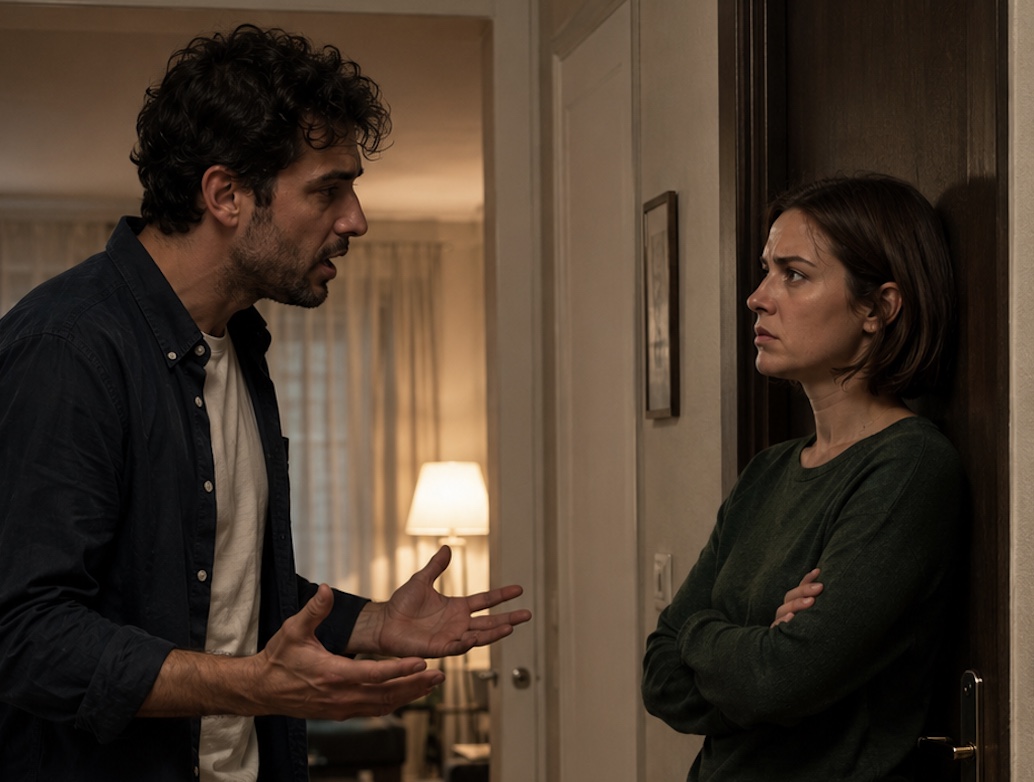
— “I was just helping my sister,” Maxim said, in a tone that made it sound like the most ordinary thing in the world.
Evgenia looked at him for several seconds without saying a word. Then her eyes moved toward the hallway, where two stuffed bags stood beside her boots, and slowly returned to her husband.
“I see,” she said.
That was all she said that evening.
The bakery where Evgenia worked had a simple name: Morning. It was a small place with a few tables, a glass display full of pastries, and a kitchen hidden from customers. That was where the real work happened — dough rising, ovens humming, flour dusting the air. Evgenia spent most of her shifts there, wearing an apron with flour on the sleeves.
She loved the job because it demanded precision. Grams, temperature, timing. If you measured something wrong or left it in the oven too long, the result was obvious immediately. No endless arguments about who was to blame. She liked that.
In life, she tried to follow the same rule: do not delay decisions, and do not pretend a problem does not exist when it clearly does. The neighbors in her building said she was “straightforward,” and Evgenia never took it as an insult. It was true. She disliked vague situations. If something was wrong, it was better to say it plainly.
She woke up at five every morning. By six, she was already standing over the dough table. By noon, her hands smelled of vanilla and butter. By evening, they ached from exhaustion. She loved her work, but it left her with no strength for long conversations after a shift. When she came home, she wanted only three things: silence, a hot shower, and sleep.
She had bought the apartment herself five years earlier. She had saved for a long time and borrowed a small amount from her parents, which she paid back in less than a year. It was a two-room apartment on the third floor, in a quiet building with a closed courtyard. She had chosen it carefully, looked at several options, negotiated the price, and when she finally signed the papers, she sat on the floor of the empty living room and simply stayed silent.
It was hers now.
That feeling alone had been enough.
She met Maxim a year after moving in. They were introduced through mutual friends and began dating. He worked as a manager at a construction company. He was calm, not fussy, and knew how to listen. Evgenia liked that. After several turbulent relationships in her younger years, she valued peace most of all — the kind of person beside whom she did not have to justify every step she took.
They married a year and a half later. Maxim moved into her apartment. Before that, he had been renting a room in a shared flat with two other people, so the decision seemed natural. Evgenia told him immediately that the apartment was registered in her name and that she had no intention of changing the documents.
Maxim nodded without objection.
“It’s your apartment,” he said back then. “I understand that. Thank you for letting me live here.”
Evgenia accepted his words calmly. He moved in, and life went on.
Their first year together passed without serious conflict. Maxim did not interfere with the way she ran the household. He earned his own money, and they split expenses. If she had an early shift or came home completely drained, he could cook something without complaints and without being asked. Evgenia appreciated that.
She did not expect anything extraordinary from marriage. Just basic respect for what belonged to her.
The apartment was always a separate subject in their relationship. Evgenia had said it once and never repeated it unnecessarily: the home was hers, the documents were hers, and no decisions about it would be made without her consent. Maxim seemed to understand.
At least, they both thought he did.
Olesya did not appear in their life all at once. At first, she came by occasionally on weekends, like any ordinary relative. She was Maxim’s younger sister, unmarried, and worked as a sales assistant in a shopping center. Evgenia had no strong feelings about her either way. She was simply someone who sometimes came over, drank tea, talked about her life, and left.
Then the visits became more frequent.
Once a week turned into once every three days. Then almost every evening. Olesya came without warning, knew where the TV remote was, and opened the refrigerator without asking. One day Evgenia came home from work and found her asleep on the sofa in the living room. It turned out Olesya had arrived during the day, when no one was home, and Maxim had given her a key “so she wouldn’t have to wait outside.”
That evening, Evgenia asked him:
“You gave her a key?”
“Yes. So she wouldn’t stand outside. You were at work.”
“Maxim, that was my key. To my apartment. You gave it away without discussing it with me.”
He looked at her as if to say, “Are you seriously making a problem out of this?” Then he said they could simply ask Olesya to return it. Nothing terrible had happened.
“It’s not about the key,” Evgenia replied.
“Then what is it about?”
“It’s about you making decisions that concern my apartment without asking me.”
Maxim was silent for a moment. Then he said she was being too strict about it.
He took the key back from Olesya that same evening, but the unpleasant feeling remained. Not because of the key itself, but because of how he reacted when Evgenia pointed it out.
The following weeks returned to their usual rhythm. Olesya still came over, though now she called in advance, and Maxim opened the door for her. Evgenia did not make scenes, but she noticed how things were slowly shifting. Her sister-in-law hung her coat on the rack as if she had a permanent place there. She left hand cream on the bathroom shelf. Once, she asked if she could put “a few things in the fridge for a couple of days.” It turned out to be three bags and a box.
Evgenia moved the box to the lower shelf and said nothing.
She watched.
She remembered.
The evening when everything was decided looked like any other evening. Evgenia finished her shift, left the bakery a little after six, stopped by the pharmacy on the way home, and climbed to the third floor. She opened the door and immediately saw bags in the hallway — large, tightly packed bags, clearly not meant for a one-night stay.
From the living room came Olesya’s voice. She was talking on the phone and laughing at something.
Evgenia took off her shoes and walked down the corridor. She looked into the room. Olesya was sitting on the sofa with her feet on the coffee table, still chatting on the phone. She only nodded in greeting. Her clothes were folded on the armchair. A cosmetics bag stood on the windowsill.
Maxim was in the kitchen.
Evgenia went to him.
“What is going on?”
“Oh, Zhenya. Listen, Olesya has a situation. She’ll stay with us for a while, okay?”
Evgenia stared at him without speaking.
“I was just helping my sister,” he added. “She temporarily has nowhere to go.”
“You could have called me before making that decision,” Evgenia said evenly.
“It was urgent. There was no time.”
“You have my number. It hasn’t disappeared.”
“Zhenya, she’s my sister. I couldn’t just abandon her.”
Evgenia looked at him again, carefully — the way one looks when confirming something one has almost understood for a long time.
“I did not discuss this with you,” she said. “I did not give my consent.”
“Are you serious? It’s only for a couple of weeks.”
“Maxim. This is my apartment. You moved someone in without asking me.”
“You’re turning this into a problem where there isn’t one.”
She poured herself a glass of water and drank it at the sink. Then she looked out the window. A streetlamp was glowing in the courtyard, and someone was sitting beneath it on a bench, looking at a phone.
An ordinary evening.
Evgenia realized that the anger she had expected to feel was not there. Something else had settled inside her instead — something calm, even cold. The feeling that comes when a situation has been clear for a long time, and the words only confirm what you already knew.
About ten minutes later, Maxim came into the kitchen.
“Zhenya, are you really serious about this?”
“Yes.”
“She’s in a difficult situation. She had nowhere to go tonight.”
“Maxim, she has a phone and she has acquaintances. A difficult situation is not a reason to move into someone else’s apartment without permission.”
“It’s not someone else’s apartment. We live here together.”
“We live here together,” Evgenia agreed. “But the apartment is mine. Those are different things.”
He fell silent. He stood there for a while, then went back to the living room. He did not return.
Evgenia did not continue the argument. She left the kitchen and went into the room. Olesya had already ended her call and was looking at her with that expression people wear when they are pretending everything is fine while carefully watching for a reaction.
“Olesya,” Evgenia said, “I need to talk to you.”
“Of course,” she nodded.
“I did not agree to you living here. Maxim made that decision without me. Tonight, you need to find somewhere else to stay.”
Olesya’s eyes widened.
“Are you serious? I really have nowhere to go.”
“That is not my issue,” Evgenia replied. “That is between you and Maxim.”
Olesya was four years younger than Maxim. She had been renting a room with a friend on the other side of the city, but according to Maxim, something had gone wrong there. Evgenia did not know the details. She had never been particularly interested in her sister-in-law’s personal affairs. They saw each other on holidays, talked about nothing important, and parted ways.
But there was one detail Evgenia had noticed.
Olesya never said “your apartment.” She said “your place,” or simply “here,” always blurring the ownership. As if the apartment belonged to both of them, or to no one in particular. Once, in front of guests, Olesya had said, “At our home it’s always like that,” and glanced at Evgenia as though it had been a slip of the tongue.
Evgenia had said nothing.
But she remembered.
The earlier conversation about the key had been closed that same evening when Maxim took it back from Olesya in front of Evgenia. But something in his behavior changed afterward. He became a little more careful with his words — not angry, not cold, just cautious. Evgenia saw it and thought: good, we handled it.
It turned out it had only been a pause.
A few weeks later, Olesya started coming around more often again. Maxim did not warn Evgenia in advance. He simply mentioned it afterward: “Olesya stopped by,” or “Olesya asked to take something from the fridge.” Evgenia listened and thought about how the boundary she had set was being pushed very slowly, millimeter by millimeter.
She did not cause a scandal. One evening, while they were having dinner, she simply said:
“Maxim, I’ve noticed Olesya comes here as if she has her own place in this apartment.”
“She’s my sister,” he replied without looking up from his plate.
“I’m not arguing with that. I’m talking about something else.”
“What exactly?”
“I want to know in advance when she is coming. And I do not want her to feel like the mistress of this home.”
Maxim was quiet for a moment.
“You’re putting it strangely.”
“I’m putting it exactly the way I mean it,” Evgenia said.
They did not return to the subject after that.
But nothing changed.
Now Olesya looked at her with the expression of someone unfairly offended.
“That’s just great,” she muttered, no longer into the phone but into the room. “I thought you were a decent person.”
“I am a decent person,” Evgenia answered. “But I am the owner here.”
Maxim came in behind her and stopped in the doorway, looking like a man preparing to mediate.
“Zhenya, come on. Let’s talk calmly. It’s literally just a couple of weeks.”
“I have already answered.” She looked at him steadily. “I do not agree.”
“What kind of nonsense is this? She’s not a stranger!”
“That is not the point. The point is that you used my apartment as if it were yours to decide about. And this is already the second time.”
Maxim fell silent. Then, quietly but with irritation, he said:
“The second time — are you talking about the key? Seriously?”
“Yes. The key too.”
Olesya sat there looking away, as though the conversation had nothing to do with her. But she was in no hurry to leave.
Evgenia did not raise her voice. She simply left the room and closed the door behind her. She went to bed early — she had to get up at five the next morning. Maxim walked around the apartment for a long time, then lay down on the sofa in the living room without coming into the bedroom. Evgenia heard him, but did not go out.
In the morning, she got up earlier than usual. She got ready for work, left the apartment, and an hour later called a locksmith from the bakery. She asked him to come at two, when her shift ended. Maxim would be at work then.
While the locksmith changed the lock, Evgenia stood in the hallway and thought that she should have done it earlier. Not out of revenge. Not out of anger. Simply as the logical step after it became clear that words did not work.
She had given her husband the chance to understand on his own.
He had not understood.
Or he had understood, but decided that explaining things to his wife was easier than refusing his sister.
The locksmith was a quiet man of about fifty. He changed the lock, checked how the door closed, and said, “Good lock. Reliable.”
Evgenia paid him, thanked him, and closed the door.
She took the new keys — two copies.
Both remained with her.
When Maxim returned that evening, the door would not open. He called her.
“Zhenya, the lock isn’t working.”
“The lock is working,” she replied. “Your key just doesn’t fit it anymore.”
Silence.
“You changed the lock?”
“Yes.”
“Are you insane? I live there!”
“You lived here,” Evgenia corrected him. “I packed your things in a bag and left them near the entrance, around the corner by the canopy. Pick them up tonight before someone moves them.”
Maxim started saying something about family, about marriage, about how she had no right. Evgenia listened until he stopped.
“We are married,” she said. “But the apartment is mine. You knew that from the first day. You said it yourself.”
“Zhenya, I understand that you’re angry. But this is not a reason to—”
“Maxim,” she interrupted, “you moved another person into my apartment without my consent. When I said I had not agreed, you argued with me. This is not anger. This is a decision.”
The line went quiet.
Evgenia put the phone into her pocket and returned to the stove. A few minutes later, a message came from Olesya — sharp, brief, and clear in meaning: Evgenia was cruel and heartless.
Evgenia read it and placed the phone face down.
Maxim called twice more that evening. Then he wrote that they would talk tomorrow and that she owed him an explanation. Evgenia replied with one sentence: if he did not agree to separate voluntarily, the divorce would be handled through court, and since they had no jointly acquired property, the process would be simple.
He did not answer.
The next day, Maxim wrote again. This time his tone was different, without accusations. He asked to meet and talk. Evgenia replied that she was willing to meet in a café, but not in her apartment.
They met on Friday.
The conversation was short. Maxim said he had not understood how important it was to her. Evgenia answered that she had told him more than once, and quite clearly. Then they silently finished their coffee, both understanding there was very little left to say.
When Maxim called that evening — the first time, the second, the third — Evgenia answered. Not because she was uncertain, but because she considered it dishonest to ignore him. She spoke briefly and directly.
When he asked, “How could you?” she replied, “I could because it is my apartment.”
When he said, “But we’re married,” she answered, “Marriage does not cancel property rights.”
When he said, “That’s cruel,” she remained silent.
Cruel was not the word she would have chosen.
Consistent was closer.
Olesya never wrote to her again. A week later, Maxim stopped calling. Life returned to its rhythm: five in the morning, the bakery, dough, evenings at home.
The divorce went through court because Maxim did not agree at first and hoped for a while that she would change her mind. She did not. The apartment had been bought before the marriage and was registered in Evgenia’s name, so there were no claims to it. They had no children. The process took several months and passed without scandals.
Later, when everything was over, Evgenia thought several times about that first conversation — the one about the key. Maxim had returned it and acted as if the matter was settled. Back then, she had thought: fine, we sorted it out.
That had been her mistake.
Not because she stayed silent, but because she believed one conversation was enough. She assumed that if a person heard you, then he understood.
But hearing and understanding are not the same thing.
And accepting is something else entirely.
Olesya never packed her belongings herself that evening. Evgenia packed them neatly — clothes into the bag, cosmetics into a separate packet. She threw nothing away and mixed nothing up. She left everything by the door. Maxim picked it all up with his own things when he came for them. Evgenia was at work at the time. She had deliberately taken an extra shift.
She did not want to stand there watching him carry out boxes.
Not out of sentimentality.
There was simply no reason to.
Later, her downstairs neighbor, Aunt Nina, called and asked what had happened. She had seen a man carrying things out.
“We separated,” Evgenia said briefly.
Aunt Nina was quiet for a moment.
“Well,” she said at last, “that happens.”
And that was the end of it.
That night, Evgenia slept well. Her alarm rang at five, as usual. At the bakery, everything smelled of vanilla and butter. The dough settled smoothly under her hands, and the shift moved along in its familiar rhythm.
When she returned to the apartment, she came back alone — without someone else’s bags in the hallway, without a voice from the living room, without a man in the kitchen who believed helping his sister was more important than asking his wife.
One day, after things had calmed down, Svetlana, her coworker at the bakery who worked the counter, asked how she was holding up. Just like that, with simple human concern.
Evgenia thought for a moment and answered honestly:
“Fine.”
Not because everything had been easy, but because she knew she had done the right thing. Not out of spite. Not to punish anyone. Simply because it was right.
Sometimes that is enough.
After the divorce, she and Maxim never saw each other again. Evgenia did not hate him. Truthfully, there had never been much anger. There was disappointment, and there was the tired understanding that some things cannot be explained to a person who does not want to understand them.
She did not regret the marriage. They had lived together for several years, and most of that time had been normal. It was simply that, in the end, it turned out Maxim had thought: her apartment was his too.
But it was not.
The keys to the apartment lay in her pocket. She walked to work as usual — past shops that had not yet opened, past the janitor with his broom, past the streetlights going out one by one as the sky slowly grew brighter.
The apartment remained hers.
Just as it had been from the very first day.