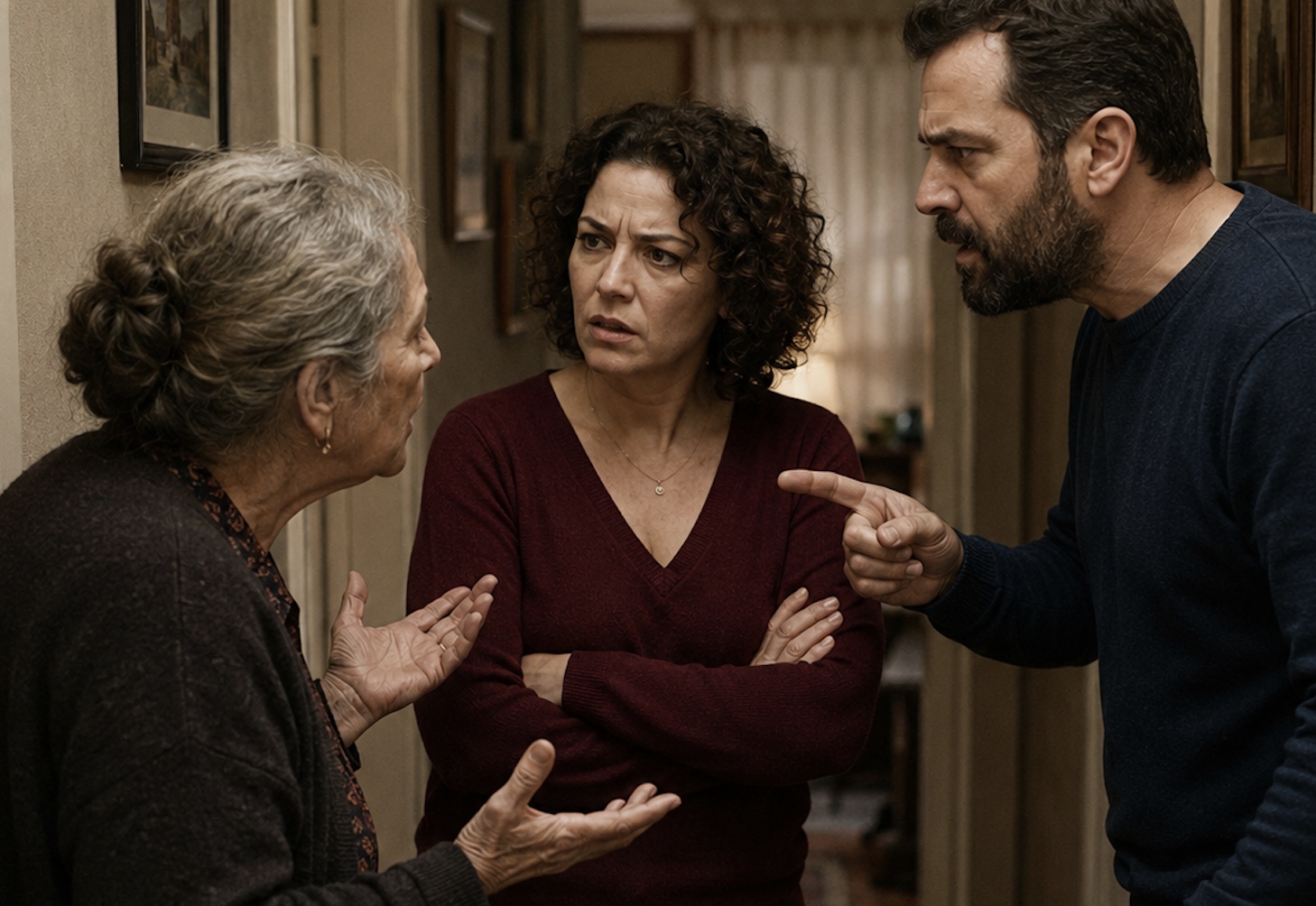
“Anna, open the door! We need to talk. It’s urgent!”
The loud knocking came so suddenly that Anna flinched and spilled tea across the table.
She quickly wiped up the puddle with a napkin and went to the front door. It was almost nine in the evening, and no one usually came to see her at that hour. Through the peephole, she saw two people: a woman in her sixties wearing a dark coat, and a man of about forty in a jacket. Their faces seemed vaguely familiar, but Anna did not recognize them right away. The light on the stairwell was dim, making it hard to see clearly.
“Who is it?” she asked without opening the door.
She was home alone, and it was late. It was better to make sure they were not strangers.
“It’s me, Lyudmila Petrovna! Sergey is with me! Open quickly, we urgently need to talk to you!”
Anna froze, listening carefully.
Lyudmila Petrovna was the mother of her ex-husband, Dmitry. Sergey was his older brother, who worked for some construction company. Almost a year had passed since the divorce, and during all that time they had not once visited, called, or even sent her a birthday message. And now they were standing outside her door late at night, demanding that she open immediately.
Had something happened?
Reluctantly, she slid the bolt back and opened the door.
Her former mother-in-law and brother-in-law were indeed standing there. Lyudmila Petrovna looked agitated. Her face was flushed, her hair was messy, and she was breathing quickly. Sergey stood beside her with a gloomy expression, his hands stuffed into the pockets of his jacket.
“Good evening,” Anna said, making no move to invite them inside. She remained standing in the doorway. “What happened?”
“Let us in. It’s uncomfortable talking on the stairs,” Lyudmila Petrovna said, already taking a step forward, clearly intending to enter.
“I’m comfortable here,” Anna replied, not moving aside. “Speak. I’m listening.”
Lyudmila Petrovna pressed her lips together and exchanged a glance with her son.
“Fine. We have a serious problem with Dima. A very serious situation.”
“What kind of situation?” Anna asked, folding her arms across her chest as she looked at her former mother-in-law.
“He… he quit his job a month ago. He came home and said he had handed in his resignation. Said he was tired of that job, that his boss didn’t appreciate him, didn’t raise his salary, didn’t give him any chance to grow. Sergey and I thought he would quickly find something better, that it was just a career change. But a month has passed, and he hasn’t even sent out his résumé! He sits at home all day, glued to the computer, doing nothing! Whenever we ask him anything, he brushes us off!”
“Lyudmila Petrovna, Dmitry and I divorced almost a year ago. I don’t understand why you came to me with this. Whether he works or stays home is his own business.”
“We came because you know him better than anyone! You lived with him for five years! You can talk to him like a normal person, make him come to his senses, explain that he can’t go on like this!”
“I’m no longer his wife. We separated. And whether he works or sits at home is not my concern. Does he have savings? He does. Then he can afford to take a break.”
Sergey stepped forward, looking down at Anna.
“Listen, Anna, we didn’t come here for nothing. Dima is really in a bad place. He fought with his friends, left his job, sits at home alone, doesn’t talk to anyone. Mother is worried.”
“Sergey, I understand your concern. But I’ll repeat myself: I’m no longer his wife. We separated. We divided our lives. Whatever is happening with him now is his personal matter.”
“You’re not a stranger!” Lyudmila Petrovna raised her voice. “You lived with him for five years! Are you really saying you don’t care at all?”
Anna and Dmitry had divorced eight months earlier, at the beginning of the previous year. Their separation had been surprisingly calm. No screaming, no broken dishes, no dramatic accusations.
One morning, over breakfast, Anna had simply said, “Dima, I think we need to get divorced.”
He had looked at her, stayed silent for a minute, and then answered, “Yes. You’re probably right.”
They had no children. Anna had not been able to get pregnant, despite examinations and treatment. There had been no property dispute either. The apartment they had lived in for the last four years belonged to Anna. She had inherited it from her grandmother before the marriage.
They had bought the furniture together and divided it peacefully. Dmitry took the sofa he liked. Anna kept the kitchen set. Dmitry packed his clothes, books, computer, and music disc collection into boxes and moved in with his mother, who lived alone in a three-room apartment on the other side of the city.
For the first month after the divorce, they occasionally exchanged short messages to settle small household matters: who would keep the multicooker they had received as a wedding gift, who would pick up the skis from the storage room, what to do about their shared online cinema subscription.
Then the messages became less frequent, and eventually stopped altogether. Anna took back her maiden name, Sokolova. She removed Dmitry from her social media friends, put away all their shared photos, and threw out the gifts he had given her for birthdays and anniversaries.
Almost a year had passed, and Anna’s life had gradually settled into a calm, normal rhythm. She found a new job as a manager at an advertising agency, signed up for yoga at a fitness club near her home, and began seeing her friends more often — friends she had barely met during her marriage.
She even did some small cosmetic repairs in the apartment herself. She changed the wallpaper in the bedroom to a light floral pattern, bought new curtains for the living room, and replaced the old chandelier with a modern one.
Sometimes she thought about her marriage to Dmitry, but no longer with bitterness or resentment. It felt like a completed chapter — something that had given her experience, taught her lessons, and ended naturally.
“Lyudmila Petrovna, I’m not a complete stranger to him, that’s true. But I’m not family anymore either. We are divorced. That means we are no longer responsible for each other.”
“How can you say that?” her former mother-in-law cried, throwing up her hands. “You had feelings! You loved each other!”
“We did. We loved each other. Past tense. Now we have nothing in common.”
“Anya, please listen,” Sergey said, trying to sound softer. “Dima is really in a bad state. He doesn’t listen to anyone. I tried to talk to him, and he told me to get lost. He ignores Mother completely. His friends turned away from him after some argument. You’re the only person who might still have influence over him.”
“Why do you think I can influence him?”
“Because he respected you. He listened to you. You ended things peacefully, without scandals.”
“We ended things. That is the key point. We separated and went our separate ways. If Dmitry has problems, they are his problems. He is a grown man. Thirty-three years old. Let him deal with his life himself.”
“But he’s alone! He’s suffering!” Lyudmila Petrovna began to sob, pulling a handkerchief from her pocket.
Anna looked at her closely.
Were the tears real or staged? It was hard to tell. But even if they were real, it did not change anything.
“Lyudmila Petrovna, if Dmitry needs a psychologist or a doctor, help him find a specialist. If he needs emotional support, you are his mother and brother. You are his family. Support him yourselves.”
“We’re trying! But he doesn’t listen to us! He says we don’t understand anything and tells us to leave him alone!”
“Then maybe he needs to be left alone. To think. To figure himself out.”
Sergey’s frown deepened.
“Anna, do you really think you can just wash your hands of this? A person is in trouble, and you say it’s not your problem?”
“I’m not saying I don’t care about him as a human being. I’m saying Dmitry is no longer part of my life. We separated. We have no shared obligations. If we had simply been acquaintances, you would never have come to me. But because we were once husband and wife, you somehow think I should drop everything and run to save him.”
“No one can help him except you! Get ready!” Lyudmila Petrovna blurted out, as if she were giving an order.
Anna stared at her in silence for several seconds, trying to understand whether she had really meant it.
Judging by her face, she had.
“Get ready? Go where?”
“To Dima, of course! You’ll go and talk to him. You’re smart. You’ll find the right words. He will listen to you.”
“Lyudmila Petrovna, I’m not going anywhere.”
“What do you mean, you’re not going? We’re asking you!”
“You are asking me to return to the life of a man I divorced. You are asking me to take responsibility for his choices. But that responsibility ended with our marriage.”
“Anya, don’t be so cruel,” Sergey said, shaking his head. “At least talk to him on the phone. Just five minutes.”
“Sergey, if I call Dmitry and say, ‘Hi, it’s your ex-wife, your mother told me you’re having problems,’ what do you think he’ll answer?”
“I don’t know. But at least try.”
“I’m not going to try. Because it is strange, inappropriate, and not my business.”
Lyudmila Petrovna wiped her eyes with the handkerchief and shoved it back into her pocket.
“So that’s it? You don’t care about the man you lived with for five years?”
“I don’t wish Dmitry any harm. I truly hope things work out for him. I hope he finds a job, makes peace with his friends, and gets his life together. But helping him do that is not my responsibility.”
“You have no heart!” her former mother-in-law shouted. “You’re cold! That’s why he left you!”
Anna gave a faint, bitter smile.
“Lyudmila Petrovna, if you remember correctly, I was the one who filed for divorce. He didn’t leave me. I left him.”
“Because you didn’t value him! You didn’t support him!”
“I supported him for five years. Then I realized I didn’t want to continue living with him. We separated peacefully. That was my decision, and I don’t regret it.”
“You see, Sergey?” Lyudmila Petrovna turned to her son. “She abandoned him, and now she refuses to help!”
“Mom, calm down,” Sergey said tiredly, waving his hand. “Anna, fine. It’s clear you don’t want to get involved. But at least give us some advice. What should we do?”
Anna thought for a moment.
“Advice? Leave Dmitry alone. Stop pressuring him. Give him time to sort himself out. If he wants to quit his job and stay home for a while, that’s his right. If he fought with his friends, let him decide whether to make peace with them or not. He’s an adult. He’ll manage.”
“And what if he doesn’t?” Lyudmila Petrovna started sobbing again.
“He will. He isn’t a teenager. He’s thirty-three. He’s educated, healthy, and capable. He has a head on his shoulders. He’ll figure it out.”
“You simply don’t want to help!” his mother said, wiping her nose with the handkerchief.
“I don’t want to return to someone else’s life. There is a big difference.”
Sergey let out a heavy sigh.
“Fine, Anna. I understand. We came for nothing.”
“Yes, you did. Because Dmitry is no longer my responsibility. If he has problems, they are his problems. I wish him luck, but I will not help.”
“You’re heartless,” Lyudmila Petrovna said with contempt. “In the old days, wives didn’t abandon their husbands. Whether he was good or bad, he was still her husband. And now what? You divorced him, and he became a stranger?”
“Yes, Lyudmila Petrovna. We divorced, and he became a stranger. That is normal. That is honest. We are not required to spend our entire lives carrying responsibility for people we were once married to.”
“Then go to hell!” the older woman snapped, turning sharply and heading toward the stairs.
Sergey lingered for a second.
“Anna, I’m sorry about my mother. She’s worried.”
“I understand. But it doesn’t change anything.”
“Yes, I get it. All right. Goodbye.”
He followed his mother down the stairs.
Anna closed the door, slid the bolt back into place, and leaned against the doorframe.
There was an unpleasant feeling in her chest. Not guilt — no, she did not feel guilty. It was more like irritation.
How could anyone come to a former daughter-in-law and demand that she drop everything to save her ex-husband? As if divorce meant nothing. As if a marriage certificate created a lifelong obligation.
Anna returned to the kitchen and poured herself a fresh cup of tea. She sat at the table and looked out the window. Outside, it had grown completely dark.
She remembered the day she and Dmitry had separated. They had sat in this same kitchen, drinking tea and calmly discussing details. Who would take the dishes. Who would keep the television.
Dmitry had not argued or tried to stop her. Anna had not cried or made a scene. They were simply two adults who had understood that they were no longer meant to continue together.
“Are you sure?” Dmitry had asked then.
“Yes,” Anna had answered.
“All right. Then let’s divorce.”
And they had divorced. They filed the paperwork and received their divorce certificates a month later. Everything had been clear, quick, and without drama.
And now, a year after that quiet separation, his relatives had appeared, demanding that she return to his life.
Because “no one can help him except you.”
Because “you’re not a stranger.”
Because “you had feelings.”
Anna finished her tea and placed the cup in the sink. She turned on the water and washed the dishes.
No, she was not a stranger to Dmitry in the sense that she did not wish him harm. She sincerely hoped he would find work, make peace with his friends, and rebuild his life.
But helping him was not her duty.
She was not his wife. Not his friend. Not even really an acquaintance anymore. They were former spouses, and that was where their connection ended.
If they had children, it would have been different. Then they would have had to interact somehow, solve matters related to the children, and remain connected in that way. But they had no children. After the divorce, each of them had taken a separate road.
Anna dried her hands with a towel, turned off the kitchen light, and went into the living room. She lay down on the sofa and picked up a book from the side table. She opened it at the bookmark.
Thoughts of Dmitry and his relatives slowly faded. She sank into reading.
A few days later, when Anna had almost forgotten about that visit, she received a long message from Lyudmila Petrovna. The text was emotional, full of accusations and bitter reproaches.
Her former mother-in-law wrote that Anna had abandoned her son at the hardest moment of his life, that she was heartless and cold, and that one day she herself would end up in a similar situation and finally understand what it felt like when everyone turned away and refused to help.
She wrote that a real woman never abandons a man, not even a former husband. She wrote that Anna simply had no heart.
Anna read the message from beginning to end, sighed heavily, and blocked her former mother-in-law’s number.
She did not reply. Explaining anything again would have been pointless. Lyudmila Petrovna would not understand. She would not hear her.
For her, divorce was just a formality. The former wife of her son was someone who remained forever indebted to their family.
A month passed. Then another.
Life continued as usual. From time to time, Anna remembered that strange evening when Dmitry’s relatives had come to her with a demand that she return to his life. Each time, she understood more clearly that she had done the right thing. There had been no other way.
She was not obligated to save her ex-husband from his own decisions. She was not obligated to return to his life and take on the role of rescuer. She was not obligated to feel guilty for living her own life.
Divorce is not just a stamp in a passport. It is not a mere formality. It is a conscious break between two people. It is the acknowledgment that from that point on, each person walks a separate path, builds a separate life, and carries responsibility only for themselves.
And when relatives try to force that connection back into existence, when they try to restore it through guilt and pressure, it is a violation of personal boundaries. It is manipulation.
One spring day, Anna accidentally learned through mutual acquaintances on social media that Dmitry had found a new job. He had applied to another company, passed the interview, and received an offer for a good position with a decent salary.
He had also made peace with some of the old friends he had fought with. He rented a one-room apartment in the city center, moved out of his mother’s place, and began living independently.
Anna was sincerely glad to hear it.
She was glad that he had handled the situation.
On his own.
Without her involvement or help.
Exactly as an adult, independent person should.
That difficult evening, when the relatives of her ex-husband had stood at her door and demanded that she “get ready and go save him immediately,” Anna understood something important — something worth remembering for the rest of her life.
Sometimes the hardest decision is firmly refusing to save someone who is no longer part of your life.
It is not hard because you secretly want to help or because something pulls you back. It is hard because people around you begin to pressure you, accuse you of being cruel, demand things from you, and manipulate you through guilt. They use loud words about inhumanity, selfishness, and how impossible it is to abandon someone when they are having a hard time.
But Dmitry had not been in true danger.
He had simply been going through a difficult period in his life. Temporary troubles. And he had to pass through that period himself, standing on his own feet.
Because he was an adult.
Because he had a head on his shoulders and the ability to act.
Because no one but Dmitry himself could truly solve Dmitry’s personal problems.
Anna closed the chapter of her life connected to him. She closed it calmly, without regret and without looking back.
And when his relatives tried to force that chapter open again, tried to drag her back into the past, she did not allow it.
She stood firm.
Because divorce is not a pause in a relationship.
It is the final end of one stage of life.
And that ending must be accepted with dignity, without going back.