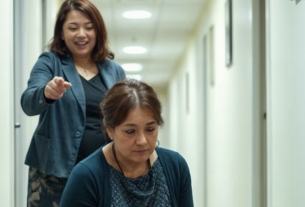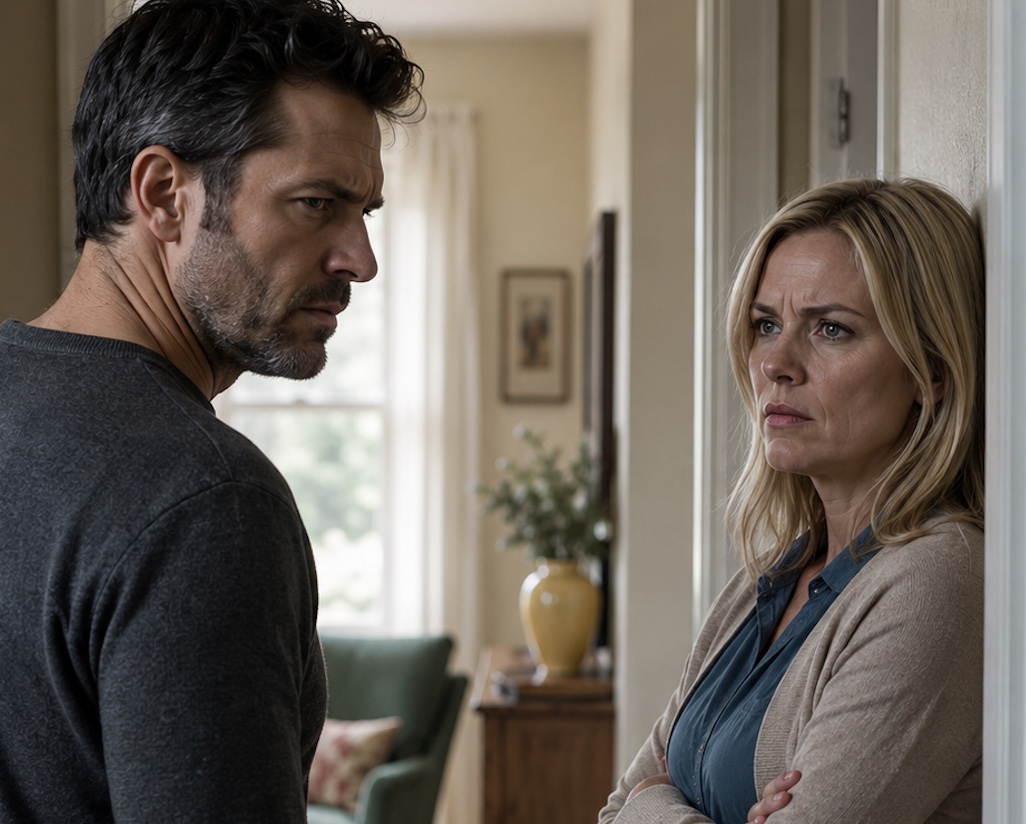
“Say one more time that your sister is going to live here, and I’ll show you the door myself,” Darya cut him off. She didn’t raise her voice, but she said it in a way that made even the kettle in the kitchen seem to stop boiling.
“Don’t start,” Artyom grimaced, tossing his keys onto the small cabinet by the entrance. “Vika isn’t coming here for a vacation. She has a housing problem.”
“A person,” Darya repeated dryly, folding her arms across her chest, “who has a mother, a father, arms, legs, and a habit of treating other people’s square meters like a family tradition.”
“You’re being sarcastic on purpose,” Artyom snapped, pulling off his jacket. “Normal families help each other.”
“Normal families,” Darya replied, looking him straight in the eyes, “ask the owner of the apartment first, and only then invite relatives with suitcases.”
His cheek twitched. Darya knew that movement well. One more second, and he would launch into his usual masculine lecture about how “difficult” she was. As if a difficult woman was simply one who didn’t dream of turning a newly bought three-room apartment into a free hostel for her husband’s relatives.
“Not the owner. My wife,” Artyom emphasized, walking into the kitchen. “We’re a family, in case you forgot.”
“A family,” Darya smirked, following him. “Funny how when it comes to money, it’s ‘Dasha, you’re so smart,’ but when it comes to rooms, suddenly it’s ‘we’re a family, we’ll make space.’”
“Why are you so obsessed with money?” Artyom flared up, yanking the refrigerator door open. “Everything we have is shared.”
“No,” Darya said quietly. “Not everything.”
And really, that was where she should have started three months earlier. Not with wallpaper. Not with the kitchen. Not with those ridiculous arguments about whether they needed blackout curtains in the bedroom. She should have started with one simple word: no.
But three months earlier, Darya had still hoped things could be handled like decent human beings.
For four years before that, they had rented a one-room apartment in Mytishchi, on the fifth floor of a building where the elevator lived a rich and independent life, appearing less often than a conscience in certain relatives. Darya worked as an accountant at a wholesale company, while Artyom was a manager at a car dealership. His income was unpredictable: one month he had a bonus, the next he announced solemnly that “the market had dipped.” Darya’s salary brought no surprises, but no miracles either.
“Dasha, are you standing by the window again like the heroine of a drama series about tragic love?” Artyom once asked, chewing a sandwich over the sink.
“I’m watching our landlord buy himself a second car with my bank transfers,” Darya replied without turning around.
“We’ll save up and buy our own place,” Artyom said carelessly, as if they were discussing a microwave, not an apartment.
“Of course,” Darya snorted. “In about two hundred years. If we live on air and don’t turn on the heating in winter.”
Sometimes she laughed at herself too. Nearly fifty, and still dreaming the same dream — a place of her own. Not a palace, not a penthouse, no gold-plated toilets or other vulgar nonsense. Just an apartment where she could repaint the walls without asking permission and wouldn’t have to hear once a year, “You’ll need to move out by August, my nephew is getting married.”
Then her grandmother called from Yaroslavl.
“Dasha, come over on Saturday,” Zinaida Fyodorovna said in her usual brisk voice. “We need to talk. And don’t argue. I’ve already started making pies.”
“Grandma, are you blackmailing me with pies?” Darya smiled.
“How else am I supposed to talk to you city people?” her grandmother snorted. “With you, it’s either delivery or a nervous breakdown.”
Darya went. They sat in the kitchen, where everything was just as it had always been: the small floral oilcloth on the table, the jar of dry biscuits, the radio mumbling something about the weather and exchange rates, as if exchange rates had ever helped anyone survive until Friday.
“I sold the dacha,” her grandmother said calmly, pouring more tea. “That’s it. I’ve had enough of sticking my backside up in the garden beds. I can survive store-bought cucumbers.”
“And you were right to do it,” Darya nodded. “It was getting hard for you to go there.”
“Exactly,” her grandmother waved her off. “And I’m giving the money to you.”
Darya actually put her cup down.
“Grandma, what do you mean — to me?”
“I mean exactly what I said,” Zinaida Fyodorovna replied firmly. “I’ve already been to the notary. We’ll draw up a gift agreement for the money, and I’ll transfer it to your account. And don’t start with your ‘you shouldn’t.’ I should. I didn’t save all these years just so strangers could later decide who needs my money more.”
“Grandma, but…” Darya was lost. “That’s a huge amount.”
“Huge,” her grandmother nodded. “Which is why you’re going to listen carefully. The money is for you. Not for ‘you two.’ Not for ‘the family.’ Not for everyone’s shared wishes. For you. So that you have a roof over your head that belongs to you. Understood?”
“I understand,” Darya said quietly.
“Good girl,” her grandmother cut in. “You can tell your husband afterward. Just pay attention to how he says the word ‘we.’ People reveal themselves best through words like that.”
Darya had laughed then. She had even felt a little offended on Artyom’s behalf. She thought her grandmother was being unfairly suspicious. But later, sitting on the train back home, she kept turning that phrase over in her mind like a splinter.
When the money arrived in her account, Artyom actually sat down.
“How much?” he asked again, staring at the phone.
“Four million seven hundred thousand,” Darya answered, still barely believing it herself.
“Dasha, that’s…” Artyom broke into a smile. “That means we can buy an apartment! Finally! A normal one! We could look for a three-room place, not some old Khrushchev-era box.”
And there it was — that “we.” Darya heard it clearly. Loudly. Exactly as her grandmother had warned her.
“We’ll see,” was all she said.
“What’s there to see?” Artyom became animated, already opening property listings. “Look, this building is good. The metro’s a bit far, but the district is fine. And this one is amazing — the kitchen is ten meters!”
“Artyom,” Darya said tiredly, “can we at least not spend today jumping from listing to listing? My head is spinning.”
“Mine too!” he laughed. “But in a good way.”
They searched for almost a month. They viewed run-down apartments with “renovations” from 2007, where the bathroom tiles were the color of despair and the glossy stretch ceiling looked as though someone had rubbed it with oil. They also looked at new builds priced as if a personal doorman came included.
In the end, they found a three-room apartment in Korolyov: a panel building, ninth floor, windows facing the courtyard, a school across the street, and a fifteen-minute walk to the station. The kitchen wasn’t royal, but the rooms were separate. It needed cosmetic work, but not an all-out war with concrete.
“We’re taking it,” Artyom said after the viewing. “We can live here.”
“I like it too,” Darya admitted.
At the closing, Darya registered the apartment in her own name. Calmly. Without drama.
“It’s more correct this way,” she told Artyom at home beforehand. “The money was gifted personally to me, and everything is documented. That way there won’t be confusion later.”
“Do whatever you want,” Artyom waved it off. “As long as we finally buy it.”
He smiled. He hugged her. He said, “Finally, our own place.” Darya almost believed everything would be fine.
Almost.
The first person to come inspect the new home was her mother-in-law.
“Well then,” Elena Viktorovna drawled as she stepped into the hallway with the air of an inspector of morals and interior design, “let’s see how you’ve settled in.”
“Come in,” Darya said politely, already sensing that something was about to begin.
“This small room,” Elena Viktorovna announced, narrowing her eyes, “will be Artyom’s office. A man needs a corner for work and rest.”
“We haven’t decided yet,” Darya answered calmly.
“What is there to decide?” her mother-in-law said, surprised. “He can’t sit on the windowsill.”
“I work too, actually,” Darya pointed out.
“Accounting isn’t work. It’s attentive sitting,” Elena Viktorovna said condescendingly. “A table in the kitchen will be enough for you.”
Darya actually laughed.
“Thank you. Such a modern approach. You might as well say women don’t need passports either.”
“Don’t be snide,” her mother-in-law pressed her lips together. “I’m talking sense.”
Viktoria, Artyom’s sister, appeared from one of the rooms with the expression of someone who had not come as a guest, but to audition for the role of “ideal victim of circumstances.”
“The middle room is actually quite nice,” she said, running a finger along the windowsill. “Bright.”
“Perfect for guests,” Elena Viktorovna immediately picked up. “Gennady Pavlovich and I could stay sometimes. After the dacha, for example. So we don’t have to travel back and forth.”
Darya slowly turned to Artyom.
“Are you hearing this?” she asked evenly.
“Mom is just thinking aloud,” he smiled tensely.
“Right,” Darya nodded. “Like a real estate agent with a very personal interest.”
The renovation lasted a month, and during that month Artyom’s relatives settled into the apartment faster than the actual owners. Elena Viktorovna came every Saturday with containers of cutlets and unsolicited advice.
“Darya,” she would say, grimacing, “why did you choose this wallpaper? This isn’t beige. This is the color of ‘people got tired and lay down.’”
“At least it’s not the color of ‘my eye is twitching,’” Darya replied, pointing to the sample her mother-in-law had brought. “That burgundy striped one of yours belongs in a district hair salon from the nineties.”
“You’re very sharp-tongued,” Elena Viktorovna clicked her tongue. “But you’ll still live in boredom.”
“Better boredom than a circus,” Darya answered calmly.
Gennady Pavlovich usually sat quietly, drank tea, and watched the tournament as if he wanted to leave the chat, but the chat was his family. Viktoria complained about men, work, nails, prices, her boss, and the weather. Artyom made jokes, smoothed things over, and went out to smoke. Like any person who finds it very convenient when two women settle conflicts instead of him.
When the renovation was finally done, Darya breathed freely for the first time. Clean walls, a new kitchen, a sofa that still smelled like a furniture showroom, and her slippers neatly standing in the hallway instead of someone else’s endless guest shoes. She wanted silence. Peace at home. Her own rhythm.
A week later, they came again.
“Dasha, put the kettle on,” Elena Viktorovna called cheerfully from the entrance, as if she had walked into her own apartment. “We need to talk.”
Even then, Darya understood: the tea would be the least dangerous thing here.
“We have a problem,” Viktoria sighed, sitting down at the table and portraying a woman crushed by the collapse of the universe. “My landlady raised the rent. By ten thousand. She said either we pay or move out by the end of the month.”
“Terrible,” Darya nodded without much horror in her voice.
“Absolutely terrible,” her mother-in-law joined in. “For that kind of money, you can only rent a shed these days. And you, by the way, have three rooms.”
“And?” Darya asked, already knowing exactly where this train was heading.
“And Vika could live with you temporarily,” Elena Viktorovna said with emphasis. “Until she finds something.”
“No,” Darya answered immediately.
The kitchen went silent. Even the refrigerator seemed offended and stopped humming.
“What do you mean, no?” her mother-in-law asked slowly.
“I mean no,” Darya repeated. “We’ve only just moved in. We need to settle in ourselves.”
“Settle in?” Elena Viktorovna raised her eyebrows. “In three rooms? Just the two of you? Don’t make me laugh.”
“I’m not trying to,” Darya replied calmly. “I simply don’t want anyone moving in.”
“Artyom?” her mother-in-law turned to her son. “Do you think the same?”
He coughed and looked away.
“Mom, it’s a complicated situation,” Artyom muttered. “We need to think.”
“What is there to think about?” Viktoria protested, suddenly no longer quiet. “It’s not forever.”
“That exact phrase,” Darya said dryly, “is usually used by people who later unpack their winter clothes.”
“Are you calling me a freeloader now?” Viktoria snapped.
“I’m not calling you anything. I said you won’t live here.”
“Darya,” Elena Viktorovna said in an icy voice, “that is not how family behaves.”
“Mm-hm,” Darya nodded. “Family also doesn’t behave like this: buy an apartment with the wife’s money and then start distributing rooms to the husband’s relatives a week later.”
“With the wife’s money?” her mother-in-law repeated, leaning forward. “So that’s how it is? We’re already dividing things into ‘mine’ and ‘not yours’?”
“The apartment is registered in my name,” Darya said clearly. “My grandmother gifted me the money. This is my property. And the decision is mine too.”
“So that’s the truth,” Elena Viktorovna said with an unpleasant calmness. “Artyom, do you hear that? Your wife is saying out loud that you have no voice in your own home.”
“Mom, don’t exaggerate,” Artyom said wearily.
“I’m not exaggerating,” his mother replied. “I’m simply hearing the truth at last.”
After that evening, a vile silence settled over the apartment. Artyom walked around with the face of a man mortally insulted by the fact that he had not been allowed to manage someone else’s property. He spoke in short phrases, slammed cabinets, and smoked on the balcony.
“Do you truly not understand what the problem is?” Darya asked one day, standing in the kitchen doorway.
“I understand,” Artyom replied coldly. “The problem is that you’re greedy.”
“No,” Darya smirked. “The problem is that I’m not stupid.”
“Don’t act like you’re the only smart person here,” he snapped. “Vika really is in a difficult situation.”
“And I really am not obligated to solve her situation with my apartment.”
“Our apartment,” Artyom hissed.
“No,” Darya repeated, looking him in the eyes. “And it seems it’s time you memorized that.”
On Friday evening, the doorbell rang as if the delivery of every misfortune in the world had arrived at once. Darya opened the door and saw Elena Viktorovna, Viktoria, and two suitcases.
“We won’t stay long,” her mother-in-law said briskly, trying to step inside. “You’ll sort things out later.”
Darya put out her hand.
“No.”
“What do you mean, no?” Elena Viktorovna snapped.
“I mean you are turning around and leaving.”
“Artyom allowed it,” Viktoria threw out, setting the suitcase down heavily.
“Artyom is not the only adult here,” Darya answered.
At that moment Artyom himself came out of the room, saw the scene, and instead of looking surprised, put on an expression of suffering.
“Why are you doing this right at the doorway?” he muttered.
“Oh, I see,” Darya said quietly. “You knew.”
“Dasha, let’s not make a scene,” Artyom quickly began. “Vika will stay for a little while, then she’ll find something.”
“How long is ‘a little while’?” Darya asked. “Until the first grandchildren or until your mother moves in too?”
“Don’t be hysterical,” Artyom snapped.
“That’s a very brave thing to say in my hallway,” Darya noted dryly.
Elena Viktorovna pulled the suitcase forward.
“Move aside and stop embarrassing yourself,” her mother-in-law hissed. “People help each other, and you’re putting on a show.”
“I’m embarrassing myself?” Darya even laughed. “You arrived at someone else’s apartment with suitcases and without the owner’s consent. The embarrassment got here a long time ago. You just failed to notice it in the corridor.”
Her mother-in-law pushed the door with her shoulder. Darya braced herself against it. The suitcase got stuck between the doorframe and her leg. Viktoria yelped. On the stairwell, as if by the law of drama, a neighbor’s door cracked open.
“Is everything all right?” an elderly woman in a robe peeked out.
“More than all right,” Darya replied without taking her eyes off her mother-in-law. “Some people have simply confused hospitality with a territorial invasion.”
“She’s insane!” Elena Viktorovna burst out. “She begrudges her husband’s own sister a place to stay!”
“Her husband’s own sister,” Darya said through her teeth, “can go stay with her own parents. That would be more logical.”
“I’m not going to a hostel with Mom’s friends!” Viktoria shouted.
“And I’m not going to live in a communal apartment disguised as a marriage!” Darya snapped.
Artyom grabbed her by the elbow.
“Stop yelling!” he hissed.
Darya pulled her arm free.
“Take your hands off me,” she said in an icy voice. “And get your mother away from my door too.”
The neighbor was now openly enjoying the show. Somewhere above, the elevator stopped. Someone began descending the stairs very slowly, clearly afraid to miss the climax.
“Mom, let’s go,” Viktoria suddenly said quietly, and for the first time there was no spoiled tone in her voice — only exhaustion. “Don’t.”
“We must!” Elena Viktorovna barked. “Otherwise this one” — she jabbed a finger toward Darya — “will put Artyom out on the doormat tomorrow!”
“If he keeps acting like this,” Darya replied calmly, “I will. I’ll even label the box for his things so nothing gets mixed up.”
Her mother-in-law swore under her breath, spun around sharply, and dragged the suitcase toward the elevator. Viktoria followed, eyes lowered. Artyom stayed where he was, red-faced, angry, humiliated — and somehow convinced that he was the one who had been humiliated.
When the door closed, he turned to Darya.
“You crossed every line,” he forced out.
“No,” she replied. “I finally drew them.”
That evening, he held family court number one — without a summons, but with plenty of theatrics.
“Listen to me carefully,” Artyom said, sitting across from her and clasping his hands. “Vika will live here for three months at most.”
“No,” Darya answered.
“You don’t even let me finish.”
“And you don’t even try to hear me.”
“What is wrong with you?” he exploded. “It’s just one room!”
“No, Artyom,” Darya said tiredly. “It’s not just one room. It’s a way of getting into my home and then saying, ‘What’s the big deal? We’re all family.’”
“Seems like you don’t have any family at all,” he threw out viciously.
“I do,” Darya answered quietly. “They just don’t break in with suitcases.”
The next day, Artyom apparently decided to go all in and invited his parents over “to discuss things calmly.” Darya found out only when her mother-in-law was already taking off her shoes in the hallway.
“Wonderful,” Darya said, seeing the whole delegation. “All that’s missing is a sign saying ‘court is now in session.’”
“No sarcasm,” Elena Viktorovna said, sitting down in the living room. “We need to make an adult decision.”
“I’ve already made the adult decision,” Darya replied, remaining standing. “You just didn’t like it.”
“Here’s the thing,” Artyom raised his hand. “I live here too, and I have a voice.”
“You have a voice,” Darya nodded. “You don’t have the right to dispose of the apartment.”
“You’re wrong,” Artyom said sharply. “The apartment was bought during the marriage.”
“With money gifted to me. I have the documents.”
“So what?” Elena Viktorovna cut in. “A husband invested in the renovation, appliances, and moving. Everything is shared.”
“Can you show receipts?” Darya asked calmly.
“This isn’t about receipts!” her mother-in-law flared up.
“When it comes to court,” Darya replied just as calmly, “it absolutely is.”
Gennady Pavlovich, who had been silent until then, sighed heavily.
“Lena, maybe enough,” he said dully. “Don’t interfere like this.”
“Of course you would say that,” his wife immediately snapped. “You always stay on the sidelines! And where is our daughter supposed to go?”
And then Viktoria suddenly said the thing she apparently was never supposed to say.
“Mom, stop it. You said yourself that if I got registered here even temporarily, Darya wouldn’t be able to kick anyone out so easily afterward.”
Silence hung over the room.
Elena Viktorovna went pale.
“Shut up,” she hissed.
“Oh no,” Darya said slowly. “Go on, Vika. This is very interesting.”
“I…” Viktoria swallowed. “I didn’t want to. Mom came up with it. And Artyom said we just needed to move me in first, and then ‘she’d get used to it.’ His words, by the way.”
Darya turned to her husband.
“I’d get used to it?” she repeated almost in a whisper.
Artyom jerked.
“That’s not how it was meant.”
“How was it meant?” Darya smirked. “‘Dasha will shout a bit and calm down’?”
He said nothing. And that silence said everything.
“Out,” Darya said very quietly.
“Darya,” Artyom began.
“Out,” she repeated louder. “All of you. Out of my apartment. Now.”
“You have no right…” her mother-in-law started.
“I do,” Darya cut her off, throwing the door open. “Immediately.”
Elena Viktorovna tried to say something else, but Gennady Pavlovich stood up.
“Let’s go,” he said tiredly to his family. “Enough. Everything is clear here.”
“Not everything!” Artyom barked. “If you kick us out now, I’ll file for divorce and property division.”
“File,” Darya nodded. “And while you’re at it, find the receipts for your imaginary share.”
He left last, throwing her a look that held no grief, no love, not even anger. Just the resentment of a man who had been denied something he had already mentally considered his own.
The next morning, while Artyom went off “to think,” Darya called a locksmith and changed the locks. She packed his belongings carefully, without hysteria, almost like an accountant: shirts separately, documents in a folder, chargers in a bag. She placed everything on the landing and sent him a message: “Pick it up by evening.”
He arrived forty minutes later.
“Are you out of your mind?!” Artyom shouted from behind the door. “Open up!”
“No,” Darya answered calmly.
“I’ll call the police!”
“Call them,” she said. “I’ll show them the property registry extract at the same time.”
“This is my apartment too!”
“Say that again,” Darya smirked through the door. “It seems your memory is selective.”
After the divorce, he really did go to court. He demanded that the apartment be recognized as jointly acquired property. Alternatively, he wanted compensation for the renovation, appliances, and “significant investments.” Darya hired a lawyer — a woman with such a gaze that even the word “objection” sounded like a sentence when she said it.
“You have the gift agreement for the money?” the lawyer asked, flipping through the documents.
“Yes.”
“The bank transfer to your account?”
“Yes.”
“The payment for the apartment from that account?”
“Yes.”
“Excellent,” the lawyer nodded. “Then we won’t fight emotions with emotions. We’ll fight with papers. Papers behave much better in court than relatives do.”
In court, Artyom sat straight-backed, as if he had been personally invited there for justice, rather than for someone else’s apartment.
“My client lived there as a spouse,” his lawyer said. “He participated in the renovation, bought materials, organized the move.”
“Supporting documents?” the judge asked calmly.
“The receipts were not preserved.”
“Then that is an opinion, not evidence,” the judge noted dryly.
Elena Viktorovna sat on the bench behind him, burning holes into Darya with her eyes.
“You’ll still end up alone,” she hissed once in the court corridor. “Who needs a woman with a character like yours?”
“At least I’ll have an apartment,” Darya replied evenly. “Your son has neither character nor an apartment. Awkward, isn’t it?”
Her mother-in-law nearly choked with indignation. Darya even felt guilty. A tiny bit. About two millimeters’ worth.
The decision was issued in November. The apartment was recognized as Darya’s personal property. Artyom’s claims were denied. The renovation claims were denied too: unsupported stories did not impress the court.
She walked out of the courthouse, breathed in the damp air, and for the first time in many months, she didn’t feel a weight in her chest. It was as if not only other people’s claims had been lifted from her, but also her own foolish politeness, the one that had made her endure for so long.
A week later, the doorbell rang. Darya opened the door and found Viktoria standing on the landing. Alone. No suitcase, no mother, no tragic expression.
“I’ll only take five minutes,” she said awkwardly. “May I?”
Darya silently stepped aside.
“Here,” Viktoria placed a small key on the entryway cabinet. “It’s a spare. Artyom made it during the renovation. Just in case. Mom told me not to say anything. I kept quiet too. It was ugly.”
Darya looked at the key, then at Viktoria.
“Thank you,” she said.
“Back then, I thought you were just greedy,” Viktoria gave a crooked smile. “Then I lived with Mom and my brother in a one-room apartment for two months and realized you’re basically a hero. I would have put them out in the stairwell on the third day. Without boxes.”
Darya unexpectedly laughed. Truly laughed, for the first time.
“You’re late to become smart,” she said.
“I agree,” Viktoria nodded. “But still. And one more thing… Artyom is renting a place now with a male colleague. Mom wouldn’t take him in. She said, ‘You’re a grown man, sort yourself out.’ That’s family support for you.”
“Ironic,” Darya said calmly.
“Very,” Viktoria sighed. “All right. I’ll go. And… you were right back then.”
When the door closed behind her, Darya stood in the hallway for a long time with that key in her palm. Such a small metal object, and yet it held so much of other people’s arrogance, deceit, and certainty that she could be pressured, outwaited, shouted down.
She went to the kitchen, put the kettle on, and sat by the window. Outside in the courtyard, two drivers were arguing over a parking space. The pharmacy sign above the entrance blinked. Someone downstairs was dragging grocery bags home from Pyaterochka and grumbling into the phone, “I told you, not that mayonnaise.” Normal life. Real life. Without theatrics.
Her phone vibrated. Grandma.
“Well then, homeowner,” Zinaida Fyodorovna asked cheerfully, “did you hang the curtains?”
Darya smiled.
“I did, Grandma.”
“And how do they look?”
“Fine. But it turns out the main decoration of the apartment wasn’t the furniture.”
“What was it, then?” her grandmother chuckled.
Darya looked at the door, at the key on the table, at the empty and finally quiet apartment.
“The locks,” she said. “Good, strong locks.”
And she laughed so lightly that it felt as if only now had she truly moved into her own home.