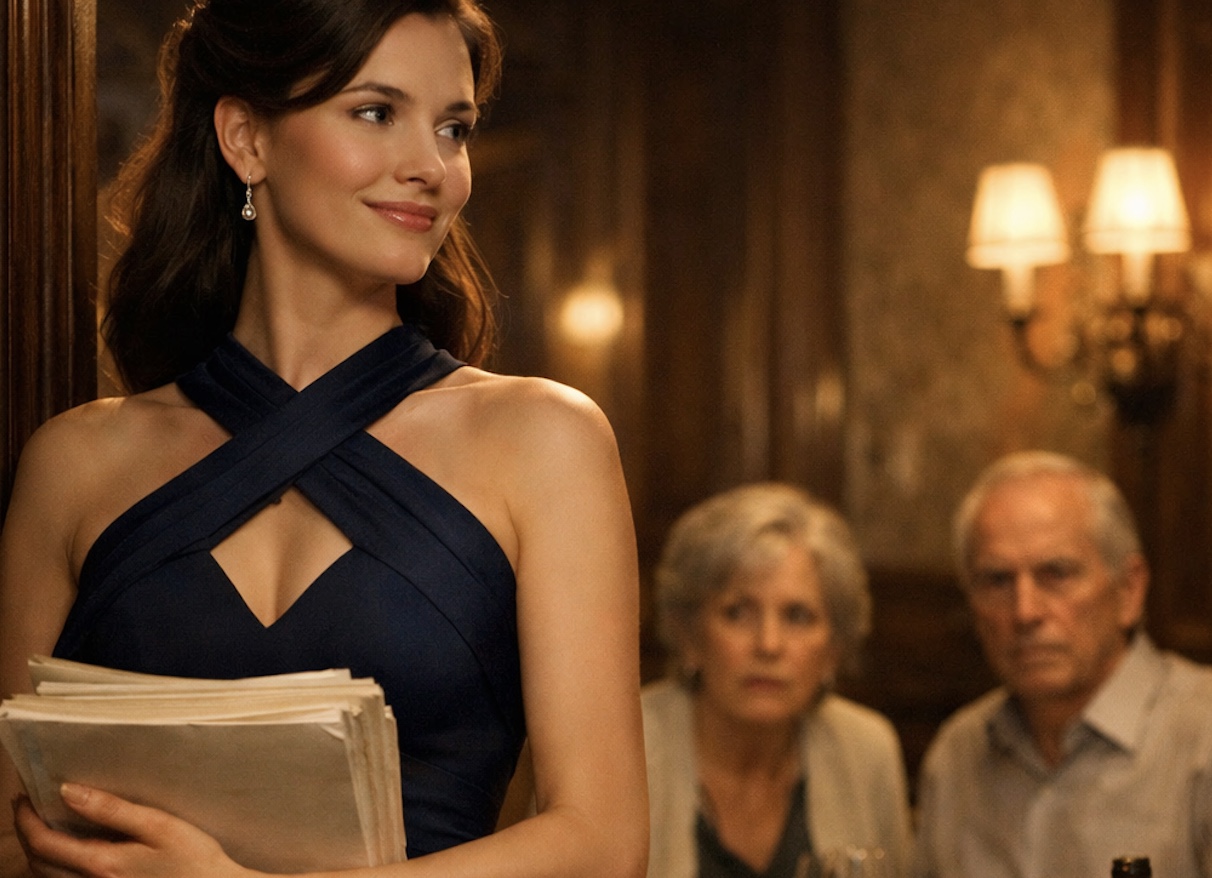
“Take the kids and leave — my mother wants some peace and quiet,” my husband said on his birthday. An hour later, he was already regretting it.
Cold autumn rain tapped against the window as if it were trying to warn her that a storm was coming. But the real storm was already building inside the apartment.
Raisa’s morning did not begin with an alarm clock or the smell of coffee. It began with a muffled, irritating murmur coming from behind the wall.
She opened her eyes and stared at the ceiling. Pavel. Again.
He was talking to someone in the kitchen, clearly trying not to wake the family, but his whispering only made it worse. His voice carried those familiar notes she had come to hate — pleading, apologetic, guilty. Raisa did not need to guess who was on the other end of the line. There was only one person in the world who could turn a thirty-five-year-old logistics department manager into a frightened schoolboy.
His mother.
Galina Petrovna.
“Yes, Mom, I understand… Of course, Mom… I’ll fix everything, don’t worry… Yes, she’ll understand… Why would you say that?” his voice drifted in from the kitchen.
Raisa let out a long sigh, threw off the blanket, and slipped her feet into her slippers. How many times had she seen this scene already? Her mother-in-law had a rare gift: in five minutes she could load her son with so much guilt that he would probably sell a kidney if it meant winning back her approval. She always knew exactly which strings to pull.
Pavel looked like an adult man from the outside, but around his mother he lost all willpower. He understood perfectly well that her demands were often absurd, yet he forgave every whim. And somehow, Raisa was always the one left paying the price. The moment she even hinted that Galina Petrovna was overstepping, Pavel would explode.
“You always exaggerate!” he would shout, his face blotchy red. “She’s my mother! She’s an elderly woman, she just needs attention. It’s my duty to help her. You are the one constantly looking for a fight.”
Galina Petrovna, for her part, knew how to strike where it hurt.
“You’re jealous, dear Raisa,” she would say with a venomous smile whenever they were all seated together at the family table. “You know I come first in Pasha’s life, and that drives you crazy. You make up stories to turn my boy against me. But it won’t work. Wives come and go. A mother is forever.”
The worst part was that she always said things like that right in front of Pavel.
And he…
He would suddenly become fascinated by the wallpaper pattern, a bowl of soup, the screen of his phone — anything at all. He switched off, pretending not to hear.
Later, when Raisa asked him through tears how he could stand there and say nothing, he would widen his eyes in fake confusion.
“You must have misunderstood, sweetheart. I was there and I didn’t hear anything like that. Mom was joking. She just has an odd sense of humor. You take everything too personally.”
There were days when Raisa wanted to grab the children and leave without looking back, just to escape this absurd circus. But she loved her husband. Or maybe she loved the version of him that existed when his mother was not nearby. She did not want to take the children’s father away from them. And a woman’s patience can stretch a very long time before it finally snaps.
That morning felt like the moment it would snap for good.
Raisa walked into the kitchen. The moment Pavel saw her, he jerked as if he had been caught stealing. He waved frantically at her while pinning the phone between his shoulder and ear.
“Don’t interrupt!” he hissed, glaring at her. “Go away. Let me finish.”
Raisa braced her hands against the doorframe, refusing to move, but Pavel — already worked up from speaking with his mother — was stronger. He grabbed her by the shoulders and turned her around.
“Go take a shower. I’ll make you coffee,” he whispered quickly, shutting the door in her face.
The next second, she heard Galina Petrovna’s sharp voice carrying loudly through the phone speaker:
“You even make her coffee now? What a pathetic henpecked fool! Does she do anything in that house, or are you her servant?”
Raisa leaned back against the closed kitchen door and shut her eyes. A shower really did sound necessary — if only to wash off the sticky disgust creeping over her skin.
As the water ran, she tried to gather her thoughts. What could have made her mother-in-law call so early on a weekend? A bad feeling settled in her chest.
It was Pavel’s birthday.
Every year, his birthday turned into a competition over who could please “her boy” better — and no matter what Raisa did, she lost. Any gift she chose was picked apart. Any effort was dismissed.
As soon as she turned off the water and wrapped herself in a towel, someone scratched softly at the bathroom door.
“Raechka, are you almost done?” Pavel’s voice had gone unusually sweet, which somehow frightened her more than his shouting.
“I’m coming,” she muttered.
The kitchen smelled of fresh coffee, but it did nothing to make the room feel warmer. Pavel fussed by the stove, which was unusual for him in the morning. A cup sat on the table, but his eyes kept darting away. He would not look at her.
“Your mother called,” Raisa said, sitting down and wrapping both hands around the cup. “That much is obvious. Let me guess — she wants something again? Money for ‘medicine’ that will somehow become a spa trip? Or maybe you need to take her cat to the vet across town?”
Pavel gave a nervous little laugh and sat across from her.
“Actually, no. This time it’s something I need. But I’m afraid you’ll take it the wrong way…”
Raisa glanced at the clock. In fifteen minutes their boys, Artyom and Denis, would wake up. She wanted to greet them with a smile, not with the aftermath of a fight.
“Pasha, let’s skip the performance. If you’re still trying to figure out how to say it without making me angry, then whatever it is must be bad. I’m going to get ready for work. You can make breakfast for the boys since you’re suddenly so domestic today.”
She stood up to leave, but Pavel suddenly rose and caught her wrist. His grip was tight, almost painful.
“No. Sit down. I need to say this now, and you need to listen calmly.” He took a breath, like a man about to jump into freezing water. “Mom is coming for my birthday.”
“So let her come,” Raisa said, pulling her hand free. “What difference does that make? I’ll set the table, survive a few hours of her insults. Nothing new there.”
“You’re not listening.” Pavel inhaled again, then rushed the words out. “You won’t need to set the table for us. I mean, you will — but… I’ll celebrate with you later. Mom wants to come on the actual day. And she has one condition. She wants to spend the evening alone with me. No extra ears around. No… irritants.”
Raisa froze.
The words took time to sink in.
“What do you mean, ‘irritants’?” she asked quietly.
“You know perfectly well she can barely stand being around you,” he said quickly, stumbling over his own explanation as though speed might somehow make it sound reasonable. “Every holiday ends in a fight. Her blood pressure spikes. And this is my milestone birthday — I’m turning thirty-five. I just want one evening without drama. So… you’ll cook, pack the kids, and go stay with Lena. You’ve said yourself you haven’t seen her in ages. Spend the night there and come back tomorrow.”
Raisa stared at him as though she were looking at a stranger.
“So that’s how it is,” she said, giving a short, incredulous laugh. “And why exactly are we being exiled from our own home? Me and the children are now ‘irritants’?”
“I’m not exiling anyone!” Pavel snapped. “Stop being dramatic. It’s just practical. One evening. One night. I can’t not invite my mother — she gave birth to me, this day matters to her too!”
“Fine, forget me,” Raisa said sharply. “Let her hate me all she wants. But the children? Those are her grandsons. Her own blood. You’re sending your sons away so your mother can enjoy her salad in peace?”
“This is an adult gathering. The kids don’t belong there,” Pavel said coldly, and for a second his voice sounded exactly like Galina Petrovna’s. “And anyway, you’re talking too much. I told you what’s happening. This is my birthday, my home, and I want things done my way. Be smart for once and don’t make a scene.”
Then he turned and walked out of the kitchen, leaving her alone with her cooling coffee.
Raisa sat motionless for several minutes.
There were no tears.
Only a strange emptiness — and clarity.
It was as if the fog she had been living in for ten years had suddenly lifted.
Give in? No. But she also did not scream, break plates, or fight with him. Instead, something cold and precise began to take shape in her mind.
A plan.
The next two days passed in tense silence. Pavel, confident that she had submitted, reminded her at least five times that she needed to be gone by five o’clock Friday evening.
“And make sure the table looks perfect,” he instructed. “Mom loves your aspic, even if she’d never admit it. Make Olivier salad too — just no onion, you know it gives her heartburn.”
“All right, Pasha,” Raisa said obediently. “Everything will be ready.”
The day before the celebration, she got up early. The kitchen turned into a full-scale production line. She boiled, roasted, baked, chopped. The apartment filled with the smells of meat, pies, and spices. She scrubbed the floors, polished the mirrors, made the place shine.
It looked as though she were preparing the house for royalty.
Pavel strutted around like a peacock, delighted with how neatly he had “put his wife in her place.”
“See?” he said smugly, stealing a cutlet right from the pan. “You can be sensible when you want to. Mom will appreciate this.”
By Friday evening, the refrigerator was packed. Raisa had even attached bright sticky notes to the dishes: “For my dear husband,” “Salad for Mom,” “Heat in the oven.”
Then she packed their bags. A beautiful dress and heels for herself. Spare clothes and toys for the children.
“Well, we’re off,” she said to Pavel, who was standing in the doorway. “Enjoy yourselves.”
“Have fun,” he said lightly, kissing her cheek without noticing the coldness in her expression. “I’ll call tomorrow and let you know when you can come back. You didn’t forget my present, did you?”
“You’ll get your surprise later,” she said with a mysterious smile, then walked out, leading the boys behind her.
They really did spend the night at Lena’s place.
After hearing the whole story, Lena cursed for several minutes straight, poured Raisa a glass of wine, and finally said, “Raya, you know this is the end, right? If you swallow this, next time he won’t treat you like a person at all.”
“I’m not swallowing anything,” Raisa replied, watching the children play. “Tomorrow it ends. I just need to print a few documents. Does your printer still work?”
She spent most of the evening — and half the night — hunched over Lena’s laptop, drafting, revising, checking everything twice. Sleep was impossible. Her blood was humming with adrenaline.
She had spent more money than expected on an urgent online consultation with a lawyer, but it was worth every cent.
The next day — the day she privately called Judgment Day — she knew from Pavel’s messages that the guests would arrive around five: his mother, a couple of friends with their wives, and an aunt from the suburbs. Raisa deliberately gave them an hour. She wanted to appear when everyone was already relaxed, slightly drunk, and praising Pavel for being such a capable host.
At six in the evening, Raisa stood outside the door of her own apartment.
She looked stunning.
An elegant evening dress. Perfect hair. Flawless makeup.
In her hand she held a slim plastic folder.
She rang for a long time. Music, loud voices, and laughter drowned out the bell. Finally, the lock clicked.
Pavel opened the door.
His face was flushed, his tie loose and crooked. When he saw her, he froze — then immediately tried to slam the door shut.
“You?!” he hissed. “I asked you not to come! I told you not to ruin my mother’s holiday! Leave right now!”
But Raisa moved faster. She jammed one stiletto into the doorway, blocked the door, and slipped into the apartment like a blade.
“What are you doing, Raisa?” Pavel whispered in panic. “Please, just go. Why are you making a spectacle of this? Are you trying to upset Mom?”
She gave him such a dazzling smile that any sane person would have felt a chill.
“Upset her? I couldn’t care less about her,” she said sweetly. “I came to congratulate my husband. Surely a wife is allowed to wish her beloved husband a happy birthday?”
“Couldn’t this wait until tomorrow?”
“No,” she sang lightly. “Tomorrow I won’t be in the mood.”
Without removing her shoes, she walked straight into the living room.
The music stopped.
The guests froze with forks halfway to their mouths.
At the head of the table, like a queen on a throne, sat Galina Petrovna. The moment she saw her daughter-in-law, her face soured instantly.
“My son!” she screeched. “You promised that woman would not be here! Why has she come? Throw her out right now! My blood pressure is rising!”
Raisa did not even blink.
She stepped toward the table, glanced calmly over the dishes she had cooked with her own hands, then turned to her husband, who was hovering miserably in the doorway.
“Come here, Pasha. I want to see your face when you open my gift.”
Pavel approached with the expression of a condemned man walking toward the scaffold.
“Fine. Give it to me. Then leave.”
“Here,” she said, handing him the folder. “Read carefully. No need to read it aloud. I know every word already.”
Then, as if nothing unusual were happening, Raisa picked up a plate, served herself a generous portion of Olivier salad, and began eating while watching him.
Pavel opened the folder.
His eyes scanned the pages.
At first he frowned.
Then his eyebrows rose.
Then all the color drained from his face until it almost matched his white shirt.
“I… I don’t understand,” he muttered hoarsely. “What is this?”
Raisa swallowed a bite of salad, dabbed her lips delicately with a napkin, and addressed the room.
“On the first page, dear guests, is the property registry extract. Proof of ownership. Just in case Pasha has forgotten whose home he lives in and who exactly he threw out. On the second page — if you kept reading, Pasha — is a formal written demand from the owner requiring the occupants to vacate the premises immediately.”
The room fell silent.
The ticking of the wall clock suddenly sounded thunderous.
Then Galina Petrovna leapt to her feet. She lunged at her son, snatched the folder from his hands, and tried to rip it apart, but the plastic sleeve would not tear.
“What nonsense is this? What eviction?” she shrieked. “This is my son’s apartment! We are registered here!”
Raisa laughed — light, clear, almost cheerful.
“No. This is my apartment, Galina Petrovna. Your son owns one quarter of it, and only because the law required that after we used maternity capital for the purchase. Maybe he never told you, but the apartment was bought with those state funds and with money gifted by my parents after they sold my grandmother’s house. I have every bank statement. Every receipt. Every certified document. And yes, Pasha, if you made it to the last page, you also saw the copy of the divorce filing — along with property division and child support.”
Pavel dropped into a chair as if his legs had given out beneath him.
“Raya… what are you saying? Divorce? Over a birthday dinner? Why?”
“Did you really think I would go on forever enduring your surrender to your mother?” she asked, and her voice turned hard as steel. “Her hatred toward me and the children? No, my dear. I have reached the absolute end of my patience. You threw your own sons out of their home to please your mother. That was the last drop.”
She looked around at the stunned guests.
“The party is over. Right now you gather your belongings, take your guests, your mother, and leave my home. All of you.”
At last, Galina Petrovna found her voice again. Folding her arms, she tried to reestablish authority.
“You are forgetting yourself, young lady! Pavel owns a quarter of this apartment. He has every right to stay. We are not going anywhere.”
Raisa smirked right at her.
“Formally? Yes. But if I call the police right now — and I will — I can tell them how he forced me and his minor children out of the apartment last night. The hallway cameras will confirm it. The concierge will confirm it. I can describe the years of psychological abuse from both of you.”
“What witnesses?” Galina Petrovna sneered. “Who is going to back up your nonsense?”
“These people, for starters,” Raisa said, nodding toward Pavel’s friends, who were already inching toward the door and trying very hard to disappear. “And the children. And my friend. And my parents. Everyone knows what you’ve been doing. Everyone knows Pasha is too spineless to say no to you. Who do you think the court and child services will believe — a mother with two children, or a man who threw his family out so he could get drunk with his mother?”
That was enough.
The guests did not wait for the conclusion. They were already pulling on coats in the hallway, desperate not to get tangled up in the family disaster.
Raisa set down her plate and strode into the bedroom. She opened the wardrobe and began throwing Pavel’s clothes onto the floor.
“Raya, stop! You’re making a mistake!” Pavel ran after her and grabbed at her arms. “I’ll never forgive you for this! I’ll move strangers into my square meters! I’ll sell my share to anyone I want!”
“Try it,” she shot back, flinging a stack of shirts at his chest. “I’m sure child services will be very impressed by your desire to ruin your children’s lives. Accept reality, Pasha. You can’t sell that share or move anyone in without my consent or a court order. And the court will side with the children. At best, you should pray I’ll be generous enough to buy your pathetic quarter at market value. Maybe it’ll get you a room in a crumbling communal apartment somewhere on the outskirts.”
“All this over one holiday?” he groaned. “You’ve gone insane. You’re destroying a family over nothing!”
Raisa stopped and looked straight into his eyes.
There was so much pain and disappointment in her face that he went silent.
“A family?” she said softly. “So now you remember we were a family? You threw us out for your mother, and now you’re lecturing me about family? Too late, Pasha. This wasn’t nothing. It was betrayal.”
In the end, he had no choice but to leave.
Galina Petrovna tried to take containers of food from the table, shouting that they had been bought with her son’s money, but Raisa stopped her immediately.
“Put that back,” she said coldly. “Consider it compensation for moral damages. Now get out.”
When the door slammed behind them, the apartment fell into a strange ringing silence.
Raisa slid down the wall and sat on the floor, covering her face with her hands.
But she was not crying.
She was laughing.
It was the kind of laughter that comes from nerves stretched to breaking point — wild, unsteady, but freeing.
An hour later, Lena arrived with the children and Raisa’s parents. They brought cake and champagne. The leftovers from Pavel’s ruined feast were quickly devoured. That night, no one raised a toast to the birthday man.
They drank to a new life.
To freedom.
The divorce was long, ugly, and exhausting. True to her word, Galina Petrovna dragged Raisa through endless court hearings, demanding the division of everything down to the cutlery. Pavel showed up to every hearing arm in arm with his mother, keeping his eyes down and echoing whatever she said. But the judge — a stern, sharp woman in her middle years — saw through the whole performance almost immediately.
Exactly as Raisa had predicted, Pavel was left with only one quarter of the apartment. He could not live there — Raisa had changed the locks and warned that she would call the police if he disturbed the children. Selling the share to outsiders turned out to be nearly impossible because of the children’s ownership rights.
In the end, he had to accept her terms.
Raisa bought out his share by taking a small loan, but the amount was far less than he and his mother had expected.
On the day the final documents were signed, Galina Petrovna once again launched into her usual tirade about the “ungrateful beast” who had robbed her precious boy. Pavel was signing the papers with trembling hands when, all at once, he snapped.
“Would you just shut up for once?” he shouted. “You helped, you advised, and now look at this! I lost everything because of you!”
Silence flooded the notary’s office.
Galina Petrovna stared at him, mouth opening and closing like a fish gasping on land.
Raisa tucked her copy of the agreement into her handbag, gave a dry little laugh, and said on her way out:
“If only you’d said that once before, Pasha… none of this would have happened. But now? Go live with your mother. You’re perfect for each other.”
She stepped outside into the sunshine.
The air was fresh and bright and alive.
A whole life was waiting for her ahead — a life without manipulation, without fear, without anyone else giving orders.
And for the first time in a very long while, she knew she was going to like that life very much.