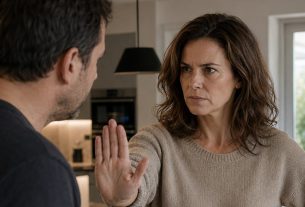
“Pack your bags, Polina. And don’t forget to take your son with you. The circus has left town—the clowns stayed behind—but you’re not welcome here anymore.”
Kiril hurled a thick white envelope onto the kitchen table. It landed with a dull, heavy smack, as if it contained a verdict poured from molten lead.
Polina didn’t even look back. She kept turning the meat patties in the pan with calm, mechanical precision. The oil sizzled, spitting hot droplets—far more deserving of attention than her husband’s latest meltdown. The kitchen was suffocating in the heat of a summer evening, and the ancient fan in the corner only chased warm air in a lazy circle.
“Are you deaf?” Kiril stepped right up behind her, hanging over her like a dark cloud. He reeked of cheap victory and, faintly, cognac—probably a shot for bravery before the scandal.
“I’ll finish frying these, then we’ll talk,” Polina said evenly, turning the heat down. “Sit. And stop pacing in my line of sight.”
“You still don’t understand,” he let out a laugh, but it came out sharp and jittery, like a bark. “There’s nothing for you to fry here anymore. This is my apartment. And the kid—he’s not mine. Now I’ve got official proof. A document. With a blue stamp.”
In the doorway appeared Artem—Kiril’s older brother. He shifted from foot to foot, avoiding everyone’s eyes, clearly wishing he weren’t part of this “celebration.” Behind his broad back hovered his wife, Larisa, whose curiosity always outweighed her sense of tact.
“Kiril… maybe you don’t have to be so harsh,” Artem rumbled, scratching the back of his head like a guilty teenager. “I mean… mistakes happen. Labs are run by people, too.”
“Mistakes?” Kiril snapped toward him so fast he nearly knocked over the sugar bowl. “The mistake is that I spent five years feeding someone else’s bastard child! Look at him! Those ears, those dark eyes! We’re a type, Artem—good stock. Light-eyed!”
“My grandfather had brown eyes,” Polina reminded him wearily, switching off the stove.
“Stop lying!” Kiril shrieked, losing control. “You can’t fool genetics! I didn’t do this test for nothing. And I tested Artem, too—I took one of his cigarette butts to the lab. I figured you were sleeping with him while I was off working shifts!”
Artem choked on air. Larisa gasped, clapping a hand over her mouth.
“I’ve been waiting for these results like a gift from heaven,” Kiril said, voice thick with smug satisfaction. “That’s it, Polya. Comedy’s over.”
He grabbed the envelope and shook it like a flag raised over a battlefield. Red blotches spread across his face from the thrill of what he thought was coming.
“I invited Artem on purpose,” he went on. “So there’d be witnesses. So you can’t claim I photoshopped anything later. Here—right in front of my own brother—I’m opening it!”
Polina slowly wiped her hands on a waffle towel, one finger at a time. She looked at her husband not with fear, but with the faint disgusted interest of a scientist watching an insect.
“Open it,” she said. “And read it out loud. So everyone hears every word.”
Kiril tore the envelope open. The paper ripped with a harsh crackle. He pulled out a tri-folded sheet and snapped it open so roughly he almost ripped it.
Larisa stretched her neck forward, transforming into pure curiosity. Artem let out a heavy sigh and stared down at the scuffed linoleum, wishing the floor would swallow him.
“Okay…” Kiril skimmed the lines greedily. “Here! Listen up! ‘Probability of paternity—0%.’ You are not the father! Zero! Nothing!”
He threw his hands up like he’d scored the winning goal. For a moment, the only sound in the kitchen was the steady hum of the old Atlant refrigerator.
But his triumph didn’t last.
His eyes dropped lower. And the smile slid off his face, slow and helpless, until it became a mask of confusion.
He blinked, brought the paper closer, then shoved it farther away like his eyesight had suddenly failed.
“What?” His voice cracked and shot up into a squeak. “What kind of nonsense is this?”
“Give it here,” Larisa snapped, unable to resist. She snatched the sheet from his slack fingers.
She dug her eyes into the text, and her bleached eyebrows climbed almost to her hairline.
“‘Based on analysis of additional markers…’” she began, reading clearly, enunciating every word. “‘The likely father is your biological brother.’”
Every head in the room turned toward Artem at the same time. The big man flushed so deeply he looked like an overripe tomato about to burst.
“Artem?” Kiril asked quietly, and there was a ringing emptiness in his voice. “You?”
“I… Kiril, I…” Artem stumbled backward, hit the doorframe with his shoulders, and froze.
“You dog!” Larisa shrieked and swung her purse into his shoulder with all her strength. “I KNEW IT! You were always hanging around them—‘fix a shelf,’ ‘repair a faucet’! So you repaired it, huh?!”
“Will you stop?!” Artem roared, shielding himself from his wife’s blows. “It’s not what you think!”
“What else is there to think?!” Kiril seized a heavy ceramic mug from the table. His fingers crushed the handle so hard it looked like it might snap. “My brother… my own brother… in my home… with my wife…”
He turned to Polina. Tears shimmered in his eyes—childish, wounded tears, like a boy watching someone grab his favorite toy and stomp it into the sand.
“Polina… how could you? With him? With that… traitor?”
Polina watched the chaos with the calm of a statue. She pulled her phone from her apron pocket, unlocked it, and opened a calendar from years back.
“Kiril,” she said in the tone used to explain basic facts to a stubborn child, “think back to May of 2018.”
“What May? What do dates have to do with anything?” He trembled with rage, still gripping the mug. “Don’t try to distract me!”
“May 2018. You had mumps—severe complications. Remember what the urologist told you when you were discharged?”
Kiril went still, as if he’d hit an invisible wall. His mouth stayed half open. The fury drained into bewilderment.
“He said…” Kiril muttered, his voice shrinking, “he said we probably wouldn’t be able to have kids.”
“Exactly. ‘Completely sterile.’ You cried for two weeks. You drank nonstop. You screamed that life was over, that the family line would end, that you weren’t a man anymore.”
Larisa stopped hitting Artem and leaned in, suddenly hungry for every word.
“And what did you do then, Kiril?” Polina continued, stepping closer. “Think. Use that memory you conveniently wiped clean. You begged Artem. You begged him yourself.”
A thick, sticky silence filled the room. Outside, someone slammed on the brakes of a passing minibus, the screech slicing through the quiet.
“You were on your knees,” Polina added, her voice hard. “‘Brother, help me. I want my blood. I want a child from our family, not from some random donor at a clinic.’”
Artem exhaled loudly, like a man finally dropping a sack of cement off his shoulders.
“It happened,” he admitted, staring at the floor. “That clinic on the avenue. You made me swear on Grandma’s icon that we’d take it to the grave. That it would be only your son.”
Kiril turned pale, almost bluish. His legs gave out, and he sank onto a stool as if someone had cut his tendons. His eyes darted around the kitchen, clinging to familiar objects—the tiles, a fridge magnet, a dirty plate—as if they could anchor him.
“I… I forgot,” he whispered.
“You forgot?” Polina’s smile was thin, and it was worse than shouting. “You erased it because it got in the way of feeling like some magnificent alpha male.”
Kiril said nothing. He stared at his hands like he’d never seen them before.
“For five years you played Father of the Year,” Polina went on, each word clean and sharp. “And when you got bored, you decided to play detective. You decided I’d cheated.”
“I thought…” he stammered, smearing imaginary crumbs on the tabletop. “I thought it didn’t work back then… and when you got pregnant, I figured the doctors were wrong… that I… that a miracle happened…”
“You decided you were a miracle of nature?” she asked. “And when the child started growing up and didn’t turn into your photocopy, you invented a story about a neighbor?”
She picked up the test results and folded them neatly into quarters.
“You humiliated me for six months,” she said quietly. “You went through my phone. You inspected my laundry. You dragged your relatives here so you could crucify me in public. And in the end, you crucified yourself.”
“Polina… forgive me,” Kiril pleaded, lifting his eyes like a beaten dog. “I just snapped. It happens. But look—”
Suddenly he brightened, grabbing at a desperate loophole, trying to twist the whole thing into something he could survive.
“But it’s still our blood! Artem is my brother! Genetically, Misha is almost mine! So everything works out!”
Larisa snorted—loud and unladylike.
“Idiot,” she declared, final as a medical diagnosis. “Come on, Artem. Let’s go. What a family. Neighborhood-grade soap opera.”
She grabbed Artem by the sleeve and dragged him toward the exit. Artem glanced back once, gave Polina a brief, guilty nod, and trudged after his wife.
The front door slammed, sealing off any road back.
Kiril stayed on the stool—deflated, small, pitiful. All his swagger evaporated with the fading alcohol fumes.
“Polya… can we just forget it?” he coaxed, testing the ground. “So it was a mistake. But now we know the truth for sure. The patties will burn…”
Without a word, Polina went to the stove, lifted the pan, and moved the browned patties into a container. She snapped the lid shut, took off her apron, and hung it on its hook.
“You’re right, Kiril. Now we know everything.”
She stepped into the hallway. Kiril heard the closet doors slide open, heard a gym bag rustle, heard hangers clink.
“Hey—what are you doing?” He jumped up, knocking the stool over. “Where are you going? I said stay! I forgive you—no, I mean, I admit I was wrong!”
Polina returned to the kitchen with a bag over her shoulder and her car keys clenched in her hand.
“I don’t think you understand,” she said calmly, looking straight at the bridge of his nose. “You’re not forgiving me. I’m leaving you.”
“Where?! This is my home!”
“Your home, yes. But the son—no.” She tapped the table where the stamped test result lay. “The document is right there. You wanted it. You paid for it.”
“But we had an agreement! It was just a formality!” His voice broke into a shrill whine.
“The agreement was with a man who wanted a family and was ready to love a child,” Polina replied. “Not with a hysterical little ego who’s willing to grind his wife into the dirt the first chance he gets.”
“You won’t dare! I’m the father on paper! I’ll take it to court!”
“Then live with your papers,” she said. “Misha and I are going to my mother’s cottage. The air is cleaner there. Breathing is easier.”
She turned and walked toward the door.
“Polina! Stop! Who’s going to want you with a kid attached?!” he shouted after her, trying to stab where it hurt, trying to claw back the control he was used to.
She paused at the threshold but didn’t turn around. She only adjusted the strap on her shoulder.
“You know what’s funniest, Kiril?” she said into the empty hallway. “It’s not even that you forgot the clinic and our deal.”
She paused, as if weighing every word.
“The funniest thing is that yesterday Misha drew your portrait. He wrote in red marker: ‘Dad is the strongest.’ He wanted to surprise you when you came home. The drawing is on the fridge under the palm-tree magnet. Take a look when you’ve got time.”
The door shut with a muted thud, a period at the end of their story.
Kiril was left alone in the sweltering kitchen. The fan kept pushing the same hot air around, useless and indifferent. On the table, beside a greasy oil stain, the white sheet of paper gleamed—quietly erasing the life he thought he had.
Slowly, as if sleepwalking, he went to the refrigerator. Under a stupid little souvenir magnet from Anapa, a page from a child’s sketchbook really did hang there.
A crooked stick figure with enormous muscles and a wide grin was holding the hand of a smaller figure. Beneath it, in careful, wobbly letters, was the caption:
“Dad is the strongest.”
Kiril slid down the fridge and onto the floor, covering his face with his hands. In the hallway, the scent of her perfume still lingered—faint, real, and already out of reach. And from the pan came the smell of patties that he would now have to eat alone—cold, bland, and tasteless.