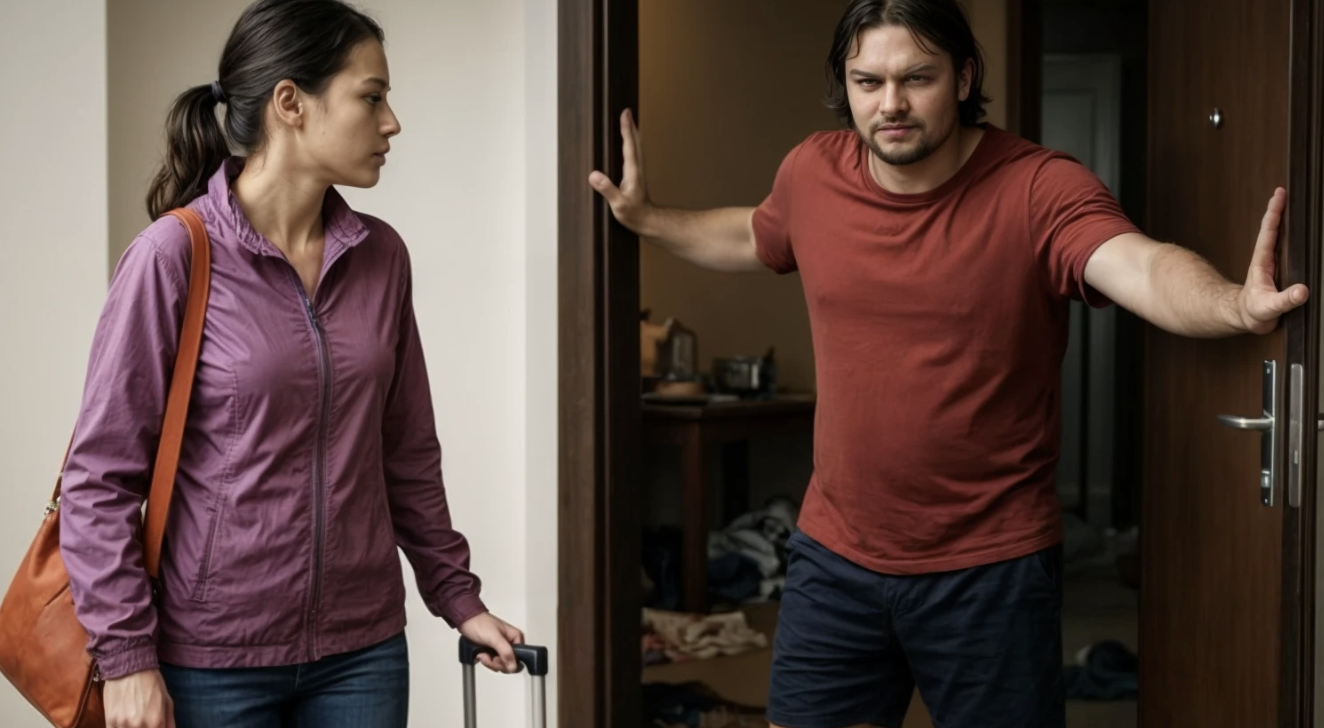
Irina stood by the door with a key in her hand, listening to someone wheezing with laughter behind it. The music was pounding so hard the door was vibrating. For two years she’d been paying for this seaside apartment—skipping vacations, saving on everything—and now she was standing there like an idiot with a suitcase, unable to get inside.
She rang the doorbell. Nothing. Rang again. The music was turned down, and a minute later the door flew open. Gleb stood there in nothing but shorts, flushed, holding a bottle of beer.
“Yeah? What do you want?”
“Open up. I’ve come for a week,” Irina tried to step inside, but he blocked the doorway.
“Are you serious? We’ve got company. Come some other time.”
She froze.
“Some other time? Gleb, I’ve been paying for this apartment for two years. I came here on vacation—what are you doing?”
“What vacation?” He took a swig and smirked. “Ira, this is my apartment. You’re standing at my door right now. Call ahead if you want to come. And for now, go stay at a hotel.”
“Yours? What are you talking about?”
“Ask the folks,” Gleb shrugged and slammed the door in her face.
She went down to the sea and sat on a low stone wall. Her hands were shaking as she dialed her father.
“Yes, Irina.”
“Dad, I’m at the apartment. Gleb won’t let me in. He says it’s his apartment. Explain what’s going on.”
A pause. Long.
“Irina, the apartment was transferred to Gleb. A year ago. He lives there, he’s the owner. And you work, you’ve got your own place. Don’t create problems.”
“So I’ve been paying for someone else’s apartment for two years?”
“It’s family. Things are hard for Gleb right now, he needs support. You understand. Be an adult—don’t throw a tantrum.”
“So who am I to you?”
“Irina, don’t start. You’re a stranger to the family if you behave like this. Respect your father’s decisions.”
She stared at her phone. Hung up. And sat there watching the waves until it got dark.
Back home, Irina opened her banking app and canceled every payment. The mortgage. Transfers to Gleb. Transfers to her mother. Everything.
Three days of silence. Then hell began.
Her mother sobbed into the phone about family, about how Irina was killing them. Her father demanded the money back, shouted about ingratitude. Gleb wrote her on messenger—she blocked him. He called from unknown numbers—she didn’t answer.
Two weeks passed. Irina went to work, checked notebooks, prepared lessons. For the first time in two years, she had money left in her account.
Gleb showed up at the school on Wednesday afternoon. A security guard came up to her classroom and said her brother was downstairs, yelling so the whole yard could hear. Irina went down and saw him by the steps—disheveled, in a dirty jacket, swaying on his feet. A group of older students had gathered nearby, phones ready.
“There she is!” Gleb screamed so loud the entire courtyard turned. “Our teacher! Abandons her family! Think you’re so smart?”
Irina stopped on the steps.
“Leave. You’re drunk.”
“And you’re greedy!” He lurched toward her, barely staying upright. “Because of you the bank calls every day! You’re doing this on purpose—you want to throw me out on the street?!”
“It’s your apartment,” she said quietly, but loud enough for everyone to hear. “You’re the owner, Gleb. So deal with it yourself. Get a job. Pay for it yourself. And don’t come near me again.”
“Who the hell do you think you are?! Dad was right when he called you—”
“If you don’t leave right now, I’m calling the police,” she said, taking out her phone. “For harassment. Right now.”
He stood there breathing heavily, staring at her with bleary eyes. Then he turned and staggered away, cursing under his breath. The students stepped aside. Irina turned and went back up to the teachers’ room. Her hands were shaking, but she clenched her fists and exhaled.
That evening, she filed a police report. Short, unemotional. Attached screenshots of Gleb’s threats. Submitted it online. Then she blocked all her parents’ numbers—every contact. Simply erased them from her life.
Four months passed.
Irina was coming back from the store when she saw her neighbor, Zinaida Fyodorovna, by the entrance. The old woman waved to her.
“Irochka! Ira, wait!”
“Hello, Zinaida Fyodorovna.”
“Listen, wasn’t it your parents who called yesterday? They gave your last name—yours. Said it was urgent, that they’d lost their daughter’s number. I told them I don’t know your phone.”
Irina froze with the shopping bags in her hands.
“Mine. Thank you for not giving it.”
“Oh, I figured something was off,” the old woman leaned closer. “The man’s voice was so… tense. And a woman was crying in the background. They said it was life and death. But I thought—if something really happened, they’d go to the police, not call neighbors. Did I do the right thing?”
“You did,” Irina nodded. “Thank you.”
She went upstairs, locked the door with every bolt, sat on the couch and just sat there for ten minutes, staring at the wall.
So it had collapsed. The apartment had gone to auction, or the bank had taken it. Now Gleb was on their neck, and they’d decided to call. To ask her to save them. Or to blame her again—for abandoning the family, for everything falling apart because of her.
Her phone lay on the table. She looked at it and thought: what if I unblock them? Find out what happened? What if it really is serious?
Then she remembered the door slammed in her face. Her father’s words: “You’re a stranger to the family if you behave like this.” Gleb at the school. Two years of payments into nothing.
Irina got up, poured herself a glass of water. Opened the closet and took out a box. Inside was the rental contract for a tiny studio—still someone else’s for now, but in a year she’d be able to buy it out. Twenty square meters. But hers. Completely hers. Without Gleb. Without her parents’ manipulation. Without calls demanding things.
She ran her fingers over the paper—and suddenly understood: for the first time in many years, she didn’t want to save anyone. She didn’t want to run, fix things, take on other people’s problems. Let Gleb look for work. Let her father deal with the consequences of his decisions. Let her mother stop crying and finally tell her son the truth.
And Irina would live. Just live. Save up to buy the studio. Buy herself decent clothes instead of clearance racks. Go on real vacations—not crashing on relatives’ couches. Build her own life.
The phone buzzed. An unknown number. She glanced at the screen, smirked, and declined the call. Then added the number to her blacklist.
Outside, it grew dark. Irina turned on the light, put the kettle on. Sat by the window with a mug in her hands and watched the evening city. Somewhere out there her father was working security to feed his thirty-year-old son. Somewhere her mother was crying and blaming Irina for every sin. Somewhere Gleb was drinking beer and complaining about life.
And she sat in her apartment—small, rented, but hers. With money in her account. With plans for the future. Without guilt.
And it was the best decision of her life