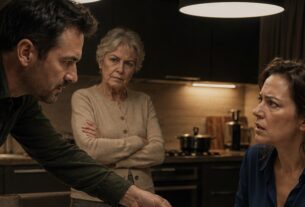
The apartment came to Yekaterina from her grandmother—three rooms on the fourth floor of a panel apartment block, with wide windows and a view of the park. Her grandmother died quietly, in her sleep, leaving her granddaughter her only treasure. Yekaterina entered into the inheritance six months later, as required, and became the lawful owner of the home.
When, a year after that, Yekaterina began dating Andrey, the housing issue never came up. Andrey rented a one-room studio on the outskirts, worked as an engineer at a factory, and didn’t particularly complain about life. Yekaterina taught Russian at a school, loved her job, and had no desire to move anywhere. They lived separately, met on weekends, and everything unfolded calmly, without unnecessary questions.
They had a modest wedding—registered at the civil registry office and celebrated with their parents at a café. Andrey’s mother, Valentina Ivanovna, arrived with a bouquet of roses and immediately began questioning the newlyweds about their plans for everyday life.
“So where are you going to live?” the mother-in-law asked as soon as they sat down at the table. “Everyone knows Andrey’s apartment is rented. And you, Katyenka—what about you?”
Yekaterina smiled and looked down at her salad plate.
“We have an apartment. Three rooms.”
“That’s good!” Valentina Ivanovna perked up. “So it’s your own? Or rented too?”
“It’s… complicated,” Yekaterina said carefully, placing the napkin on her lap. “The apartment is registered in my mother’s name. We live there, but the documents are with her.”
“And why is it in your mother’s name?” the mother-in-law pressed.
“That’s how it worked out. Grandma left it through Mom, so we registered it that way.”
Andrey nodded without digging into the details. Yekaterina could see her husband was simply happy the housing problem was solved. He wasn’t the kind of person who got lost in legal fine print. Valentina Ivanovna frowned but said nothing. Still, Yekaterina noticed how her mother-in-law exchanged a look with her husband, Nikolai Stepanovich, and pursed her lips.
After the wedding, Andrey moved his things into Yekaterina’s apartment. Life became more convenient—spacious, bright, and not far from work. Yekaterina gave her husband a separate room as an office, where he could draft his projects and sit at the computer. She took the bedroom, and the third room became the living room.
The first few months went smoothly. Andrey worked late, Yekaterina graded notebooks in the evenings, they had dinner together and talked about little things. Valentina Ivanovna visited once a week—bringing pies, asking how things were going, and surveying the apartment with a long, sharp, appraising look.
“Katyenka, where do you keep the apartment documents?” the mother-in-law asked one day as they sat in the kitchen with tea.
Yekaterina looked up from her mug.
“With my mom. I told you—it’s all in her name.”
“But have you at least seen those documents?” Valentina Ivanovna leaned in closer. “I’m just curious how it’s set up. Maybe there’s a mortgage hanging over it? Or debts?”
“There are no debts. Mom controls everything.”
“Then why don’t you re-register it in your name? You’re Andrey’s lawful wife now. That would be the logical thing.”
Yekaterina shrugged.
“Why rush? Mom will sort it out when it’s necessary.”
Her mother-in-law fell silent, but Yekaterina saw her shoulders tense. The conversation ended there, but from that day on Valentina Ivanovna began coming more often. Sometimes on the pretext of bringing jam, sometimes just to “drop by” and check how they were doing. Each time she asked questions about the apartment—registration, utility bills, renovations.
“Katyenka, who pays for the apartment?” Valentina Ivanovna asked while Yekaterina was reheating lunch.
“Andrey and I do.”
“And if your mom is the owner, shouldn’t she be paying?”
“We live here, so we pay. It’s more convenient.”
“I see,” her mother-in-law drawled. “I just think maybe it would be better to register everything to you and Andrey. So there aren’t misunderstandings. God forbid something happens to your mom…”
Yekaterina turned to the stove and began stirring the soup.
“Mom is healthy. Everything’s fine.”
“Sure, sure,” Valentina Ivanovna said, getting up from the table. “I’m just saying it as a friend. Think about it.”
Yekaterina had no intention of re-registering anything. The apartment belonged to her; the documents were kept in a safe at a notary’s office. Yekaterina’s mother, Lyudmila, lived in another city and didn’t even know her daughter was using her as a cover. Yekaterina had told her mother only that she’d gotten married, but she never clarified anything about the apartment. Lyudmila didn’t interfere in her daughter’s affairs—she was used to trusting her.
A few weeks later, Valentina Ivanovna came again, this time with Nikolai Stepanovich. Her father-in-law stayed quiet as always, nodding and smiling. Valentina Ivanovna sat on the living room couch and looked around.
“Katyenka, where do the apartment documents go—maybe in some kind of safe?”
Yekaterina raised her eyebrows.
“Valentina Ivanovna, I already said—my mom has them.”
“Yes, yes, I understand. I’m just thinking: what if something needs to be signed urgently? To register someone, for example. Or to go to the bank. You have to know where the papers are.”
“If we need them, I’ll ask Mom to bring them. She doesn’t live far away.”
“And what city does your mom live in?”
“In Tver.”
“That’s three hours by commuter train!” Valentina Ivanovna threw up her hands. “That’s inconvenient. Why don’t you ask her to send copies? Or the originals? We could keep everything here, in one place.”
Yekaterina smiled and shook her head.
“No need. My mom is reliable. She won’t lose anything.”
Her mother-in-law pursed her lips and didn’t ask again. But Yekaterina saw Valentina Ivanovna glance at her husband, and he gave a barely noticeable nod. After they left, Yekaterina called the notary’s office and arranged an appointment.
The next day, Yekaterina went to the notary. The documents were in the safe: the ownership certificate, the gift deed from her grandmother, BTI papers. Everything was registered to Yekaterina Sergeyevna Belova. No mother. No mortgage. The notary, an elderly woman with gray hair, looked at Yekaterina over her glasses.
“Everything is in order; the documents are safe. Did you want to change something?”
“No. Just check that everything is there.”
“It’s there. If you need a power of attorney or a certified copy, come back.”
Yekaterina nodded and left the office. Winter was just beginning; the first snow lay outside—wet and gray. She walked down the street, thinking whether she’d done the right thing hiding the truth from her husband. Andrey trusted her, didn’t meddle, didn’t demand papers. But Valentina Ivanovna was different. She wasn’t just curious—she was digging, prying, verifying every word.
That evening Andrey came home tired, took off his jacket, and went into the kitchen.
“Was Mom here again?” he asked, taking kefir out of the fridge.
“Yes. She came by with your dad.”
“What did she want?”
“She asked about the apartment documents.”
Andrey smirked.
“Mom likes to get into everything. Don’t pay attention.”
“I’m not.”
“She’s just worried. Thinks we should keep everything under control.”
Yekaterina said nothing. Andrey finished the kefir, put the glass in the sink, and went to his room. Yekaterina stayed in the kitchen, looking out at the falling snow. Anxiety grew, but she didn’t know how to explain to her husband that his mother wasn’t just a caring parent—she was a woman who wanted to control everything around her.
A week later Valentina Ivanovna called again.
“Katyenka, can I come by tomorrow? We need to talk.”
“About what?”
“Oh, little things. Not over the phone.”
Yekaterina sighed.
“Fine. Come.”
The next day her mother-in-law arrived with a cake and a bag of apples. She sat down at the table and laid out the treats.
“Katyenka, I’ve been thinking,” Valentina Ivanovna began, cutting the cake. “Maybe we should register Andrey in the apartment? Officially, through the passport office. He’s your husband, legal and all. Makes sense, right?”
Yekaterina took a piece of cake and put it on her plate.
“Andrey already lives here. Registration isn’t required.”
“But if something happens, it will be easier for him. What if he needs some certificate or to file papers? Registration gives rights.”
“What rights?”
“Well… the right to live there, for example. Or inheritance.”
Yekaterina looked up.
“Inheritance?”
“Yes, if your mother—God forbid—passes, the apartment will go to someone. Better to sort it out now.”
Yekaterina set down her fork.
“Valentina Ivanovna, my mother is alive and well. She’s fifty-two. It’s too early to talk about inheritance.”
“Early or not, it’s better to be safe. Life is unpredictable.”
“If something happens, we’ll deal with it. But we’re not touching anything now.”
Her mother-in-law pursed her lips and didn’t insist further. But Yekaterina could see dissatisfaction accumulating in Valentina Ivanovna’s eyes. After her mother-in-law left, Yekaterina called her mother.
“Mom, I have a strange question,” Yekaterina said when Lyudmila answered.
“Go on.”
“If anyone asks about the apartment, say it’s registered to you. Okay?”
Lyudmila was silent.
“Katya, what happened?”
“Nothing. It’s just more convenient.”
“But the apartment is in your name. Why lie?”
“Mom, please. I’ll explain later.”
Lyudmila sighed.
“Fine. If someone asks, I’ll say it’s in my name.”
Yekaterina hung up and leaned against the wall. The lie was growing like a snowball, but it was too late to stop. Valentina Ivanovna wouldn’t back off until she reached the truth. And the truth would open a path to the apartment, the documents, the control. Yekaterina didn’t want to share—not out of greed, but out of fear of losing the only thing she had left from her grandmother.
Andrey noticed nothing. He came home from work, ate dinner, watched TV, and went to bed. Yekaterina envied his calm. He didn’t see danger where she felt a storm approaching.
One evening Valentina Ivanovna called Andrey. Yekaterina could hear the conversation from the next room.
“Son, have you seen the apartment documents?” the mother-in-law asked.
“No, Mom. Why would I need to?”
“How could you not? You live there. You should know how it’s registered.”
“Katya said it’s all in her mother’s name. That’s enough for me.”
“And are you sure there aren’t any debts? Or encumbrances?”
Andrey laughed.
“Mom, are you serious? Katya wouldn’t hide it if there were problems.”
“Or maybe she doesn’t know herself. Ask her to show you the documents. Just for order’s sake.”
“I’m not asking for anything. I trust my wife.”
Valentina Ivanovna said something else, but Andrey ended the call and hung up. Yekaterina came out of the room; her husband turned toward her.
“Mom’s on about the apartment again,” Andrey said with a grin. “Wants me to check the documents.”
“And what did you say?”
“That I trust you. Why should I dig through papers?”
Yekaterina came over and hugged him.
“Thank you.”
Andrey shrugged.
“No problem. My mom overdoes it sometimes. Don’t pay attention.”
But Yekaterina did pay attention. Valentina Ivanovna wouldn’t calm down until she got answers to every question. And those answers would reveal the truth Yekaterina wasn’t ready to disclose. The apartment was hers—hers alone. And no one was supposed to know that. For now.
Three years flew by unnoticed. Yekaterina continued teaching at school, Andrey worked at the factory. Life went on steadily, but something started to change. Andrey began coming home later than usual, answering in short phrases, snapping over trivial things. Yekaterina blamed it on fatigue, on workload. But one evening Andrey threw his keys onto the nightstand and went into the kitchen without taking off his jacket.
“I’m sick of it,” Andrey said, standing by the window.
Yekaterina looked up from the notebooks.
“Sick of what?”
“Everything. Living here. Being a guest in someone else’s apartment.”
“This is our apartment.”
Andrey turned around.
“Ours? Seriously? You yourself said it’s all in your mother’s name. I’m nobody here. I live, I pay, I invest—and I have no rights.”
“What do rights have to do with it? We’re a family.”
“A family,” Andrey scoffed. “But the apartment isn’t mine. If something happens, I’m out on the street.”
Yekaterina stood up.
“Andrey, what are you talking about? Why are you thinking this all of a sudden?”
“Not all of a sudden. I’ve been thinking about it for a long time. I want honesty. I want to understand what I can count on.”
“You can count on me.”
“On you, yes. But on the apartment?”
Yekaterina fell silent. Andrey turned and walked out of the kitchen. The door to his office slammed. Yekaterina stood by the table, gripping her red pen. The conversation broke off, but the residue remained.
From that evening Andrey grew colder. He came in, ate dinner in silence, and went into his room. Yekaterina tried to talk, but he answered curtly, avoiding her eyes. A few weeks later he brought up the apartment again.
“I want a divorce,” Andrey said on a Saturday morning as they sat at breakfast.
Yekaterina froze with a mug in her hands.
“What?”
“You heard me. I want a divorce. We’re not right for each other.”
“Why?”
“Because I’m tired of living in uncertainty. I put money into this apartment for three years. I paid the utilities, renovated the bathroom, bought furniture. That means I have a right to half of it.”
Yekaterina set the mug down on the table.
“Andrey, the apartment came to me from my grandmother. It’s not marital property.”
“And who says so? We’re married. Everything acquired in marriage is split fifty-fifty.”
“Inheritance isn’t split. That’s the law.”
Andrey stood up.
“We’ll see what the court says.”
He left, slamming the door. Yekaterina stayed sitting in the kitchen, staring at her cooling tea. Anxiety flared inside her. Andrey wasn’t just talking—he was preparing to act. And behind him, Yekaterina felt it, stood Valentina Ivanovna.
The next day the doorbell rang. Yekaterina opened the door—her mother-in-law stood on the threshold holding a folder. Valentina Ivanovna stepped into the apartment without asking permission.
“Katyenka, we need to talk,” she said, sitting down on the couch.
Yekaterina closed the door.
“About what?”
“About fairness. Andrey lived here three years, invested money, worked. The apartment should be divided.”
“The apartment isn’t subject to division. It’s an inheritance.”
Valentina Ivanovna opened the folder and pulled out several papers.
“Here are Andrey’s bank statements. Here are receipts for furniture. Here are invoices for repairs. He paid for all this. That means he invested in shared property. In court we’ll prove that half the apartment belongs to my son.”
Yekaterina took the papers and flipped through them. Receipts for a sofa, a kitchen set, payment to a plumber. Everything neatly collected, filed, ready for court.
“Valentina Ivanovna, furniture isn’t an apartment. A sofa doesn’t give rights to housing.”
“It does. Investments in marital property give the right to compensation. Either money or a share.”
Yekaterina returned the papers.
“If Andrey wants a divorce, we’ll divorce. But the apartment will remain mine.”
Her mother-in-law pursed her lips.
“You’re very confident. We’ll see what the court says. And for now I demand the keys to half the apartment. Andrey has the right to live here until it’s resolved.”
“Andrey already lives here.”
“Not as a guest, but as an owner. Give me the spare set of keys. I’ll take them so Andrey can come and go freely.”
Yekaterina shook her head.
“The keys will stay with me.”
Valentina Ivanovna stood up, her face flushing.
“So it’s war? Fine. See you in court.”
She left, slamming the door loudly. Yekaterina leaned against the wall and exhaled. The war had begun. But Yekaterina had an advantage neither Andrey nor Valentina Ivanovna knew about. The apartment belonged to her—only to her—and no receipts for furniture could change that.
That evening Yekaterina called the notary.
“I need an extract from the Unified State Register of Real Estate. Urgently.”
“Come tomorrow—we’ll arrange it.”
The next day Yekaterina received the document—an official extract stating that the owner of the apartment was Yekaterina Sergeyevna Belova. No encumbrances, no co-owners. The apartment had been hers since she entered the inheritance.
Andrey came home late that evening. He went into his room without saying a word. Yekaterina heard him talking on the phone—his voice dull, irritated. Then silence. Yekaterina went to bed, but couldn’t fall asleep. Her thoughts tangled; anxiety wouldn’t let go.
In the morning she woke to the doorbell. She opened it—Valentina Ivanovna stood on the threshold with Nikolai Stepanovich. Her father-in-law was silent as always; her mother-in-law looked at Yekaterina defiantly.
“We’re going to the MFC,” Valentina Ivanovna said. “To check the documents.”
“What for?”
“To find out who owns this apartment. You said it’s all in your mother’s name. I want to verify that.”
Yekaterina nodded.
“Let’s go.”
Valentina Ivanovna raised her eyebrows in surprise. She must have expected resistance—shouting, refusal. But Yekaterina calmly took her passport, put on her coat, and went out with them. On the way to the MFC Valentina Ivanovna talked nonstop.
“If it turns out the apartment is in your mother’s name, Andrey still has the right to compensation. He lived there three years and invested money. We’ll get justice.”
Yekaterina stayed silent. Nikolai Stepanovich drove, eyes on the road. Valentina Ivanovna kept going.
“And besides, if it’s in your mother’s name, then you have no right to kick Andrey out at all. The apartment isn’t yours—what right do you have to say who lives there?”
Yekaterina stared out the window. Snow fell in large flakes, covering the city with a white blanket. The MFC was downtown; they got there quickly. Inside, they took a ticket and sat to wait. Valentina Ivanovna nervously fiddled with her bag; Nikolai Stepanovich read a newspaper.
They were called after twenty minutes. They went into an office where a young employee with short hair sat behind a desk.
“Hello. How can I help you?”
Valentina Ivanovna stepped forward.
“We need information about an apartment. Here’s the address. We want to know who it’s registered to.”
The employee took the paper and entered the data into the computer. The pause dragged on. Yekaterina stood by the window, hands in her pockets. Valentina Ivanovna leaned over the desk, trying to see the screen.
“All right,” the employee said. “The apartment is registered to Belova, Yekaterina Sergeyevna. Date of registration of ownership—four years ago. Basis—inheritance by will.”
Silence fell in the room. Valentina Ivanovna froze, her mouth slightly open. Nikolai Stepanovich looked up from the newspaper.
“How can it be registered to Belova?” the mother-in-law asked hoarsely.
“That’s what the system shows,” the employee said, turning the monitor. “See? Owner—Belova, Yekaterina Sergeyevna.”
Valentina Ivanovna stared at the screen. Her face went pale; her hands began to shake.
“But… she said it was in her mother’s name…”
The employee shrugged.
“The system has no information about any other owners. The apartment belongs only to this woman.”
Valentina Ivanovna slowly turned to Yekaterina.
“You lied.”
Yekaterina nodded calmly.
“Yes.”
“All this time… you lied!”
“I protected my property.”
Valentina Ivanovna grabbed the edge of the desk.
“Andrey lived there three years! He has a right!”
The employee raised her hand.
“Excuse me, but if an apartment is received by inheritance—whether before marriage or during—it isn’t subject to division. It is personal property. A spouse has no right to a share.”
Valentina Ivanovna opened her mouth, but no words came. Nikolai Stepanovich stood up and took his wife by the hand.
“Let’s go,” the father-in-law said quietly.
Yekaterina thanked the employee and left the office. Valentina Ivanovna and Nikolai Stepanovich remained standing by the desk. Yekaterina walked through the lobby and went outside. Snow was still falling; the city was quiet and white.
At home, Yekaterina took out bags and began packing Andrey’s things. Clothes, shoes, books, drawings—she packed everything neatly and brought it to the entryway. Andrey had left his keys on the nightstand that morning when he went out.
An hour later the doorbell rang. Yekaterina opened the door—Andrey stood on the threshold, looking lost.
“Mom called,” he said. “She said the apartment is yours.”
“Yes.”
“Why didn’t you tell me?”
“I didn’t want problems.”
Andrey looked at the bags.
“I have to leave?”
“Yes.”
He lowered his head.
“I really thought I had a right to half.”
“You were wrong.”
Andrey took the bags and left. Yekaterina closed the door and leaned back against it. Silence settled over the apartment. The anxiety was gone; only exhaustion remained.
That evening Yekaterina sat by the window with a mug of tea. The snow kept falling, covering the streets. The apartment was hers—only hers. The silence she had kept for three years had saved not just the home. It had saved her from people who saw in her not a person, but square meters—people who believed it was acceptable to demand, divide, and take.
Her grandmother had left the apartment to Yekaterina, believing her granddaughter would protect it. And Yekaterina protected it—not with loud declarations, not with contracts, not with promises, but with quiet persistence and the ability to stay silent at the right moment.
They finalized the divorce at the civil registry office. There was nothing to divide; both agreed. A month later Yekaterina received the divorce certificate. Andrey never called again. Valentina Ivanovna disappeared as well. Yekaterina returned to her life—school, notebooks, lessons. Only now the apartment was truly hers. Without unnecessary questions, without threats, without other people’s claims.
One evening Yekaterina called her mother.
“Mom, remember you promised to say the apartment was in your name?”
“I remember. Why did you need that?”
“Thank you for not asking questions back then.”
Lyudmila was silent.
“Katya, what happened?”
“Everything’s fine. I just realized that sometimes silence matters more than words.”
Her mother laughed.
“You’re a smart one. Just be careful.”
Yekaterina hung up and looked around the apartment. Three rooms, bright windows, a view of the park. Everything she had left from her grandmother. Everything Yekaterina managed to protect—not with shouting, not with scandals, but with simple stubborn silence. The very silence that turned out to be more reliable than any words