Sveta came home from work exhausted. The day had been rough—reports, meetings, deadlines slipping. She worked as a procurement manager at a small company, and before New Year’s it was always chaos: everyone wanted to close contracts before the holidays. She kicked off her shoes in the entryway and went into the kitchen, hoping at least to drink some tea in peace. Her husband Denis was sitting at the table with his phone in his hands. He lifted his eyes when she walked in and grunted:
“Mom’s coming the day after tomorrow. For a couple of days. While I sort things out with her apartment.”
Sveta froze, kettle in hand.
“What do you mean—coming? We didn’t discuss this…”
“What’s there to discuss? She’s my mother. She’s having problems with the heating; the repair guys won’t come for another week. Should she freeze out on the street?”
“Denis, there are two weeks until New Year’s. I planned to celebrate the holiday calmly. Just the two of us. You remember—we talked about it a month ago.”
“We will. She won’t be here long,” Denis said, burying his face back in his phone, making it clear the topic was closed.
Sveta poured water into the kettle and switched it on. Inside, everything tightened with the feeling that “a couple of days” would stretch into weeks—maybe longer. She knew her mother-in-law too well to hope otherwise.
Raisa Fyodorovna arrived on Saturday morning. Sveta opened the door and saw not one travel bag, as she’d expected, but two huge suitcases, three shopping bags, and some kind of box labeled “Fragile.”
“Hello, Svetochka,” her mother-in-law said as she walked in without waiting to be invited. “Help Denis bring the things in—he can’t manage alone.”
Sveta silently grabbed one of the bags and followed. Denis dragged the suitcases, panting and turning red with effort. Raisa Fyodorovna was already standing in the middle of the living room, surveying the space with a critical gaze.
“You should move the sofa, and the bookcase should be put somewhere else entirely. There’ll be more space,” she said, taking off her coat. “And the light is so dim. You should change the bulbs to brighter ones.”
Sveta looked at her husband, expecting him to say something like, Mom, don’t, but Denis only nodded and went into the kitchen.
“Raisa Fyodorovna, are you staying long with that much luggage?” Sveta asked carefully.
“Well, I don’t know how long the repairmen will take. I brought things just in case. Better more than having to run back for every little thing. Besides, you’ve got plenty of space here—it’s not like it’s a problem.”
Sveta swallowed the lump of irritation and went to put the kettle on. She felt the apartment become cramped at once—not physically, but in the sense that the air itself had gotten thinner.
By evening Raisa Fyodorovna had fully settled into the living room. Her things were on the sofa, on the armchair, on the coffee table. She pulled out magazines, cosmetics, medicines and arranged everything on shelves as if she planned to live there for months. Her favorite mug appeared on the table; a potted houseplant showed up on the windowsill.
“It’s a violet,” she explained to Sveta. “I take it with me everywhere. I can’t be without it.”
Sveta nodded, not knowing what to say.
Sveta was cooking dinner, and her mother-in-law popped into the kitchen every ten minutes with advice.
“You need to cut the potatoes smaller so they boil faster. And you overcooked the meat—now it’ll be tough. Denis likes everything soft and tender. You should learn to cook properly. At your age I already knew how to make forty kinds of salads and fifteen kinds of soups.”
Sveta gripped the knife tighter. She stayed silent and kept chopping vegetables. Denis sat in the other room at the computer, pretending to be busy with work.
“And anyway,” Raisa Fyodorovna went on, “you need to change a few things here. Get rid of these flowers—they collect dust. The carpet is kind of old, too. You should freshen up the interior. My neighbor just had renovations—gorgeous! Everything new, modern. And yours looks like it’s from the last century.”
Sveta inhaled and exhaled slowly.
“Raisa Fyodorovna, this is our apartment. We’re comfortable here the way it is.”
“I’m not ordering you around, I’m just giving advice,” her mother-in-law said, pursing her lips in offense. “Young people these days—you can’t say a single extra word. They get offended right away.”
The next day Sveta woke up to the sound of the television. Raisa Fyodorovna had been in the living room since morning, watching some talk show at full volume. It was eight a.m., Sunday. Sveta usually liked to sleep in on weekends, but she could forget about that now.
She went into the kitchen hoping to at least drink coffee in peace, but her mother-in-law immediately appeared beside her.
“Svetochka, you know, I’ve been thinking. New Year’s is soon. We have to celebrate properly! I’ll invite my friends, Denis will invite his colleagues. We should invite our neighbor Valentina Ivanovna too—she lives alone, poor thing. We’ll set a big table like we did in my day. With aspic, jellied dishes, real Olivier salad—not your simplified version.”
Sveta froze with her cup in hand.
“Raisa Fyodorovna, Denis and I planned to celebrate New Year’s just the two of us. Quietly, calmly.”
“Oh, what do you know! Young people are always like that—sitting in corners. A holiday should have guests, noise, fun! Music till morning, dancing! That’s a real New Year’s! Otherwise you sit there like two old people. Boring!”
Sveta looked at Denis, who had just come out of the bedroom.
“Denis, we agreed…”
“Mom… maybe it really isn’t worth it?” he said uncertainly.
“What do you mean, ‘isn’t worth it’?” Raisa Fyodorovna lifted her eyebrows. “You know I’ve always loved loud holidays. Or do you want me to sit bored all alone? I’m doing this for you—I want it to be fun!”
Denis shifted awkwardly and lowered his gaze.
“Alright, Mom. Whatever you say.”
Sveta slowly set her cup down on the table. Something inside her snapped. She understood her opinion didn’t matter again.
The next days passed in constant tension. Raisa Fyodorovna moved things around every day, rearranged, gave instructions. Sveta would come home from work and find her favorite vase moved to a different shelf, the sofa pillows placed differently, someone having touched her cosmetics. One day she discovered her mother-in-law had gone through her wardrobe.
“Raisa Fyodorovna, please don’t rearrange my things,” she asked one evening, trying to stay calm.
“Oh, I’m just putting things in order! You’re not against having a clean home, are you? Your closet was such a mess—T-shirts mixed with dresses. I sorted everything by color and by season.”
“I am against someone touching my personal things.”
Her mother-in-law grimaced.
“Well, look at that. So sensitive. Denis, do you hear how she’s talking to me?”
Denis sat on the sofa with his phone and pretended not to hear. Sveta saw his shoulders tense, but he didn’t lift his head.
Three days before New Year’s, Sveta came home and found that her mother-in-law had hung garlands around the apartment, put out figurines of Ded Moroz and Snegurochka, and on the kitchen counter there was a stack of groceries—clearly bought for a big feast. On the table lay a menu written on a sheet of paper.
“Raisa Fyodorovna, what is this?”
“Preparing for the holiday! I already invited everyone. There’ll be fifteen people. Maybe even twenty. We have to welcome the New Year properly! I made a menu—here. We’ll make aspic tomorrow, salads the day after. You’ll help me, of course.”
Sveta felt her temples start pounding.
“You invited people to our apartment? Without our permission?”
“Oh, permission—what permission! It’s a holiday! Everyone will be happy! And anyway, I’ll stay here until January. It’s more convenient for everyone. I have nowhere to go, and you’ve got enough space. And besides, who will cook if I leave? You can’t really do anything properly.”
Sveta turned to her husband, who was just coming into the entryway.
“Denis, did you hear that?”
He nodded.
“Yeah. Mom said so. It’s no big deal—we’ll put up with it a little longer.”
“What do you mean, ‘put up with it’? January is two weeks away!”
“Sveta, don’t make a scene. She’s my mother. Where should she go? Her heating isn’t working.”
“Aren’t the repairmen supposed to have fixed it already?”
“Well… they’re delayed a bit,” Denis said uncertainly.
“Delayed,” Sveta repeated. “I see.”
She went into the bedroom, not wanting to continue the conversation.
Sveta closed the bedroom door and sat on the bed. She put her hands on her knees, breathing evenly and deeply, trying to calm down. But calm didn’t come. Instead, clarity arrived—cold, sharp, merciless.
There would be no more conversations. Not now, not later. Denis didn’t see the problem. He didn’t see his wife was suffocating in her own home. He didn’t see his mother had taken up all the space—physical and psychological. He simply didn’t want to see it. Because it was easier. Because it required him to choose—and he didn’t know how to choose.
Sveta took out her phone and wrote to her friend Tanya: “Can I come to you for New Year’s? Urgently.”
Tanya replied almost immediately: “Of course! Come even tomorrow. What happened?”
“I’ll tell you later. Thank you. You’re saving me.”
Sveta turned off the phone and started packing a small bag. A few outfits, a makeup bag, documents, a charger, her favorite book. She moved quickly, clearly, without thinking about consequences. Inside, she felt calm. The decision was made—no doubts.
The rest of the evening Sveta was quiet. She came out for dinner, ate silently, went back to the bedroom. Raisa Fyodorovna talked about plans for tomorrow, about needing to buy more groceries, about washing the windows. Sveta nodded without listening.
That night she slept poorly, running through her plan. In the morning, while everyone was still asleep, she would take her mother-in-law’s things out, leave a note, and leave. Simple. No extra words, no explanations—because explaining was useless.
On the morning of December 31, Sveta woke up at six. Denis was still asleep; Raisa Fyodorovna was snoring in the living room. The apartment was quiet—maybe for the last time in a long while.
Sveta got dressed, took her bag, and stepped out of the bedroom. She went into the living room, where her mother-in-law’s belongings were piled on the sofa among blankets and pillows. Methodically, she gathered the suitcases, bags, the box with the violet—everything Raisa Fyodorovna had brought. She worked silently, carefully, without rushing.
Raisa Fyodorovna turned over in her sleep, mumbled something incoherent, but didn’t wake up. Sveta opened the apartment door and carried the suitcases onto the landing. One, then the second, then the bags and the box with the violet. She arranged everything neatly by the wall so it wouldn’t block anyone.
She went back inside, closed the door, and listened—silence. Her mother-in-law was still asleep.
Sveta still had the apartment keys—there was no need to change the locks. Raisa Fyodorovna wasn’t registered here, and she didn’t have her own set of keys. Sveta took a sheet of paper and a pen and wrote briefly, without extra words: “Your mom’s things are on the landing, and I’ve gone to celebrate New Year’s without scandals.”
She put the note on the little table in the entryway where it would be seen right away. She took her bag, went out, locked the door, and walked downstairs. Outside it was frosty but fresh. Sveta inhaled deeply and felt relief.
She took a taxi to the train station. A train to Tanya’s city left in an hour. She bought a ticket, sat in the waiting room, and turned off her phone. She didn’t want to hear calls, messages, excuses.
On the train she watched the landscape rush past the window and felt a strange calm—not anger, not hurt, but calm. As if she’d taken a heavy sack off her shoulders that she’d been carrying too long.
Tanya met her at the station with hot coffee and a hug.
“Tell me what happened.”
“Later. Right now I just want to be in silence.”
Tanya nodded and didn’t push. She drove Sveta to her place and showed her a room where she could sleep.
“Stay as long as you want. We’ll celebrate New Year’s just the two of us, quietly. Or with my brother—he’s coming too. No noise and no pushy relatives.”
Sveta smiled—for the first time in a long while.
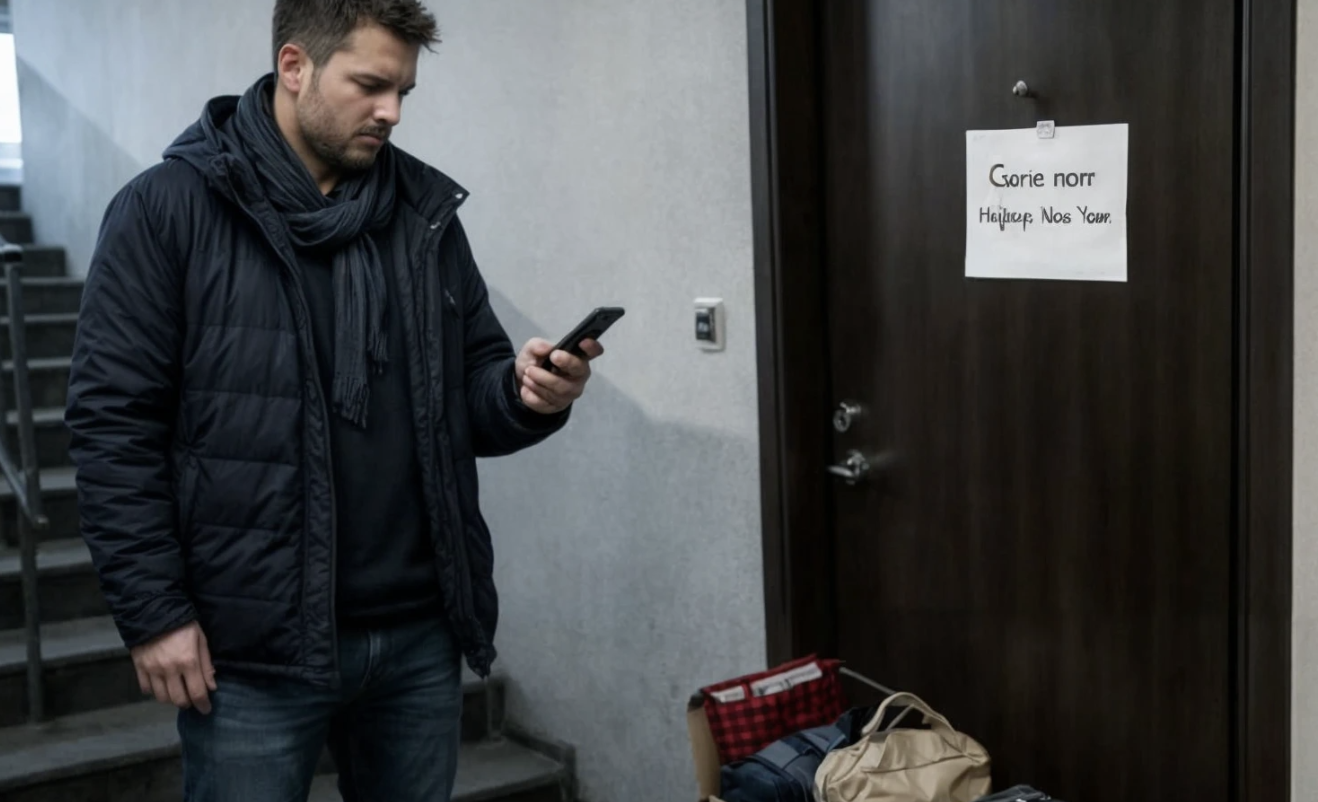
Denis came home around six in the evening. He brought bags of groceries—his mother had given him a list of what else to buy for the holiday table. He came up to his floor and froze in front of the door.
On the landing were his mother’s suitcases. Two large ones, three bags, and the box with the violet. Everything neatly lined up along the wall.
“What the…” he muttered.
He pulled out his keys, opened the door, and walked inside, looking around. The apartment was quiet. Too quiet.
“Sveta?” he called.
Silence.
“Mom?”
Raisa Fyodorovna peeked out from the living room, sleepy and disheveled.
“Denis, why are you yelling? I dozed off…”
“Mom, your things are on the landing.”
“What?!” She ran into the entryway. “How are they on the landing?!”
Denis noticed a sheet of paper on the little table. He picked it up and read it. Then read it again.
“Your mom’s things are on the landing, and I’ve gone to celebrate New Year’s without scandals.”
He stood there with the note, trying to process what had happened. Raisa Fyodorovna snatched the paper from him and read it herself.
“What?! How dare she?! Denis, do you hear?! She threw me out! Me! Your mother!”
Denis said nothing. He reread the line silently several times, as if hoping the meaning would change. But the words stayed the same.
“Denis! Are you going to do something or are you just going to stand there?!”
He took out his phone and dialed his wife. Long rings. Then voicemail: “The subscriber is unavailable.”
He called again. And again. Same result.
“She’s not answering,” he said quietly.
“Then go find her! Bring her home! Explain to her that you can’t do that!”
Denis looked at his mother, then at the note, then back at his phone. Slowly, understanding grew inside him: it was already too late to explain.
Raisa Fyodorovna began wailing about how it was shameful, how the neighbors would see her belongings on the landing, how she’d always known Sveta was a bad wife. Denis listened with half an ear. He went into the bedroom—Sveta’s things weren’t there. Her clothes still hung in the closet, but her bag was gone. Her makeup pouch was gone too. Her favorite book, which always lay on the bedside table, had disappeared.
She had left. For real.
He returned to the entryway. His mother was still ranting about disrespect and shamelessness. Denis silently stepped onto the landing and began hauling the suitcases back into the apartment.
“That’s right!” Raisa Fyodorovna said approvingly. “At least you behave normally. She’s gotten completely out of hand.”
Denis said nothing. He set the things down in the entryway and closed the door. Something inside him tightened, but he couldn’t yet understand what it was.
That evening guests began to arrive—the very people his mother had invited. Ten people in the first half hour. Raisa Fyodorovna greeted them cheerfully, telling them how wonderfully they’d celebrate New Year’s. Denis sat in the kitchen staring at the table.
One of the guests, a neighbor from the stairwell, came up to him.
“Why so gloomy? It’s a holiday!”
“My wife left,” Denis answered shortly.
“Left? Where to?”
“I don’t know. She said she’s celebrating New Year’s without scandals.”
The neighbor snorted.
“Then there were reasons. Wives don’t just leave for no reason.”
Denis didn’t reply.
The apartment grew noisier. People drank, laughed, turned on music. Raisa Fyodorovna walked around pleased, serving food, telling jokes. Denis sat off to the side and understood this holiday wasn’t his. He’d never wanted it. He agreed because it was easier—because he didn’t want to argue with his mother.
Sveta didn’t argue. She just left.
He tried calling her again. Her phone was still unavailable.
By midnight the guests were already fairly drunk. Raisa Fyodorovna sang karaoke; the neighbor Valentina Ivanovna danced with some unfamiliar man. Denis went out onto the balcony just to have a little silence.
The city glittered with lights; laughter and music drifted from windows in neighboring buildings. Somewhere out there, in one of those homes, his wife was celebrating New Year’s. Without him. Without scandals. Without his mother.
He remembered how, just two weeks earlier, he and Sveta had planned a quiet evening together. She wanted to cook something special; they were going to watch their favorite movie and drink champagne on the balcony. Just the two of them. Peacefully.
And he had ruined those plans without even asking her opinion. He simply said his mother was coming—and that was it. As if Sveta’s wishes didn’t matter.
At one in the morning the guests began to leave. Raisa Fyodorovna, happy and tired, lay down to sleep in the living room. Denis stayed alone in the kitchen. The apartment was a mess—dirty plates, glasses, napkins on the floor, leftover food on the table. It smelled of tobacco and alcohol.
He began cleaning. Silently he stacked dishes in the sink, wiped the table, took out the trash. He worked mechanically, thinking of nothing.
He finished at three a.m. Then sat on the sofa and stared at the wall.
Sveta’s phone was still unavailable. He typed her a message: “I’m sorry. I understand everything. Please call me.”
It wouldn’t send—her phone was off.
On the morning of January 1, Denis woke up with a heavy head. Not from alcohol—he’d barely drunk. From the realization of what he’d done.
He got up, washed, got dressed, and went into the living room. Raisa Fyodorovna was already awake, drinking tea.
“Mom, it’s time for you to go home,” he said calmly but firmly.
“What? But I said I’d stay until—”
“No. You’re leaving today. Now.”
His mother’s mouth fell open in surprise.
“Denis, have you lost your mind? Because of that Sveta?!”
“Because of me, Mom. I should have told you ‘no’ two weeks ago. I should have protected my wife. But I chickened out. It was easier for me to agree with you than to admit you were wrong.”
“How dare you… I’m your mother! I raised you! And now you—”
“I’m packing your things. In an hour I’ll call you a taxi.”
Raisa Fyodorovna jumped up and started yelling about ingratitude, about how she’d raised him, about him being a traitor. Denis listened in silence. Then calmly repeated:
“In an hour the taxi will be downstairs. And you will not come here again without an invitation. This is my wife’s home. Our home. And our rules apply here—not yours.”
When his mother left, Denis was alone. The apartment was quiet—for the first time in a long while, truly quiet. He walked through the rooms and understood he’d lost something important. Something he might never get back.
He sat down on the sofa and tried calling Sveta again. This time the call went through.
“Hello,” her voice was calm, even cold.
“Sveta… I’m sorry. I’m an idiot. I understand everything.”
She was silent.
“Mom left. I sent her home. She won’t come again without your agreement. I promise.”
“Denis, it’s not just about your mom,” Sveta said softly. “It’s about the fact that you didn’t hear me. At all. You didn’t even try. You just made decisions, and I was supposed to accept them.”
“I know. And I want to fix it. If you give me a chance.”
She sighed.
“I need time to think. I don’t know, Denis. You can’t even imagine what it’s like to live in your own home and feel like you don’t belong there.”
“I understand. I’m sorry. Truly sorry.”
“I’ll see you in a few days.”
She hung up. Denis put the phone down and looked at the note that still lay on the little table.
That New Year he celebrated without guests, without noise, with a clear understanding that one person’s comfort can’t be paid for with another person’s patience. He understood his wife had every right to peace in her own home—and that he’d lost her trust when he chose silence instead of protecting her.
His phone buzzed. A message from Sveta: “I’ll think about it. But know this—if it happens again, I’ll leave forever.”
Denis replied: “It won’t happen again. I promise.”
Sveta returned a week later. They talked for a long time—honestly, without half-truths. Denis admitted all his mistakes and promised he would never again let chaos into their home without her consent. Sveta agreed to give him one more chance, but warned: if he chose convenience over her peace again—she would leave forever.
And Denis knew she wasn’t joking. He saw it in her eyes. And he was grateful for that chance—for the fact that she didn’t leave for good, for giving him a way to make things right.
And Raisa Fyodorovna never came without warning again. The next year they celebrated New Year’s just the two of them—quietly, calmly, the way they both wanted.