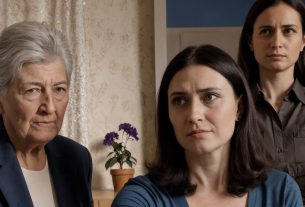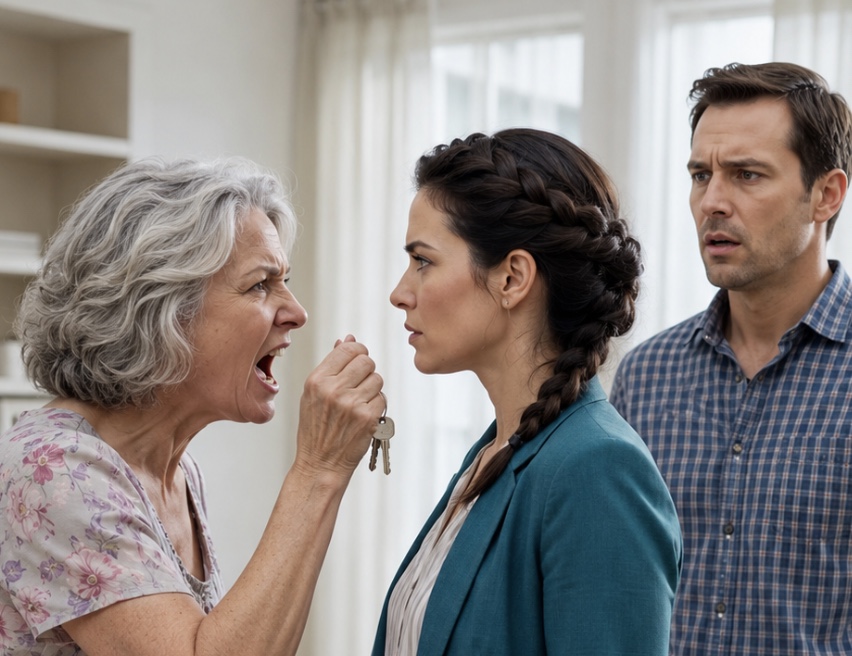
“Do you even realize what you’re doing?!” Tamara Vasilyevna’s voice burst through the phone before Yulia even had time to say hello. “When you get back, we’ll sort this out. That’s it. Conversation over.”
The line went dead.
Yulia lowered the phone onto her lap and stared out of the bus window. Beyond the glass, the fields outside Moscow slid past—sun-scorched, dusty, unmistakably July. Beside her, her husband Seryozha was dozing with headphones in his ears and his mouth slightly open.
They were returning from Karelia. Two weeks of lakes, silence, and something close to happiness.
Almost.
“When you get back, we’ll sort this out.”
What was that supposed to mean?
Yulia didn’t wake her husband. She simply kept looking out the window, replaying the phone call in her mind like a scene from a bad movie that refused to end.
She and Tamara Vasilyevna had always had an unspoken agreement: stay out of each other’s lives.
 
Yulia didn’t interfere with her mother-in-law’s affairs. She ignored her habit of calling her son at any hour of the day or night, her tendency to say “we” when she really meant “Seryozha,” and her firm opinions on everything from the correct way to cook borscht to how children should be raised. Yulia and Seryozha didn’t even have children yet, but that had never stopped Tamara Vasilyevna from offering advice.
In return, Tamara Vasilyevna stayed out of their apartment.
The country house was different.
Officially, it belonged to Seryozha, but in practice, his mother ruled the place. Every summer, from May until September, she lived there, growing tomatoes, repainting the fences in unexpectedly bright colors, and entertaining friends on the veranda.
Yulia rarely visited—perhaps once a month. Every time she left, she had the strange feeling that she had been a guest on someone else’s property.
But technically, the house was hers too.
At least as part of their family.
They reached the village late in the evening.
Seryozha drove in silence. His mother had also called him while they were on the road, but his entire response had been:
“We’re coming, Mom. Everything’s fine.”
Then he hung up.
When Yulia asked what she wanted, he shrugged.
“Something about the country house.”
The property greeted them with silence.
The gate opened normally. Its old lock squeaked exactly as Yulia remembered.
The front door, however, was another matter.
Yulia took out her key and pushed it into the lock.
It wouldn’t go in.
She tried again.
Nothing.
She twisted it, pushed harder, pulled it back out.
“Seryozha.”
He came over and tried his own key.
Same result.
They looked at each other.
Seryozha pulled out his phone and called his mother.
She answered after the first ring, almost as if she had been waiting for the call.
“Mom, our key doesn’t fit.”
“I know. I changed the locks. I have the new keys. I’ll come tomorrow and explain everything.”
“Wait. What do you mean, you changed them?”
“I changed them because I had to. We’ll talk tomorrow, Seryozhenka. I’m already in bed. I’m tired.”
The call ended.
Seryozha lowered the phone and stared at it with the expression of someone who had just been told something completely absurd in a foreign language.
“She changed the locks,” he said aloud, almost as if he needed to hear the words to determine whether they made any sense.
 
They didn’t.
They still managed to get inside through the summer kitchen, a small extension on the side of the house that Tamara Vasilyevna rarely locked properly. The lock there was old and cheap, and Seryozha opened it with his existing key without difficulty.
Inside, the house smelled of warm timber and dried herbs. Tamara Vasilyevna liked to hang bunches of St. John’s wort in the corners. She called it “proper airing.”
Yulia walked through the rooms.
Everything seemed to be exactly where it had always been: the sofa with its checked blanket, the old sideboard filled with dishes, and a framed photograph on the wall showing seven-year-old Seryozha in a sun hat, squinting into the camera.
And yet something felt wrong.
At first, Yulia couldn’t tell what it was.
Then she entered the small room where she and Seryozha usually slept whenever they stayed overnight.
Their old folding bed was there. So was the bedside table and the mirror.
But underneath the bed was something new.
A cardboard box.
It had been sealed tightly with tape.
It wasn’t theirs.
Yulia left it untouched.
When she returned to the veranda, Seryozha was already unpacking their bags with the determined air of someone pretending nothing unusual had happened.
That was one of his talents: if a problem had not yet physically cornered him, he could somehow behave as though it didn’t exist.
Sometimes Yulia admired that ability.
Sometimes it drove her insane.
“Seryozha, why would she change the locks?”
“I don’t know. She’ll tell us tomorrow.”
“You didn’t ask?”
“She said tomorrow.”
Yulia exhaled.
She poured herself a glass of water and walked into the garden.
The evening was warm and smelled of freshly cut grass. A light was glowing on the neighboring property, and someone was laughing nearby.
It was an ordinary summer evening at a country house.
Nothing unusual.
Except that Yulia didn’t have a key to a house that was supposed to belong to her family.
She discovered the new keys by accident.
She wasn’t searching for them.
She simply went to make tea and opened the cupboard above the stove where the mugs were kept.
Behind the mugs was a small paper envelope.
Thick.
Heavy.
Yulia opened it.
Inside were two keys.
Brand-new and shiny.
A yellow tag was attached to them, with the words “MAIN ENTRANCE” written in marker.
Yulia stood there for a long time, staring at them.
So Tamara Vasilyevna had changed the locks—and then hidden the keys inside the house.
Inside the very house she had made impossible for them to enter through the front door.
It was strange.
More than strange.
It felt like a puzzle with the most important piece missing.
Why?
 
Who were the keys meant for?
And why had all of this happened while they were away?
Yulia closed her fingers around the keys and felt something cold beginning to form inside her.
Not anger.
Not yet.
More like a warning.
A growing sense that while she and Seryozha had been drifting across Karelia’s lakes, cooking fish over a fire and enjoying their vacation, something had been happening here.
Without them.
Behind their backs.
And Tamara Vasilyevna knew exactly what it was.
Yulia didn’t show the keys to Seryozha.
Not yet.
She put them back into the envelope, slipped it into the pocket of her shorts, and returned to the veranda carrying two mugs of tea.
Seryozha was already lying on the sofa, scrolling through his phone.
He glanced at her and gave her a tired, familiar smile.
“Everything okay?”
“Everything’s fine,” Yulia replied.
She wasn’t particularly good at lying.
But she was capable of keeping quiet.
That was different.
That night, Yulia couldn’t sleep.
She lay on the folding bed staring at the ceiling and listening to the poplar tree rustling outside the window.
Seryozha fell asleep almost immediately.
That was another one of his remarkable abilities. His head touched the pillow, and he was gone.
Sometimes Yulia envied him.
She kept thinking about the box under the bed.
The next morning, when Seryozha went to take a shower, she crouched down and pulled it out.
The tape had been wrapped around it carefully and tightly, the way people seal something they expect to store for years.
Yulia slid her fingernail under the edge and peeled it back.
The box was full of documents.
At first, she didn’t understand what she was looking at.
There were loose papers, folders, stapled sheets.
Then she picked up the top document and saw the address.
The address of this country house.
And a name.
It wasn’t Seryozha’s.
The name was Pavel Ignatievich Krotov.
Yulia read it again.
Then once more.
She had absolutely no idea who Pavel Ignatievich Krotov was.
Tamara Vasilyevna arrived at around ten thirty.
She drove up in her old car wearing a wide-brimmed hat and carrying a bag of cherries.
She looked perfectly calm.
She had the confidence of a person who believed everything was under control and saw no reason to explain herself to anyone.
“Seryozhenka.”
She kissed her son on the cheek.
Then she glanced briefly at Yulia.
“Yulia.”
“Tamara Vasilyevna.”
 
They sat down on the veranda.
Her mother-in-law poured the cherries into a bowl, placed it on the table, and served herself a glass of water.
Seryozha watched her with the expression of a man who desperately wanted answers but had no idea how to begin asking for them.
“Mom, explain the locks.”
“I will.”
Tamara Vasilyevna folded her hands on the table.
“While you were away, Tonya came here.”
“What Tonya?” Seryozha asked.
“Antonina Krotova. Pasha Krotov’s wife. You don’t know him. It’s an old matter of mine.”
She spoke calmly and deliberately, like someone who had rehearsed the conversation in advance.
“She came onto the property without permission. Walked around. Looked at the house. I was here that day. I saw her through the window.”
“Wait,” Seryozha said, frowning. “What do you mean she came without permission? Why?”
“Because Pasha Krotov believes he has a claim to this property. It’s an old story. I never told you. It goes back to your grandfather. Some dispute involving the land or the buildings—I don’t know every detail. But suddenly Pasha has decided that now is the right time to bring it all up again.”
Silence settled over the veranda.
Outside, the poplar leaves rustled, and somewhere in the distance someone was running a lawn mower.
“Why now?” Yulia asked.
Tamara Vasilyevna looked at her, calmly but with faint surprise, as though Yulia had not been expected to participate in this conversation.
“I don’t know,” she said. “Maybe because your grandfather died three years ago. Maybe Pasha thinks there’s no one left to defend the property.”
She said it without drama.
Simply as a fact.
Afterward, Seryozha drove into the village, claiming he needed bread and wanted to stop at the gas station.
Yulia knew this maneuver well.
Whenever something uncomfortable happened and he needed time to process it, he got into the car and drove somewhere.
Sometimes for quite a while.
That left Yulia alone with Tamara Vasilyevna.
Yulia brought the cardboard box from the bedroom and placed it on the table.
Her mother-in-law looked at the box.
Then at Yulia.
Then back at the box.
“You found it,” she said.
It wasn’t a question.
“Yes.”
A pause followed.
Somewhere outside, a neighbor’s gate slammed.
“These belonged to your grandfather,” Tamara Vasilyevna said. “I brought them here because I didn’t want to keep them at home. I thought no one would look through them.”
“What’s in them?”
“The entire history of this property.”
Tamara Vasilyevna opened the box herself, removed one folder, and placed it on the table without opening it.
“Grandfather bought this land in 1989 from Krotov’s father. Fairly. He paid money for it. The papers are all here. But Pasha claims his father signed everything under pressure.”
“Is that true?”
Tamara Vasilyevna hesitated.
Only for a second.
“I don’t know,” she said quietly. “I had only recently married into the family at the time. I was young. I didn’t see what happened between them.”
That answer surprised Yulia.
 
She looked at her mother-in-law—the woman who always seemed to have an answer for everything, who entered every room like she owned it—and saw something she had never noticed before.
Weariness.
Or perhaps fear.
“Tamara Vasilyevna,” Yulia said carefully, “has Krotov done anything official yet?”
“Not yet. But Tonya didn’t come here for nothing. She was looking around and taking pictures. I saw her holding up her phone.”
“So they’re preparing something.”
“Looks that way.”
Yulia stood and walked across the veranda.
Through the window she could see the garden, the vegetable beds, and the old apple tree with a crooked wooden ladder leaning against its trunk.
Everything looked ordinary.
Familiar.
And yet suddenly the place no longer felt entirely secure.
Suddenly ownership itself had become a question.
“I work in a legal department,” Yulia said.
Tamara Vasilyevna already knew that, although she had never shown much interest in the details.
“I’m not a lawyer, but I work with documents every day. I can go through everything in this box.”
Her mother-in-law said nothing.
“If you want me to,” Yulia added.
The pause lasted long enough for a dog to bark somewhere nearby, for something metallic to clatter in the garden, and for silence to return again.
“Look,” Tamara Vasilyevna finally said.
She pushed the box toward Yulia.
It wasn’t a thank-you.
It wasn’t an admission of trust.
Just one word.
“Look.”
But coming from Tamara Vasilyevna, even that meant something.
Yulia opened the first folder.
On top was a yellowed sheet of paper—a handwritten purchase agreement with a blue stamp on the side.
The date was May 1989.
There were signatures from both parties.
And the address was unmistakable.
This exact house.
This exact plot of land.
Yulia began reading.
She went through the documents for nearly two hours.
Tamara Vasilyevna sat beside her in silence, drinking tea and occasionally glancing over her shoulder.
When Seryozha returned with bread and sausage, he saw the two women sitting together at the table, carefully placed his shopping bag in the kitchen, and disappeared into the garden.
Apparently his instincts worked when they needed to.
Gradually, the story became clearer.
The sale agreement itself was properly written, especially for something dating back to 1989.
The land had been purchased.
The payment had been made.
Both parties had signed.
Then, in another folder, Yulia found a letter.
It was handwritten on a sheet torn from a squared notebook.
There was no date.
Krotov’s father had written it to Seryozha’s grandfather in clumsy, error-filled handwriting, clearly while deeply upset.
The meaning, however, was obvious.
Yes, he had accepted the money.
But he was asking for another year in which to buy the property back.
Otherwise, he wrote, “things would turn bad.”
Whether that was a threat or a desperate request was difficult to say.
But the letter existed.
And if Pavel Krotov knew about it, he might try to use it to construct a story about coercion.
“Tamara Vasilyevna,” Yulia said, “have you seen this letter before?”
 
Her mother-in-law took the paper and looked at it.
“Yes. Grandfather said it was nonsense and not to worry about it.”
“But you kept it.”
“Grandfather kept everything.”
Yulia nodded.
That was fortunate.
Because the letter did not prove coercion.
Quite the opposite.
It sounded like a man who had sold his property, regretted the decision afterward, and wanted an opportunity to reverse the sale.
That was something entirely different.
Yulia carefully straightened the papers and returned them to the folder.
“If Krotov goes to court, his position is extremely weak. The contract is valid, the money was paid, and as far as these documents show, there are no witnesses who can support his story. This letter actually works against him. There’s no mention of coercion whatsoever. His father is simply asking to buy the land back.”
Tamara Vasilyevna listened without interrupting.
“But,” Yulia added, raising one finger, “that’s only if he chooses the official route. If he tries to pressure you outside the legal process, that’s a different matter.”
“What do you mean?”
“His wife has already been here taking pictures. That looks like reconnaissance. They’re testing how prepared you are to defend yourselves. If they sense uncertainty, they may push harder.”
Tamara Vasilyevna slowly lowered her cup.
“I changed the locks because she walked around the property.”
“I understand. But from the outside, changing them suddenly may look like panic.”
Her mother-in-law turned toward the window.
“And what do you suggest?”
Seryozha learned the full story that evening.
The three of them sat at dinner while Yulia explained everything clearly and without unnecessary detail.
He listened, chewing bread and frowning.
Finally he looked at his mother.
“Mom, why didn’t you tell us straight away?”
“Because you were on vacation.”
“That isn’t an answer.”
“Seryozha.”
Tamara Vasilyevna gave him the expression Yulia knew so well—a mixture of patience, superiority, and exhaustion.
“I’ve been handling everything by myself for thirty years. It’s a habit.”
“Mom. This is our country house too.”
He didn’t say it aggressively.
He simply said it.
And Yulia felt something in the atmosphere shift.
Just slightly.
Tamara Vasilyevna didn’t respond.
She picked up her fork and continued eating.
The following morning, Yulia traveled into town alone by commuter train.
She had spent half the night thinking about one particular possibility, and now she wanted to check it.
She spent three hours at the district archives.
Eventually she found what she needed: records concerning land disputes in the village between 1985 and 1995.
Krotov’s father appeared twice.
The first time, he had been a claimant in a dispute with a neighbor concerning another parcel of land.
The second entry was far more important.
In 1988, he had taken out a loan and fallen into debt.
That was one year before he sold the country house.
And that explained everything.
There was no evidence of pressure.
He had simply been in financial trouble and sold the property to pay off his debts.
Then, apparently, he regretted the sale and wrote the letter asking for another chance to buy the land back.
His son had grown up believing the story had been unfair and now wanted to rewrite the past.
Yulia photographed the relevant pages and returned to the country house.
In the end, the issue with Krotov was resolved far faster than anyone expected.
And not at all the way Yulia had imagined.
He came to the property himself on Saturday around noon.
He was a tall, broad man in his fifties, with a heavy expression and a slow, deliberate manner of speaking, as though every word he used weighed a kilogram.
He came alone, without his wife, driving an expensive car.
Tamara Vasilyevna opened the gate herself.
Yulia stood a little behind her.
“I came to talk,” Krotov said.
It wasn’t really a request.
 
More of an announcement.
“Then talk,” Tamara Vasilyevna replied.
He spoke about his father.
About injustice.
About how the land had once belonged to his family.
About how the sale had been forced.
He didn’t shout.
He wasn’t openly hostile.
He spoke calmly, which somehow made the conversation more unpleasant than anger would have.
Yulia listened carefully.
And one thing became obvious.
He genuinely believed what he was saying.
This was his version of the past.
In his story, his family had been wronged.
When he finished, Tamara Vasilyevna remained silent for about three seconds.
Then she turned toward Yulia.
Yulia stepped forward, took out her phone, and opened the photographs from the archives.
“Pavel Ignatievich, your father took out a loan in March 1988. He sold this property in May 1989. Here are the records concerning the debt. The purchase agreement was legally valid. We have also read the letter your father wrote after the sale. There is no mention of coercion or pressure in it. If you want to file a lawsuit, that is your right. But based on the documents, you have virtually no chance of succeeding.”
Krotov stared at her.
Then at the phone.
Then back at her.
“Who are you?” he finally asked.
“The daughter-in-law,” Yulia replied.
Something in his expression shifted.
Only slightly.
But she noticed.
 
He had clearly expected to find an older woman alone, someone he might be able to intimidate through persistence and pressure.
He had not expected this.
He remained silent for another moment.
Then he gave a short nod, turned around, and walked back toward his car.
They never saw him again.
That evening, for the first time since Yulia had known her, Tamara Vasilyevna poured her a cup of tea without being asked.
She placed it in front of Yulia, said nothing, and walked over to the window.
“You did well,” she finally said without turning around.
Her voice was completely neutral.
That was precisely why Yulia believed her. “It wasn’t difficult,” Yulia replied.
“For me, it was.”
That too was said without drama.
Simply as a fact.
For a while, they sat in silence.
The sun was setting beyond the garden, and long shadows stretched across the vegetable beds.
Somewhere outside, Seryozha was moving pieces of wood around.
Then Tamara Vasilyevna suddenly said:
“The locks.”
“What about them?”
“The new locks. You need your keys.”
She walked to the sideboard, opened a drawer, and removed a set of keys.
She placed them on the table in front of Yulia.
“Here. These are yours.”
Yulia looked down at them.
New.
Shiny.
Almost identical to the ones she had discovered hidden behind the mugs.
Except these had been handed to her willingly.
By Tamara Vasilyevna herself.
Yulia picked them up.
“Thank you, Tamara Vasilyevna.”
Her mother-in-law merely nodded and went into the kitchen, where she began doing what she always did—cooking, moving pots around, keeping herself busy.
But something had changed.
It was small.
Almost invisible.
Like opening a window just a few centimeters in a room that had been sealed shut for years.
Not wide open.
Just enough to let in a little air.
Yulia closed her fingers around the keys.
For now, she thought, perhaps that was enough.
They left the country house on Sunday afternoon.
Tamara Vasilyevna came out to see them off.
She stood beside the gate in her usual apron, squinting in the bright sunlight.
Seryozha loaded their bags into the car, slammed the trunk shut, and hugged his mother.
She patted him on the back quickly and practically, exactly as she always did.
Then she turned toward Yulia.
Yulia expected nothing more than a nod and a dry goodbye.
That would have been normal.
Instead, Tamara Vasilyevna stepped toward her and awkwardly wrapped her arms around her.
It was brief.
Barely two seconds.
She seemed almost stiff, like someone who had not done this in a very long time and had forgotten exactly how.
“Drive carefully,” she said, stepping back.
 
Yulia got into the car.
Seryozha pulled onto the road, leaving the country house behind—the fence, the apple tree, and Tamara Vasilyevna’s wide-brimmed hat visible above the gate.
“You noticed that, right?” Seryozha asked after a minute.
“I noticed.”
He was quiet for a moment.
“She’s never hugged you before.”
“I know.”
He glanced at her, trying to hide a smile and failing.
“So? How was it?”
Yulia thought for a second.
“Fine,” she said. “Unexpected. But fine.”
Outside the car window stretched rows of country fences, vegetable gardens, and old apple trees lining the road.
An ordinary summer landscape.
Nothing remarkable.
But Yulia watched it pass and thought about how sometimes things change quietly.
Not through shouting.
Not through some dramatic final conversation.
Not through explanations.
Sometimes change is simply a two-second hug beside a gate.
Or a set of keys placed on a table without unnecessary words.
Maybe that was the most Tamara Vasilyevna was capable of giving.
And maybe, for her, it was actually a great deal.
Yulia took the keys from her pocket and turned them over in her fingers.
Bright.
New.
And somehow heavier than they looked.
Then she put them into her bag.