I came back about an hour before sunset. The trip home from my business trip had drained me to the bone: the bus swayed and jolted, the aisle smelled like fried meat pies the entire way, and all I could think about was how I’d open the windows in Grandma’s apartment, let the stale air escape, water her violets, and put the kettle on. Tonight, for sure, I’d brew the linden tea she adored—sweet, honey-scented, the kind that always made everything feel like it fell back into place.
The key turned in the lock more stiffly than usual. The door cracked open and I stopped cold: the hallway light was on, two supermarket boxes sat on the floor, and—just like Grandma used to do—someone’s shoes had been left on the mat. So… I had visitors. I assumed it was Alyona, my sister-in-law. I’d asked her to water the flowers, and maybe she simply hadn’t left yet. I called out:
“Alyona? I’m home.”
No answer. Only silence.
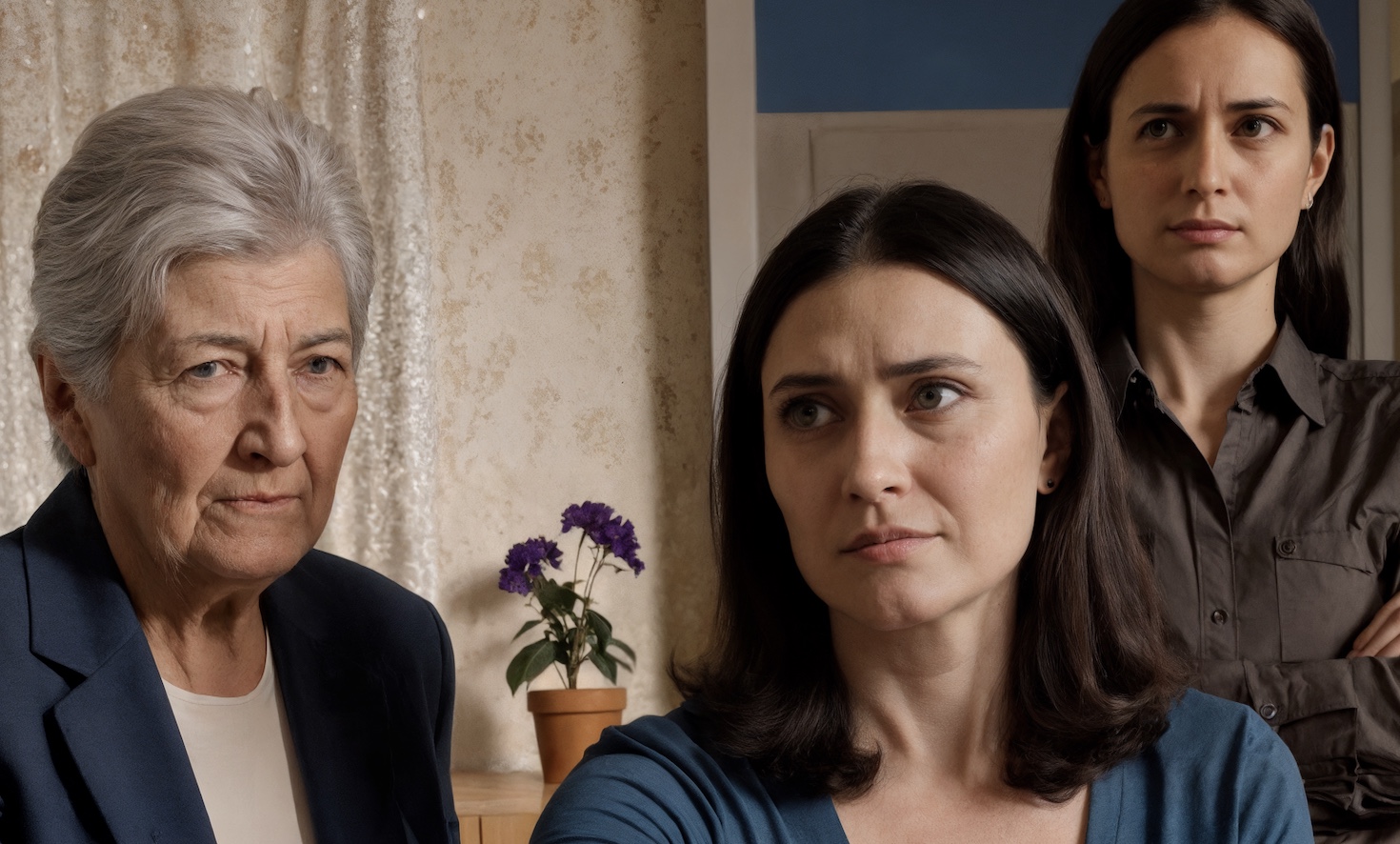
Then a door somewhere inside thumped shut, and my mother-in-law, Nina Pavlovna, stepped out of a room. She was wearing a new gray jacket, papers in her hands, and she looked perfectly at ease—like a person who’s on their own territory.
“Oh, Katyenka,” she said in a tone that pretended to be happy to see me, “how perfect. We’re just in the middle of some business. You’re right on time.”
I walked into the living room and saw a stranger’s laptop and briefcase on Grandma’s table. A stranger’s jacket lay tossed over a stool. On the windowsill beneath the violets was a business card: Property Appraisal. Fast. Honest. The kettle hissed in the kitchen. And the air carried a cheap, fresh perfume—nothing like ours, nothing like Grandma’s. чужой. чужой.
“Katya, don’t get worked up,” Nina Pavlovna said, catching my look and placing the papers down. “We’ve already discussed everything as a family. We agreed. We’re doing this for you, really. Everyone comes out ahead.”
“For me?” I let out a short, disbelieving laugh. “In my apartment? While I’m out of town?”
Alyona hugged a folder to her chest and, without looking down, said evenly—like she was reading an official notice:
“We’re selling the apartment you inherited. We’ve already called an appraiser, so pack your things and leave.”
The words landed like heavy stones. I even heard a tiny clink from a glass jar on the shelf.
“It’s very simple,” Alyona said, tucking the folder under her arm and gesturing around the room with the confident sweep of a real estate agent she had never been. “Mom and I thought it through. You and Sasha were planning to move closer to his job anyway. You basically live at his place, and this one just sits empty. And your grandma’s place is… well, it’s dreary. We found an appraiser—he’ll come at seven tonight. Tomorrow, a realtor. This weekend, a lawyer. You don’t have to do anything—just agree. We’ll divide the money fairly: you get the bigger share, we get something for the hassle, and Mom will keep a little too—she needs it for treatment. Everything honest.”
“And what did you do with the keys?” I asked, surprised by how calm my voice sounded. “The keys I gave you so you could water the violets.”
“We have them,” Nina Pavlovna replied, sliding an arm around her daughter’s shoulders. “She came regularly, like you asked. You should be grateful. And by the way, your flowers need repotting. Your windowsill is filthy—you don’t take care of things.”
“Stop,” I said. “This apartment is mine. The inheritance is in my name. No one sells anything without my consent. You give me the keys right now and you leave. And I’ll call the appraiser myself—if your imagination has made it as far as a phone.”
“But we’ve already arranged everything,” Alyona lifted her chin. “Katya, you’ve always been… soft. And irresponsible. With your timid little ways you’d never handle any of this. But we move. We get things done. Family is supposed to help. You know Mom helped Sasha when you lived with us—she went to the supermarket for groceries, she watched over your renovation. Now it’s your turn to help.”
“Helping means asking,” I said, looking her straight in the face. “Not breaking in and taking over. Where is Sasha?”
“At work,” Nina Pavlovna answered. “But he knows. In fact, he agreed we should speed things up. A man should make the decisions.”
My heart dropped—not dramatically, not loudly—just softly, like something giving way inside me. Sasha, my husband, had promised me for years: We’re a team. And now the “team” had “sped things up” behind my back.
“He knows?” I repeated.
“He’ll call you back,” Alyona said, and at that moment she slipped toward the kitchen as the kettle boiled.
I went into the room and looked at Grandma’s photograph—her in the garden, in a headscarf, laughing, bright and alive. Grandma, you’d tell them exactly how it is, I thought, and felt anger rise in me—steady, unstoppable, like water pushing against a dam. I opened the window and let cold air rush in. Outside, someone was arguing with a courier; a bird rocked a lilac branch—still bare, just buds.
“Katya,” my mother-in-law came in after me and crossed her arms. “Let’s do this without hysterics. Life is practical. An apartment is just walls. You have to make those walls useful. You’re not going to live here anyway. And the money—oh, it’ll be useful. For Sasha—a car. For us—a dacha. For you—whatever you want. Done and forgotten. Your grandmother was smart. She’d approve.”
“My grandmother never approved of taking things without asking,” I said, turning around. “And the fact that you walked in here like it’s yours—this is the last time you do that in my home. The keys. Now. The easy way.”
“Don’t raise your voice,” Nina Pavlovna stepped back, but the predatory chill in her eyes didn’t leave. “We’re not strangers here. And honestly—you’ve always acted like a stranger in this family. Sasha has it hard with you, God knows.”
“God has nothing to do with this,” I said. “The law does. And basic decency. The keys.”
Alyona returned with cups and placed one on the edge of the table like bait—so I’d take it without thinking.
“Exhale,” she said. “Don’t ruin the evening. The appraiser is already near the building, Mom’s been holding her phone all day for a reason. You have to be polite and punctual with people.”
“Then be polite and punctual and tell him the appraisal is canceled,” I said, pulling out my phone. “And your conversation with the realtor is over too.”
I called my husband. He answered on the second ring, like he’d been expecting it.
“Kitten,” he said, rushed as always. “I’m in a meeting—if it’s quick…”
“Are you aware that your mother and your sister are in our home—with an appraiser and a realtor?” I cut in. “Did you ‘speed this up’ for them?”
The pause was brief.
“Katya, don’t start,” he exhaled. “It’s an apartment… I mean… you understand it’ll be better for all of us. We’ll handle everything quickly. You get money. We get money too. No headaches. And you with your business trip… Trust me, it’s a good thing.”
“For whom?” I asked. “I haven’t signed anything. I didn’t authorize anyone. We’re all adults—and what you just did is… I don’t even know what to call it.”
“Don’t dramatize,” he lowered his voice. “I’ll explain later. Just—no scandals, okay? Mom will tell you how we’ll split it. Tonight. Don’t ruin people’s day.”
I slowly pulled the phone away from my ear. It wasn’t even painful anymore. It was empty—like something important had been carried out of the house while nobody bothered to notice.
“So,” Alyona said brightly, “let’s do this properly. What are you taking from here? Mom and I will pack it into boxes and call a taxi. You can come tomorrow and pick it up. Tonight’s appraisal, then showings the day after.”
“You won’t be ‘showing’ anything,” I said. “Not my bedroom, not my kitchen, not my belongings. The apartment documents are in a safe. The ownership is mine. And you are the ones who are packing up and leaving. Right now. Before I call the district officer.”
Nina Pavlovna smirked.
“Oh, straight to the police. For what? From your mother-in-law? From your sister-in-law? Three rooms and you’ve got kindness for half. Guests come—and she’s annoyed. Go complain to the building association while you’re at it.”
“I will,” I said. “To the building association, to the local officer, and to every agency—with a list of restrictions. And by the way, I have cameras on my phone—recording,” I nodded at the little black eye in the corner, “and your words will be there too. For memory’s sake—since you love ‘family decisions.’”
Alyona flinched. Nina Pavlovna snorted. But the stubborn certainty in them dulled, just a little.
I walked to the front door, took the spare key ring off the hook—the second set I’d handed Alyona a month ago—and held my palm out calmly.
“Keys. Now. And take anything that belongs to you. Visits are by invitation. Not today.”
“Alyona, give them,” Nina Pavlovna said reluctantly. “I don’t need her actually bringing the police.”
Alyona’s face tightened. She was furious, but she fished the keys out and dropped them into my palm so the metal clinked sharply.
“You’ll regret this,” she said. “Sasha will regret it too.”
“That’s a bet for your side of the family,” I said. “You know the door.”
They left—of course not quietly. Nina Pavlovna told me on her way out that “I was unlucky with daughters-in-law,” that “Sasha is pure gold,” that “we only wanted what’s best.” Alyona added, “You’re depriving yourself of money.”
I shut the door behind them and immediately slid the latch, as if that small strip of iron could keep someone else’s will outside.
The kettle was still hot. I brewed Grandma’s linden tea. I sorted the mail from the box—among the flyers there was a notice from the housing office and a brochure that literally said Sell without hassles. I found the number of the appraiser who was supposed to arrive “at seven,” and dialed.
“Good evening,” I said. “Cancel, please. The owner does not consent. And in the future, verify the authority of ‘relatives.’ Otherwise you might end up without payment.”
The man on the other end sounded like he was relieved.
“Of course. Sorry. I was given your number by your sister… well, a relative. We won’t come.”
Then I opened my laptop and wrote to the building management company that no third parties were to be granted access without my permission. I drafted a brief, businesslike note to the local district officer—no drama: “attempted unlawful actions, entry using keys, request to speak with the parties.” I messaged a couple of realtors I knew through work: “Any offers to sell this apartment are invalid without written authorization from: Katerina…” And I sent Sasha one line: “I took back the keys. I canceled the appraisal. There’s nothing to discuss tonight.”
His reply came almost immediately: “Don’t do something stupid. I’m coming over.”
I didn’t want to see him today. But the door opened anyway—he still had a key. I met him in the hallway, one hand on the doorframe, like in those old movies where a woman holds up a home with her own shoulder.
“Katya, you’re always…” Sasha sighed, walked into the kitchen, and sat down as if he belonged there—and the worst part was, he did. “Couldn’t you have waited? We promised Dima’s kid—Nina Pavlovna’s son—that we’d help… never mind. Fine. Let’s be practical. We’re not enemies. We’re family.”
“Family asks,” I said. “Family doesn’t ambush. You let them decide for me.”
“I tried calling,” he spread his hands. “You were traveling, your signal… They just nudged the process a little. You said yourself money is better than an empty apartment.”
“I said money is freedom to choose for myself,” I answered. “Not through Nina Pavlovna. Not through Alyona. And definitely not through an appraiser showing up at seven. Sasha, I don’t want decisions in my home made without me. If you can’t understand that—then you’re a stranger in this apartment. And maybe… in my life.”
He stood up sharply.
“What, you’re throwing me out?” Hurt flashed across his face. “Because I tried to think about both of us? You’re always like this—you dig in and… Mom’s heart is weak, Alyona has it hard with a child, I… I want to help everyone. And you could have helped too. But you always wave the flag that says ‘mine.’”
“Because it is mine,” I said. “It’s Grandma’s inheritance. It’s memory and place for me. I’m not obligated to turn it into your family’s wishes. You can help your mother and sister as much as you want. Just not with my home.”
We talked for a long time and still felt like we were standing on opposite shores. He kept repeating “for the best,” “rational,” “everyone will breathe easier.” I answered with boundaries, rights, and the idea that building someone else’s happiness on my foundation wasn’t building—it was taking. In the end he said:
“Fine. If you’re like this, decide for yourself. I’m going to Mom’s. When you figure it out—call.”
“There’s nowhere to call,” I said.
He left. His smell lingered in the hall—tobacco and pine cologne. I opened the windows, set my cup of linden tea on the sill, and stared out into the yard where a man, limping slightly, carried a sack of potatoes through puddles as if crossing small seas. And I understood that in one day something inside me had clicked into place—like a gear that used to slip and grind. Now it caught. Cleanly.
After that came ordinary days—ordinary only from the outside. I changed the locks. I called the local officer; he came, a restrained young man, listened, wrote something down: “Conversation conducted.” I left a note for Grandma’s neighbors: “Do not let anyone in.” I made a list of what needed doing: paint the window frames, resew the curtains, sort Grandma’s dishes—give some away, keep some. I wasn’t living there full-time yet; my job was on the other end of the city, and in the last days I’d still been staying at Sasha’s—until now. But everything began moving here: my toothbrush, my thoughts, my home.
Of course the calls didn’t stop. Alyona rang and texted: “You’re cruel.” “We’re not asking you for money.” “Mom feels terrible, she’s crying.” Nina Pavlovna called once and said, “You’re not our family anymore.”
A week later, an ad appeared on the bulletin board in our entrance—photos of my kitchen, my window—with the caption: “For Sale.” I tore it down, called the number, and heard a dull, businesslike voice. I told him I was the owner and that if it happened again I would file a report. The next day the ad was gone and never returned.
Some evenings I sat in the kitchen and looked at Grandma’s photograph. She smiled from the garden where there was so much light. I’d set out two cups—one for her, one for me—and think that this whole story was like a heavy bucket. You can balance it on your head the way women do in old photos and keep walking steady. Or you can throw it down and smash it. I chose the first. And more and more often, it worked.
Sasha and I met a couple more times: officially, at the registry office to file the paperwork, and unofficially, on a bench near our former building where we once ate ice cream in summer, sitting on warm boards. He said quietly, “Maybe we could still…” and trailed off. I said, “No.” He nodded. Later a mutual acquaintance told me Sasha, his mother, and Alyona had “almost bought” a small apartment in the next district in Alyona’s name, and Sasha was planning to “help with the renovation.” That was his choice. My renovation was mine.
Two months later I moved in for good. Spring came, the lilac bloomed, and the scent slipped in through the window like water finding a channel—slow, certain. I hung clean curtains I’d sewn from one of Grandma’s old tablecloths. I re-glued a strip of wallpaper in the kitchen where the seam had peeled. I repotted the violets. I placed a small wooden bird on the sill—one Grandpa had carved once. In the evenings, when the yard is quiet and only the tram hums far off at the intersection, I sit with a cup of linden tea and listen to the old clock ticking in the next room. It ticks as it always did. Not to remind me of other people’s words—only to remind me of time that now belongs to me.
Sometimes I run into Alyona at the market. She looks straight past me as if we’re strangers. Once Nina Pavlovna walked past me at a bus stop and pretended to study newspaper prices. I don’t hold a grudge. It’s easier this way. I live in the home that was left to me with care, and I don’t let anyone turn that care into a ticket to somebody else’s wallet or somebody else’s version of the past. If someone feels cold because of that—let them close their own windows. Mine stay open.
And yes, I still go on business trips. Only now no one keeps a spare set of my keys. The violets will survive without Alyona’s “help.” I water them, I lock up, and the door clicks soft and sure—like it did back when Grandma would pop out to the shop and come home with a loaf of still-warm bread. I rest my hand on the warm windowsill and think: no one will ever again tell me “pack up and get out” in my own kitchen. That’s the one contract I’ll sign with myself—no appraisers, no realtors. And it will have my last name on it.