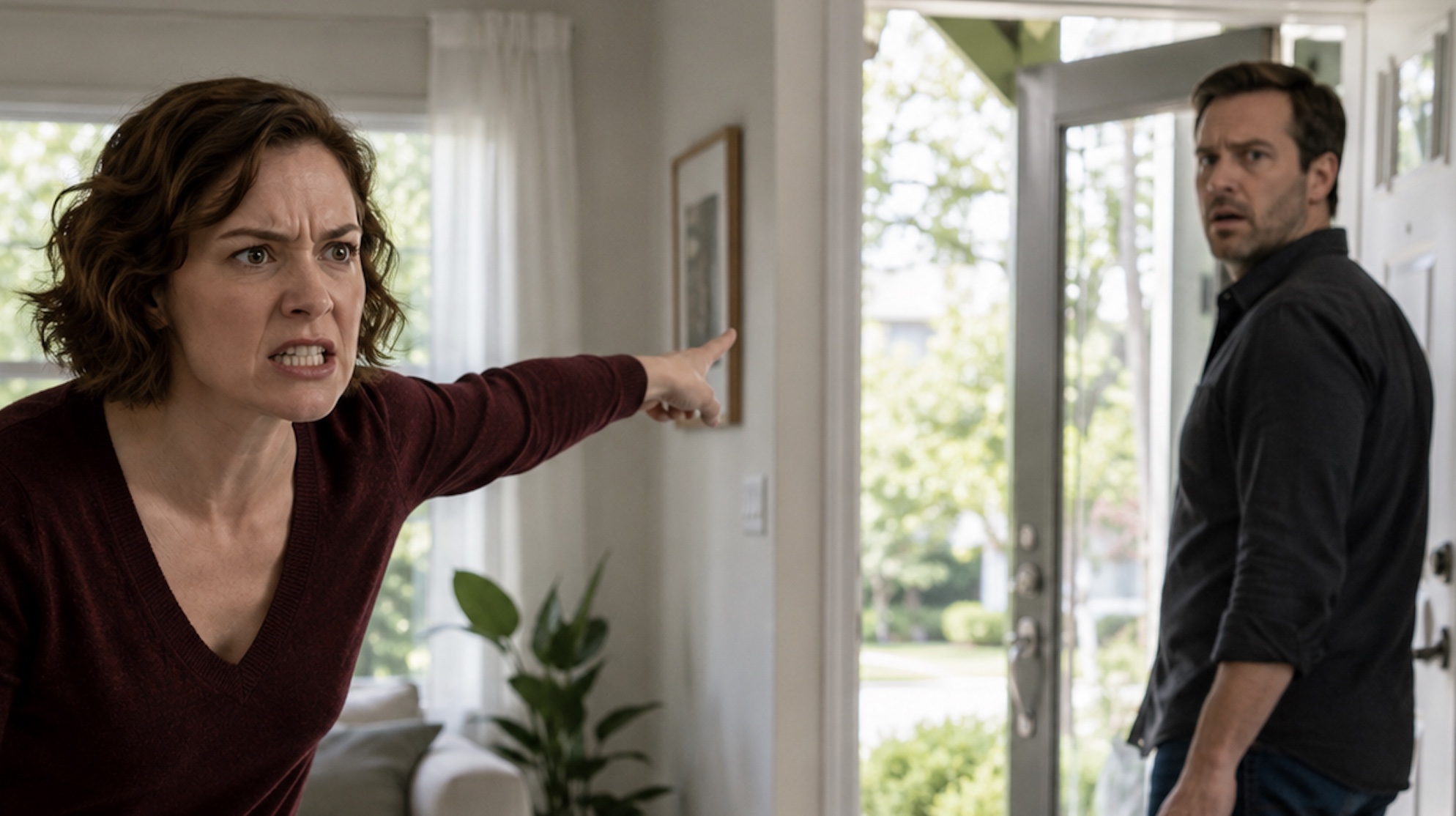
“Enough. I’ve had it. Get out of my house,” the wife said to her husband.
Andrei looked up from the table. Around him sat three of his friends and his mother, Nina Viktorovna, who had been speaking animatedly just a moment earlier and now fell silent. A heavy quiet settled over the room — the kind that appears when nobody expected the situation to turn like this.
“Kira, what are you doing?” Andrei said in that patronizing tone people use when they think the other person is overreacting.
“I said what I had to say,” Kira replied, and went into the kitchen.
There, she put the kettle on. Not because she wanted tea, but simply to give her hands something to do. From the living room she heard chairs scraping, someone beginning to gather their things. Andrei was saying something under his breath. Nina Viktorovna too. Kira stood by the window and looked out into the yard. The apple trees stood like dark silhouettes. Everything was quiet.
Kira worked as a clothing repair specialist in a small tailor’s shop on the edge of the settlement. Her work was quiet and precise: shorten, hem, adjust to fit. Her hands were patient and accurate. She knew how to finish things properly without unnecessary words, and that quality applied not only to her work.
The house in the settlement had come to her from her grandfather. He had died three years earlier, and after the required six months, Kira legally inherited it. It was a wooden house with a large fenced yard, old apple trees along the fence, and a veranda where her grandfather used to sit in the evenings. Kira knew every floorboard there. She had grown up within those walls — spending summers with her grandfather while her parents worked — and she had considered the place hers long before it officially became so.
She met Andrei at the birthday party of a mutual acquaintance. It was late September. Someone was burning leaves in the garden, and someone else had brought a guitar. Andrei talked loudly and amusingly all evening, telling stories about things that had happened to him on the road. He traveled all over the region for work and could turn any trip into an entertaining tale. Kira watched him and thought: here is a man who never gets bored.
She herself was made differently. A quiet evening with a book or some work suited her much more than a noisy gathering. But at the time, she mistook that attraction of opposites for something meaningful.
Andrei worked as a delivery driver. He was sociable, loud, the kind of person who immediately filled any space with his voice and gestures. He liked being the center of attention — not out of vanity, perhaps, but simply because he didn’t seem to know how to exist any other way. At the table, he was always the one speaking. In company, people laughed at his jokes.
Kira observed all of this calmly and thought: it is good when a person knows who he is. It is bad when that is the only thing he knows about himself.
At first, she liked his liveliness. She was not talkative herself, and his energy seemed refreshing. A year after they met, they got married.
“I’ll move in with you,” Andrei said when they began discussing where they would live. “I actually like the settlement. It’s quiet there, the air is different. We could even plant a vegetable garden.”
“I take care of the garden myself,” Kira warned him.
“Then I’ll help,” Andrei shrugged.
And at first, he really did help. He fixed the gate, painted the fence, chopped firewood for the winter. On weekends, he got up without being asked and went out into the yard. Kira watched him through the window and thought: good. She was not the kind of person who looked for hidden problems in advance. A person revealed himself through actions — that rule worked for her with clients and with people in general. So far, Andrei’s actions seemed decent.
Kira looked at it with satisfaction. She did not expect anything extraordinary from her husband, but she respected order in the home and saw that Andrei seemed to understand it.
Or so she thought.
Before the wedding, she had visited Andrei’s rented apartment in the city several times. It was a one-room apartment on the fifth floor, overlooking a parking lot. He lived without much comfort: minimal furniture, dishes for one person, and a cactus on the windowsill that looked as though it had last been watered three months earlier. Back then, Kira thought he simply did not need all those things — comfort, order, household warmth. She thought he was one of those men who only needed a bed and an outlet to charge his phone.
She did not judge him for it. But when he moved into her house, she assumed it would change naturally, simply because the surroundings were different. A house demands a different attitude than an apartment. Here there was a garden, a woodshed, a cellar, a fence. Everything here lived by its own rules.
The first signs that something was changing appeared about four months after the wedding. One day, Andrei brought two friends over without warning. He simply opened the door and called from the entrance, “Kira, we’re only here for a little while.”
At that moment, Kira was sitting on the veranda with some work — she sometimes took orders home — and carefully moved the fabric aside. She went out, greeted them, and put the kettle on. She decided it was a one-time thing.
The one-time thing happened again a week later. Then again a few days after that. Gradually, it became normal: Andrei might call at lunchtime to say that Seva and Kolya were coming over in the evening, or he might not call at all and simply arrive with company, settling everyone in the living room.
“Andrei,” Kira said one evening after the guests had finally left and they were alone, “without irritation, I’m asking you to warn me in advance if you invite someone.”
“What’s the big deal? The guys just stopped by.”
“This is my house. I have the right to know who will be in it.”
Andrei grimaced.
“You say that like I’m bringing strangers here. They’re my friends.”
“I’m not saying they’re strangers. I’m saying: warn me.”
He promised. For several days, he really did warn her. Then he stopped again.
Kira stayed silent and watched. She did not like returning to the same conversation twice. She believed that if a person did not hear her the first time, repeating herself would not change much. She waited for Andrei to understand on his own. He did not.
One day, she came home from work and discovered that the tools in the storage room had been rearranged — the same tools her grandfather had kept in specific places, and which Kira never touched without reason. Andrei explained that he had “just organized things” and that it was more convenient now.
Kira asked him to put everything back the way it had been.
He did it — reluctantly, with the expression of someone granting a favor. There was no argument about it. But Kira remembered. She generally remembered such things, not out of spite, but because she knew how to assemble a full picture. Each separate incident seemed small. But together they formed one clear conclusion: a person was living here as though the rules of this house were not hers.
She returned her grandfather’s tools to their places herself — carefully, back onto the same nails where they had always hung. She looked at them and thought: these are not just tools. This is the order in which my grandfather lived here for forty years. To touch it without reason means not understanding what a home is.
Kira was not one of those people who silently stored up resentment and then exploded all at once. She preferred to speak immediately, but only once — without reminders and without repeating herself. If a person heard her and still did not change, she drew conclusions.
With Andrei, she had already spoken twice. Both times, he had agreed, nodded, and a few days later returned to the same behavior. Kira looked at this and thought: either he does not consider it necessary to change, or he does not understand that I am serious. The second seemed worse to her.
One late evening, after yet another group of visitors had left and Andrei was clearing the table, Kira sat on the veranda and heard him humming something under his breath. He felt fine. He had spent the evening with friends, eaten, and was now cleaning up without being asked. Everything he needed was in place.
He did not think about the fact that she had spent the evening in the bedroom behind a closed door, because there had been nowhere for her to sit in her own living room.
Then Nina Viktorovna appeared.
Andrei’s mother lived in a neighboring town and had previously visited rarely — on holidays, sometimes for a weekend. Kira treated her without prejudice. Her mother-in-law was talkative, with an opinion about everything, but Kira knew how to let other people’s advice pass by her ears.
Until the advice began to concern her own house.
One Friday evening, Nina Viktorovna arrived with Andrei and stayed until Monday. On Saturday morning, Kira entered the kitchen and found her mother-in-law standing in front of an open cabinet, rearranging jars of grains.
“What are you doing?” Kira asked.
“Oh, I was just thinking how to organize things better. You have everything mixed together.”
“It’s convenient for me this way,” Kira replied evenly. “Please don’t touch anything.”
Nina Viktorovna turned around with the expression of someone who had just been insulted.
“I only wanted to help.”
“I understand. But nothing needs to be moved.”
That evening, Andrei pulled his wife aside.
“Why did you speak to Mom like that?”
“I asked her not to touch my things. That is a normal request.”
“She was just trying to put things in order.”
“I put things in order in my own house.”
Andrei shook his head in that way people do when they disagree but do not want to argue. Kira looked at him and understood: he was not on her side. Not because he was cruel, but because, in his mind, the house had long ago become shared. He did not understand why his wife held so tightly to the word “mine.”
Nina Viktorovna began visiting more often. Sometimes with Andrei, sometimes Andrei brought her himself because “she wanted some fresh air.” Her mother-in-law grew more confident. She entered rooms without asking, inspected them like an appraiser, and commented: there was too much dishware, the storage room was inconveniently placed, it would be better to knock down that partition.
One day, she brought an acquaintance with her — “just to show her what a good house it is” — and walked with her through the rooms, opening doors and saying, “Here we have the living room, and here is the bedroom.”
“We.”
Kira stood in the hallway and listened silently. Nina Viktorovna’s acquaintance was a polite woman. She looked at the real owner of the house with slight embarrassment, as if she herself understood that something was wrong.
“Nina Viktorovna,” Kira said once during lunch, “this house belongs to me. I inherited it. I am the one who decides how things are arranged here.”
The table went quiet. Andrei looked up from his plate.
“Kira, why make it sound so official?”
“Not official. Just clear,” she answered.
Nina Viktorovna was silent for a moment, then smiled the kind of smile people use when they do not want to start a scandal, and said something neutral about the weather.
That evening, Andrei spoke to his wife.
“You offended Mom.”
“I told the truth.”
“The truth isn’t always necessary at lunch.”
“When is it necessary?” Kira asked.
He did not answer. He went to watch television.
The next day, after his mother left, Andrei said something Kira would remember.
“Listen, we live here together. This is our home now, understand? Yours, mine — what difference does it make?”
Kira looked at him.
“A big difference, Andrei. This house is mine. I grew up here. My grandfather left it to me. You moved in as my husband, not as a co-owner.”
She did not say it with resentment. She said it as a fact — calmly, the way one explains something that seems obvious. But Andrei looked at her as though she had said something unfair. As though the very mention of whose house it was had insulted him.
“You make it sound like I’m your tenant.”
“No. You are my husband. But those are different things.”
She thought about that conversation for several days. Not because it had been especially harsh — it had not; they had spoken calmly. But in his words, “what difference does it make,” there was something that explained a lot. He truly did not feel the difference. Not because he wanted to take her house away — he was not greedy. For him, moving in simply meant: this is my home now. Not hers, not his — theirs, shared, without distinctions.
He did not think about inheritance, documents, or what this place meant to her. It was not important to him, and he could not understand why it was important to her.
Kira tried to explain it once, without anger, simply as a fact.
“My grandfather left this house to me. He died here. I grew up here. For me, these are not just walls.”
Andrei looked at her and said, “So what now, are we supposed to preserve it like a museum?”
Kira fell silent. There was no point continuing.
Andrei frowned and said she was making everything too complicated. Kira did not continue the conversation. But she remembered the words “what difference does it make.”
A few days later, she came home at lunchtime. She had asked to leave work early because her head hurt. She entered the house and heard voices. Andrei was in the living room with Seva, both of them watching some match. Bottles stood on the table, along with a plate of food.
Kira took off her coat, went into the kitchen, took a pill, and lay down.
Andrei looked in on her an hour later and asked if everything was all right. She said yes, just a headache. He nodded and returned to Seva.
She lay there thinking: he did not even think to warn me. It never entered his mind that this mattered.
On the evening when everything finally crossed the line, Kira came home from work later than usual. She had been delayed by an urgent order — a coat that needed fitting by the next morning. As she approached the house, she saw an unfamiliar car in the yard. Seva’s, she recognized from the license plate. Beside it stood another car she did not know.
There was lively conversation in the living room. Voices overlapped each other. Kira opened the door and saw four people: two of Andrei’s friends whom she knew, one unfamiliar man, and Nina Viktorovna — wearing house slippers, holding a cup, as if she lived there.
Andrei sat at the head of the table, laughing at something. When his wife came in, he looked at her, gave a small nod — as if to say, you see, we have company — and turned back to the guests.
Kira stopped by the door. For several seconds, she looked at her husband. He did not get up. He did not come over. He did not offer a single word of explanation. He simply nodded, the way one nods at something ordinary.
She walked into the room without taking off her jacket.
“I’m asking everyone to leave,” she said calmly.
The conversation at the table broke off. The unfamiliar man exchanged a look with Seva.
“Kira, what are you doing?” Andrei began.
“This is not a place for constant gatherings. Please leave the house.”
Nina Viktorovna did not move. She looked at her daughter-in-law with the expression of someone watching a person create a scene out of nothing.
“Kira, what is this?” she said calmly. “People are sitting here, bothering no one. You can’t treat guests like this.”
“This is my house, Nina Viktorovna,” Kira replied. “I decide who is invited here. Please leave.”
Nina Viktorovna placed her cup on the table with the air of someone deciding whether to be offended now or later.
“We won’t stay long,” Seva said.
“Please leave,” Kira repeated. Her voice did not rise.
Andrei stood up. His face was irritated.
“Do you even hear yourself? People are sitting quietly. They’re not bothering anyone.”
“They are bothering me. This is my house, and I decide who stays here.”
“This is our house!” Andrei raised his voice.
Kira was silent for a few seconds. Then she slowly straightened and looked at her husband.
A different kind of silence filled the room — the kind that comes when everyone understands that something is about to happen that cannot be undone. Andrei’s unfamiliar friend was the first to stand and begin buttoning his jacket. Seva reached for his phone. Nina Viktorovna sat with her hands folded on her knees.
“Enough. I’ve had it. Get out of my house.”
The guests began gathering their things quickly, without unnecessary words, sensing that this was more serious than they had first thought. Nina Viktorovna said something quietly to Andrei. He tried to argue with Kira, saying she had put on a performance, that people did not behave this way, that the guests were not to blame.
Kira did not explain again. Everything had already been said — clearly, once, without shouting. She was not going to repeat herself anymore.
She went into the hallway, took out her phone, and called the district police officer. She explained the situation briefly: her husband refused to leave the house despite her demand. The house was inherited property and legally belonged to her.
The officer arrived twenty minutes later.
After Nina Viktorovna had once again come over and spent three days in the house, Kira had already understood that she could no longer postpone a conversation with her husband. Not because she had suddenly reached a breaking point — she knew how to control herself. It had simply become inefficient: to endure, to restrain herself, to wait, to explain the same thing again and again.
One evening, she sat sewing and thought that the tailor’s shop was a peaceful place. Everything there was clear: someone brought an item, explained what needed to be done, and she did it. Nobody rearranged her scissors. Nobody came in without warning. Strange that she felt calmer at work than at home.
She put her work aside, went into the living room where Andrei was watching television, and said:
“Andrei, I need you to understand one thing. I will not repeat it again.”
“What is it?” he asked, lowering the volume.
“Your mother cannot come here without my consent. Neither can your friends. This is my house. I am the owner here. This is not up for discussion.”
Andrei stared at her for several seconds.
“So you’re forbidding me from inviting people?”
“I am asking you to warn me and get my agreement. That is basic respect, not a ban.”
“Kira, I live here. I have the right…”
“You have the right to live here as my husband. That does not give you the right to manage a house that does not belong to you.”
He was silent for a long time. Then he clicked the remote and turned the television volume back up. From his side, the conversation was over.
Kira returned to her room. She had done what she could. The rest was his choice.
Kira met the district officer at the gate and explained the situation shortly, without extra details: the house had been inherited, it was in her name, and her husband refused to leave after she demanded it. The officer — an older man whom she had previously seen only at village meetings — listened, nodded, and entered the house.
He did not speak with Andrei for long, and he did not raise his voice. He simply explained that, by law, she was the owner, and if she was asking him to leave, it was better for him to leave.
By then, Andrei had already realized that there was no point continuing. He packed a bag in silence, with the expression of a man trying to preserve his dignity. At the doorway, he turned around.
Kira stood in the hallway and looked at him. She felt neither triumph nor deep regret — only the kind of exhaustion that comes after a long and tiring task. Everything was right. This was how it had to be.
“You’ll regret this.”
“No,” Kira replied.
She took the house keys from him right there at the threshold. He handed them over without a word, only pressing his lips together.
Nina Viktorovna left after her son without saying goodbye.
Kira did not watch where they went. She went to the window and saw Andrei’s car drive out of the yard. Then she closed the gate and slid the bolt into place. She entered the house, took off her jacket, and hung it on the hook in the hallway — the one she had hammered into the wall herself two years earlier.
Kira closed the door. She walked out onto the veranda where her grandfather had once sat in the evenings and lowered herself onto the old bench. The yard was quiet. The apple trees stood as they always had. From beyond the fence came the distant barking of a dog.
A few weeks later, she filed for divorce through the court. Andrei did not come to submit the application together, so it had to be done legally. There was nothing to divide: the house was inherited property, there was almost no jointly acquired property, and they had no children.
When everything was finalized, Kira returned home as usual — through the same gate, past the same apple trees. She did not think about Andrei or remember their last conversation. She thought that the gate needed repainting — the paint had started peeling back in the summer, and her grandfather would not have approved. She also thought she should finally sort through the storage room and throw away what was unnecessary.
Ordinary tasks. The kind that do not disappear no matter what happens around them.
She went into the kitchen and put the kettle on. The jars of grains stood exactly where she always kept them. Nobody had touched them.
She opened the window. Autumn air drifted in from outside — cold and clean.
The house was quiet.
Her quiet.
Her neighbor, Tamara Ivanovna, who lived two houses away, once asked her later, after everything had settled, “Was it hard?”
Kira thought about it and answered honestly, “No. What was hard was silently watching strangers walk through my house. Once it was over, it felt easy.”
Tamara Ivanovna shook her head.
“You did the right thing.”
They never returned to the subject again.
Her grandfather had always said that a house was not walls, but the person who was its master. Kira understood that better now than ever before.
She did not regret speaking directly instead of waiting for the problem to disappear on its own. Things do not disappear on their own — that much she knew for certain. Some things have to be said aloud, and only once.
And after that, silence can also be an answer.
The next morning, she arrived at the tailor’s shop on time. She laid out the orders and picked up the first one. The needle moved evenly. Her hands did not tremble.
Everything was as usual.
Work does not wait.
The seams were straight.
The order would be finished on time.