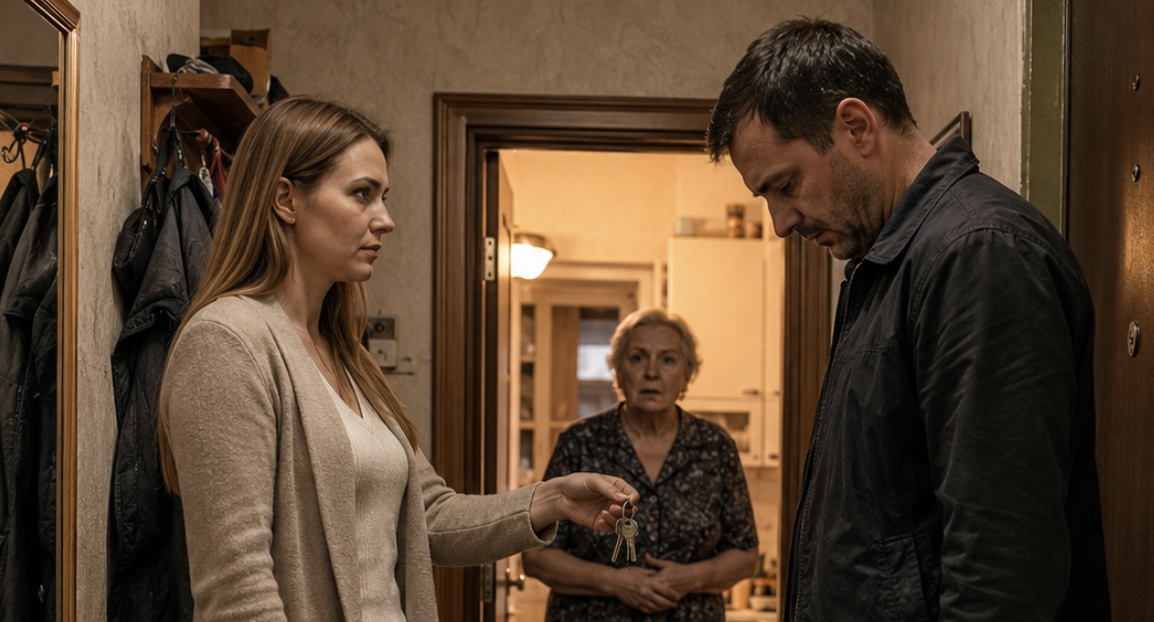
Marina said it calmly, although everything inside her was trembling. She stood in the entryway with one hand resting against the doorframe, watching her husband shift awkwardly from foot to foot beside a travel bag he hadn’t even packed himself.
His mother had packed it for him.
She had come over during the day while Marina was at work, let herself in with her own key, and folded Kostya’s shirts with such care that it looked as though she were sending her son off to a health resort rather than helping him leave his own home.
But the story had begun long before that evening.
Marina worked as an accountant for a small construction company. Eight years at the same desk. Eight years with the same calculator, which seemed to know the movements of her fingers better than her husband did.
She trusted numbers because numbers did not lie.
People lied. Numbers never did.
If a balance sheet failed to add up, there was always an error somewhere. You just had to find it.
For a long time, there had been an error in Marina’s own life too.
She had simply mistaken it for exhaustion.
Her mother-in-law, Raisa Pavlovna, lived in the apartment building next door. It was barely a five-minute walk through the courtyard.
Yet those five minutes had become a major problem in Marina’s marriage, because Raisa Pavlovna believed living nearby gave her the right to enter their home whenever she pleased.
Without calling.
Without knocking first.
With her own key.
Kostya had given it to her years ago.
“Mom, just in case something happens. Or if we go away and someone needs to water the plants.”
They owned three flowerpots.
The plants hardly needed a personal caretaker.
But the key remained.
And along with the key came Raisa Pavlovna’s growing habit of treating her son’s apartment as though it belonged to her.
“Marina, why do you behave like a stranger?” she would say while rearranging the dishes in the kitchen cupboards. “The plates should face this way so you can see the pattern. Didn’t your mother teach you anything?”
Marina’s mother had taught her plenty.
Including patience.
Unfortunately, patience was not endless.
And eventually, Marina’s ran out.
It all started with money.
Raisa Pavlovna owned a two-bedroom apartment. It was nothing luxurious, but it was hers, earned honestly after many years of factory work.
And she had a dream.
She wanted to transfer the apartment to her grandson, four-year-old Danya.
In itself, it sounded generous. Marina had no objection. She would have been happy knowing her son would one day have a home of his own.
The problem was that Raisa Pavlovna’s generosity came with conditions.
“I’ll put the apartment in Danya’s name,” she once explained over tea, stirring sugar into her cup with deliberate slowness, as if weighing every word. “But you’ll all move in with me. You can rent out your one-bedroom apartment and give me the rental income for utilities and medicine. I’ll help with Danya. Everyone benefits.”
Marina listened while something inside her tightened like a wire.
Everyone benefits.
Everyone except Marina.
Moving in with her mother-in-law would mean surrendering what remained of her independence.
It would mean leaving the apartment she and Kostya had spent years paying off.
It would mean handing over rental income from property they had bought together.
And worst of all, it would mean living under the same roof as a woman who had spent their entire marriage acting as though Marina had been an unfortunate mistake in her beloved son’s life.
“Raisa Pavlovna,” Marina began carefully, “I appreciate everything you want to do for Danya. But I don’t think we need to move in together. We have our own apartment, our own routine…”
“Our own apartment!” her mother-in-law exclaimed, throwing up her hands. “That little box of yours is barely fit for three people. I have two rooms and an enclosed balcony. You should think about your child instead of your own whims.”
Kostya said nothing.
He always said nothing during conversations like this.
He stared at the tablecloth, avoiding Marina’s eyes, and his expression told her everything.
He had already agreed with his mother.
Probably long before this conversation had even begun.
Marina looked at her husband and, for the first time, allowed herself to ask a cold and uncomfortable question.
Whose side was he actually on?
She got her answer soon enough.
Kostya began spending more and more time at his mother’s apartment.
Before, he might stop by once a week.
Now he went almost every day.
The faucet was leaking.
A lightbulb needed replacing.
His mother was lonely.
His mother needed help.
His mother missed him.
Marina tried not to make an issue of it.
A son helping his mother was hardly a crime. Marina herself had grown up in a family where respecting one’s parents was considered important.
But the accountant in her began noticing discrepancies.
Kostya started coming home with documents.
He would slide them into his work bag, and whenever Marina asked about them, he brushed her off.
“Just work stuff.”
Except Kostya was an installer.
And the papers did not look like anything connected to his job.
One evening Marina caught a glimpse of an official stamp on one of them.
A notary’s seal.
Something inside her dropped.
She did not search his bag.
That was not how she behaved.
She had never believed in secretly digging through another person’s belongings.
Instead, she watched.
The same way she would study financial records when the numbers refused to match.
And finally, on Tuesday night, everything fell into place.
Kostya came home late.
He was tired and believed Marina had already fallen asleep.
She was lying silently in the dark when she heard him speaking quietly on the phone in the kitchen.
The apartment walls were thin.
Marina heard every word.
“Mom, I already signed everything. Yes. The notary said it’s all fine… Don’t tell Marina yet. She won’t understand. We’ll just present it to her once everything’s done… Stop worrying. I transferred the apartment into my name, exactly like we agreed. Half of it is yours.”
Marina lay perfectly still.
For a moment, she forgot how to breathe.
The apartment.
Their apartment.
The one-bedroom home they had spent eight years paying for together.
The place into which Marina had poured her savings, her salary, her effort, her sleepless nights spent working through endless reports.
Kostya had secretly transferred it into his own name.
Behind her back.
Through a notary.
And he had promised half of it to his mother.
Marina closed her eyes.
In the darkness, everything suddenly became crystal clear.
The numbers had finally balanced.
Raisa Pavlovna had never simply wanted them to move in with her.
She wanted control.
And Kostya had already helped her make the first move.
The next morning Marina behaved exactly as usual.
She cooked porridge for Danya.
Poured Kostya his coffee.
Kissed her son on the top of his head.
She gave nothing away.
Eight years in accounting had taught her one rule very well: never make accusations before you have the documents to prove them. Otherwise, somehow, you might end up being blamed.
After dropping Danya off at kindergarten, Marina did not go to work.
She went to see a lawyer.
“Tell me,” she said, placing copies of the documents on his desk. She had photographed them from Kostya’s bag while he slept. “If an apartment was purchased during the marriage and my husband transferred it into his own name without my consent, is that legal?”
The lawyer, an older man with glasses, studied the papers for a long time.
Then he removed his glasses and looked at Marina.
“Forgive me for saying this, but they tried to trick you. Not very successfully, either. Property acquired during marriage is generally considered shared marital property, regardless of whose name appears on the papers. He can register it solely in his name ten times over, but your share doesn’t disappear. And if he promised part of it to his mother without your agreement, that arrangement may have no legal force at all. Nobody can simply take your apartment away from you.”
Marina slowly exhaled.
The tightness inside her finally began to loosen.
“And if I file for divorce?”
“Then the property will be divided according to the law. Either it is split, or one spouse buys out the other spouse’s share. But your mother-in-law does not automatically get anything. Legally speaking, she has no claim just because her son promised her one.”
Marina gathered the documents, thanked him, and stepped outside.
The October sun was unexpectedly bright.
She stood on the steps breathing in the cool autumn air and felt something she had not expected.
Relief.
Yes, they had deceived her.
But the deception turned out to be fragile.
The structure Raisa Pavlovna had spent years building was like a house of cards supported by one thing: Marina’s obedience.
All Marina had to do was stop holding it up.
That evening, she said nothing.
She said nothing the next day either.
She waited.
She wanted to see what they would do next.
Three days later, Raisa Pavlovna made her move.
As usual, she arrived without calling.
As usual, she used her own key.
This time, Marina happened to be home.
“Marinochka,” her mother-in-law sang in that sugary voice that always made Marina clench her teeth, “we need to talk. Like family. Calmly.”
She sat down at the table and folded her hands in front of her like a schoolteacher preparing to lecture a troublesome student.
“Kostya told me everything. Things haven’t been going well between you two. As his mother, I can’t just stand aside. Let’s speak honestly.”
“Fine,” Marina said, sitting opposite her. “Let’s.”
“You should move in with me. I’ve thought everything through. Your apartment can be transferred—well, practically speaking, it already has been. Kostya took care of that. You’ll live at my place, I’ll help with Danya, and the rent from your apartment will go into the household budget. That’s how families survive. Everyone helps each other.”
Marina remained silent.
Let her talk.
Let her reveal every last part of the plan.
“I’m doing this for your own good,” Raisa Pavlovna continued, encouraged by Marina’s silence. “The two of you won’t manage on your own. Kostya is too soft and impractical, just like his father. And you, Marinochka, you’re a decent woman, but you don’t know how to take control of things. Who’s going to look after all of you? With me, you’ll be protected.”
“Protected,” Marina repeated quietly. “And my apartment would eventually belong to you?”
“Oh, don’t be ridiculous,” Raisa Pavlovna said with irritation. “Not belong to me. It would stay in the family. Family is one whole. Yours, mine—what difference does it make? The important thing is that we’re together.”
“It makes a very big difference,” Marina said.
She stood, walked into the other room, and returned carrying a folder.
She placed the lawyer’s documents on the table.
“Raisa Pavlovna, the apartment Kostya transferred into his own name is still marital property. If we divorce, I’m entitled to my share. And the share he promised you? According to the lawyer, you have no automatic right to it. So you are not getting my half. You are not getting control of my home. You are getting nothing from me.”
The older woman went pale.
She grabbed the documents and scanned them quickly.
The legal language meant little to her.
But one word was easy enough to understand.
Divorce.
“What divorce? What are you talking about?”
“A normal divorce,” Marina replied. “Since you both decided how I should live without asking me, I’ve decided I’ll choose for myself.”
At that exact moment, Kostya came home.
He opened the door, saw his mother at the table, then looked at Marina’s face.
He understood immediately.
This balance was not going to work in his favor.
“Marina, what’s going on?” he began.
“I know everything, Kostya,” she said.
Her voice was as steady as a final figure in a completed report.
“I know about the notary. I know you transferred the apartment into your own name. I know you promised your mother half of it. I heard your entire phone conversation Tuesday night.”
Kostya opened his mouth.
Then closed it again.
Red patches began climbing up his neck.
“I was trying to do what was best,” he finally managed. “Mom said it would be safer this way…”
“Mom said,” Marina repeated.
Then she looked directly at him.
“Do you have thoughts of your own? Or are you planning to spend your entire life speaking with your mother’s voice?”
“Don’t you dare talk to him like that!” Raisa Pavlovna snapped. “He was thinking about the family!”
“The family?” Marina gave a short, humorless smile. “Apparently his family is you. Danya and I are just accessories.”
She stood.
“Well, if that’s the family he chose, then the two of you can live together.”
The next day Marina went to a notary of her own choosing.
Then she filed for divorce and began the legal process of dividing the marital property.
Everything was done properly.
Everything documented.
Everything transparent.
Exactly the way Marina preferred things.
Raisa Pavlovna called repeatedly.
She shouted that Marina was destroying the family.
That she was leaving a little boy without a father.
That she was cold-hearted.
Greedy.
Selfish.
Marina listened without interrupting.
Then, eventually, she said one sentence.
“I didn’t destroy the family, Raisa Pavlovna. I simply stopped carrying it alone.”
Then she ended the call.
And that brought them to the evening where this story began.
Kostya had come to collect his belongings.
His mother had packed the bag for him because apparently even that was too difficult for him to do himself.
Raisa Pavlovna had entered the apartment during the day using her key, folded his shirts, organized his things, and left everything ready.
That evening Kostya stood in the entryway beside the travel bag without knowing what to say.
“Marina,” he began carefully. “Maybe it isn’t too late. Maybe we can undo all of this.”
Marina looked at him.
At the man she had spent eight years with.
The man whose child she had given birth to.
The man with whom she had shared breakfasts, bills, a bed, plans and ordinary evenings.
And surprisingly, she no longer felt angry.
She did not even feel much pain.
Only exhaustion.
And beneath it, a quiet sense of freedom.
“You know what hurts the most, Kostya?” she said. “I could have forgiven almost anything. The arguments. Your mother criticizing me. Even her having a key to our apartment. But you went to a notary behind my back. You made decisions about our home without telling me. You treated me like someone stupid enough to manipulate. I can’t forgive that.”
“I never thought you were stupid.”
“You did. Maybe you never said it out loud, but you acted like it. Otherwise you wouldn’t have hidden everything.”
She opened the front door.
“Your things are packed. Go live with your mother if she matters more to you. And leave your key.”
Kostya stood there for another moment.
Then he picked up the bag and walked out.
He placed the key on the small table in the hallway before leaving.
The same key his mother had once treated as a symbol of her right to enter whenever she wanted.
The door closed.
Marina was alone.
She went to the kitchen, made herself tea, and sat near the window.
Outside, the October evening had grown dark. A few streetlights glowed in the courtyard. Somewhere in the distance, a dog barked.
It was an ordinary evening.
Except that now it belonged entirely to her.
The divorce ended more quickly than Marina had expected.
The apartment was divided according to their legal shares, and Marina eventually bought out Kostya’s portion.
She had some savings, and her own mother helped with the rest.
The apartment was finally hers.
Completely.
For the first time in eight years, her home genuinely felt like her own home.
Kostya stayed with his mother.
He kept working.
He saw Danya on weekends, took him to the park and bought him ice cream.
To Marina’s surprise, Kostya turned out to be a fairly good father when his mother was not standing nearby telling him what to think and how to behave.
As for Raisa Pavlovna, she never transferred her apartment to her grandson.
She was offended.
“If this is how you treat me, then none of you will get anything.”
Marina merely shrugged.
She did not need someone else’s apartment tied up in conditions.
Her own was enough.
Her own home had been paid for honestly.
And it came with freedom.
A year passed.
One spring evening, someone rang the doorbell.
Marina opened the door.
Raisa Pavlovna was standing outside.
She looked older.
Quieter.
The commanding shine in her eyes had faded.
“Marinochka,” she said softly, almost hesitantly. “I came to see Danya. I miss him.”
Marina looked at her.
A year earlier, she might have shut the door immediately.
But the anger was gone now.
In its place was something calmer.
Something stronger.
“Come in, Raisa Pavlovna. Danya will be happy to see his grandmother.”
She stepped aside.
The older woman entered.
But this time she entered as a guest.
Not as the owner.
Not as someone entitled to interfere.
And perhaps, for the first time in all those years, Raisa Pavlovna finally understood the difference.
While she spent time with her grandson, Marina made tea in the kitchen.
She found herself thinking about how strangely life worked.
A year earlier, she had believed everything was collapsing.
In reality, only the part built on lies had collapsed.
Raisa Pavlovna appeared in the kitchen doorway.
“Marina,” she said, looking down at the floor. “Forgive me. I truly thought I was helping my son. But instead… I pushed him away from his family. He barely looks at me the same way anymore. I suppose he finally realized he shouldn’t have listened to me.”
Marina did not comfort her.
She did not attack her either.
She simply poured tea into a cup and placed it in front of her.
“Drink it, Raisa Pavlovna. It’ll get cold.”
Her former mother-in-law took the cup in trembling hands.
It was the first cup of tea she had ever drunk in that apartment as a guest.
With gratitude.
Not entitlement.
That evening, after putting Danya to bed, Marina sat beside the window again.
Outside, spring was beginning to bloom.
The air smelled of melting snow, wet earth and the first fresh greenery.
On the small table in the hallway lay one single key.
Her key.
There were no extra sets anymore.
No “just in case something happens.”
No one else’s access.
Marina thought about how frightened she had once been of ending up alone.
Raisa Pavlovna had repeatedly told her that without Kostya she would struggle.
That she would not cope.
That she needed them.
Instead, the opposite had happened.
Only after being left alone had Marina finally stopped being afraid.
Danya grew into a cheerful, peaceful little boy.
Marina was promoted and became chief accountant.
She bought her son the bicycle he had wanted for months, and the two of them spent warm evenings riding through the park where the three of them had once walked as a family.
Sometimes Marina felt a little sadness.
Not because she missed Kostya.
She missed the life she had once imagined they would have.
The marriage she had believed would last forever.
But even that sadness was gentle now.
Like remembering a dream after waking up.
Marina rebuilt her home.
No one else had a key to her front door.
There was no husband who valued his mother’s opinion above his wife’s.
There was no mother-in-law reorganizing her kitchen and deciding what belonged where.
Instead, there was her son.
There was work she genuinely enjoyed.
There was an apartment that finally belonged to her.
And there was Marina herself.
The version of herself she had almost forgotten existed.
It was not the kind of ending a woman dreams about while standing in a white wedding dress.
But life rarely follows the script we imagine.
Sometimes it destroys what once seemed permanent only to make room for something more truthful.
Marina finished her tea, washed the cup, and placed it back in the cupboard.
Pattern facing outward.
Exactly the way her mother-in-law had once insisted.
But this time Marina did it because she wanted to.
Because she happened to like it that way.
It was her kitchen.
Her home.
Her life.
And for the first time in many years, every number in that balance finally added up.